
Casey Luskin writes about it at Uncommon Descent.
Excerpt:
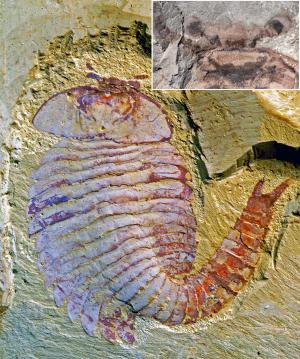
Over at PhysOrg.com, there’s a study being reported highlighting a 520 million year old fossil arthropod with a highly-developed brain. So soon in evolutionary time, and an already developed brain??? (To go beside the very complex eye of the Trilobites)
Here’s what one scientist said:
“No one expected such an advanced brain would have evolved so early in the history of multicellular animals,” said Strausfeld, a Regents Professor in the UA department of neuroscience.
Sorry, Darwinists, but IDers would expect it.
Let’s keep track of the problems that this good scientific discovery creates for naturalists.
Problem #1: Darwinism does not support rapid change from single-celled organisms just before the Cambrian explosion to complex brains just after the Cambrian explosion. Darwinian evolution has to go gradually from simple to complex.
Now for some more:
And, to add insult to injury for our Darwinist brethren, here’s this confirmation of “genetic entropy” and Behe’s QRB “rule”:
“The shape [of the fossilized brain] matches that of a comparable sized modern malacostracan,” the authors write in Nature. They argue the fossil supports the hypothesis that branchiopod brains evolved from a previously complex to a more simple architecture instead of the other way around.
So, that’s another problem.
Problem #2: Darwinism does not support going from more complex to less complex organisms, in general. This is especially true for complex biological systems like brains. Darwnists must explain how complex brains can be built from simpler parts through a long sequence of likely mutations.
And more:
Here’s how the article ends:
The fossil supports the idea that once a basic brain design had evolved, it changed little over time[Translation: ID is completely correct!!!], he explained. Instead, peripheral components such as the eyes, the antennae and other appendages, sensory organs, etc., underwent great diversification and specialized in different tasks but all plugged into the same basic circuitry. “It is remarkable how constant the ground pattern of the nervous system has remained for probably more than 550 million years,” Strausfeld added. “The basic organization of the computational circuitry that deals, say, with smelling, appears to be the same as the one that deals with vision, or mechanical sensation.”
Yet another problem.
Problem #3: Darwinism does not work if organisms are observed to remain changeless and static over time. Darwinism requires change over time from simple to complex. Backwards change or no change falsifies Darwinism.
It’s just another prediction of Darwinian orthodoxy falsified by experimental evidence published in the top scientific peer-reviewed journal. Will this cause Darwinians to revise their theory to fit the evidence? Not likely. Their motivations for clinging to naturalism, the religion that undergirds Darwinism, are entirely beyond correction by evidence.
I wonder what people like P.Z. Myers and Larry Moran do when their religion comes into conflict with scientific evidence? Do they bitterly cling to their mythology from the 19th century? Or do they adjust their worldview to be in line with the progress of science?
Let Richard Dawkins explain evolution and the role of evidence:
“My argument will be that Darwinism is the only known theory that is in principle capable of explaining certain aspects of life. If I am right it means that, even if there were no actual evidence in favour of the Darwinian theory (there is, of course) we should still be justified in preferring it over all rival theories.” — p. 287, Blind Watchmaker” (1986)
Or Richard Lewontin:
“Our willingness to accept [naturalistic] scientific claims that are against common sense is the key to an understanding of the real struggle between science and the supernatural. We take the side of science in spite of the patent absurdity of some of its constructs, in spite of its failure to fulfill many of its extravagant promises of health and life, in spite of the tolerance of the scientific community for unsubstantiated just-so stories, because we have a prior commitment, a commitment to materialism. It is not that the methods and institutions of science somehow compel us to accept a material explanation of the phenomenal world but, on the contrary, that we are forced by our own a priori adherence to material causes to create an apparatus of investigation and a set of concepts that produce material explanations, not matter how counterintuitive, no matter how mystifying to the uninitiated. Moreover, that materialism is absolute, for we cannot allow a divine foot in the door.” (Richard Lewontin in New York Review of Books, January 9, 1997, p. 28)
Last month, we saw a peer-reviewed published paper that falsified the Darwinian predictions about junk DNA. Recently, the Darwnists were proven wrong again about vestigial organs. Before that, we had another discovery of oxygen on the early Earth’s atmosphere, which blocks naturalistic origin of life scenarios. Did these scientific discoveries stop the worship of the Flying Spaghetti Monster by the Darwinian faithful? Of course not. And they don’t want to debate it with you, either.
Naturalists don’t want to have to explain why they are always believing things that are falsified by the progress of science. Naturalists fought the Big Bang tooth and nail, trying to save their eternal universe from the progress of science. Naturalists invented the now discredited oscillating model of the universe in order to “explain” the evidence for a cosmic beginning. Naturalists invented the unobservable, untestable multiverse to “explain” the cosmic fine-tuning. Unobservable aliens were posited in order to “explain” the origin of life so soon after the cooling of the Earth. Precursor fossils are invented without evidence in order to “explain” the Cambrian era explosion in biological complexity. And so on.
Evidence doesn’t matter to people who are motivated by naturalistic faith. Like belief in a flat-Earth, the delusion of naturalism is not accountable to scientific evidence. They believe what they want to believe. It’s not up for debate. For some people like Richard Dawkins, a prior lifestyle commitment makes theism (and the moral law!) an impossibility a priori. But rational people know that believing something just so that your actions are “justified” doesn’t make what you believe true.
Speaking of Richard Dawkins, if you haven’t seen the video of that coward being “Eastwooded” by William Lane Craig, here’s the link. Dr. Craig has obviously seen a lot of Clint Eastwood movies, and he manages to work in about a half-dozen Clint Eastwood lines into a careful philosophical and scientific refutation of Dawkins’ faith-based atheist delusions. I don’t mind if Dawkins wants to have his religious beliefs for comfort in the privacy of his home or church, but I don’t think that we should be making policy off of his subjective preferences. In the public square we need to be guided by public evidence – like the evidence from science.

