American health care: does it cause poor life-expectancy and high infant mortality?

Probably one of the best health care policy experts writing today is Avik Roy, who writes for Forbes magazine.

Here is his latest column, which I think is useful for helping us all get better at debating health care policy. (H/T Matt from Well Spent Journey)

Excerpt:

It’s one of the most oft-repeated justifications for socialized medicine: Americans spend more money than other developed countries on health care, but don’t live as long. If we would just hop on the European health-care bandwagon, we’d live longer and healthier lives. The only problem is it’s not true.

[…]If you really want to measure health outcomes, the best way to do it is at the point of medical intervention. If you have a heart attack, how long do you live in the U.S. vs. another country? If you’re diagnosed with breast cancer? In 2008, a group of investigators conducted a worldwide study of cancer survival rates, called CONCORD. They looked at 5-year survival rates for breast cancer, colon and rectal cancer, and prostate cancer. I compiled their data for the U.S., Canada, Australia, Japan, and western Europe. Guess who came out number one?

Here is the raw data:
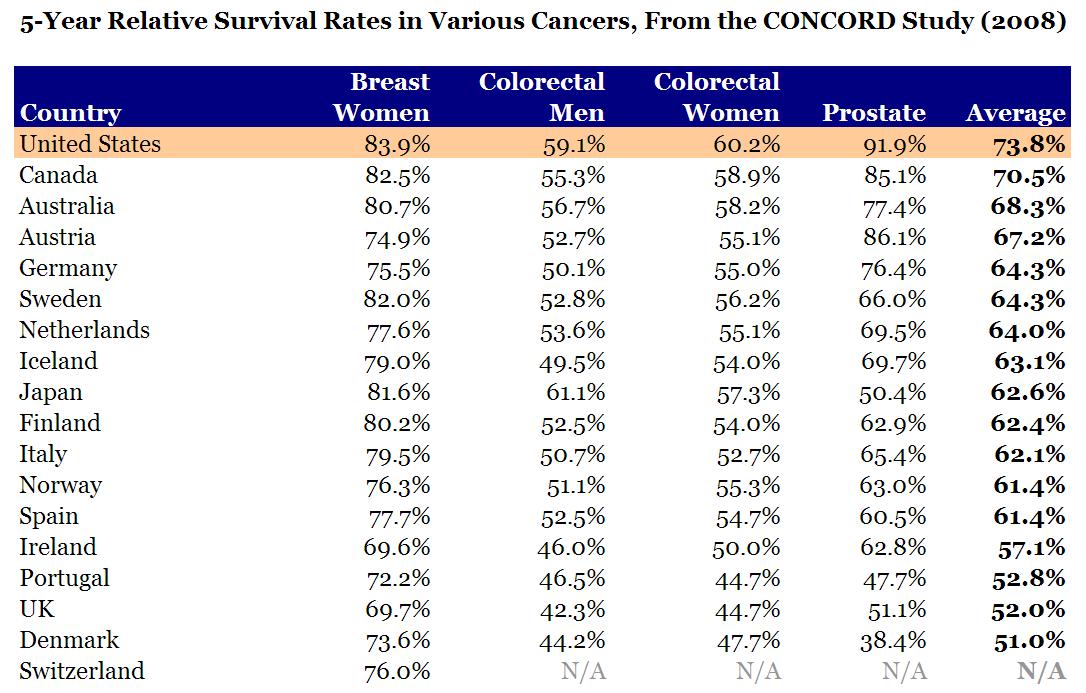
Health care outcomes
Health care outcomes by country and type of treatment

Click here to see the larger graph.

So, what explains this?

The article continues:

Another point worth making is that people die for other reasons than health. For example, people die because of car accidents and violent crime. A few years back, Robert Ohsfeldt of Texas A&M and John Schneider of the University of Iowa asked the obvious question: what happens if you remove deaths from fatal injuries from the life expectancy tables? Among the 29 members of the OECD, the U.S. vaults from 19th place to…you guessed it…first. Japan, on the same adjustment, drops from first to ninth.

It’s great that the Japanese eat more sushi than we do, and that they settle their arguments more peaceably. But these things don’t have anything to do with socialized medicine.

Finally, U.S. life-expectancy statistics are skewed by the fact that the U.S. doesn’t have one health-care system, but three: Medicaid, Medicare, and private insurance. (A fourth, the Obamacare exchanges, is supposed to go into effect in 2014.) As I have noted in the past, health outcomes for those on government-sponsored insurance are worse than for those on private insurance.

To my knowledge, no one has attempted to segregate U.S. life-expectancy figures by insurance status. But based on the data we have, it’s highly likely that those on private insurance have the best life expectancy, with Medicare patients in the middle, and the uninsured and Medicaid at the bottom.

I know that my readers who like to dig deep into economics and policy will love the links at the bottom of the article:

For further reading on the topic of life expectancy, here are some recommendations. Harvard economist Greg Mankiw discusses some of the confounding factors with life expectancy statistics, citing this NBER study by June and Dave O’Neill comparing the U.S. and Canada. (Mankiw calls the misuse of U.S. life expectancy stats “schlocky.”) Chicago economist Gary Becker makes note of the CONCORD study in this blog post. In 2009, Sam Preston and Jessica Ho of the University of Pennsylvania published a lengthy analysis of life expectancy statistics, concluding that “the low longevity ranking of the United States is not likely to be a result of a poorly functioning health care system.”

The funniest thing I have found when talking to people from countries with socialized health care systems, like Canada and the UK, is that they are woefully uninformed about American health care. They literally do not know about free emergency room care, which is free for anyone regardless of insurance – including illegal aliens. They do not know about our expensive Medicaid program, which helps people who cannot afford health insurance. And our very very expensive Medicare program, which provides health care to the elderly – including prescription drugs. I get the feeling that foreign critics of American health care are getting their views from amateur documentaries produced by uneducated Hollywood propagandists, or maybe from TV shows on the Comedy Channel. They certainly are not getting their information from peer-reviewed studies by credentialed scholars from top universities, like the ones cited above.

I have literally spoken to Canadians who think that people in the USA without insurance do not get treatment and just die in the streets from stab wounds. They don’t know about the emergency room rule, or about charity care, or about Medicaid and Medicare. There is a lot of ignorance up there – wilful ignorance, in some cases. And keep in mind that the average Canadian household is paying over $11,000 a year for this substandard health care! They are paying more for less, and that’s not surprising since a large chunk of the taxes that are collected for health care go to overpaid unionized bureaucrats. Naturally, when their left-wing politicians need treatment, the first place they go is to the United States, where they pay out of pocket for the better health care. But that doesn’t stop them from denouncing American health care when they are talking to voters.

Higher infant mortality rates?

One of the other common arguments you hear from uninformed people outside the USA is the higher infant mortality rates argument.

Here’s an article by Stanford University professor Scott Atlas to explain why the argument fails.

Excerpt:

Virtually every national and international agency involved in statistical assessments of health status, health care, and economic development uses the infant-mortality rate — the number of infants per 1,000 live births who die before reaching the age of one — as a fundamental indicator. America’s high infant-mortality rate has been repeatedly put forth as evidence “proving” the substandard performance of the U.S. health-care system.

[…]n a 2008 study, Joy Lawn estimated that a full three-fourths of the world’s neonatal deaths are counted only through highly unreliable five-yearly retrospective household surveys, instead of being reported at the time by hospitals and health-care professionals, as in the United States. Moreover, the most premature babies — those with the highest likelihood of dying — are the least likely to be recorded in infant and neonatal mortality statistics in other countries. Compounding that difficulty, in other countries the underreporting is greatest for deaths that occur very soon after birth.

[…]The United States strictly adheres to the WHO definition of live birth (any infant “irrespective of the duration of the pregnancy, which . . . breathes or shows any other evidence of life . . . whether or not the umbilical cord has been cut or the placenta is attached”) and uses a strictly implemented linked birth and infant-death data set. On the contrary, many other nations, including highly developed countries in Western Europe, use far less strict definitions, all of which underreport the live births of more fragile infants who soon die. As a consequence, they falsely report more favorable neonatal- and infant-mortality rates.

[…]Neonatal deaths are mainly associated with prematurity and low birth weight. Therefore the fact that the percentage of preterm births in the U.S. is far higher than that in all other OECD countries — 65 percent higher than in Britain, and more than double the rate in Ireland, Finland, and Greece — further undermines the validity of neonatal-mortality comparisons.

You can listen to a podcast with Dr. Atlas here, from the Library of Economics web site.

If you want to read more about how American health care compares with health care in socialized systems, read this article by Stanford University professor of medicine Dr. Scott Atlas. And you can get his book “In Excellent Health: Setting the Record Straight on America’s Health Care” from Amazon.

Gay activist Dan Savage: abortion should be mandatory for the next 30 years

Gay activist Dan Savage thinks that we should murder every single child born on the planet for the next 30 years, against the will of the parents, in every single country in the world.

The Daily Caller explains what happened. (H/T Mysterious Wes)

Excerpt:

Self-styled anti-bullying advocate Dan Savage told a giggling and applauding audience in Australia that “abortion should be mandatory for 30 years” on Monday during a panel discussion on Christianity, marriage and sex.

Savage made his remarks during a program titled “Q&A, Adventures in Democracy” broadcasted from the Sydney Opera House Concert Hall on Monday in response to the question: ”Which so-called dangerous idea do you each think would have the greatest potential to change the world for the better if it were implemented?”

“Population control: There’s too many goddam people on the planet,” Savage said as the audience burst into applause at his predictable response. “You know, I’m pro-choice. I believe that women should have a right to control their bodies. Sometimes in my darker moments, I’m anti-choice. I think abortion should be mandatory for about 30 years.”

Savage, creator of the “It Gets Better” viral video anti-suicide crusade on behalf of gay teens, takes a hateful, violent pro-death position toward everyone who irritates him, from unborn babies to hapless Green Party candidates standing in the way of total Democratic domination.

“I wish [Republicans] were all f***ing dead,” he said on liberal comedian Bill Maher’s HBO show “Real Time” in 2011 during the debt-ceiling brouhaha.

Back in 2006, Savage called for the barbaric murder of a Green Party candidate, angered by the threat of third-party candidates to spoil the Democratic Senate victory of Bob Casey.

“Carl Romanelli should be dragged behind a pickup truck until there’s nothing left but the rope,” Savage told the Daily Pennsylvanian, alluding to the 1998 torture and death of hate crime victim James Byrd, Jr.

Voters thinking of casting a ballot for Romanelli should be “beaten,” said Savage, who had previously used the beating death of 21-year-old gay teen Matthew Shepard as blog post fodder.

Remember, this is just what he says in public. Can you imagine what his real views are?

The Obama administration is a big fan of Dan Savage:

President Barack Obama himself supports Savage’s “It Gets Better” campaign, devoting a page of WhiteHouse.gov to it as a civil rights issue.

Obama appears to share Savage’s view on abortion as well: During his tenure in the Illinois state legislature, Obama spoke and voted against a version of the “Born Alive Infants Protection Act,” which would have made it illegal to kill a living, breathing, defenseless child that survived an abortion.

It’s very important to take a close look at what gay activists say and do. Below are a couple of examples of what gay activists do.

From the leftist Washington Post.

Excerpt:

A satellite church affiliated with controversial Seattle pastor Mark Driscoll was vandalized early Tuesday (April 24) and a group calling itself the “Angry Queers” has reportedly taken responsibility.

Stained glass and other windows were broken at the Mars Hill Church, according to a post on the Facebook page of Pastor Tim Smith.

“Neighbors of the church reported seeing several young adults in black masks throwing large rocks into the windows,” a church news release said. “Police stated that a bank in the area was also vandalized in the same way and that they believe the vandalism was planned ahead of time, most likely by an activist group.”

On Tuesday, KPTV FOX 12 reported it had received an email from someone using the name “Angry Queers” and claiming responsibility.

Mars Hill Portland opened last October. During the first service, protesters gathered in front of the church and yelled obscenities at worshipers to speak out against the church’s stance on homosexuality.

Here’s part of the e-mail written by the gay activists responsible for the attack:

The e-mail, which is peppered with foul language, berates the Q Center, a local LGBT activist organization, for engaging in a dialogue with the Mars Hill’s leadership. “What we have to say to the Q Center is this: F—K YOU, you don’t represent us. You are disgusting traitors who prioritize social peace and the bourgeois aspirations of rich white cis gay people over the more pressing survival needs of more marginalized queers.”

“F—k dialog with people who want us dead,” the e-mail read. “The only dialog we need with scum like Mars Hill is hammers through their windows.”

“We hope this small act of vengeance will strike some fear into the hearts of all of Mars Hill’s pastors, and warm the hearts of our friends and comrades (known or unknown). It may not get better, but we can certainly get even,” it concludes.

You can read about a few more examples of gay activism here and a more recent example of gay activism here.

And of course, we can’t forget the prominent gay activist Floyd Corkins, who was convicted of domestic terrorism for his attack on the Family Research Council.

The man accused of opening fire and shooting a security guard at the conservative Family Research Council headquarters last August plead guilty to three charges in a D.C. federal court Wednesday.

Floyd Lee Corkins, II of Herndon, Virginia entered guilty pleas to a federal weapons charge as well as a local terrorism charge and a charge of assault with intent to kill, according to news reports.

The Washington Post reports that, according to the plea agreement Corkins signed, he told FBI agents on the day of the shooting that he “intended to kill as many people as possible” and planned to “smother Chick-fil-A sandwiches in their faces.”

Investigators found additional magazines and 15 Chick-fil-A sandwiches in his backpack on the day of the shooting.

Following the guilty plea the FRC issued a statement placing a large portion of the blame for the shooting at the feet of the liberal Southern Poverty Law Center, which had listed FRC as a hate group. FRC noted that prosecutors discovered Corkins identified his targets on the SPLC’s website.

“The day after Floyd Corkins came into the FRC headquarter and opened fire wounding one of our team members, I stated that while Corkins was responsible for the shooting, he had been given a license to perpetrate this act of violence by groups like the Southern Poverty Law Center which has systematically and recklessly labeled every organization with which they disagree as a ‘hate group,’” FRC president Tony Perkins said in a statement, which went on to demand that SPLC stop attacking organizations that have a different opinion on gay rights.

The Human Rights Campaign, a very large and influential gay rights group favored by Democrats, joins the SPLC and the convicted domestic terrorist Floyd Corkins in condemning the FRC as a “hate group”. Gay activists continued to condemn the FRC after the terrorist attack had occurred.

You can read more about the views of Floyd Corkins here, and note this:

Corkins told the FBI he found the FRC building as his target using a “hate map” on the website of the Southern Poverty Law Center (SPLC). The SPLC refuses to acknowledge any responsibility for the shooting. SPLC still lists FRC as a hate group and continues to maintain a map to FRC’s office building on the SPLC website.

Now read this quotation from Dan Savage:

Dan Savage often speaks on college campuses and on television as a liberal commentator. He often makes controversial remarks, such as saying that Family Research Council President Tony Perkins, in opposing homosexual behavior, contributes to gay suicide.

On Sept. 27, 2012, Savage told a student audience at Winona State University, “[E]very dead gay kid is a victory for the Family Research Council. They argue that the gay lifestyle is sick and sinful and dangerous and they point to the suicide rate, and then they turn around and do everything in their power to make sure that suicide rate does not come down and to drive it up.”

“Tony Perkins sits on a pile of dead gay kids every day when he goes to work — and he calls himself a Christian,” said Savage.  “I don’t understand how real Christians let that little f–ker get away with that.”

What does the FRC do? They put out research papers showing the importance of mothers and fathers to children. That’s what gay activists consider to be “hate”. It’s very important to understand what gay activists actually say. I have no doubt that if you ask gay activists like Dan Savage and Floyd Corkins whether they are tolerant people, they would say “of course we are tolerant”. So you have to look for yourself at what they say, and what they do, and judge for yourself whether they are as tolerant as they want you to believe.

Formation of life-permitting elements carbon and oxygen is fine-tuned

First, let’s review the structure of the fine-tuning argument.

The argument goes like this:

  1. The fine-tuning of the universe to support life is either due to law, chance or design
  2. It is not due to law or chance
  3. Therefore, the fine-tuning is due to design

Here are the facts on the fine-tuning:

  • Life has certain minimal requirements; long-term stable source of energy, a large number of different chemical elements, an element that can serve as a hub for joining together other elements into compounds, a universal solvent, etc.
  • In order to meet these minimal requirements, the physical constants, (such as the gravitational constant), and the ratios between physical constants, need to be withing a narrow range of values in order to support the minimal requirements for life of any kind.
  • Slight changes to any of the physical constants, or to the ratios between the constants, will result in a universe inhospitable to life.
  • The range of possible values spans 70 orders of magnitude.
  • The constants are selected by whoever creates the universe. They are not determined by physical laws. And the extreme probabilities involved required put the fine-tuning beyond the reach of chance.
  • Although each individual selection of constants and ratios is as unlikely as any other selection, the vast majority of these possibilities do not support the minimal requirements of life of any kind. (In the same way as any hand of 5 cards that is dealt is as likely as any other, but you are overwhelmingly likely NOT to get a royal flush. In our case, a royal flush is a life-permitting universe).

Carbon is that element that can serve as a hub, and oxygen is also a vital element, since it is a component of water, which is required for life. So both carbon (the hub of large molecules) and oxygen (a building block of water) are required for complex life of any imaginable kind.

Now for the study.

Mysterious Jen, who blogs at Victory Rolls and V8s sent me this amazing article on Science Daily about a new peer-reviewed study that supports the fine-tuning argument.

Here’s an excerpt:

Life as we know it is based upon the elements of carbon and oxygen. Now a team of physicists, including one from North Carolina State University, is looking at the conditions necessary to the formation of those two elements in the universe. They’ve found that when it comes to supporting life, the universe leaves very little margin for error.

Both carbon and oxygen are produced when helium burns inside of giant red stars. Carbon-12, an essential element we’re all made of, can only form when three alpha particles, or helium-4 nuclei, combine in a very specific way. The key to formation is an excited state of carbon-12 known as the Hoyle state, and it has a very specific energy — measured at 379 keV (or 379,000 electron volts) above the energy of three alpha particles. Oxygen is produced by the combination of another alpha particle and carbon.

NC State physicist Dean Lee and German colleagues Evgeny Epelbaum, Hermann Krebs, Timo Laehde and Ulf-G. Meissner had previously confirmed the existence and structure of the Hoyle state with a numerical lattice that allowed the researchers to simulate how protons and neutrons interact. These protons and neutrons are made up of elementary particles called quarks. The light quark mass is one of the fundamental parameters of nature, and this mass affects particles’ energies.

In new lattice calculations done at the Juelich Supercomputer Centre the physicists found that just a slight variation in the light quark mass will change the energy of the Hoyle state, and this in turn would affect the production of carbon and oxygen in such a way that life as we know it wouldn’t exist.

[…]The researchers’ findings appear in Physical Review Letters.

So that’s the latest research that supports the fine-tuning argument. But how effective is this argument really? Is it only admitted by theists, or do atheists accept the fine-tuning as well?

Is the fine-tuning real?

Yes, it’s real and it is conceded by the top-rank of atheist physicists. Let me give you a citation from the best one of all, Martin Rees. Martin Rees is an atheist and a qualified astronomer. He wrote a book called “Just Six Numbers: The Deep Forces That Shape The Universe”, (Basic Books: 2001). In it, he discusses 6 numbers that need to be fine-tuned in order to have a life-permitting universe.

Rees writes here:

These six numbers constitute a ‘recipe’ for a universe. Moreover, the outcome is sensitive to their values: if any one of them were to be ‘untuned’, there would be no stars and no life. Is this tuning just a brute fact, a coincidence? Or is it the providence of a benign Creator?

There are some atheists who deny the fine-tuning, but these atheists are in firm opposition to the progress of science. The more science has progressed, the more constants, ratios and quantities we have discovered that need to be fine-tuned. Science is going in a theistic direction. Next, let’s see how atheists try to account for the fine-tuning, on atheism.

Atheistic responses to the fine-tuning argument

There are two common responses among atheists to this argument.

The first is to speculate that there are actually an infinite number of other universes that are not fine-tuned, (i.e. – the gambler’s fallacy). All these other universes don’t support life. We just happen to be in the one universe is fine-tuned for life. The problem is that there is no way of directly observing these other universes and no independent evidence that they exist.

Here is an excerpt from an article in Discover magazine, (which is hostile to theism and Christianity).

Short of invoking a benevolent creator, many physicists see only one possible explanation: Our universe may be but one of perhaps infinitely many universes in an inconceivably vast multiverse. Most of those universes are barren, but some, like ours, have conditions suitable for life.

The idea is controversial. Critics say it doesn’t even qualify as a scientific theory because the existence of other universes cannot be proved or disproved. Advocates argue that, like it or not, the multiverse may well be the only viable non­religious explanation for what is often called the “fine-tuning problem”—the baffling observation that the laws of the universe seem custom-tailored to favor the emergence of life.

The second response by atheists is that the human observers that exist today, 14 billion years after the universe was created out of nothing, actually caused the fine-tuning. This solution would mean that although humans did not exist at the time the of the big bang, they are going to be able to reach back in time at some point in the future and manually fine-tune the universe.

Here is an excerpt from and article in the New Scientist, (which is hostile to theism and Christianity).

…maybe we should approach cosmic fine-tuning not as a problem but as a clue. Perhaps it is evidence that we somehow endow the universe with certain features by the mere act of observation… observers are creating the universe and its entire history right now. If we in some sense create the universe, it is not surprising that the universe is well suited to us.

So, there are two choices for atheists. Either an infinite number of unobservable universes that are not fine-tuned, or humans go back in time at some future point and fine-tune the beginning of the universe, billions of years in the past. I think I will prefer the design explanation to those alternatives.