Here’s a quick overview of Michael Licona’s latest book on the resurrection, entitled “The Resurrection of Jesus“.
60 minutes of lecture, 20 minutes of Q&A.
Summary:
Dr. Licona’s background and education
The definition of history and philosophy of history
Postmodern approaches to history
Historical bedrock: facts that are historically demonstrable
Historical criterion 1: Explanatory scope
Historical criterion 2: Explanatory power
Historical criterion 3: Plausibility
Historical criterion 4: Ad Hoc / Speculation / non-evidenced assumptions
Inference to the best explanation
Investigating miracle claims: is it possible? How?
Objection of James D.G. Dunn
Objection of Bart Ehrman
New Testament sources: Gospels and Paul’s letters
The Gnostic gospels: are they good sources?
The minimal facts
The hallucination hypothesis
The best explanation
While watching this lecture, it struck what good preparation it was for understanding debates. This lecture is more about historical methods, but if you’re interested in Mike’s minimal facts case for the resurrection, here’s a video on that:
This is the case he uses in his debates with Richard Carrier, Dale Allison, Bart Ehrman, etc.
Mike Licona’s ministry is here: Risen Jesus, and I noticed that the most popular article on the site is on the comological argument, which is not surprising at all, since he co-edited a book on 50 evidences for God from many differences with William Dembski. He likes evidence from every discipline you can think of, and then some.
Here are the three things that Darwinists must demonstrate:
It is possible to add biological information.
There are more upward steps than downward steps (or at least a way to get more upward steps than downward steps at least some of the time).
There does exist a gradual genetic pathway that can be climbed in tiny, incremental steps.
So first of all, the main two arguments for intelligent design and against naturalism are the origin of life and the Cambrian explosion. Both involve massive infusions of new biological information. So Lindsay is right to focus on whether Darwinism can add new biological information. But I wanted to focus on number three, because I really think that her post is about the burden of proof on Darwinists more than it is about our burden of proof. And we do need to get used to asking Darwinists for the evidence for their view.
Take a look at the detail on number three:
In order for evolution to be true, not only does information have to be added over time, but each successive change must occur in a living organism and it must be conserved by being passed on to offspring. Thus, the change cannot kill the organism or seriously disable it, or the change will not be passed on. This must be the case for EVERY step in the entire evolutionary sequence, no matter how small. At every step you must have a functional organism. Thus, the changes must be gradual enough that the tiny upward steps (if they exist) can achieve each new level without killing or disabling the organism. To use a simplistic analogy, if one tries to change from one word to another by changing one letter at a time (cat to cot to dot to dog, for example), there must, at every step, be an actual word that can be reached by changing one letter. In the Mount Improbable analogy, this means that there can be no upward jumps in the trail. If the maximum possible upward step is 6 inches, then there can be no 6 foot cliffs along the trail, or even 7 inch steps. If ever there is a step which requires more information than unguided evolution can provide, then evolution is falsified in that instance. It cannot account for the change in information if that is the case.
Now I have never seen a gradual genetic pathway from one body plan to another in any peer-reviewed paper. I am talking about from one phyla to another. What I need to see to believe in the ability of Darwinian mechanisms to drive change from one body plan to another is that sequence of changes at the genetic level. And I don’t just need to see the steps, I need to see the probabilities of getting the correct sequence of changes at the genetic level within the time available by chance. That’s what Darwinists assert in their theory – that’s what they need to prove. Talking about how one creature looks like another creature is irrelevant. My car looks like my Dads car, because we drive the same model, but different model years – and both cars are designed.
When people ask our side for evidence for our claims, we are able to produce the evidence to substantiate our claims, e.g. – cosmic fine-tuning factors or protein sequencing probabilities. I would like to see the other side do the same, and not just tell me a story.
If you are looking to understand what the other side has to prove, and in a concise way, read her post.
Dina tweeted this UK Daily Mail article that made me think about how women vote.
Excerpt:
More than a third of working mothers would like to give up their jobs completely and stay at home with their children, a major Government survey has found.
It showed that millions of mothers of young children who go out to work do so only because they need to work to pay the bills.
The research for the Department for Education found that, far from being anxious to get out of their homes and into employment, the great majority of mothers are only reluctant workers.
Nearly six out of ten of all working mothers would cut down their hours to spend more time with their families if they could afford to, it said.
The yearning among mothers to leave their jobs and look after their children instead is even more pronounced among the highest achieving women, the survey indicated.
More than two-thirds of those in senior and middle management roles would spend fewer hours in the office and devote more time to their children if they had enough money, it said.
[…]Yesterday’s survey also undermines the claims that prejudice and discrimination against women in male-dominated companies is the reason why women are heavily outnumbered in the boardroom.
Rather, it suggests that many women who could get to the top in business choose instead to put their children before their careers.
The problem is that when government gives people free stuff, people who work have to work more to pay for it. And the strangest thing is that even though women seem to want to stay home with their kids (which is good), when it comes time to vote, they actually vote NOT to stay home with their kids. How? By growing the size of government, which results in higher taxes. To find out what women really think about staying home with their kids, we can look at how they vote.
Women voted 56-44 for more government spending in 2012
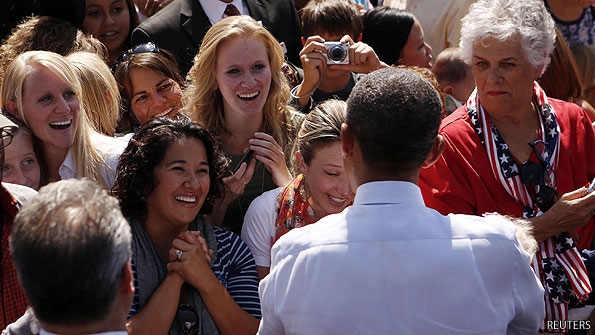
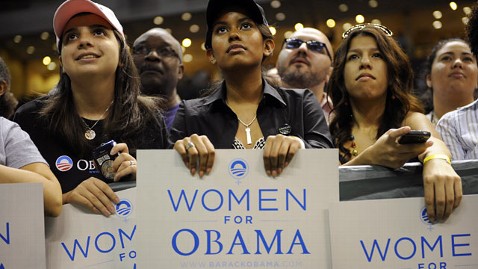
According to CNN’s exit polls, 55% of women and 45% of men voted for Obama and 44% of women and 52% of men voted for Romney. That level of female support for the president made an especially big impact in swing states like Ohio where the gender breakdown mirrored the national figures.
[…]There are some indications that social issues directly impacting women might have helped sway votes in some states.
Tuesday’s early exit polls showed 51% of Missouri voters said they believed abortion should be legal all or most of the time. Of those voters, exit polls showed 76% supported Democratic incumbent Claire McCaskill, who won Tuesday night, while 19% voted for Akin.
Forty-seven percent of Missouri’s voters said abortion should be illegal. Exit polls showed Akin netted 67% of this group’s votes while 27% of people who think abortion should be illegal supported McCaskill.
But much more than social issues, pocketbook economic issues most concerned women voters, exit polling showed.
“Women like all voters felt the economics were most important,” Swers said. “Women tend to be more supportive of government spending… than men are … so they were less responsive to Romney in that way and more responsive to Obama’s message on empathy and helping the middle class.”
Gallup reported that the gender gap in the 2012 election was actually 20 points. That was the largest ever measured in a Presidential election. The actual vote for Obama among women, according to Gallup, was 56-44.
Women are also more pro-abortion more than men
Here is a peer-reviewed research paper that shows the problem that we need to warn women about, so that they vote smarter.
The abstract reads:
This paper examines the growth of government during this century as a result of giving women the right to vote. Using cross‐sectional time‐series data for 1870–1940, we examine state government expenditures and revenue as well as voting by U.S. House and Senate state delegations and the passage of a wide range of different state laws. Suffrage coincided with immediate increases in state government expenditures and revenue and more liberal voting patterns for federal representatives, and these effects continued growing over time as more women took advantage of the franchise. Contrary to many recent suggestions, the gender gap is not something that has arisen since the 1970s, and it helps explain why American government started growing when it did.
When people vote for government to do more for everyone else, then men who work have to pay more in taxes.
Women vote for higher taxes, so they have to work more
If women want to stay home with their children more, then they need to vote for their husbands (present or future) to pay less in taxes when they work. That means voting for smaller government, more liberty and more personal responsibility. Until women get to the point of connecting their future plans (marriage and parenting) for their lives with their current voting, this situation is not going to change. Marriages run on money. It’s no good to urge men to “man-up” and then take away their ability to provide by taxing more of their earnings to pay for Sandra Fluke’s birth control pills and abortions. Keep the money in the family, and then you can stay home with the kids more.


 WINTERY KNIGHT