David Axelrod: Obama lied about gay marriage in 2008 in order to get elected

This is from Life Site News.

Excerpt:

A former senior adviser to President Obama has confirmed what his most strident critics have said all along: Barack Obama lied to the American people about opposing gay “marriage” to boost his chances of winning the 2008 presidential elections.

David Axelrod, a veteran of Chicago left-wing politics who advised Obama during the campaign, makes the admission in a new book Believer: My Forty Years in Politics, which hits book shelves today.

Obama first indicated his support for redefining marriage while running for state office in Illinois in 1996, filling out a questionnaire that said, “I favor legalizing same-sex marriages, and would fight efforts to prohibit such marriages.”

Candidate Obama wanted to publicly broadcast his views during his campaigns for national office but was afraid the position – then radically unpopular – would end his chances of becoming president. Axelrod writes that campaign manager Jim Messina warned Obama that backing same-sex “marriage” could cost him the electoral votes of North Carolina.

Instead, both he and Hillary Clinton said they held to the traditional definition of marriage, although they supported “civil unions” for homosexuals.

During a 2008 debate, Obama told Saddleback Church megapastor Rick Warren, “I believe that marriage is the union between a man and a woman. Now, for me as a Christian, it is also a sacred union. God’s in the mix.”

But Axelrod reveals in his new book that, after proclaiming his support for marriage at one campaign event, Obama dismissed his rhetoric as nothing more than a bout of “bullsh—ing.”

Axelrod said that the candidate agreed to conceal his views, but “Obama never felt comfortable with his compromise and, no doubt, compromised position. He routinely stumbled over the question when it came up in debates or interviews.”

When others asked about Obama’s 1996 campaign statement, his supporters played it off as a campaign snafu. White House Communications Director Dan Pfeiffer said in 2011, “That questionnaire was actually filled out by someone else.”

As a candidate, he walked a thin line, stating his support for traditional marriage – but opposing any efforts that would legally codify that belief and backing government policies that would grant greater acceptance (and benefits) to homosexuals. In 2008, he dismissed opposition to homosexuality as based on “an obscure passage in Romans.”

Obama did, in fact, carry North Carolina in 2008 on his way to the White House, where he chose to bide his time until he could come out in favor of gay “marriage.”

I can remember like yesterday talking to two black Christians in the parking lot outside my office after work about Obama, just before the 2008 elections. Both of them went to church, and both claimed to be evangelical Christians. One in particular loved the writing of Alistair Begg and read lots of Reformed theology. I asked them who they were voting for, and they said “we are voting for Obama”. I told them both about his votes on the Born-Alive Infant Protection Act in Illinois (he voted in favor of infanticide multiple times), his 1996 position in support of gay marriage, his support for cap and trade carbon taxes, his weak stance on national security, and more. I told them that if we ever hoped to repeal Roe v. Wade, that we could not elect this man President. I told him he would pick two pro-abortion Supreme Court judges, at least (and he already has picked two, and will get more in all likelihood). They told me I was wrong about everything and that Obama was pro-life, pro-marriage and really tough on Islamic terrorism.

I also spoke to a black Christian woman in my office. She loved to read books on Bible Study and theology so that she could teach in the church. She even knew some basic apologists, something that the two black guys did not know. She was a much more avid reader than the two guys, who seemed to be more focused on sports, movies and music. She also voted for Obama. I remember her saying she would vote for him, and I could not believe my ears. She was very strong on being pro-life and pro-marriage.
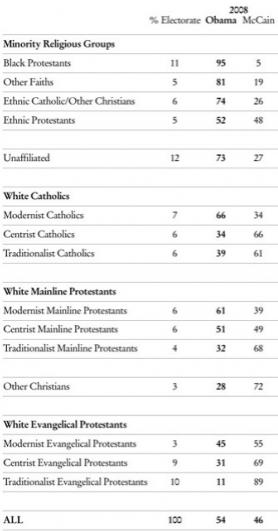
Should Christians have voted for Obama?

I was one of the 5 percent who did not vote for Obama in 2008, despite having dark skin just like my 3 co-workers who voted for him. Those conversations with those three people will stay with me till the day I die. I don’t think I have ever really understand how much people could suppress evidence in order to keep their beliefs before, until I spoke to those people. When I asked them if they were conservative Christians, they told me that they were. I went to a barbecue at one of their houses and saw bookshelves filled with Christian books. And yet they voted for a radical on abortion and a supporter of gay marriage, even when I told them about Obama’s voting record.

Skin color doesn’t matter to me when I am picking a candidate, but to some people it mattered more than facts.

How much do we pay as a society for removing the rules around love and marriage?

Dina sent me this UK Daily Mail article.

It says:

The cost of family breakdown to the country has shot up by more than £10 billion a year since 2009, a study found yesterday.

It put the price to taxpayers in 2015 of clearing up the damage after families fail and looking after the separated adults and children at £47.31 billion.

The bill takes in the cost of benefits, health and social care, housing, policing and the courts, and the price of failure in the education system of children hurt by divorce or the parting of their parents.

The Relationships Foundation think tank said that the money spent because of family breakdown amounts to three per cent of the economic product of the country and each taxpayer will have to contribute £1,546.

The bill has risen from £37.03 billion since the costs were first calculated in 2009. Over the past year alone, despite falling costs for policing, vandalism and disciplinary problems in schools attributable to family breakdown, the cost has risen by £1.55 billion.

Now the further along we go into the sexual revolution, the more the rules slip off and the more the costs go up. But don’t try to tell any secular leftists that marriage is necessary to keep government small and tax bills low – they are so committed to “anything goes” moral relativism when it comes to sex that no restrictions of any kind are acceptable to them.

Let’s see some more numbers from the United States.

Divorce and out-of-wedlock childbearing cost U.S. taxpayers more than $112 billion a year, according to a study commissioned by four groups advocating more government action to bolster marriages.

Sponsors say the study is the first of its kind and hope it will prompt lawmakers to invest more money in programs aimed at strengthening marriages. Two experts not connected to the study said such programs are of dubious merit and suggested that other investments — notably job creation — would be more effective in aiding all types of needy families.

There have been previous attempts to calculate the cost of divorce in America. But the sponsors of the new study, being released Tuesday, said theirs is the first to gauge the broader cost of “family fragmentation” — both divorce and unwed childbearing.

The study was conducted by Georgia State University economist Ben Scafidi. His work was sponsored by four groups who consider themselves part of a nationwide “marriage movement” — the New York-based Institute for American Values, the Institute for Marriage and Public Policy, Families Northwest of Redmond, Wash., and the Georgia Family Council, an ally of the conservative ministry Focus on the Family.

[…]Scafidi’s calculations were based on the assumption that households headed by a single female have relatively high poverty rates, leading to higher spending on welfare, health care, criminal justice and education for those raised in the disadvantaged homes. The $112 billion estimate includes the cost of federal, state and local government programs, and lost tax revenue at all levels of government.

Now I blog a lot about the kinds of behaviors that cause marriages to break down – all of which are pushed by radical feminists. We have the sexual revolution, recreational premarital sex, no fault divorce, single mother welfare, and so on – all of these things make it easier for people to break up and harder for them to see relationships as self-sacrificial and permanent. Opening the door to gay marriage is just another redefinition that will remove marital norms like permanence and exclusivity. The more unstable marriage is, the more it creates expensive litigation. The more children grow up without fathers and/or mothers, the more we have to pay in social programs.

Love is a serious business.

William Lane Craig lectures on naturalistic alternatives to the Big Bang

Here’s the lecture, which was given in 2004 at the University of Colorado, Boulder.

This lecture might be a little advanced for beginners, but if you stretch your mind first, you shouldn’t tear anything. (Note: standard disclaimers apply if you do tear something!)

The description of the video states:

This is quite simply one of the best lectures William Lane Craig (a philosopher of science) has given. Craig explores the origins of the universe. He argues for a beginning of the universe, while refuting scientific models like the Steady State Theory, the Oscillating Theory, Quantum Vacuum Fluctuation Model, Chaotic Inflationary Theory, Quantum Gravity Theory, String Theory, M-Theory and Cyclic Ekpyrotic Theory.

And here is the description of the lecture from Reasonable Faith:

A Templeton Foundation lecture at the University of Colorado, Boulder, laying out the case from contemporary cosmology for the beginning of the universe and its theological implications. Includes a lengthy Q & A period which features previous critics and debate opponents of Dr. Craig who were in attendance, including Michael Tooley, Victor Stenger, and Arnold Guminski.

Craig has previously debated famous atheists Stenger and Tooley previously. And they both asked him questions in the Q&A time of this lecture. Imagine – having laid out your entire case to two people who have debated you before and who know your arguments well. What did they ask Craig, and how did he respond?

The scientific evidence

The Big Bang cosmology that Dr. Craig presents is the standard model for how the universe came into being. It is a theory based on six lines of experimental evidence.

Scientific evidence:

  1. Einstein’s theory of general relativity (GTR)
  2. the red-shifting of light from distant galaxies implies an expanding universe
  3. the cosmic background radiation (which also disproves the oscillating model of the universe)
  4. the second law of thermodynamics applied to star formation theory
  5. hydrogen-helium abundance predictions
  6. radioactive element abundance predictions

If you are looking for some detail on these evidences, here’s a re-cap of the three main evidences for the Big Bang cosmology from Caltech. (Numbers 2, 3 and 5 from the list above)

Excerpt:

Until the early 1900s, most people had assumed that the universe was fixed in size. New possibilities opened up in 1915, when Einstein formulated his famous general relativity theory that describes the nature of space, time, and gravity. This theory allows for expansion or contraction of the fabric of space. In 1917, astronomer Willem de Sitter applied this theory to the entire universe and boldly went on to show that the universe could be expanding. Aleksandr Friedmann, a mathematician, reached the same conclusion in a more general way in 1922, as did Georges Lemaître, a cosmologist and a Jesuit, in 1927. This step was revolutionary since the accepted view at the time was that the universe was static in size. Tracing back this expanding universe, Lemaître imagined all matter initially contained in a tiny universe and then exploding. These thoughts introduced amazing new possibilities for the universe, but were independent of observation at that time.

[…]Three main observational results over the past century led astronomers to become certain that the universe began with the big bang. First, they found out that the universe is expanding—meaning that the separations between galaxies are becoming larger and larger. This led them to deduce that everything used to be extremely close together before some kind of explosion. Second, the big bang perfectly explains the abundance of helium and other nuclei like deuterium (an isotope of hydrogen) in the universe. A hot, dense, and expanding environment at the beginning could produce these nuclei in the abundance we observe today. Third, astronomers could actually observe the cosmic background radiation—the afterglow of the explosion—from every direction in the universe. This last evidence so conclusively confirmed the theory of the universe’s beginning that Stephen Hawking said, “It is the discovery of the century, if not of all time.”

It’s probably a good idea to be familiar with these if you are presenting this argument, because experimental science is a reliable way of knowing about reality.

Published research paper

This lecture by Dr. Craig is based on a research paper published in an astrophysics journal, and was delivered to an audience of students and faculty, including atheist physicist Victor Stenger and prominent atheist philosopher Michael Tooley, at the University of Colorado at Boulder.

Here’s the peer-reviewed article that the lecture is based on.

Here’s the abstract:

Both cosmology and philosophy trace their roots to the wonder felt by the ancient Greeks as they contemplated the universe. The ultimate question remains why the universe exists rather than nothing. This question led Leibniz to postulate the existence of a metaphysically necessary being, which he identified as God. Leibniz’s critics, however, disputed this identification, claiming that the space-time universe itself may be the metaphysically necessary being. The discovery during this century that the universe began to exist, however, calls into question the universe’s status as metaphysically necessary, since any necessary being must be eternal in its existence. Although various cosmogonic models claiming to avert the beginning of the universe predicted by the standard model have been and continue to be offered, no model involving an eternal universe has proved as plausible as the standard model. Unless we are to assert that the universe simply sprang into being uncaused out of nothing, we are thus led to Leibniz’s conclusion. Several objections to inferring a supernatural cause of the origin of the universe are considered and found to be unsound.

The whole text of the article is posted online here.

If you want something to post on your Twitter or Facebook that is much shorter than this lecture, then you should check out this quick 4-minute explanation of the kalam argument.