
How secular leftists misuse science to normalize sexual anarchy

Jay Richards tweeted this article Touchstone magazine.

Here’s part of it:

Here is how the Mead Method works. It has four easily memorized steps. You begin by proving that some behavior is natural, in the sense of being enjoyed by primitive people, who are assumed to be far closer to the basic human realities than we are. As the Chronicle’s writer put it:

Less than 50 years ago, Canela women, who live in Amazonian Brazil, enjoyed the delights of as many as 40 men one after another in festive rituals. When it was time to have a child, they’d select their favorite dozen or so lovers to help their husband with the all-important task. Even today, when the dalliances of married Bar ladies in Colombia and Venezuela result in a child, they proudly announce the long list of probable fathers.

Then you find some way to show that the behavior works. If to our overdeveloped modern eyes it looks like self-indulgence or sluttishness, it is actually a rational and effective way of living. An anthropologist quoted in the article claims that the more possible fathers a child has, the more men will take care of him and his mother. As the writer put it, “Fooling around appears to have helped our ancestral mothers equip their little ones for success—the sexual equivalent of reading to them every night or enrolling in the after-school chess club.”

Having established to your satisfaction that the behavior is not only natural but effective, you then declare that all such behaviors are just social constructions anyway and ours (the modern, still sort of Christian way) is really not nearly so common as we would like to think. To do this the writer quotes an anthropologist who studied tribes in Paraguay and Tanzania, who said, “This model of the death-do-us-part, missionary-position couple is just a tiny part of human history. The patterns of human sexuality are so much more variable.”

At this point, the case is often strengthened by caricaturing the present. That “missionary-position couple” is supposed, I think, to suggest “dull.” It can be strengthened even more by not stopping to ask what the patterns found in history might actually be. Perhaps there are only a few patterns, and contemporary marriage an expression (as it seems to be) of a dominant mode by which human societies try to restrain the destructive effects of human sexual desire and direct it to social ends.

Finally, you imply, without quite saying it, that the primitive behavior would work just as well for us, it being (though a social construction) more natural and all. The writer does this with quotes, like this one from a William Crocker of the Smithsonian Institution: “Multiple lovers, that’s just part of the life. It’s recreation, just like races and running. It’s all done in the spirit of joy and fun.”

The Margaret Mead Method, in either its original or modified form, is a very useful method . . . if you’re a creep. It proves—to the standard of the man with his pants halfway off and the woman who has gotten a better offer than her husband the couch potato will make, anyway—that sexual libertinism is natural and sexual restraint unnatural, and since being natural is always good, you ought to let go and have fun, just like the jolly party girls of the South American tribes.

This is why Coming of Age in Samoa made Mead famous. You want to have an affair with the babe next door? Well, those darling little Samoans living in a state of nature are doing it all the time, and look how happy and fulfilled and innocent they are. Margaret Mead said so. It’s scientific. You feel guilty? You’re a modern man afflicted with Judeo-Christian guilt, but just ignore it—socially constructed and unnatural as it is—and enjoy the pleasures nature and evolution have provided for you.

I am afraid this is the idea these stories almost always promote, whatever insights into the nature of a fallen creation they provide. They begin with reports of young Samoans having free and joyful sex among the palm trees, and end with middle-aged Barney desperately betraying his wife at the Hampton Inn.

Now this is supposed to be a hopeful, helpful blog post, so let me give you some advice.

There are things you can do to get around the older people who try to sell you this in school and in the culture. You have to do your own research, and learn the consequences of getting rid of the rules around sexual conduct before you break them.

First, read Romans 1, and understand that people who are doing evil things feel better about what they are doing if they can get you to approve of it, celebrate it, and subsidize it. So keep that in mind when people are telling you that something wrong is “right”.

Second, understand that people who are teaching you in school often portray themselves one way in class, but in actual fact, their private lives are totally messed up. It’s tempting to give them more respect than they deserve.

Third, it’s good to be think critically about what you see in the culture, and to read history in order to gain a perspective that allows you to judge what is seen as normal in your own time.

Fourth, it’s good to read studies to find out what happens next, should you take some course of action that is “normal”. For example, it’s a very good idea to research the link between the number of premarital sexual partners and divorce rate.

Fifth, you should be skeptical of people who misuse science in order to push an agenda. Just understand where they are going and then see if they might not be abusing science to get there. It happens all the time – just look at how global cooling / global warming has been used to justify increased control of energy development and consumption by government.
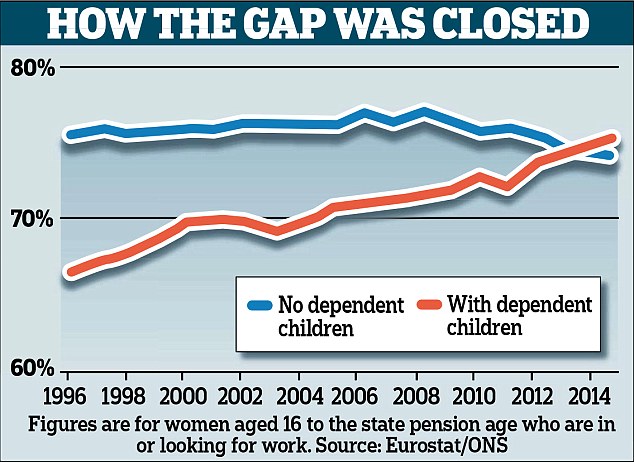
Report: UK moms with children as likely to work as women with no children

Stay-at-home moms in the UK at 25%

Dina sent me this stunning article from the UK Daily Mail.

It says:

Mothers are now as likely to go out to work as women without children, figures showed yesterday.

The historic landmark reached last year means just one mother in four stays at home to raise children.

Figures from the Office for National Statistics showed 74.1 per cent of mothers with children under 16, or between 16 and 18 if they are still at school, are regarded as ‘participating in the labour market’. 

By comparison, 75 per cent of women without dependent children were either in work or looking for a job last year.

[…]The new estimates are based on the large-scale Labour Force Survey covering women who either have jobs or are unemployed and looking for work. The ONS report said benefit changes that have pressed single parents into looking for work may have influenced the change.

It added: ‘Other government policies, for example to fund 570 hours of free early education childcare a year in England for all three to four-year-olds, will have provided additional incentives to engage with the labour market.’

The biggest change has been among mothers of children under five. In 1996, 1.6 million of them were in the labour market, compared with 2.1 million last year. This represents a rise from 54.5 per cent of mothers of under-fives in work in 1996 to 65 per cent now.

There are three things I want to say about this.

First, it’s undeniable that daycare is not optimal for a child when compared with having a stay-at-home mom for the early years of childhood. That’s not my opinion, it’s a fact. Part of preparing to get married and have kids is understanding what marriage requires and what children need. Don’t rely on the government to provide for your kids, they are only interested in putting you to work so they can get your income taxes. That’s especially true for big-government leftist parties that want to weaken marriage and the traditional family in any case.

Second, it’s undeniable that government programs can make the choice to stay home or not more or less financially feasible. Make sure when you vote that you vote for smaller government and lower taxes. The bigger the government, the less money you have to run your own family game plan. Social programs exist so that the government can buy votes from people by transferring wealth from those who work to those who don’t. If you work and want to have a family, then vote for your family, not for big government.

Third, single men and women need to factor in the costs of a stay-at-home mom into their marriage plan early. Your 20s are not the time for you to waste money on alcohol, parties, contraceptives, and recreational sex with hawt atheists. Your pre-marriage years should be the time when you to get used to hard work and save a nest egg. If the needs of your future children are important to you, then you study STEM subjects or a trade in school, you get a real job after college, you pay off your student loans, and you start saving money for your marriage as soon as possible. Again, you can’t “feel” your way to a good marriage. Recklessness is not going to work.

What is it like to be a donor-conceived child?

Marriage and family
Marriage and family

Yesterday, I wrote about children who are raised by same-sex parents. Today I want to link to an article written by two donor-conceived children.

The thing about donor-conceived children is this – the child’s natural father and/or mother’s absence has been bought and paid for by the adopting couple. One or both of the people who conceived the child is being paid by the adopter to go away.

From the article:

[M]y mother informed me of my true parentage when I was 14, and it was, as they say, irrevocable. My mother’s then-husband had waited until they divorced to permit her to tell me, and the revelation of his not being my biological father clarified an overwhelming amount of issues between us. For a multitude of reasons—his background, my personality and beliefs, our lack of biological connection—the cards were stacked against our having a conventional, loving father-daughter relationship. And we didn’t.

One of the greatest tragedies of donor conception is the loss of belonging: to family, to a culture. Essentially, one becomes malleable like an infant. I crave a home. I see myself as I travel in many directions—doing anything in order to find one.

Through the storytelling of other donor-conceived individuals, and scientific research pertaining to third-party reproduction and genetics, I have discovered that my situation is by no means unique, and I now understand the scientific explanations as to why my social father and I—up to a certain point—were unable to bond. It is natural for me to desire my father, for evolution has blessed those that secure such a bond with better survival rates.

The lack of my biological father’s presence is a devastating reality, a burden I will likely bare my entire existence. And now, knowing the truth of my conception, when I remember my past I remember everything that was absent from it.

The study she linked to in that paragraph says this:

It is on these grounds that we hypothesized, many years ago, that any and all sorts of abuse and exploitation would be seen to occur at higher rates in steprelationships than in genetic parent-child relationships, and that the differences would persist when possible confounds such as socio-economic status were controlled for… This hypothesis has since been abundantly supported in our own research and in that of many others. This differential (mis)treatment is what we refer to as the “Cinderella effect”.

[…][I]n several countries, stepparents beat very young children to death at per capita rates that are more than 100 times higher than the corresponding rates for genetic parents.

[…]The evidence for Cinderella effects in nonlethal abuse is much more extensive than that for homicides. Numerous studies from a diversity of countries indicate that stepparents perpetrate both nonlethal physical assaults and sexual abuse at much higher rates than genetic parents.

[…][S]teprelationships are difficult, and those who make it their business to help stepfamilies in distress are unanimous in cautioning that it is a mistake to expect that a stepparent-stepchild relationship is, or will with time become, psychologically equivalent to a birthparent-child relationship… Research tells the same story. Duberman (1975)… interviewed a select sample of well-established, “successful”, middle class, registered-marriage U.S. stepfamilies, and reported that only 53% of the stepfathers and 25% of the stepmothers felt able to say that they had any “parental feeling” (much less “love”) for their stepchildren.

It’s a well-known fact that mothers in particular have trouble treating their adopted children as well as their naturally-born children. This should be a caution to those women who want to put off marriage through their 20s and 30s, thinking that they can always adopt. Until you study the issues, it’s hard to know how to make a plan that takes into account the what children need in order to be happy, healthy and effective. Research should be consulted in order to make plans that will actually work.

More from the original article:

In the study “My Daddy’s Name Is Donor,” it was found that, “Regarding troubling outcomes, even with controls, the offspring of lesbian couples who used a sperm donor to conceive appear more than twice as likely as those raised by their biological parents to report struggling with substance abuse,” an alarming result displaying the reality of being raised without both genetic parents.

Some suggest that spending more money on making children means that they are more loved. Our children are definitively wanted, they say.

“The baby doesn’t care anything about the money,” says marriage and family therapist Nancy Verrier, regarding the issues surrounding surrogacy. “That’s not what hurts the baby. The baby is hurt by the separation, by the loss of that mother that it knows.” This ever-present realization of loss remains with both mother and child throughout their lives. Nature has ensured that mothers and children attach to one another, as it is a trait necessary to our survival; without motivation to love or instinctively care for her child, why would a mother protect her children from potential danger? She wouldn’t, and that would have heralded the end of our species. With this biological connection so immediate and meaningful, why doesn’t society view maintenance of that connection as more imperative?

The answer is that we are becoming more secular as a society as belief in God and therefore in objective morality declines. We are elevating the need to pursue happiness in this life over respect for objective morality. That’s why laws are changing to promote adult selfishness over the needs of children. Abortion, no-fault divorce, same-sex marriage… these are all elements of the secular worldview which wants to avoid the demands that children place on us. We want to have fun – not be saddled with moral obligations to others, that diminish our fun. We as a society have decided – whether we admit it or not – that the universe is an accident, that morality is an illusion, that responsibilities must be avoided, and that this life is all we have.

It’s amazing how widespread this attitude is, not just among atheists, but among Christians as well. Usually, the Christians just put a little spiritual spin on it though – “God told me to pursue my calling, so you can’t assess the feasibility and destructive impact of my choice”. That works to fool many “spiritual” people who put more faith in feelings than competence, but it doesn’t work to prevent the destructiveness of not thinking things through.