
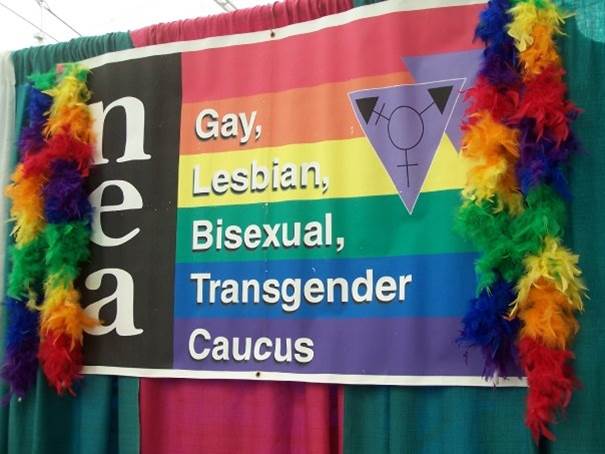
This article from the radically leftist Washington Post unapologetically praises public school teachers for pushing their vision of sex and marriage onto children as young as four years old.
It says:
As young children develop their understanding of the world, they tend to rely heavily on binaries. If we understand the binaries a child is working within, we can encourage that child to think of counterexamples or introduce counterexamples ourselves into the conversation. These provide useful stumbling blocks that encourage them to expand their thinking.
[…]As the year unfolded, my students continued to play at themes of love and marriage. The conversations expanded and both kids and I were able to introduce new and different stumbling blocks: One can be in love and not get married, not all married people are moms or dads, and not all moms and dads are married. The conversations shifted based on what information the kids had internalized.
The author relays an example conversation about same-sex marriage and incest marriage, which she participates in, trying to undermine the traditional views expressed by the children.
More:
As this deeply layered conversation moved on, many points of view were stated, more questions were posed, and the children were able to articulate what they thought. I made a mental note to myself about topics to revisit, including finding a way to talk about inherited traits and Jane’s ideas about the dangers of incest. There’s always a new challenge!
[…]It’s easy to feel vulnerable or overwhelmed when children ask questions about identity, but when we don’t engage the issues involved, we are sending a message that the subjects are taboo. In terms of gender and sexuality, avoidance and silence can be particularly harmful for students who are or will later identify as LGBTQ (Lesbian/Gay/Bisexual/Transgender/Queer) or who come from families with LGBTQ family members. Silence is not a neutral response.
Is this a conversation that you want a secular public school teacher having with your kids?
Regardless of what you do with your own kids, your tax dollars are going to be paying for these kinds of conversations. They are, in fact, undermining the natural desire of most parents under the parents’ noses. Although leftist educators tend to have fewer children than conservatives, or even no children, they can push their ideas into the next generation by running the public schools.
Public schools tend to do a woeful job of teaching the useful skills that parents really want, but they do a great job of pushing leftist values onto children, and the earlier the better. In fact, they are not being paid on the basis of whether your child learns math and science and engineering and is able to get a job. Public school teachers are paid regardless of student performance, because public schools are a monopoly. This is not a free market which service providers compete to give customers more quality for less money. Public schools are totally insulated from the demands of consumers, that’s why public school teachers are free to push whatever values they want on kids.
If you want to see how far the gay left intends to go with this, take a look at the province of Ontario, Canada, where the sex education curriculum was designed by an education minister who was convicted for child pornography. The Ontario premier is a lesbian, and she is a strong defender of that sex education curriculum, over and against the protests of traditional-minded parents. But somehow, she got elected, and somehow, the child-pornographer became the minister of education. Somebody decided that he was the right person for the job, and somebody decided that public school teachers have a right to push his curriculum on children. And the taxpayers are paying for this indoctrination of young, impressionable kids.
Now, take a look at this story that I got from my friend Ari, about a gay rights conference in Iowa, held at a very rural public school.
Read it:
In rural, small-town Iowa, a group of parents and community leaders is seeking to prevent students from the local taxpayer-funded middle school and high school from attending future versions of an anti–bullying conference for lesbian, gay, bisexual and transgender teens.
The last one — in April — left many of the denizens of Humboldt, Iowa up in arms, reports Des Moines NBC affiliate WHO-TV.
Iowa Safe Schools, an activist group out of Des Moines, hosted the conference.
[…]Among the nearly two dozen speakers, “only two” addressed bullying, one attendee estimated, according to EAGnews.org.
The rest of the sessions involved issues such as “how to pleasure their gay partners.”
Middle school girls from Humboldt (pop.: 4,690) had the opportunity to learn “how to sew fake testicles into their underwear in order to pass themselves off as boys.”
One speaker wore a dress made out of condoms to which could be “used as needed.” . . .
Nate Monson, executive director of Iowa Safe Schools, said parents who worry about middle school kids hearing about anal sex with strap-ons and analingus are “disgusting.”
“It’s incredibly frustrating that adults are being the problem and being the bully,” Monson told the Des Moines NBC affiliate. “
The mission statement of “Iowa Safe Schools” makes it clear that this is about pushing early sexual activity and the broader gay agenda onto children in the public schools:
The mission of Iowa Safe Schools is to: a) improve school climate in order to increase the personal safety, mental health, and student learning of lesbian, gay, bisexual, transgender, and allied (LGBTA) and all other students; b) increase awareness and understanding among current and future educators, school administrators, and key community agents of inequities regarding the safety of LGBTA students and their family member(s) in schools and communities throughout Iowa. Iowa Safe Schools also seeks to empower these key actors with effective, research-based tools and strategies to combat intolerance and safety inequities.
That’s what’s happening in public schools. Should we be voting to send more money to these public schools? Will more money result in kids having better math, science and engineering skills? It seems to me that public schools have nothing to do with teaching math, science and engineering, and everything to do with normalizing the gay lifestyle, against the wishes of most traditional parents. Make sure that when you are voting, you vote for school choice, not a government-run public school monopoly. Let parents get the money, and let the parents decide where to send their kids based on what the kids need to learn valuable skills and get real jobs.

 and apologetics, debate vs. dialogue, pitfalls to apologists, and more.
 WINTERY KNIGHT