

Does the word atheism mean “a lack of belief in God”?

Making sense of the meaning of atheism

First, let’s see check with the Stanford University Encyclopedia of Philosophy.

Excerpt:

‘Atheism’ means the negation of theism, the denial of the existence of God.

Stanford University is one of the top 5 universities in the United States, so that’s a solid definition. To be an atheist is to be a person who makes the claim that, as a matter of FACT, there is no intelligent agent who created the universe. Atheists think that there is no God, and theists think that there is a God. Both claims are objective claims about the way the world is out there, and so both sides must furnish forth arguments and evidence as to how they are able to know what they are each claiming.

Philosopher William Lane Craig has some thoughts on atheism, atheists and lacking belief in God in this reply to a questioner.

Question:

In my discussions with atheists, they  are using the term that they “lack belief in God”. They claim that this is different from not believing in God or from saying that God does not exist. I’m not sure how to respond to this. It seems to me that its a silly word-play and is logically the same as saying that you do not believe in God.
What would be a good response to this?
Thank you for your time,

Steven

And here is Dr. Craig’s full response:

Your atheist friends are right that there is an important logical difference between believing that there is no God and not believing that there is a God.  Compare my saying, “I believe that there is no gold on Mars” with my saying “I do not believe that there is gold on Mars.”   If I have no opinion on the matter, then I do not believe that there is gold on Mars, and I do not believe that there is no gold on Mars.  There’s a difference between saying, “I do not believe (p)” and “I believe (not-p).”   Logically where you place the negation makes a world of difference.

But where your atheist friends err is in claiming that atheism involves only not believing that there is a God rather than believing that there is no God.

There’s a history behind this.  Certain atheists in the mid-twentieth century were promoting the so-called “presumption of atheism.” At face value, this would appear to be the claim that in the absence of evidence for the existence of God, we should presume that God does not exist.  Atheism is a sort of default position, and the theist bears a special burden of proof with regard to his belief that God exists.

So understood, such an alleged presumption is clearly mistaken.  For the assertion that “There is no God” is just as much a claim to knowledge as is the assertion that “There is a God.”  Therefore, the former assertion requires justification just as the latter does.  It is the agnostic who makes no knowledge claim at all with respect to God’s existence.  He confesses that he doesn’t know whether there is a God or whether there is no God.

But when you look more closely at how protagonists of the presumption of atheism used the term “atheist,” you discover that they were defining the word in a non-standard way, synonymous with “non-theist.”  So understood the term would encompass agnostics and traditional atheists, along with those who think the question meaningless (verificationists).  As Antony Flew confesses,

the word ‘atheist’ has in the present context to be construed in an unusual way.  Nowadays it is normally taken to mean someone who explicitly denies the existence . . . of God . . . But here it has to be understood not positively but negatively, with the originally Greek prefix ‘a-’ being read in this same way in ‘atheist’ as it customarily is in . . . words as ‘amoral’ . . . . In this interpretation an atheist becomes not someone who positively asserts the non-existence of God, but someone who is simply not a theist. (A Companion to Philosophy of Religion, ed. Philip Quinn and Charles Taliaferro [Oxford:  Blackwell, 1997], s.v. “The Presumption of Atheism,” by Antony Flew)

Such a re-definition of the word “atheist” trivializes the claim of the presumption of atheism, for on this definition, atheism ceases to be a view.  It is merely a psychological state which is shared by people who hold various views or no view at all.  On this re-definition, even babies, who hold no opinion at all on the matter, count as atheists!  In fact, our cat Muff counts as an atheist on this definition, since she has (to my knowledge) no belief in God.

One would still require justification in order to know either that God exists or that He does not exist, which is the question we’re really interested in.

So why, you might wonder, would atheists be anxious to so trivialize their position?  Here I agree with you that a deceptive game is being played by many atheists.  If atheism is taken to be a view, namely the view that there is no God, then atheists must shoulder their share of the burden of proof to support this view.  But many atheists admit freely that they cannot sustain such a burden of proof.  So they try to shirk their epistemic responsibility by re-defining atheism so that it is no longer a view but just a psychological condition which as such makes no assertions.  They are really closet agnostics who want to claim the mantle of atheism without shouldering its responsibilities.

This is disingenuous and still leaves us asking, “So is there a God or not?”

So there you have it. We are interested in what both sides know and what reasons and evidence they have to justify their claim to know. We are interested in talking to people who make claims about objective reality, not about themselves, and who then go on to give reasons and evidence to support their claims about objective reality. There are atheists out there that do make an objective claim that God does not exist, and then support that claim with arguments and evidence. Those are good atheists, and we should engage in rational conversations with them. But clearly there are some atheists who are not like that. How should we deal with these “subjective atheists”?

Well, my advice is to avoid them. They are approaching religion non-cognitively. When you engage in serious discussions with people about God’s existence, you only care about what people know and what they can show to be true.

Senate Majority Leader Mitch McConnell should step down

Mitch McConnell shaking hands with his buddy Obama

I’ve just had it with this man, he is utterly useless as a Republican, and he is harming the brand with his kowtowing to the left.

The Daily Caller reports:

Senate Majority Leader Mitch McConnell has never been a favorite of conservatives. Those who see him as a “squishy” compromiser more interested in placating President Barack Obama and K Street lobbyists than the Republican base had more fuel tossed on that fire when he blocked amendments to the Highway Bill Tea Party members wholeheartedly support.

One amendment would defund Planned Parenthood, the nationwide abortion provider which receives more than a half billion dollars in taxpayer subsidies annually. McConnell has previously said he supports defunding Planned Parenthood, which was recently the subject of undercover sting videos in which executives with the organization can be heard discussing the sale of organs from aborted babies. But the leader blocked an amendment to the Highway Bill that would have defunded the organization.

At a time when we have the public behind us on defunding Planned Parenthood, McConnell blinks. What good is he?

As if the social issues were not bad enough, he’s screwed up fiscal issues as well.The Senate revived the Export-Import Bank on Sunday, which is just a nightmare of crony capitalism and corporate welfare. Thankfully, the conservatives in the House of Representatives killed it, and stopped McConnell from screwing the conservative base of the Republican party again.

I hope everyone understands that big corporations are not conservative, and we should not be helping them in any way. If anything, the government should be pushing for more choice and  competition, and lowering barriers to entry for new start-ups.

What do we do about Mitch McConnell?

Next time he is up for election, he should be primaried. If you get a request for donations from anything remotely related to the Senate, send it back with a note that says “not till McConnell steps down as majority leader”.

Frankly, I recommend never donating to the NRSC.

New study: Saturn’s orbit keeps Earth in the circumstellar habitable zone

Circumstellar Habitable Zone

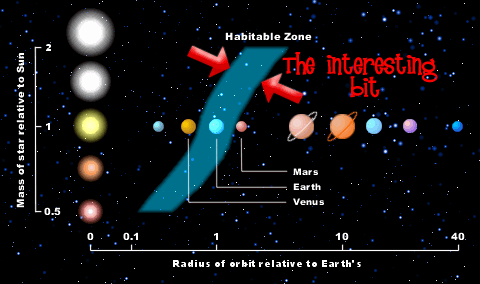
What do you need in order to have a planet that supports complex life? First, you need liquid water at the surface of the planet. But there is only a narrow range of temperatures that can support liquid water. It turns out that the size of the star that your planet orbits around has a lot to do with whether you get liquid water or not.

A heavy, metal-rich star allows you to have a habitable planet far enough from the star so  the planet can support liquid water on the planet’s surface while still being able to spin on its axis. The zone where a planet can have liquid water at the surface is called the circumstellar habitable zone (CHZ). A metal-rich star like our Sun is very massive, which moves the habitable zone out further away from the star.

If our star were smaller, we would have to orbit much closer to the star in order to have liquid water at the surface. Unfortunately, if you go too close to the star, then your planet becomes tidally locked, like the moon is tidally locked to Earth. Tidally locked planets are inhospitable to life. So we need a star massive enough to give us a nice wide habitable zone far away from the Sun itself.

But even with the right size star, which we have in our solar sytem, we still have CHZ problems. Just because a planet starts off in the circumstellar habitable zone, it doesn’t mean that it will stay there.

Jay Richards tweeted about this new article from the New Scientist, which talks about that very problem.

Excerpt: (links removed)

Earth’s comfortable temperatures may be thanks to Saturn’s good behaviour. If the ringed giant’s orbit had been slightly different, Earth’s orbit could have been wildly elongated, like that of a long-period comet.

Our solar system is a tidy sort of place: planetary orbits here tend to be circular and lie in the same plane, unlike the highly eccentric orbits of many exoplanets. Elke Pilat-Lohinger of the University of Vienna, Austria, was interested in the idea that the combined influence of Jupiter and Saturn – the solar system’s heavyweights – could have shaped other planets’ orbits. She used computer models to study how changing the orbits of these two giant planets might affect the Earth.

Earth’s orbit is so nearly circular that its distance from the sun only varies between 147 and 152 million kilometres, or around 2 per cent about the average. Moving Saturn’s orbit just 10 percent closer in would disrupt that by creating a resonance – essentially a periodic tug – that would stretch out the Earth’s orbit by tens of millions of kilometres. That would result in the Earth spending part of each year outside the habitable zone, the ring around the sun where temperatures are right for liquid water.

Tilting Saturn’s orbit would also stretch out Earth’s orbit. According to a simple model that did not include other inner planets, the greater the tilt, the more the elongation increased. Adding Venus and Mars to the model stabilised the orbits of all three planets, but the elongation nonetheless rose as Saturn’s orbit got more tilted. Pilat-Lohinger says a 20-degree tilt would bring the innermost part of Earth’s orbit closer to the sun than Venus.

So the evidence for a our solar system being fine-tuned for life keeps piling up. It’s just another factor that has to be just right so that complex, embodied life could exist here. All of these factors need to be just right, not just the orbits of any other massive planets. And you need at least one massive planet to attract comets and other such unwelcome intruders away from the life-permitting planets.

Here’s a good clip explaining the circumstellar habitable zone:

The factor I blogged about today is just one of the things you need in order to get a planet that supports life.

Here are a few of the more well-known ones:

  • a solar system with a single massive Sun than can serve as a long-lived, stable source of energy
  • a terrestrial planet (non-gaseous)
  • the planet must be the right distance from the sun in order to preserve liquid water at the surface – if it’s too close, the water is burnt off in a runaway greenhouse effect, if it’s too far, the water is permanently frozen in a runaway glaciation
  • the solar system must be placed at the right place in the galaxy – not too near dangerous radiation, but close enough to other stars to be able to absorb heavy elements after neighboring stars die
  • a moon of sufficient mass to stabilize the tilt of the planet’s rotation
  • plate tectonics
  • an oxygen-rich atmosphere
  • a sweeper planet to deflect comets, etc.
  • planetary neighbors must have non-eccentric orbits

Here is a study that I wrote about recently about galactic habitable zones.