Category Archives: Polemics

Ryan T. Anderson presents the case for natural / traditional marriage

A must-read long paper from the Heritage Foundation. It’s a great concise presentation of the reasons why the United States should not redefine marriage. (H/T A tweet from Ryan T. Anderson)

Abstract:

Marriage is based on the truth that men and women are complementary, the biological fact that reproduction depends on a man and a woman, and the reality that children need a mother and a father. Redefining marriage does not simply expand the existing understanding of marriage; it rejects these truths. Marriage is society’s least restrictive means of ensuring the well-being of children. By encouraging the norms of marriage—monogamy, sexual exclusivity, and permanence—the state strengthens civil society and reduces its own role. The future of this country depends on the future of marriage. The future of marriage depends on citizens understanding what it is and why it matters and demanding that government policies support, not undermine, true marriage.

Excerpt:

Supporters of redefinition use the following analogy: Laws defining marriage as a union of a man and a woman are unjust—fail to treat people equally—exactly like laws that prevented interracial marriage. Yet such appeals beg the question of what is essential to marriage. They assume exactly what is in dispute: that gender is as irrelevant as race in state recognition of marriage. However, race has nothing to with marriage, and racist laws kept the races apart. Marriage has everything to do with men and women, husbands and wives, mothers and fathers and children, and that is why principle-based policy has defined marriage as the union of one man and one woman.

Marriage must be color-blind, but it cannot be gender-blind. The color of two people’s skin has nothing to do with what kind of marital bond they have. However, the sexual difference between a man and a woman is central to what marriage is. Men and women regardless of their race can unite in marriage, and children regardless of their race need moms and dads. To acknowledge such facts requires an understanding of what, at an essential level, makes a marriage.

And a bit later:

If the law taught a falsehood about marriage, it would make it harder for people to live out the norms of marriage because marital norms make no sense, as matters of principle, if marriage is just intense emotional feeling. No reason of principle requires an emotional union to be permanent or limited to two persons, much less sexually exclusive. Nor should it be inherently oriented to family life and shaped by its demands. This does not mean that a couple could not decide to live out these norms where temperament or taste so motivated them, just that there is no reason of principle to demand that they do so. Legally enshrining this alternate view of marriage would undermine the norms whose link to the common good is the basis for state recognition of marriage in the first place.

Insofar as society weakens the rational foundation for marriage norms, fewer people would live them out, and fewer people would reap the benefits of the marriage institution. This would affect not only spouses, but also the well-being of their children. The concern is not so much that a handful of gay or lesbian couples would be raising children, but that it would be very difficult for the law to send a message that fathers matter when it has redefined marriage to make fathers optional.

And one last one:

In fact, much of this is already occurring. Heritage Foundation Visiting Fellow Thomas Messner has documented multiple instances in which redefining marriage has already become a nightmare for religious liberty.[48] If marriage is redefined to include same-sex relationships, then those who continue to believe the truth about marriage—that it is by nature a union of a man and a woman—would face three different types of threats to their liberty: the administrative state, nondiscrimination law, and private actors in a culture that is now hostile to traditional views.[49]

After Massachusetts redefined marriage to include same-sex relationships, Catholic Charities of Boston was forced to discontinue its adoption services rather than place children with same-sex couples against its principles.[50] Massachusetts public schools began teaching grade-school students about same-sex marriage, defending their decision because they are “committed to teaching about the world they live in, and in Massachusetts same-sex marriage is legal.” A Massachusetts appellate court ruled that parents have no right to exempt their children from these classes.[51]

The New Mexico Human Rights Commission prosecuted a photographer for declining to photograph a same-sex “commitment ceremony.” Doctors in California were successfully sued for declining to perform an artificial insemination on a woman in a same-sex relationship. Owners of a bed and breakfast in Illinois who declined to rent their facility for a same-sex civil union ceremony and reception were sued for violating the state nondiscrimination law. A Georgia counselor was fired after she referred someone in a same-sex relationship to another counselor.[52] In fact, the Becket Fund for Religious Liberty reports that “over 350 separate state anti-discrimination provisions would likely be triggered by recognition of same-sex marriage.”[53]

This article is long and comprehensive. It will take some time to read. It’s includes logical arguments as well as empirical evidence from research – with footnotes. I really recommend taking a look at the article. Even if it takes a long time to read, it will definitely expand your mind to think about why we had a definition of marriage in the first place, and what we would lose by changing that definition. When you debate people who want to redefine marriage, it’s very important to appeal to logical arguments and evidence from studies. Get the conversation away from emotions and instead introduce facts and arguments.

You can get an even longer treatment in the new book by Ryan T. Anderson and his co-authors Sherif Girgis and Robert P. George. This is *the* book to get on the marriage issue.

Related posts

Two famous near-death experiences: Pam Reynolds and Maria’s tennis shoe

Dr. Mario Beuregard writes about out of body experiences and near death experiences in the leftist Salon.com, of all places. (I said Slate before, but it’s Salon, thanks Mary for the correction)

NDE number one:

Pam was brought into the operating room at 7:15 a.m., she was given general anesthesia, and she quickly lost conscious awareness. At this point, Spetzler and his team of more than 20 physicians, nurses, and technicians went to work. They lubricated Pam’s eyes to prevent drying, and taped them shut. They attached EEG electrodes to monitor the electrical activity of her cerebral cortex. They inserted small, molded speakers into her ears and secured them with gauze and tape. The speakers would emit repeated 100-decibel clicks—approximately the noise produced by a speeding express train—eliminating outside sounds and measuring the activity of her brainstem.

At 8:40 a.m., the tray of surgical instruments was uncovered, and Robert Spetzler began cutting through Pam’s skull with a special surgical saw that produced a noise similar to a dental drill. At this moment, Pam later said, she felt herself “pop” out of her body and hover above it, watching as doctors worked on her body.

Although she no longer had use of her eyes and ears, she described her observations in terms of her senses and perceptions. “I thought the way they had my head shaved was very peculiar,” she said. “I expected them to take all of the hair, but they did not.” She also described the Midas Rex bone saw (“The saw thing that I hated the sound of looked like an electric toothbrush and it had a dent in it … ”) and the dental-drill sound it made with considerable accuracy.

Meanwhile, Spetzler was removing the outermost membrane of Pamela’s brain, cutting it open with scissors. At about the same time, a female cardiac surgeon was attempting to locate the femoral artery in Pam’s right groin. Remarkably, Pam later claimed to remember a female voice saying, “We have a problem. Her arteries are too small.” And then a male voice: “Try the other side.” Medical records confirm this conversation, yet Pam could not have heard them.

I like the second one even better than the first.

NDE number two:

Maria was a migrant worker who had a severe heart attack while visiting friends in Seattle. She was rushed to Harborview Hospital and placed in the coronary care unit. A few days later, she had a cardiac arrest but was rapidly resuscitated. The following day, Clark visited her. Maria told Clark that during her cardiac arrest she was able to look down from the ceiling and watch the medical team at work on her body. At one point in this experience, said Maria, she found herself outside the hospital and spotted a tennis shoe on the ledge of the north side of the third floor of the building. She was able to provide several details regarding its appearance, including the observations that one of its laces was stuck underneath the heel and that the little toe area was worn. Maria wanted to know for sure whether she had “really” seen that shoe, and she begged Clark to try to locate it.

Quite skeptical, Clark went to the location described by Maria—and found the tennis shoe. From the window of her hospital room, the details that Maria had recounted could not be discerned. But upon retrieval of the shoe, Clark confirmed Maria’s observations. “The only way she could have had such a perspective,” said Clark, “was if she had been floating right outside and at very close range to the tennis shoe. I retrieved the shoe and brought it back to Maria; it was very concrete evidence for me.”

This case is particularly impressive given that during cardiac arrest, the flow of blood to the brain is interrupted. When this happens, the brain’s electrical activity (as measured with EEG) disappears after 10 to 20 seconds. In this state, a patient is deeply comatose. Because the brain structures mediating higher mental functions are severely impaired, such patients are expected to have no clear and lucid mental experiences that will be remembered. Nonetheless, studies conducted in the Netherlands, United Kingdom, and United States have revealed that approximately 15 percent of cardiac arrest survivors do report some recollection from the time when they were clinically dead. These studies indicate that consciousness, perceptions, thoughts, and feelings can be experienced during a period when the brain shows no measurable activity.

Here’s the author bio:

Mario Beauregard is associate research professor at the Departments of Psychology and Radiology and the Neuroscience Research Center at the University of Montreal. He is the coauthor of “The Spiritual Brain” and more than one hundred publications in neuroscience, psychology and psychiatry.

It’s a helpful article, and one you might want to share or tweet to get a discussion started.

An honest look at the many contributions of Hugo Chavez to Venezuela

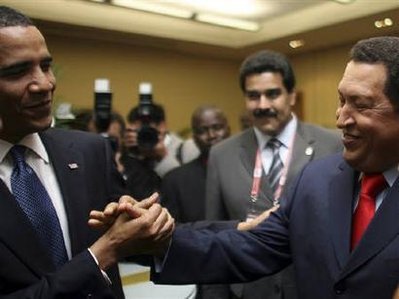
Are Barack Obama and Hugo Chavez very different?

From Reason magazine. (H/T Ian L.)

Excerpt: (links removed)

Hugo Chávez’ presidency has been a disaster for the Venezuelan people. Chávez’ “Socialism of the 21st Century” changed Venezuela from one of the most prosperous and politically free countries in Latin America to one of the least competitive and most repressive countries worldwide. Venezuelans who go to the polls today will ponder many of the President’s policy failures, including a long list of Chávez’nblunders in the last year alone.

Under Chávez’ rule, oil-rich Venezuela has become one of the least economically competitive countries in the world. In 2012, the country ranked 126 of 144 in a study by the World Economic Forum. According to the report, Venezuela now has some of the lowest scores worldwide in functioning of public institutions, trust in the justice system and domestic competition. It has some of the highest scores in terms of regulation, trade tariffs, and rules that deter foreign investment. The country has an inflation rate of 26 percent, and has also suffered several food shortages this year.

Venezuelan infrastructure has been falling apart under Chávez. On August 15th, the Cupira bridge near Caracas collapseddespite repeated warnings from engineers that it was in disrepair. Last month, poor drainage infrastructure led to nationwide flooding, resulting in over 400 families losing their homes and 1,500 people ending up in shelters. Chávez also mismanages Venezuela’s oil wealth. Since the government effectively took control of the national oil company in 2004, it has become much less efficient and production is 25 percent lower than when Chávez took office. Accidents are common—an offshore oil rig sank into the sea in 2010 and an oil refinery explosion in August killed at least 48 people. Despite sitting atop the world’s largest proven oil reserves, Venezuela nowimports and rations gasoline.

According to USA Today, Venezuela has the fourth highest murder rate in the world and is now the most violent South American country. Between the time Chávez took power in 1998 and 2012, kidnappings have risen from a few hundred annually to a record of 16,000 in 2011. Homicide rates have nearly tripled and suspect arrests have fallen by 61 percent. Only eight in every 100 murder investigations lead to an arrest. Murder of police officers has risen by 45 percent  in the last year alone. Violence is much worse for Venezuela’s inmates despite Chávez’ campaign promises of prison reform. A prison riot on August 24 left 26 people dead and 43 injured after inmates took over the compound and held it for four hours. Venezuelans are 20 times more likely to be killed in penitentiaries than outside of them. More than three hundred people have died and 572 have been injured in Venezuelan prisons this year alone.

Venezuelans have also witnessed alarming revocations of political liberties during Chávez’ presidency. On September 10th, Chávez decided to withdraw from the Inter-American Court of Human Rights. He regularly targets media who expose his failures. He recently arrested two journalists for writing a satirical article about his leadership. In addition, he demanded the names of voters who participated in the opposition’s primary election last February, just as he did to those who unsuccessfully voted to remove him from office in 2004. Chávez has banned foreign funding for civil society watch dogs, which will make electoral transparency in upcoming elections difficult.

UPDATE: Reformed Seth sent me this article from Human Rights Watch as well.

Excerpt:

Hugo Chávez’s presidency (1999-2013) was characterized by a dramatic concentration of power and open disregard for basic human rights guarantees.

After enacting a new constitution with ample human rights protections in 1999 – and surviving a short-lived coup d’état in 2002 – Chávez and his followers moved to concentrate power. They seized control of the Supreme Court and undercut the ability of journalists, human rights defenders, and other Venezuelans to exercise fundamental rights.

By his second full term in office, the concentration of power and erosion of human rights protections had given the government free rein to intimidate, censor, and prosecute Venezuelans who criticized the president or thwarted his political agenda. In recent years, the president and his followers used these powers in a wide range of prominent cases, whose damaging impact was felt by entire sectors of Venezuelan society.

Many Venezuelans continued to criticize the government. But the prospect of reprisals – in the form of arbitrary or abusive state action – forced journalists and human rights defenders to weigh the consequences of disseminating information and opinions critical of the government, and undercut the ability of judges to adjudicate politically sensitive cases.

[…]Chávez also rejected international efforts to promote human rights in other countries. In recent years, Venezuela consistently voted against UN General Assembly resolutions condemning abusive practices in North Korea, Burma, Iran, and Syria. Moreover, Chávez was a vocal supporter of Syria’s Bashar al-Assad, Libya’s Muammar Gaddafi, and Iran’s Mahmoud Ahmadinejad, bestowing upon each of these leaders the “Order of the Liberator,” Venezuela’s highest official honor.

Under Chávez, Venezuela’s closest ally was Cuba, the only country in Latin America that systematically represses virtually all forms of political dissent. Chávez identified Fidel Castro – who headed Cuba’s repressive government until his health deteriorated in 2006 – as his model and mentor.

That’s the dream of people on the left like Sean Penn. They love the idea of doing away with liberty and human rights. They want to force their secular leftist ideology on everyone at gunpoint.

Everyone who is praising this communist dictator today should be ashamed. None of them would move out of the United States to live in Venezuela – it’s nothing but hypocrisy.

Related posts