
Category Archives: Mentoring

Should Christians be motivated by the fear of missing out (FOMO)?

Theology that hits the spot

Dina was off from her stressful job last week, so we spent some time talking over some articles that we found on the culture. We specifically talked about what is motivating young people, so I wanted to write something about that.

FOMO: Fear Of Missing Out

Here’s a leftist New York Times article explaining where FOMO comes from:

It’s known as FOMO, or “fear of missing out,” and refers to the blend of anxiety, inadequacy and irritation that can flare up while skimming social media like Facebook, Twitter, Foursquare and Instagram. Billions of Twitter messages, status updates and photographs provide thrilling glimpses of the daily lives and activities of friends, “frenemies,” co-workers and peers.

[…]When we scroll through pictures and status updates, the worry that tugs at the corners of our minds is set off by the fear of regret, according to Dan Ariely, author of “Predictably Irrational” and a professor of psychology and behavioral economics at Duke University. He says we become afraid that we’ve made the wrong decision about how to spend our time.

[…]A friend who works in advertising told me that she felt fine about her life — until she opened Facebook. “Then I’m thinking, ‘I am 28, with three roommates, and oh, it looks like you have a precious baby and a mortgage,’ ” she said. “And then I wanna die.”

It’s like they want to run a race to do fun and exotic things with their peers, and not finish last.

Anyway, I want to begin this post with examples of FOMO behavior I have personally encountered.

FOMO Travel

Dina and I read and discussed this article by Alain de Botton in The European – notice the emphasis on travel and having fun, sophisticated experiences:

We’re continually being bombarded with suggestions about what we might do (go jet skiing, study in Colorado, visit the Maldives or see the Pyramids). We’re always hearing of the amazing things friends have done or are going to do: ‘there was this great bar we all went to …’; ‘she’s getting married in a little country church, then we’re having a picnic…’; ‘the sun was glinting on Sydney Harbour…’ There are endless hints of the allure of life in other places: an article about family-friendly restaurants in Brooklyn, a crime novel set in Trieste, the departure board at the airport with its list of places only a plane trip away: Moscow, Bangkok, Addis Ababa… The modern world makes sure we know at all times just how much we’re missing. It is a culture in which intense and painful doses of FOMO (Fear Of Missing Out) are almost inevitable.

What’s interesting is this – how does FOMO travel affect young, unmarried Christians?

Travel through missions work seems to be the FOMO activity of choice for at least a few young, unmarried Christians. One of my best friends who is married to another of my best friends told me about her missions trip to a European country. I asked her why she did it, since it meant lost savings, lost earnings, lost work experience, etc. (She gave up a year of earnings, and she had a great job in engineering). Her answer was that she did it for the adventure. I have a hard time hearing Jesus say that he was going to do something because he was bored and wanted an adventure. Especially when it’s $30,000 in costs, $60,000 of lost income, and lost work experience – per year. This was before the time of the Internet, though, when missionary work actually made sense. I just don’t think it’s worth spending that kind of money for the impact you make. The people I know who went on missionary trips just wanted to feel spiritual, look spiritual, and have a fun “life experience” vacation. One missionary told me that she was desperate to get away from her boring mid-Western roots.

If you really want to share Christ effectively with people in other countries, then you can start a blog and pay the tiny costs for it out of your earnings from your day job – that’s what I do. I get more people from Europe reading my blog than I could contact in a year of missionary work. I Skype with the people who are interested in Christianity from these countries (Scotland, Northern Ireland, England, Canada, etc.), as well. Meanwhile, I keep working my not-exciting job, so my savings increase, and my resume remains gap-less. This is good stewardship of finances, and self-denial prepares your character for the hard work of marriage and parenting. The Bible says that those who do not work should not eat. And Paul says that he built tents so that no one could accuse him of taking on missionary work for financial gain.

You can tell whether a person is sincere in their missionary intentions by looking at how responsible they’ve been in their decision-making. If a person has gone into debt paying for fun, thrilling activities like skydiving, ziplining, surfing, etc., then it’s FOMO travel. We must look past the spiritual smokescreen, and tell young people to grow up.

After all, if defending God’s honor was the missionary’s main goal, then the real battlefield would be the university.

Bill Craig puts it best:
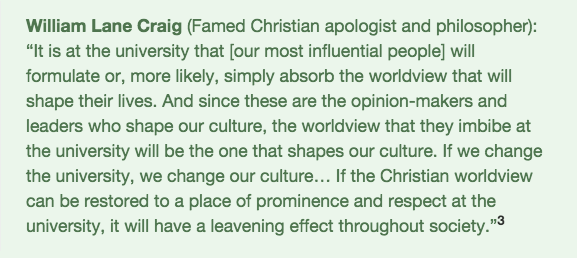
If serving God is your goal, look to the university

There is already a perfectly fine university right next door – no need to fly to Europe to find one! Remember, the university that took your faith away, or maybe the faith of someone you cared about? Yeah, it’s still there in your home town! And it’s still ruining the lives of thousands of young people. It seems to me that it’s better stewardship to stay here and work, then give money to groups like Reasonable Faith. And you can start a blog, teach in church and invite scholars to the local university, too. That costs almost nothing, and it produces better results.

What about Jesus?

Sometimes, it’s a good idea to look beyond the words of the Bible and reflect on the overall message of it at a higher level. When I look in the Bible, I see that Jesus went through a lot of suffering in obedience to God in order to secure the salvation of people who did not even like him. And it’s from this sacrifice on our behalf that his claim on our obedience comes. There are things that I don’t like to do that I do anyway because they work to serve God. Jesus life’s ambition was not to do things that were easy, or that made him happy. Experienced Christians do things that are not fun, because these things are right and because they solve the real problem.

The importance of having a narrative when confronting the assumption of naturalism

Apologetics and the progress of science

How do you present theism as a rational belief to a person who thinks that the progress of science has removed the need for God?

Canadian science writer Denyse O’Leary writes about the history of cosmology at Evolution News.

Excerpt:

What help has materialism been in understanding the universe’s beginnings?

Many in cosmology have never made any secret of their dislike of the Big Bang, the generally accepted start to our universe first suggested by Belgian priest Georges Lemaître (1894-1966).

On the face of it, that is odd. The theory accounts well enough for the evidence. Nothing ever completely accounts for all the evidence, of course, because evidence is always changing a bit. But the Big Bang has enabled accurate prediction.

In which case, its hostile reception might surprise you. British astronomer Fred Hoyle (1915-2001) gave the theory its name in one of his papers — as a joke. Another noted astronomer, Arthur Eddington (1882-1944), exclaimed in 1933, “I feel almost an indignation that anyone should believe in it — except myself.” Why? Because “The beginning seems to present insuperable difficulties unless we agree to look on it as frankly supernatural.”

One team of astrophysicists (1973) opined that it “involves a certain metaphysical aspect which may be either appealing or revolting.” Robert Jastrow (1925-2008), head of NASA’s Goddard Institute for Space Studies, initially remarked, “On both scientific and philosophical grounds, the concept of an eternal Universe seems more acceptable than the concept of a transient Universe that springs into being suddenly, and then fades slowly into darkness.” And Templeton Prize winner (2011) Martin Rees recalls his mentor Dennis Sciama’s dogged commitment to an eternal universe, no-Big Bang model:

For him, as for its inventors, it had a deep philosophical appeal — the universe existed, from everlasting to everlasting, in a uniquely self-consistent state. When conflicting evidence emerged, Sciama therefore sought a loophole (even an unlikely seeming one) rather as a defense lawyer clutches at any argument to rebut the prosecution case.

Evidence forced theorists to abandon their preferred eternal-universe model. From the mid 1940s, Hoyle attempted to disprove the theory he named. Until 1964, when his preferred theory, the Steady State, lost an evidence test.

Here is a quick summary of some of the experimental evidence that emerged in the last few decades that caused naturalists to abandon the eternal universe that they loved so much when they were younger.

The importance of having a narrative

Now I want to make a very, very important point about Christianity and the progress of science. And that point is that it is very important that Christians present the evidence in exactly the way that Denyse presented it in that article – in its historical context, featuring the conflict between naturalists and the experimental evidence.

All Christians should be familiar with the following basic pieces of evidence which fit the war between science and naturalism narrative:

  1. The origin of the universe
  2. The cosmic fine-tuning
  3. The origin of life (biological information)
  4. The sudden origin of the Cambrian phyla
  5. The habitability/observability correlation

When you talk about these evidences as a Christian theist to non-Christians, you have to have cultivated a genuine interest in reconciling your beliefs with science. You have to accept that there are two books that reveal God’s character and attributes. The book of nature, and the book of Scripture. And you need to be flexible about getting these two books to fit together. The book of nature gives us natural theology (see Romans 1). It tells us that God is Creator and Designer. The book of Scripture tells us that God stepped into history as a man to save us by taking the punishment for our headlong rush away from God, which the Bible calls sin. Science is one way that humans can recover some of basic knowledge about God. Knowledge that is only possible because God created and designed the universe (and us) in such a way that we are capable of making discoveries, and that the universe is capable of being explored and understood.

It’s very important to present these five basic evidences to non-Christians in the historical context. And here is the story you must tell: “In the beginning, there was the naturalism, and the naturalism tried to argue from ignorance that God was not Creator and God was not Designer. And then came the science, and now people have to give up their naturalism in order to not be crazy and irrational”. That’s the narrative you use when talking to non-Christians about science.

In the beginning was the naturalism:

  1. In pre-scientific times, atheists maintained that the universe was eternal
  2. In pre-scientific times, atheists maintained that a life-permitting universe was as likely as a life-prohibiting universe
  3. In pre-scientific times, atheists maintained that the cell was a simple blob of jello that could spontaneously emerge in some warm pond
  4. In pre-scientific times, atheists maintained that the sudden origin of the Cambrian phyla would be explained by subsequent fossil discoveries
  5. In pre-scientific times, atheists maintained that there was nothing special about our galaxy, solar system, planet or moon

But then science progressed by doing experiments and making observations:

  1. Scientists discovered redshift and the cosmic microwave background radiation (evidence for a cosmic beginning) and more!
  2. Scientists discovered the fine-tuning of gravity and of the cosmological constant and more!
  3. Scientists discovered protein sequencing and exposed the myth of “junk DNA” and more!
  4. Scientists discovered an even shorter Cambrian explosion period and the absence of precursor fossils and more!
  5. Scientists discovered galactic habitable zones and circumstellar habitable zones and more!

And now rational people – people who want to have true beliefs about reality – need to abandon a false religion (naturalism).

Now naturally, science is in a state of flux and things change. But you have to look at the trend of discoveries, and those trends are clearly going against naturalism, and in favor of Christian theism. No one is arguing for a deductive proof here, we are simply looking at the evidence we have today and proportioning our belief to the concrete evidence we have today. People who are guided by reason should not seek to construct a worldview by leveraging speculations about future discoveries and mere possibilities. We should instead believe what is more probable than not. That’s what a rational seeker of truth ought to do. Proportion belief to probabilities based on current, concrete knowledge.

Atheism, as a worldview, is not rooted in an honest assessment about what science tells us about reality. Atheism is rooted in a religion: naturalism. And the troubling thing we learn from looking at the history of science is that this religion of naturalism is insulated from correction from the progress of science. Nothing that science reveals about nature seems to be able to put a dent in the religion of naturalism, at least for most atheists.

It falls to us Christian theists, then, to hold them accountable for their abuse and misrepresentation of science. And that means telling the story of the progress of science accurately, and accurately calling out the religion of naturalism for what it is – a religion rooted in blind faith and ignorance that has been repeatedly and convincingly falsified by the progress of science in the modern era.

Positive arguments for Christian theism

Advice for Christians who discuss their faith with atheists… from an atheist

I spotted this post by Jeffery Jay Lowder on The Secular Outpost, and I think it’s good advice.

There are times where two people speak the same language, use the same words, and mean very different things by the same words. In conversations between Christians and atheists, “faith” is one such word. For many atheists, the word “faith” means, by default, belief without evidence or even belief against the evidence. In contrast, I doubt many Christians would accept that definition. For example, according to the NIV translation, Hebrews 11:1 states, “Now faith is confidence in what we hope for and assurance about what we do not see.”

Victor Reppert, at Dangerous Idea, writes this about the word “faith.”

Every time you use the word “faith” in a discussion with an atheist, they are going to declare victory. They will presume that you are believing for no reason, and that you are are admitting that the evidence is against you.

I think he is probably right. If Christians want to dialogue with atheists, I think Christians would be well served to speak the ‘language’ of atheists. The word “faith” simply has too much baggage associated with it; inserting that word into the conversation is likely to become a distraction from whatever point the Christian was probably trying to make. So if you’re a Christian talking with atheists, my advice is to temporarily delete the word “faith” from your vocabulary. Find some other way to make your point.

A better word to use is “trust”, and here’s Christian apologist Greg Koukl of Stand to Reason to make the same point:

Christian apologist Jonathan Morrow had a similar post on Think Christianly. (Mark well the part he put in bold)

Excerpt:

In today’s post I want to share a conversation I had with some of the sharp young men during lunch. It had to do with how we talk about Christianity with our friends, family, and coworkers. Most of the time, well meaning Christians talk about Christianity in the context of religion…not reality. Is that a problem? Yes, and here’s why. Religion is understood as a personal and private feeling that is not accessible by everyone else. You can’t question, challenge, or investigate it; you must simply be tolerant of it (and by tolerant, I am using the modern misunderstanding of tolerance which believes that all religious views are equally valid simply because a person sincerely believes them). That’s why having a conversation about Christianity as a religion is a dead end. It’s a non-starter.

That’s why I encouraged these students to talk about Christianity in the context of reality where terms like truth, knowledge, reason, and evidence apply. Any claim about reality is either true or false (it can’t be both). If Christianity is not the kind of thing that can be true or false…the battle has already been lost and the Gospel cannot be seriously considered. We need to talk about Christianity in the same way we talk about having a prescription filled at the pharmacy or receiving instruction from a Doctor.

In today’s society, religion is a fuzzy (i.e., socially constructed or psychologically projected) category that makes little difference in everyday life. But if Christianity is true, then it speaks to ALL of life. It makes a comprehensive claim on reality. Jesus didn’t intend to merely address two hours of our week. As Christians we need to have more conversations about reality and less about religion.

I’ve even written a post about the concept of faith that is presented in the Bible and the word faith has nothing to do with blind belief in the Bible – it’s always based on evidence, so that people can know for certain what the truth is. I highly recommend it for anyone who disagrees with Jeffery,Greg or Jonathan. When you’re talking about Christianity, you’re talking about what you know. You’re talking about the way the world is, for everyone. When you talk about your belief in God, you should say “trust”. You should not say “faith”.

Positive arguments for Christian theism