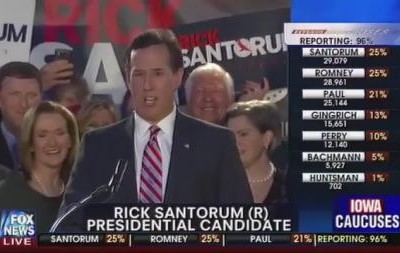
With his near-win in Iowa and his recent rise in the polls, Republican presidential candidate Rick Santorum is facing new scrutiny about his views on intelligent design and evolution. Reporters and others have expressed particular interest in the so-called “Santorum Amendment” authored by Senator Santorum, which was adopted in revised form in the Conference Report of the landmark No Child Left Behind Act. A media backgrounder on Rick Santorum, evolution, and intelligent design is available to download at: http://www.discovery.org/a/18071.
The Santorum Amendment won overwhelming bipartisan support in the United States Senate. In fact, Sen. Ted Kennedy enthusiastically endorsed the Amendment on the Senate floor. Others voting in favor of the Amendment included Sen. Hillary Clinton, Sen. Joe Biden, Sen. Barbara Boxer, Sen. Harry Reid, Senator John McCain, and Senator Sam Brownback. (See Congressional Record, June 13, 2001, p. S6153.)
The Santorum Amendment did not mandate teaching intelligent design, nor did it encourage teaching creationism or religion in the classroom. Instead, it encouraged open discussion and inquiry by teachers and students of the evidence both for and against controversial scientific theories such as Darwin’s theory of evolution.
The approach advocated in the Santorum Amendment is favored by the vast majority of Americans, no matter what their race, gender, or political party. According to a nationwide Zogby poll in 2009, 80 percent of likely voters “agree that teachers and students should have the academic freedom to discuss both the strengths and weaknesses of evolution as a scientific theory.”
“Allowing discussions of all the scientific evidence about evolution in the classroom is good for students and good for science. It’s the mainstream approach supported by most Americans,” says Dr. John West, Associate Director of Discovery Institute’s Center for Science & Culture. “Those who are trying to put a gag order on teachers and students to insulate Darwin’s theory from critical inquiry are the real extremists.”
Quin Hilyer explains, in the pro-Romney National Review, of all places.
Excerpt:
On taxes, for instance, Santorum has always been superb. The Club for Growth’s white paper on Santorum, calling his tax stances “very strong,” confirms that “Santorum has consistently supported broad-based tax cuts and opposed tax increases either by sponsoring key legislation or by casting votes on relevant bills.”
His record on a host of other conservative issues is as solid as that of any politician in the past two decades. He has been firmly and repeatedly against all sorts of regulatory abuse, against McCain-Feingold and other restrictions on political speech, for school choice, for tort reform, for a strong military, and for a balanced-budget amendment.
Obviously he has been as stalwart a defender of social conservatism, for 20 full years, as any other public figure. And as virtually every conservative involved in the judicial wars during Santorum’s time in the Senate has confirmed, in person or in print, Santorum and his staff were the go-to people in the Senate when you needed to find tireless, committed advocates for conservative jurists. Santorum is, wrote Ed Whelan of the Ethics and Public Policy Center, “the candidate in whom I have by far the greatest confidence” in terms of how likely he would be “to appoint excellent Supreme Court justices and lower-court judges and to work tenaciously to get them confirmed.”
Meanwhile, as Santorum frequently (and entirely accurately) reminds anybody who will listen, his work on the single most important conservative policy reform of the past half century, the 1996 welfare-to-work effort that cut spending and poverty rates simultaneously, was seminal, indefatigable, and remarkably effective. Iowa’s Sen. Chuck Grassley explained to the Des Moines Register a week ago that he was unconvinced about welfare reform until Santorum paid him an office call and “took a lot of time to convince me of his point of view… The sincerity and effort that he has to get his point across in the presidential campaign is almost a total reflection of how he operated as a United States senator.” Grassley yielded and voted for reform.
More broadly, until Rep. Paul Ryan’s recent prominence, nobody in Congress has been as passionate and fearless an advocate for entitlement reform as Santorum. Medicaid block grants. Investment accounts for Social Security. Medicare payments controlled by the beneficiaries rather than third-party payers. Choice rather than government mandates. Indeed, Santorum was the first candidate this year to fully embrace Ryan’s proposed reforms — with this exception, as he reminded me in a phone interview on Thursday: “I’ve criticized Ryan on one thing: waiting ten years [for many of the reforms to kick in]. We can’t afford to wait. We’ve got to start now.”
[…]As for overall spending and his much-discussed history of support for “earmarks” (a position also shared by tightwad Ron Paul), conservative groups’ ratings show that Santorum was better than the average Republican, despite representing a state far bluer than those of most of his Republican colleagues. He demonstrated particular courage in his support for the Freedom to Farm Act and in frequent opposition to floor amendments that would have put additional spending in appropriations bills. Denizens of Capitol Hill in the 1990s fondly remember Santorum’s repeated use of a prop during floor debate called the “Spendometer,” which he used to make a persuasive (and entertaining) case against wasteful federal largesse.
Out of office, he vociferously opposed TARP, the various “stimulus” packages, and the bailouts of car companies and of Fannie Mae and Freddie Mac. All those stances were perfectly in line with the voting record he had established in the House and Senate.
Social conservative leader and former presidential candidate Gary Bauer will endorse Rick Santorum in South Carolina, he confirmed to The Hill on Saturday.
Bauer said that he didn’t want to get into the details of the endorsement since it was officially still embargoed, but confirmed his support and said he’ll work to get other social conservatives on board for Santorum.
“I want to do whatever I can to convince my colleagues that Sen. Santorum is the right man,” he told The Hill.
[…]Bauer has organized a Friday meeting with top social conservatives in Texas to see if they can coalesce behind one candidate. He said the point of the meeting is not to try to stop Mitt Romney from being the Republican nominee, but that he believes Santorum would be the best candidate to beat President Obama, as well as the best commander in chief.
It’s worth remembering what Rick Santorum did to encourage critical thinking in public school science education, too. This is good news for us who want to have evidence for and against things like naturalistic macro-evolution and anthropogenic catastrophic global warming presented to students. That’s above and beyond the basics of conservatism, right there – and he’s solid on school choice.
The best thing about Santorum, though, is that he has a working class background and he isn’t afraid to debate with people instead of just speaking about his beliefs and generalities. He tries to convince people, and to reason things out with them.
A new report by Pew Research Center shows that barely half — 51 percent — of adults in the United States are married. In place of marriage are nontraditional living arrangements — including cohabitation, single-person households, and single parenthood — that may likely continue. The share of adults who are currently married could drop to below half within several years.
While the report says it’s “beyond the scope of this analysis to explain why [emphasis mine] marriage has declined,” senior writer D’Vera Cohn adds this: “I’m struck by the fact that a large percentage of people who say that marriage is obsolete still want to get married. I think they may be having two ideas in their head at once: one about the institution of marriage and what its status is in society today, which is to say that it’s a lot less dominant, central, or important in society, [and another about] their own wishes for their future, in which they personally would very much like to be married.”
Indeed they do. But some major changes have to take place first.
[…][W]e must retract the message Boomers sent young women about female empowerment. Indeed, it isn’t a coincidence that marriage rates have plummeted alongside America’s fascination with the feminist movement. Empowerment for women, as defined by feminists, neither liberates women nor brings couples together. It separates them. It focuses on women as perpetual victims of the Big Bad Male. Why would any man want to get married when he’s been branded a sexist pig at “hello”? In the span of just a few decades, women have managed to demote men from respected providers and protectors to being unnecessary, irrelevant, and downright expendable.
[…]Women have also been raised by their feminist mothers to “never depend on a man.” As a result, couples no longer think of themselves as one unit but as separate entities sharing space. “The confusion over roles is there, as are the legacies of a self-absorbed, me-first, feminist-do-or-die, male-backlash society,” wrote Judith Wallerstein and Sandra Blakeslee in The Good Marriage: How and Why Love Lasts. Honestly, are we really surprised marriage is on the decline?
[…]There may be more than one reason Americans are delaying or eschewing marriage, but almost all of them can be attributed to feminism. Feminists assured women their efforts would result in more satisfying marriages, but that has not happened. Rather, women’s search for faux equality has damaged marriage considerably (some might say irrevocably, but I’m an optimist) by eradicating the complementary nature of marriage — in which men and women work together, as equals, toward the same goal but with an appreciation for the unique qualities each gender brings to the table. Today, men and women are locked in a battle. The roles have changed too drastically, and the anger runs deep.
I don’t know about you, but I don’t call that progress.
You know something? Women can’t neglect the roles of men in a marriage and then expect to get married to a man. That is going to come to a shock to a lot of feminists who think that they can act selfishly and men will still continue to woo them and marry them and love them faithfully for life. Men have noticed that feminists are no longer interested in being wives and mothers. And that feminsts are no longer respecting men for their traditional roles as protectors, providers and moral/spiritual leaders. Feminists don’t want men who earn and save – that’s bad because men who earn and save have authority to make decisions, unless the woman works too. They don’t want men who can use guns to defeat burglars and use reason and evidence to defeat lies – that’s bad because guns and truth are scary. They don’t want men who make moral judgments and exclusive theological statements – that’s bad because moral judgments and exclusive theological statements can hurt people’s feelings, and make women less popular with her friends.
According to feminists, men are supposed to be fun, funny and sexy! They should provide drama and turmoil – not stability. It’s the government’s job to provide, protect and lead. Men should be replaced by welfare checks, policemen and universal public school education for children – from birth to adulthood. But all of those views are completely opposed to marriage – so why do feminists think that are suitable for marriage? What man in his right mind would consider marriage to a feminist? Marriage isn’t when a woman does whatever she feels like all the time, and neglects her husband and children. Marriage means that women take care of their husbands and children, and in return husbands take care of their wives and children, too.

 WINTERY KNIGHT