
Category Archives: Commentary

Did your science textbook teach that peppered moths prove evolution?

Here’s a post by Jonathan Wells at Evolution News, which re-caps the history of the peppered moths experiment.

Excerpt: (links removed)

The peppered moth story is familiar — even overly familiar — to most readers of ENV, so I will summarize it only briefly here. Before the industrial revolution, most peppered moths in England were light-colored; but after tree trunks around cities were darkened by pollution, a dark-colored (“melanic”) variety became much more common (a phenomenon known as “industrial melanism”). In the 1950s, British physician Bernard Kettlewell performed some experiments that seemed to show that the proportion of melanic moths had increased because they were better camouflaged on darkened tree trunks and thus less likely to be eaten by predatory birds.

Kettlewell’s evidence soon became the classic textbook demonstration of natural selection in action — commonly illustrated with photos of peppered moths resting on light- and dark-colored tree trunks.

By the 1990s, however, biologists had discovered several discrepancies in the classic story– not the least of which was that peppered moths in the wild do not usually rest on tree trunks. Most of the textbook photos had been staged.

In the 2000s the story began disappearing from the textbooks. British biologist Michael Majerus then did some studies that he felt supported the camouflage-predation explanation. But before he died of cancer in 2009, he only managed to publish a report of his study in the Darwin lobby’s in-house magazine Evolution: Education and Outreach. Now four other British biologists have presented his results posthumously in the Royal Society’s peer-reviewed Biology Letters. In an accompanying supplement, the authors presented their version of what they call “the peppered moth debacle.” And a debacle it certainly is, but not in the way they think.

According to Charles Darwin, natural selection has been “the most important” factor in the descent with modification of all living things from one or a few common ancestors, yet he had no actual evidence for it. All he could offer in The Origin of Species were “one or two imaginary illustrations.” It wasn’t until almost a century later that Kettlewell seemed to provide “Darwin’s missing evidence” by marking and releasing light- and dark-colored moths in polluted and unpolluted woodlands and recovering some of them the next day. Consistent with the camouflage-predation explanation, the proportion of better-camouflaged moths increased between their release and recapture.

Throughout the 1970s and 1980s, however, researchers reported various problems with the camouflage-predation explanation, and in 1998 University of Massachusetts biologist Theodore Sargent and two colleagues published an article in volume 30 of Evolutionary Biology concluding “there is little persuasive evidence, in the form of rigorous and replicated observations and experiments, to support this explanation at the present time.” (p. 318)

The same year, Michael Majerus published a book in which he concluded that evidence gathered in the forty years since Kettlewell’s work showed that “the basic peppered moth story is wrong, inaccurate, or incomplete, with respect to most of the story’s component parts.” (p. 116) In a review of Majerus’s book published in Nature, University of Chicago evolutionary biologist Jerry Coyne wrote: “From time to time, evolutionists re-examine a classic experimental study and find, to their horror, that it is flawed or downright wrong.” According to Coyne, the fact that peppered moths in the wild rarely rest on tree trunks “alone invalidates Kettlewell’s release-and-recapture experiments, as moths were released by placing them directly onto tree trunks.”

In 1999, I published an article in The Scientist summarizing these and other criticisms of the peppered moth story, and in 2000 I included a chapter on peppered moths in my book Icons of Evolution. Then, in 2002, journalist Judith Hooper published a book about the controversy titled Of Moths and Men. Hooper accused Kettlewell of fraud, though I never did; my criticism was directed primarily at textbook writers who ignored problems with the story and continued to use staged photos even after they were known to misrepresent natural conditions.

Jonathan has actually written about a number of  misleading things that you may mind in Biology textbooks.

Here are the sections in his book “Icons of Evolution“:

  • The Miller-Urey Experiment
  • Darwin’s Tree of Life
  • Homology in Vertebrate Limbs
  • Haeckel’s Embroys
  • Archaeopteryx–The Missing Link
  • Peppered Moths
  • Darwin’s Finches
  • Four-Winged Fruit Flies
  • Fossil Horses and Directed Evolution
  • From Ape to Human: The Ultimate Icon

Dr. Wells holds a Ph.D in Molecular and Cell Biology from the University of California at Berkeley.
Don Johnson: six reasons why people reject Christianity

Here’s a post on practical evangelism by Christian scholar Don Johnson.

His list of reasons why people often reject Christianity:

  1. Christians behaving badly
  2. Disappointment with God
  3. Weak or absent father
  4. Social pressure
  5. Cost of discipleship
  6. Immorality (especially sexual immorality)

And here’s the detail on #6:

Of all the motivations and reasons for skepticism that I encounter, immorality is easily the most common. In particular, sexual sin seems to be the largest single factor driving disbelief in our culture. Brant Hanson calls sex “The Big But” because he so often hears this from unbelievers: “’I like Jesus, BUT…’ and the ‘but’ is usually followed, one way or the other, with an objection about the Bible and… sex. People think something’s deeply messed-up with a belief system that says two consenting, unmarried adults should refrain from sex.” In other words, people simply do not want to follow the Christian teaching that sexual intercourse should take place only between and man and woman who are married, so they throw the whole religion out.

The easiest way to justify sin is to deny that there is a creator to provide reality with a nature, thereby denying that there is any inherent order and purpose in the universe.

Aldous Huxley admitted that this is a common reason for skepticism:

I had motives for not wanting the world to have a meaning; consequently I assumed that it had none and was able without any difficulty to find satisfying reasons for this assumption…. Those who detect no meaning in the world generally do so because, for one reason or another, it suits their books that the world should be meaningless. …

For myself as, no doubt, for most of my contemporaries, the philosophy of meaninglessness was essentially an instrument of liberation. The liberation we desired was …liberation from … a certain system of morality.  We objected to the morality because it interfered with our sexual freedom…. There was one admirably simple method in our political and erotic revolt: We could deny that the world had any meaning whatsoever. Similar tactics had been adopted during the eighteenth century and for the same reasons. (Ends and Means, 270-273)

Indeed, similar tactics have been used extensively up to the present day. If you are looking for two great resources that document the extent to which the work of the world’s “great” atheistic thinkers has been “calculated to justify or minimize the shame of their own debauchery,” (Spiegel, 72) I recommend Intellectuals by Paul Johnson and Degenerate Moderns: Modernity as Rationalized Sexual Misbehavior by E. Michael Jones. The bottom line is that these skeptical scholars didn’t reach their conclusions by following the evidence where it led. They didn’t “discover” that the world was meaningless and then proceed to live accordingly. They lived sinful lives (usually involving some type of sexual deviancy) and then produced theories that justified their actions.

It’s important to understand that an atheist is not identical to a Christian, except not religious. There is something else going on in their minds when they reject very obvious evidences like the origin of the universe, the cosmic fine-tuning, the origin of life, the Cambrian explosion, the habitability arguments, etc. The something else that is going on is hinted at when you look at atheist attitudes to abortion. According to a recent survey of atheists, 97% of them were pro-abortion!

What kind of person likes abortion? The kind of person who wants to be sexually active with no consequences, even if it means taking someone else’s life. The desire to do as they please and retreat from obligations to others is the key. Now dispensing with God and his obligations is not an unreasonable view if there is no evidence for God, but it does provide a motive for people to not look for that evidence if happiness is their main goal. When I discuss these issues with atheists, I find that no work has been done to read anything. Not even debates, where there are two sides. They don’t want to hear the case for Christian theism, and they work hard to avoid stumbling across it by accident, too.

God and the cosmic authority problem

Tough Questions Answered has a quote from Christian philosopher Paul Moser that I think is relevant:

It would be a strange, defective God who didn’t pose a serious cosmic authority problem for humans.  Part of the status of being God, after all, is that God has a unique authority, or lordship, over humans.  Since we humans aren’t God, the true God would have authority over us and would seek to correct our profoundly selfish ways.

So we’re not dealing with unbiased truth-seekers here. The goal might not always be sex, but let’s be honest. Who wants to have to spend time reading the Bible, praying, going to church and reading thick books by Stephen C. Meyer, Michael Licona and Hugh Ross so that we can answer questions? No one. Who wants to give up premarital sex so that we can create a stable marriage for children so they can grow up in a safe place where knowing God is natural and easy? No one. We just don’t want to have to do stuff for God, even if it’s good stuff. We don’t want to have build a life that is a testament to God’s existence and character, especially if it means that other people will think that we are weird and maybe even a bit mean. We want to do what we want to do instead, and be liked by other people.

That’s the real challenge of Christianity: setting aside what you wanted to do, and letting God be your customer, instead. You’d be surprised how many Christians aren’t comfortable with the idea of serving God and being viewed in a bad way by non-Christians. They aren’t OK with the self-sacrifice, and they are really not OK with the social disapproval. It’s hard to be chaste, and to be known to be chaste by your peers, for example. Much easier to just give in and do what everyone else is doing.

Let’s illustrate with C.S. Lewis

And here’s a relevant quote from C.S. Lewis’ “The Screwtape Letters” to illustrate:

You must have often wondered why the enemy [God] does not make more use of his power to be sensibly present to human souls in any degree he chooses and at any moment. But you now see that the irresistible and the indisputable are the two weapons which the very nature of his scheme forbids him to use. Merely to over-ride a human will (as his felt presence in any but the faintest and most mitigated degree would certainly do) would be for him useless. He cannot ravish. He can only woo. For his ignoble idea is to eat the cake and have it; the creatures are to be one with him, but yet themselves; merely to cancel them, or assimilate them, will not serve…. Sooner or later he withdraws, if not in fact, at least from their conscious experience, all supports and incentives. He leaves the creature to stand up on its own legs—to carry out from the will alone duties which have lost all relish…. He cannot “tempt” to virtue as we do to vice. He wants them to learn to walk and must therefore take away his hand…. Our cause is never more in danger than when a human, no longer desiring, but still intending, to do our enemy’s will, looks round upon a universe from which every trace of him seems to have vanished, and asks why he has been forsaken, and still obeys.

— Uncle Screwtape, in The Screwtape Letters

I’m not a big fan of Lewis, but I think he is onto something there. That’s really what the Christian life is like, and no wonder more people don’t choose it. Who wants to do your duty for God, as part of a relationship with him, in a universe that seems so unfair? It’s a tall order, and most people prefer to do their own thing instead of building something nice for God with their lives.

Woman who had sex with 18 different men shocked that men don’t want to marry her

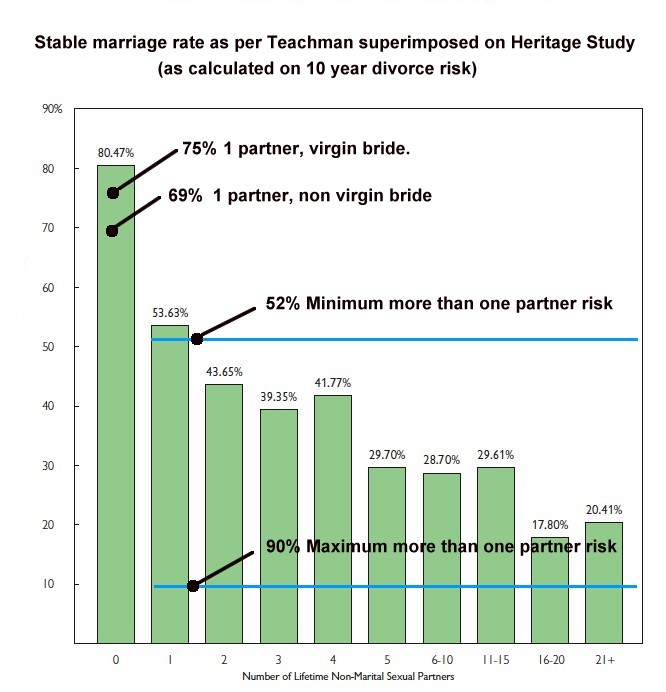
Does being a virgin before marriage affect marital stabilitity?
Does being a virgin before marriage affect marital stability?

Sunshine Mary linked to a post from Reddit by a 32-year old “progressive” woman who is surprised that 15 years of sleeping around with 18 different guys is not attractive to marriage-minded men.

Excerpt:

My parents are first generation immigrants. I have a younger brother and younger sister. In my family I was always the rebellious one; I would often challenge my parents. My family was very strict, when it came to dating and my siblings usually fell in line. However, I would challenge that norm.

My brother and sister were very repressed with their sexualities as a result, while I lost my virginity at 17 to my then boyfriend. While my brother and followed the traditional Indian path. My brother ended up not having any sexual contact with a girl until he got married at 25 (arranged marriage) and now they have a child together. My sister (too never kissed a boy) has recently gotten married too at 24 with an Indian boy she met at our Temple (both parents approved).

I live in LA, a city where both men and woman tend to marry a bit later in life, and yet I still spent the last years of my 20‘s feeling that somehow, I’d messed up. I had followed the wrong trail and thus, my “important-life-moments” timeline was off. Even with my more progressive friends it began slowly at first, when I was 27 … an engagement post on Facebook, an invite to a wedding—it was happening. People I knew were beginning the next stage of life and saying “I do.”

Throughout my whole life I never really dated any Indian guys; I exclusively dated white guys. However now I realize more than ever that the guys I dated never really took me seriously. They never really viewed me as someone they would eventually marry. I was always just some exotic fun. This part was definitely a realization that has hurt me to the core. I didn’t actually do it to spite Indian men or anything like that. I did what a lot of my white female friends did; I thought I was the same as them, but that could be farther from the truth. Most white guys I ran into wanted white wives.

I am now 32, and seems like everyone in my family has lapped me. I too want a family a marriage. However, now my chance of finding someone is gone. At my age getting an arranged marriage or finding another Indian man to marry me is out of the question. Majority of Indian guys usually get married pretty early. Often either to another Indian girl they meet here, or they go back to India for an arranged marriage. My parents have tried signing me up for a matrimony site, but of the guys I’d meet they would be turned off by my history (drink/eat meat/not a virgin).

[…]Most of my relationships have been long term I have only been with 18 guys and I have been sexually active since I was 17 years old.

She has only had steady sexual relationships with 18 guys in 15 years! That’s not a lot. Is it?

Let’s see what Sunshine Mary says first:

However, the more I think about it, the more it seems to me that articles like hers are a good thing simply because they expose the lie.  Feminists have sold young women a bill of goods, that they can live like men, work like men, have sex like men, and then turn back into women when they feel like it.  We laugh at a woman like this sometimes and make fun of her and say, “Didn’t she know that she’d end up like this?”

No, she didn’t know that.  That’s because when you are 17 years old, you don’t know much, especially in this culture of extended adolescence.  And when you have been told from a very young age that, as a girl, it is your destiny to Have It All exactly When You Want It, I’m sure it is very baffling to find yourself in your thirties with no husband and none in sight, with the dawning realization that your job and lonely apartment are not nearly as fulfilling as being a wife and mother would have been.

[…]Personally, I feel no joy in this woman’s pain.  I don’t think a White Knight should ride in to save her because I think she should suffer the natural consequences of her decisions so that other young women may see and learn from her errors, but I take no pleasure in the fact that she will have this lot in life.  However, what most of us don’t seem to understand is that young women make the terrible choices that they are making because they are told from an early age that these are actually good choices.  Some girls are able to resist that message, which saturates every aspect of the media and schools, but most girls aren’t, and they don’t develop the necessary wisdom until it is too late.

Emphasis hers. And now my turn.

Let me tell you what I think awaits a man who marries a woman like that, who spent her 20s hooking up with hot guys who had no interest in marriage and no demonstrated ability to protect, provide and lead on moral/spiritual issues. She will have convinced herself that she is more attractive than she really is because in her mind she deserves a man as attractive as these men. What other criteria is there for a man? It’s all appearances. I therefore do not recommend that any man marry this woman as she is now. What men need in marriage is respect, affection, affirmation and approval. A woman with a background like this will not have the trust and vulnerability that a marriage-minded man wants. The only way to fix this shattered trust is a long period of chastity. She must choose to form relationships with good protector / provider / moral leader / spiritual leader men and to support those men. That is the only way to fix the damage of promiscuity, if it even can be fixed.

A man can sense how trusting and vulnerable a woman is by how much she trusts and encourages him in his plans. If a woman is constantly putting him down, calling him names, and making excuses for why she doesn’t have to care about his needs and feelings, then that’s just her past promiscuity showing itself. Virgins with good relationships with their fathers don’t put men down like that – they choose good men who are doing good things and they build them up. My recommendation for women who realize that they are making bad choices with men and being negative about the men they choose is to look in the mirror and acknowledge that they are the problem. The solution, then, is to find a good man and work hard at being submissive and supportive, but chastely. Stop choosing men with motorcycles. Stop choosing atheists. Stop choosing drunkards. Stop choosing men who are pro-abortion and pro-gay-marriage. Stop choosing men who want bigger government. Just stop it.

That’s the advice I would give this woman. Choose men who can do the work that men do in a marriage. Find out what a man’s plan is. Build the skills he needs for his plan. Marry him.