
All posts by Wintery Knight

https://winteryknight.com/

Are all sins equally bad? Or are there degrees of severity for different sins?

Bible study that hits the spot

This question came up recently so I did some digging on theology web sites to find what Bible verses applied to the question.

Here’s what Ligonier said:

It’s clear that we have different degrees of sin when we consider the warnings of Scripture. There are at least twenty-two references in the New Testament to degrees of rewards that are given to the saints in heaven. There are different levels, different rewards, and different roles in heaven. The Bible warns us against adding to the severity of our judgment. Jesus said to Pontius Pilate, “He who delivered me over to you has the greater sin” (John 19:11). Jesus measures and evaluates guilt, and with the greater guilt and greater responsibility comes the greater judgment. It’s a motif that permeates the New Testament.

The idea of gradation of sin and reward is based upon God’s justice. If I commit twice as many sins as another person, justice demands that the punishment fits the crime. If I’ve been twice as virtuous as another person, justice demands that I get more of a reward. God tells us that entrance into heaven will be only on the basis of the merit of Christ, but once we get to heaven, rewards will be dispensed according to works. Those who have been abundant in good works will receive an abundant reward. Those who have been derelict and negligent in good works will have a small reward in heaven. By the same token, those who have been grievous enemies of God will have severe torments in hell. Those who have been less hostile will have a lesser punishment at the hands of God. He is perfectly just, and when He judges, He will take into account all of the extenuating circumstances. Jesus said, “I tell you, on the day of judgment people will give account for every careless word they speak” (Matt. 12:36).

A while back, my friend Dina sent me a sermon where that exact passage (John 19) was brought up by the pastor.

I think the correct position is that any sin is enough to separate you from God, but some sins are more severe than others in God’s objective standard of right and wrong.

OK, that was fine and good, but then I noticed a few days later that Michael Krueger had also blogged about this “all sin are equal” view, too.

Krueger says this:

First, to say all sins are the same is to confuse the effect of sin with the heinousness of sin.  While all sins are equal in their effect (they separate us from God), they are not all equally heinous.

Second, the Bible differentiates between sins. Some sins are more severe in terms of impact (1 Cor 6:18), in terms of culpability (Rom 1:21-32), and in terms of the judgment warranted (2 Pet 2:17;  Mark 9:42; James 3:1).

Even more Bible references, so we’re not on the wrong track.

So then why do some people insist that all sins are equal? It turns out that it is coming from the secular ideal of non-judgmentalism.

Krueger explains:

We should begin by observing that this phrase does not come from Scripture.  People do not use it because it appears in the Bible. Why then do they use it?

One reason, as noted above, is that some Christians use this phrase to uphold the seriousness of sin. It is viewed as a way to remind people not to be dismissive about their sin or regard it is a triviality.

Others use this phrase as way to “flatten out” all sins so that they are not distinguishable from each other.  Or, to put it another way, this phrase is used to portray all human beings as precisely the same.  If all sins are equal, and all people sin, then no one is more holy than anyone else.

In a world fascinated with “equality,” this usage of the phrase is particularly attractive to folks. It allows everyone to be lumped together into a single undifferentiated mass.

Such a move is also useful as a way to prevent particular behaviors from being condemned.  If all sins are equal, and everyone is a sinner, then you are not allowed to highlight any particular sin (or sinner).

Needless to say, this usage of the phrase has featured largely in the recent cultural debates over issues like homosexuality.  Yes, homosexuality is a sin, some Christians reluctantly concede.  But, they argue, all sins are equal in God’s sight and therefore it is no different than anything else.  Therefore, Christians ought to stop talking about homosexuality unless they are also willing to talk about impatience, anger, gluttony, and so on.

Krueger also posted this fascinating follow up post, where he looks at how the phrase is being used by people on Twitter.

Look at these tweets:

  • All sins are equal. People tend to forget that. There is no bigger or smaller sin. Being gay and lying, very equal.

  • all sins are equal in God’s eyes. whatever you’re doing, is no better than what someone else is doing.

  • If you have sex before marriage please don’t come on social media preaching about the wrongs of homosexuality. All sins are equal

  • Need people to realize that all sins are equal… don’t try to look down on me or question my faith just cuz you sin differently than I do.

  • Don’t understand why you’re so quick to judge me, when all sins are equal. So much for family..

  • if you think being gay is a sin, let me ask you something, have you not done anything wrong in your life? all sins are equal. we’re sinners

  • Nope no difference at all. All sins are equal no matter what you’re running for. The bible says do not judge lest ye be judged

  • A huge problem I have with religion is the notion that all sins are equal. Like pre-martial sex and murder are the same amount t of bad.

  • people do bad things because they believe that all sins are equal and ~god~ loves y’all equally so he’s going to forgive you naman ha ha ha

  • It a sin to condemn another sinner and their actions. All sins are equal. So what makes you better than the person you’re condemning?

  • I think so b/c having sex before marriage doesn’t make you less of a women then if you waited until marriage.. all sins are equal soo

  • friendly reminder, all sins are equal in gods eyes so you’re not better than I am in any way. please worry about your own sins before mine.

  • People don’t like when I suggest abortion as an option. This is a free country and all sins are equal so mind your business!!!

  • What I do is no worse than wat you do… all sins are equal no matter what it is… a sin is a sin

  • to god all sins are equal so you have no right to compare your sins to someone else’s bc in the end it doesn’t matter

The first thing that I noticed is that premarital sex and homosexuality are the most popular sins. I would think that divorce and abortion would be up there in the rankings, as well.

Something strange has happened in our society such that more and more people want to be led by their feelings, rather than be bounded by rules or standards. When people get caught breaking moral rules, rather than be accountable, they attack the person judging them. They would rather escape the judgment of their peers than admit fault and try to fix the mistake, and do better next time.

It’s so bad now, that the people who have morals and who make moral judgments are seen as the real bad people. The immoral people are on the offense, and even trying to ban people from being able to disagree with them. We’re seeing that with people who are being attacked for defending natural marriage against divorce and redefinition of marriage. In France, they want to make speech critical of abortion a criminal offense. And in Canada, they’ve now made speech critical of the gay agenda a criminal offense. (It’s already a human rights tribunal offense)

What is even more interesting is when the people who push the “don’t judge me” line try to justify it from the Bible. Very strange, but we seem to have forgotten the value of setting moral boundaries. Now moral boundaries are “evil”. Instead, having compassion for people who break the moral boundaries and harm themselves and others is “good”.

Large-scale UK study confirms the importance of fathers to children

A family praying and reading the Bible

Dina sent me this article from the UK Daily Mail.

Excerpt:

A father’s love is as important to a child’s emotional development as a mother’s, a large-scale study has confirmed.

Examining the cases of more than 10,000 sons and daughters revealed how a cold or distant father can damage a child’s life, sometimes for decades to come.

The review of 36 studies from around the world concluded that his love is at least as important to youngsters as that of their mothers.

Researcher Professor Ronald Rohner said that fatherly love is key to  development and hopes his findings will motivate more men to become involved in caring for their offspring.

‘In the US, Great Britain and Europe, we have assumed for the past 300 years that all children need for normal healthy development is a loving relationship with their mother,’ he said.

‘And that dads are there as support for the mother and to support the  family financially but are not required for the healthy development of the children.

‘But that belief is fundamentally wrong. We have to start getting away from that idea and realise the dad’s influence is as great, and sometimes greater, than the mother’s.’

His conclusions came after he examined data from studies in which  children and adults were asked how loving their parents were.

Questions included if they were made to feel wanted or needed, if their  parents went out of their way to hurt their feelings and if they felt loved.

Those taking part also answered questions about their personality. These ranged from ‘I think about fighting or being mean’ to ‘I think the world is a good, happy place’.

Tallying the results showed that those rejected in childhood felt more anxious and insecure as well as hostile and aggressive.

Many of the problems carried over into adulthood, reported the study published in the journal Personality and Social Psychology Review.

Crucially, a father’s love was often just as important as a mother’s. In some cases, it was even more so. One reason for this may be that rejection is more painful when it comes from the parent the child regards as more powerful or respected.

You can read more about how fatherlessness damages children here.

I think the first question we should ask the people who want to redefine marriage is this: “which parent to do you think that a child can do without? the mother or the father?”. We must do everything we can as a society to keep both of a child’s natural parents in the home while the child grows up. If we really care about children, then we should prefer to meet their needs, even if the grown-ups have to be a bit more responsible in their decision making. if the conflict is between innocent children and selfish grown-ups, then the children should win.

We need laws and policies that promote traditional marriage, not laws and policies that break it down and destroy it. Repealing no-fault divorce, lowering subsidies for single motherhood, and making shared parenting the default position, would all help solve the problem. Policies like school choice and lower corporate tax rates helps men to be able to perform in their role as provider. We have to be practical and ask: “what makes men capable of marriage and parenting?” If we want strong fathers, then it makes sense to ask how to make fatherhood more reasonable: what do men need in order to do what we want them to do?

Christians should be especially concerned about the presence of fathers, given the evidence I blogged about before showing how the presence of quality fathers is essential for passing Christian beliefs on to children. Churches need to ask themselves tough questions: Are we teaching women how to choose men based on practical concerns and proven abilities in our churches? And are we doing a good job of attracting men to churches by promoting the masculine, practical aspects of Christianity that men like – like science, apologetics debates, economics and foreign policy?

Moderate senator Lindsey Graham rips Democrats for unfair treatment of Kavanaugh

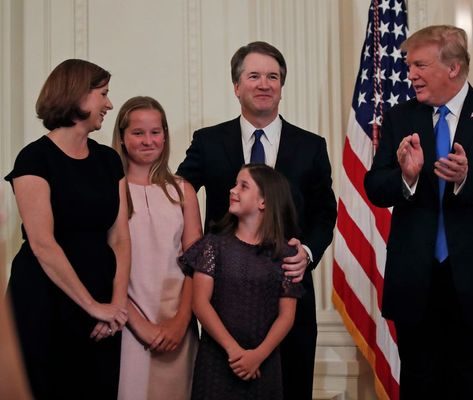
Brett Kavanaugh, his wife, and his two daughters

Democrats have accused Kavanaugh of drugging and raping women, participating in gang rapes and operating a gang-rape ring (when he was a high school student). I tweeted a lot about the hearing on Thursday, but the comments of Lindsey Graham, a moderate centrist Republican, was the best response to the Democrat’s charges against Kavanaugh.

First, here is a good sample of how the Democrats questioned Kavanaugh during the hearing, to evaluate his suitability for the Supreme Court of the United States of America: (5 minutes)

Kavanaugh threw up too much, farted too much, etc. when he was 16 years old.

Senator Lindsey Graham also questioned Kavanaugh: (5 minutes)

He’s so angry that his thoughts are all jumbled up. But you can get the basic idea of what he’s saying.

Real Clear Politics had the transcript, here’s some of it:

SEN. LINDSEY GRAHAM (R-SC): If you wanted an FBI investigation, you could have come to us. What you want to do is destroy this guy’s life, hold this seat open and hope you win in 2020. You’ve said that, not me.

[…]This is the most unethical sham since I’ve been in politics. And if you really wanted to know the truth, you sure as hell wouldn’t have done what you’ve done to this guy.

[…]Boy, you all want power. God, I hope you never get it. I hope the American people can see through this sham.

That you knew about it and you held it. You had no intention of protecting Dr. Ford. none. She’s as much of a victim as you are.

God, I hate to say it because these [Democrats] have been my friends, but… [t]his is going to destroy the ability of good people to come forward because of this crap. Your high school yearbook. You have interacted with professional women all your life, not one accusation. You’re supposed to be Bill Cosby when you’re a junior and senior in high school. And all of a sudden you got over it. It’s been my understanding that if you drug women and rape them for two years in high school, you probably don’t stop.

[…]To my Republican colleagues: If you vote no, you are legitimizing the most despicable thing I have seen in my time in politics.

I listened to reactions from people like Dana Loesch, Buck Sexton and Matt Walsh to Lindsey Graham on their podcasts, and they were as shocked as  I was. This is the guy who, throughout his career, bent over backwards to cut compromise deals with Democrats in the Senate. He’s been  centrist moderate as a Republican senator. I have nothing good to say about him. I supported his last primary challenger, and was disappointed when Graham won the primary.

So I really have no idea what is going on here – this is the last thing I would have expected from Graham. But it does tell you something about how unfair the Kavanaugh hearings were.

Here is Senator Graham sounding less angry, and more coherent, talking to the news media – the same news media that fawned over his RINO actions for so many years: (5 minutes)

PJ Media summarized the video above:

“I feel ambushed,” Graham told reporters at the conclusion of the hearing this afternoon.

“When it comes to where it happened,” Graham said, “I still don’t know. I don’t know when it happened. She says she’s 100% certain it did happen. I bet you Judge Kavanaugh will say I’m 100% sure I didn’t do it.”

He said the people named by Ford as corroborating witnesses “don’t know what Ms. Ford’s talking about.” In addition, “She can’t tell how she got home and how she got there and that’s the facts I’m left with. A nice lady who has come forward it to tell a hard story that’s uncorroborated.”

“And this is enough, ” he said. “God help anybody else who gets nominated,” Graham continued. “Based on what I heard today, you could not get a search warrant or an arrest warrant because you don’t know the location, you don’t know the time, you don’t have any corroboration.”

Graham said all he heard today was a bunch of speeches from politicians who have politicized the confirmation process..

The South Carolina senator, who has a background as a prosecutor and a judge, said, “I didn’t find her allegations to be corroborated against Mr. Kavanaugh. I don’t doubt something happened to her… but she can’t tell me the house, the city, the month of the year.”

“When you have a emotional accusation and an emotional denial,” he explained, “you use the rule of law, the presumption of innocence attaches to the person accused. You have to give them… time and location. You ask is there anybody to verify this, and when you give hames all of them goes the other way.”

Asked about whether Graham thought there should be a full investigation, the visibly angry Graham said, “If you really believe we needed an investigation for this, why didn’t you tell us in August? The FBI is going to tell us what? What house are they going to go to? What city are they going to go to? Who are they going to talk to because they can’t tell us the month, barely the year.”

“This is all delay” on the part of Democrats, he told reporters. “I’m not going to reward people for playing a political game.” He said Ford “is just as much a victim as, I think, Brett Kavanaugh. Somebody betrayed her trust. And we know who she gave the letter to and the people that betrayed her trust, they owe her an apology.”

There were not enough specific details in Ford’s testimony to warrant a search warrant, an arrest warrant, or any further investigation. In any case, the Democrats had the allegations in July, but they didn’t ask for an investigation then, because they wanted to drag out the confirmation process past the mid-terms.

The Senate Judiciary Committee vote on Kavanaugh is scheduled for Friday morning, a full Senate procedural vote on Saturday, and the full Senate confirmation vote on Tuesday. Already, Bob Corker, who was on the fence about Kavanaugh has tweeted that he will support Kavanaugh. A tweet from a reporter from The Atlantic suggests that Democrat Joe Manchin will do the same. A tweet from a Washington Post reporter Friday morning says Jeff Flake will vote for Kavanaugh. We’re still waiting to hear from center-left Republican senators Lisa Murkowski and Susan Collins, as well as red-state Democrats Joe Donelly and Heidi Heitkamp.

More Lindsey Graham on video here. (8 minutes)