All posts by Wintery Knight

https://winteryknight.com/

Michael Egnor asks atheist P.Z. Meyers about the New Atheism worldview

First, I should say that if you don’t know who P.Z. Myers is, you should know that he is an incredibly arrogant and vulgar internet atheist. He is very popular on the Internet with atheists because of his foaming-at-the-mouth, howling-at-the-moon ranting against intelligent design, theism in general and Christianity in particular.

Anyway, Myers is interviewed by Michael Egnor, a neurosurgeon and professor of pediatrics, who appeared in the movie “Expelled”. He asks P.Z. Myers questions about the New Atheism, then comments on Myers’ answers. (H/T ECM)

Here are the questions:

  1. Why is there anything?
  2. What caused the Universe?
  3. Why is there regularity (Law) in nature?
  4. Of the Four Causes in nature proposed by Aristotle (material, formal, efficient, and final), which of them are real? Do final causes exist?
  5. Why do we have subjective experience, and not merely objective existence?
  6. Why is the human mind intentional, in the technical philosophical sense of aboutness, which is the referral to something besides itself?
  7. Does Moral Law exist in itself, or is it an artifact of nature (natural selection, etc.)
  8. Why is there evil?

Myers’ answers are short and betray an incredible ignorance of the philosophical issues.

Here’s TWO of the eight answers and Egnor’s responses:

1) Why is there anything?

Myers: 
 Nothing is unstable.

Egnor: “Nothing” is not unstable. Nothing is not stable. Nothing is not metastable, nor hypostable, nor quasi-stable. Nothing is nothing. Nothing has no properties. “Nothing is unstable” is gibberish. Hence its central place in New Atheist atheology. If by “nothing” Myers is referring to the emergence of matter by quantum fluctuations (today’s trendy New Atheist evasion of theism), I observe that a quantum field isn’t “nothing.” A quantum field is very much something, in need of explanation. A quantum field gives rise to particles, not to itself. You have to explain the existence of the quantum field. Nice try. The question “why is there anything” is fundamental. The classical theist answer is that God’s essence is His existence, and He is the ground of existence. Note that God (as understood classically) does not need explanation or cause. The uncaused nature of God is demonstrated, not stipulated, by classical theism (see Aristotle’s Prime Mover argument and Aquinas’ First, Second, and Third Ways). Furthermore, the Prime Mover argument (Aquinas’ First Way) demonstrates that God’s existence is necessary even if the universe was eternal and had no beginning; His existence is necessary for existence of the universe at every moment. New Atheists don’t understand the question, don’t understand the terminology, and don’t understand their own rudimentary logical contradictions. New Atheist ignorance doesn’t mean that classical theism is true; it merely means that New Atheism has nothing to say. But I sort of suspected that.

2) What caused the Universe?

Myers: Nothing caused it.

Egnor: “Nothing” doesn’t cause anything. Nothing is absence of existence. Nothing has no agency. “Nothing caused…” is an oxymoron.

Let’s look at coherent answers to the question. The basic cosmological argument is this: 1) Whatever begins to exist is caused by another 2) the Universe began to exist 3) The Universe was caused by another. Modus ponens. Something that begins to exist cannot cause itself, because that would mean that it was prior to itself, which is nonsense.

The universe began to exist 13.75 ± 0.17 billion years ago. So another caused it. The universe is nature, so its cause is super-nature-al (sometimes the hyphens and the last ‘e’ are omitted). The supernatural cause of the universe is an insight provided by science and reason. Denial of a supernatural cause of the universe is denial of science (Big Bang Cosmology) and reason (elementary logic).

Let’s consider the alternatives:

1) Perhaps the universe was caused by a quantum fluctuation, a black hole, fecundity of a multiverse, ad nauseum (vide supra). But then the causation problem just shifts to the quantum field or the black hole or the multiverse. What caused the quantum field, or the maternal black hole, or the whole damn multiverse itself? You can’t change the subject.

2) Perhaps the word “cause” doesn’t apply to the universe at all. Perhaps the universe is a Kantian noumenon, not a phenomenon, and it’s not subject to the rules that govern the things we perceive (this was Kant’s gambit against the Cosmological Argument).

But if this is true, then the principle of sufficient reason is invalid. The principle of sufficient reason, for you New Atheists, is the principle that anything that happens does so for a reason. It’s the proposition that everything that begins to exist has a cause. If you deny the principle of sufficient reason to elide the inference to theism, then there is nothing wrong with asserting that lesser things in the universe (e.g. rabbits, hominids) popped into existence for no reason as well. If the whole shebang doesn’t need reason, no thing needs a reason. You can invoke “it’s uncaused” anytime. If you can shuck the principle of sufficient reason for the existence of the universe, you sure as hell can shuck the principle of sufficient reason for origin of species. POP. The universe exists. POP. Primordial prokaryotes exist. No need for OOL research. POP. Trilobites exist. No need for “natural selection” when you’ve got “uncaused existence.” POP. Whales exist. POP. Man exists. New Atheist creationism, with no need for God. No need for any explanations. Stuff just POPs into existence. POP POP POP. No need for evolutionary biologists.

If the universe doesn’t need a cause, no part of it needs a cause. Denial of the principle of sufficient reason is denial of logic, science, and history, all of it. Any surprise that New Atheists invoke it? They’d rather invoke nonsense than admit the obvious: there is a Cause.

I like to blog on the scientific research and the scientific evidence, but I still think that it is important to understand philosophical concepts like intentionality, final causes and the ontological foundations of morality. That’s table stakes for a comprehensive worldview. Science only provides you with experimental confirmation for premises in logically valid arguments. You can’t prove anything without an argument. And that requires at least some knowledge of logic and analytical philosophy.

You might also like to read the survey I gave some of the atheists I know and their horrible answers that show what atheists really think about truth and morality.

Atheists oppose science and evidence

Theists support science and evidence

Why are so many British feminists converting to Islam?

Mary sent me this article a while back about a trend of conversions to Islam by women in the UK.

Here’s an example story:

Women like Kristiane Backer, 43, a London-based former MTV presenter who had led the kind of liberal Western-style life that I yearned for as a teenager, yet who turned her back on it and embraced Islam instead. Her reason? The ‘anything goes’ permissive society that I coveted had proved to be a superficial void.

The turning point for Kristiane came when she met and briefly dated the former Pakistani cricketer and Muslim Imran Khan in 1992 during the height of her career. He took her to Pakistan where she says she was immediately touched by spirituality and the warmth of the people.

Kristiane says: ‘Though our relationship didn’t last, I began to study the Muslim faith and eventually converted. Because of the nature of my job, I’d been out interviewing rock stars, travelling all over the world and following every trend, yet I’d felt empty inside. Now, at last, I had contentment because Islam had given me a purpose in life.’

‘In the West, we are stressed for super­ficial reasons, like what clothes to wear. In Islam, everyone looks to a higher goal. Everything is done to please God. It was a completely different value system.

‘Despite my lifestyle, I felt empty inside and realised how liberating it was to be a Muslim. To follow only one god makes life purer. You are not chasing every fad.

‘I grew up in Germany in a not very religious Protestant family. I drank and I partied, but I realised that we need to behave well now so we have a good after-life. We are responsible for our own actions.’

For a significant amount of women, their first contact with Islam comes from ­dating a Muslim boyfriend. Lynne Ali, 31, from Dagenham in Essex, freely admits to having been ‘a typical white hard-partying teenager’.

She says: ‘I would go out and get drunk with friends, wear tight and revealing clothing and date boys.

‘I also worked part-time as a DJ, so I was really into the club scene. I used to pray a bit as a Christian, but I used God as a sort of doctor, to fix things in my life. If anyone asked, I would’ve said that, generally, I was happy living life in the fast lane.’

But when she met her boyfriend, Zahid, at university, something dramatic happened.

She says: ‘His sister started talking to me about Islam, and it was as if ­everything in my life fitted into place. I think, underneath it all, I must have been searching for something, and I wasn’t feeling fulfilled by my hard-drinking party lifestyle.’

Why is this happening? Why are women in the West choosing Islam? Is it because Islam is tested and found to be true?

I have a hypothesis, but I am open to hearing other ideas. I think that what these women are looking for is not really truth, but community and a system of rules that they can follow in order to feel accepted by the community and to feel less guilty about the mistakes they made in the past. It’s not like they are undertaking some survey of religions and evaluating each one based on logical and evidential criteria. It’s not like they watched debates and listened to multiple sides in conflict. No. It’s that they partied a lot, then felt guilty, then picked a religion with rules about prayer and dress, (easy things they can show off and talk about), that would make their guilt go away. They turned over a new leaf and their new community-approved behavior is giving them acceptance and self-esteem. Truth has nothing to do with their search, and they don’t think that anyone else’s view is “false” either. They have no intention of arguing for their new convictions with other faith communities to see whose view is true. The point of their conversion is NOT to be RIGHT, it’s to FEEL GOOD about themselves after all the bad things they did. Religion is really on the same level as yoga, vegetarianism, recycling or pilades – it’s about subjective experience and feelings not about objective truth.

I identify this phenomenon primarily with women, but many men do it too. I would say something like 70% of women and 30% of men have this subjective approach to religion. This is why I complain about the “feminization” of Christianity. But Biblical Christianity is not feminized – it’s not postmodern, it’s not relativistic and it’s not universalist. We Christians should not want to appeal to the felt needs of people looking for community and self-esteem. We are a community based on truth, not a community based on feelings and needs and emotions. If religion is nothing but community and emotions, then there is nothing special about Jesus. He’s just one flavor – you can choose him if you like him, but if you don’t like him then you aren’t rationally obligated (by arguments and evidence) to choose him. I am appalled some people think of religion this way. It annoys me intensely. They are treating religion as the search for handbag or a new pair of shoes – shopping therapy to assuage guilty feelings.

When I see people choosing their religion like these women, it really causes me to wonder what is really going on in our churches. Is that all we are – a country club where people sing and feel a sense of belonging to a community and that some untested spirit in the sky is taking care of them? I know that the Bible doesn’t sanction a subjective approach to religion, but what if the church gets feminized and just dumps the Bible and focuses on creating tolerant welcoming communities and self-esteem building? Do we really believe that these moral rules are authoritative, and that they reflect God’s character and his design for us – our moral obligations? What if we minimize truth and sin and Hell and just give people a country club where people can discuss the weather, vacations and their kids’ extracurricular activities, and sing songs together, and assuage their guilt over their mispent youths. I am not saying that Christians have to be morally perfect – but maybe we would project seriousness about these matters if we were a little more informed and a little more self-sacrificial.

The question I have is – why don’t Christians make a bigger deal about the importance of truth so they can distinguish Christianity from other religions, and why don’t we do a better job of explaining our moral rules, (e.g. – chastity, pro-life, pro-marriage), with real logic and real evidence? Maybe if we made our Biblical criteria (truth) known, then people who choose Islam would realize that they were just jumping at religions based on their personal preferences, and neglecting to ask which one is true. Maybe then we would have something to offer other than nice buildings, “non-judgmental” (moral relativist) people, and good worship songs that make people have happy feelings. I know that people actually choose churches based on superficial things like whether they like the building or the songs. It makes me sick. It makes me sick to think that atheists are looking at us and thinking that we are all just irrational weaklings mouthing words that we have no reason to believe, and adopting rules in order to feel good about ourselves. Do people in the church have any idea how this looks to outsiders? They’re not stupid. They can tell authentic Christians from fakes.

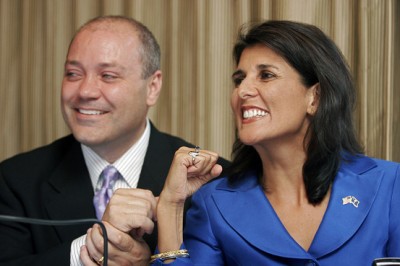
Tea party candidate Nikki Haley is the new governor of South Carolina

Nikki Haley and her husband Michael Haley

The Hindustan Times is awfully proud of our two Indian-American governors – Bobby Jindal and now Nikki Haley. (Both Republicans!)

Excerpt:

Parents of both Nikki Randhawa Haley, who on Tuesday won the governor’s election in South Carolina, and Bobby Jindal, the other Indian American governor of Lousiana, were born to immigrants from Punjab. Nikki Haley is the first woman and the second person of Indian origin after Bobby Jindal to become governor in the US. Jindal won the top job in Louisiana state in 2007.

[…]”I don’t do anything halfway – I’m in this race to win,” Nikki had told IANS in July taking time off her busy campaign for raising money.

“I am confident that come November, the people of South Carolina will send me to the Governor’s Mansion.

“When they (voters) do, I will immediately get to work to give them progress that makes them proud.”

Asked whether her Sikh background will matter in the race, she had said,”What matters most in South Carolina – and I imagine elsewhere in the country – is not the personalities of the candidates but the message they carry.

“Our message of bringing good government back to the people of this state, creating jobs by reforming our tax code so it’s flatter and fairer, and reminding government of the value of a dollar resonates with all the people of this state.

“I am very proud of my background and how I was raised. Just as in 2004 (when her opponents had raised the issue of background) I will hold my head up high and focus on what I can do for the people of this state.”

It seems to me that the Indian culture of hard work and family is a natural fit with conservative ideals.