All posts by Wintery Knight

https://winteryknight.com/

William Lane Craig meets the Reasons to Believe panel

Here’s the video: (106 minutes)

Host:

  • Kenneth Samples, philosopher

Panel:

  • Hugh Ross, astrophysicist
  • Dave Rogstad, astronomer
  • Jeff Zweerink, astrophysicist

Guest:

  • William Lane Craig, philosopher

Topics in the first hour:

  • is there a pro-theism/pro-Christian revolution going on in philosophy departments today?
  • is the revolution in philosophy spreading outside of the Anglo-American sphere?
  • has the progress of science hurt or helped the traditional theistic arguments?
  • is the epistemological argument from reason from Alvin Plantinga convincing?
  • what is the significance of the “heat death of the universe” for atheism?
  • can atheism rationally ground objective moral value and objective moral duties?
  • can atheists make any rationally-grounded moral judgments?
  • should Christians abandon rational arguments and evidence to appeal to postmoderns?
  • what is middle knowledge and Molinism and how are they different?
  • how would a Wesleyan/Arminian respond to the verses that seem to favor Calvinism?
  • how do arguments and evidence work with God’s drawing people into a relationship with him?
  • can God achieve full sovereignty over the universe merely by controlling circumstances?
  • what are counterfactuals and how are they related to middle knowledge?
  • what is Dr. Craig’s disagreement with Einstein’s special theory of relativity?
  • how does this disagreement with Einstein affect a person’s view of time?

And then there is an hour of questions from the callers, where topics like the Incarnation, God’s purpose in creating the universe, sin and Hell, annihilationism, and the “best” argument for God’s existence, and so on are covered. This is getting rave reviews by other Christian apologists on Facebook.
New study finds that young people value marriage and hope to marry

From the National Post. (H/T Andrew)

Excerpt:

Young adults still tend to view marriage as an important life commitment to which they aspire, results of a new U.S. study suggest.

The findings appear to contradict public and academic anxiety over the state of marriage, and surprised even the researchers.

“What was so striking about what the young people said is that no one really described rejecting marriage,” said lead author Maria Kefalas, a sociology professor at Saint Joseph’s University in Philadelphia. “I had a category all written -marriage rejector -and we couldn’t find any. There was no one who said, ‘Marriage is meaningless and I don’t want to get married.’ ”

The researchers uncovered a divide between rural and urban young adults after examining interviews with 424 people aged 21 to 38 who lived in New York, San Diego and Minneapolis/St. Paul or rural Iowa.

Young adults in small towns and rural areas -dubbed “marriage naturalists” -generally have a 1950s view toward marriage, they found, seeing it as the inevitable “next step” in a long-term relationship.

“It was like a time capsule,” Ms. Kefalas said. “Marriage was expected. It wasn’t fretted about, there was very little hand-wringing about it. A lot of the pressure for marriage was external in terms of social expectation that that’s what you do.”

In contrast, urban young adults -dubbed “marriage planners” by the researchers -had high standards for potential marriage partners and a strong sense that marriage was something they had to be “ready for.”

[…]Ms. Kefalas said she believes declining marriage rates in Canada and the United States are due to a shifting economic landscape that makes it more difficult for young adults in the Millennial cohort born in the 1980s and 1990s to get the education, career, housing and general stability they feel they need before saying “I do” -not a lack of interest in the institution itself.

“One of the great myths has been that young people, in particular millennials, are saying, ‘We don’t want to get mar-ried and marriage is irrelevant to us,’ and that’s not true,” Ms. Kefalas said.

The paper is to be published in the Journal of Family Issues.

I think the problem I see, and this is something for Christians to research, and for churches to get serious about – is that we need to help young people to translate these aspirations to marry into a solid plan for how to get married well. That means telling them how to prepare themselves to be married, how to find and evaluate another person for marriage, and how to court another person in a way that will result in a stable, loving marriage. Young people need to understand things that social scientists know – like the fact that chastity is good for marital stability, and that cohabitation is bad for marital stability. We need to study these factors and then inform the young people in winsome ways.


Poll: Canadians becoming more conservative

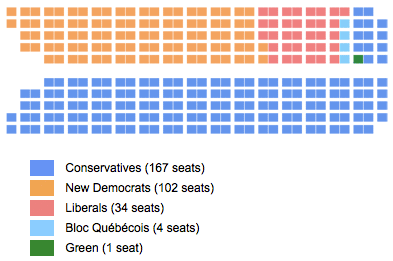
Canada 2011 Federal Election Seats
Canada May 2011 Federal Election Results

Consider this story from the Vancouver Sun. (H/T Andrew)

Excerpt:

Canadian ideals are shifting to the right, being taken over by a “unique strain of conservatism,” a poll from Preston Manning’s Calgarybased think-tank shows, the former Reform party leader said Wednesday.

This was the second year the Manning Centre for Building Democracy conducted the poll, which asked Canadians about their attitudes toward values and policies generally ascribed to Conservatives. Last year’s results indicated similar movements, with more people saying they don’t want government peddling grand views and having its hands in all aspects of society.

The only exception to this opinion is public safety and security policies, Manning said in an interview Tuesday.

Of those surveyed, 65 per cent said government should focus on current issues, and 67 per cent said government should decrease in size to do more.

Canada, it seems, has arrived at a point where its citizens have shifted their expectations for government, said Allan Gregg, the head of Harris Decima, which helped with the polling.

“(Government) is no longer the grand designer,” he said.

But the national shift isn’t necessarily being ascribed to Stephen Harper, who has been prime minister for slightly more than five years.

“This can’t be traced back the last two or three or four years,” said Andre Turcotte, president of Feedback Research Centre, which also helped with polling and interpreting the results. Instead, he said, this is something that has been happening since the late 1980s -around the same time the Reform Party began its rise.

Turcotte couldn’t speculate to whether it was by design or surprise, but he said that in 2008, Harper tapped into what many wanted out of government -being smaller and more focused on specific issues.

“As these conservative values become mainstream values, people will less and less identify them with Conservatives. People will just say these are Canadian values,” Manning said.

The poll was conducted from May 4 to 11, almost immediately after the election. A total of 1,000 interviews were conducted with randomly selected Canadians, resulting in a margin of error of 3.1 percentage points 19 times out of 20.

I blogged recently about how Canada’s economic numbers are vastly superior to the American numbers. I think the Canadians are learning what works by comparing what they’ve been doing (e.g. – corporate tax cuts down to half of our rate) compared to what we’ve been doing, (e.g. – massive bailouts and government spending). They know that they are better off than we are, and they know that conservative policies work – they’ve lived through it. That’s why a country that used to be liberal is now trending conservative. Prime Minister Stephen Harper gave them a five-year economics course and they gave him rave reviews as a professor, and a BIG promotion.