When is it appropriate for Christians to start dating?

Painting: "Courtship", by Edmund Blair Leighton (1888)
Painting: “Courtship”, by Edmund Blair Leighton (1888)

First, read this article from a Crisis Pregnancy Center worker.

Excerpt:

I have a bone to pick with young, socially conservative Americans, and I know it’s something that will get under your skin. Just sit tight, though, and hear me out, because the elephant in our tidy little room is starting to tear things up. It’s time we acknowledge his existence, and maybe even call in some animal movers to take him back to the zoo.

I currently live in a small community in the Bible-belt of the country and I have been given some opportunities to mentor young people from my area through different venues. I can count on one hand the kids I know from the local high school whose parents have never been divorced.  I’ve witnessed reactions of genuine surprise and envy from students who hear that my parents are still together. In any given conversation with groups of youth, I can expect to hear continual references to step-parents, step-siblings, and half-siblings. Divorce is a way of life down here – albeit one that has taken its toll in the lives of the young people that will make up the next generation.

However, while I could certainly write extensively on my experience with the negative effects of divorce on children and on society at large, I actually want to address something else entirely.  I have concerns about the number one way that our culture chooses to perpetuate the cancer of broken marriages and failed relationships– underage dating.

You can follow them on Facebook – the failed attempts at love, I mean. Somebody is always changing their status from “in a relationship” to “single.” Unfortunately, a huge number of these disappointed lovers are too young to be legally married. I wonder sometimes if I am the only one who winces to hear a thirteen-year old speak with cavalier abandon of his or her “ex?”  Since when is it considered healthy and acceptable for underage people to be in “relationships?” Just what do parents and educators expect to be the result of the romantic conquests of these middle-school children and young high school students? The results I’ve witnessed personally are beyond disturbing; they are downright sinister, and have caused me to question whether or not those who claim to champion marital fidelity and family values are paying any attention at all to the standards we are passing to our children.

The trouble with underage dating is that it presents an entirely faulty view of what interaction with the opposite gender should be about. Rather than placing emphasis on building one strong relationship with one person at a stage of life when a marital commitment is feasible, dating encourages young people to pour their energies into consistently seducing other young people at a time when neither of them are capable of making any long-term commitments. Their “relationships” are destined to fail from the get-go because they are founded on unhealthy perceptions of love and not backed by any real necessity to stick it out.

The beauty of marriage, as it was intended to be, is that it teaches two people of opposite genders to learn to work through incompatibilities and give of themselves. In the same way, the great ugliness of dating as it is practiced by our culture and portrayed by our media, is that it teaches two people of opposite genders to be selfish by giving them an easy “out” when things don’t go according to their initial feelings. I believe it is fair to say that this form of dating is a training manual for divorce, because it encourages young people to grow accustomed to giving their hearts away and then taking them back.

Sadly, parents who should know better continue to display shocking naïveté regarding the absurd practices of driving their twelve year olds out on a “date,” or purchasing provocative clothing for their sixteen-year-olds, or sympathizing with their broken-hearted fourteen-year-olds by assuring them that they’ll “find someone better.” “They’re just having fun,” they’ll tell us, rolling their eyes at what they consider to be our tightly wound principles. I work a volunteer shift at Crisis Pregnancy Clinic where I witness every week the ruined lives and broken dreams that “fun” has left with our youth.

And now here’s my take.

Basically, you can start dating as a prelude to courting when the woman and man are able to demonstrate to the other person that they are ready to fulfill their roles in the marriage.

For example, the woman should be able to show that she has been able to maintain commitments to caring for others through some period of time, maybe with small children or pets. She should be voluntarily entering into relationships and responsibilities with other people where she is giving of herself – like volunteering at a crisis pregnancy center or caring for an ailing or elderly relative. That shows potential suitors that she has the right attitude to relationships – serving others self-sacrificially, and not looking for tingles and amusement. She should be able to show that she is good at making commitments and solving problems by studying hard subjects in school like nursing, economics, biology, chemistry, physics, engineering or computer science. That shows that she is able to do hard things that she doesn’t feel like doing, and apply herself over time until she has a degree. Obviously being conservative politically and being good at apologetics are also important if she intends to raise children.

And for the man, he should be able to show that he is able to do his roles – protector, provider and moral/spiritual leader. He should be able to prove that he is able to mentor and guide other people to learn things and do things that will make them more effective Christians. That’s moral and spiritual leadership. He should have studied a subject that is going to allow him to find work. If he is committed to going to graduate school, then he can study philosophy and law and other “world-changing” subjects, like a William Lane Craig or a Ryan Anderson. Otherwise, he should study things like petroleum engineering, computer science, or other fields that will allow him to be stable and secure. It’s not enough to be a hard worker, you have to be able to pull in the money and save it and still have time left over to care for your wife and lead the children. Again, conservative politics and apologetics are a must.

I think there are other ways for men and women to show that they are ready for marriage, but those are some ways. The key thing is that people shouldn’t be dating until they are able to show that they know the roles that they are expected to fill in marriage as men and women. They should also be looking for the right things in others. They can’t be looking for the shallow things that give them tingles, like looks, athleticism, etc. They can’t be looking for sexual attraction, primarily. Marriage requires specific behaviors from men and women, which are derived from what men and women do in marriage. Before men and women start dating, they have to be able to show that they are working on being able to handle their responsibilities, and they have to show that their selection criteria for the opposite sex are at least partly based on the responsibilities that the opposite sex has in a marriage. Otherwise they are just training to be governed by their tingles and to be selfish and to break up when all that falls apart.


Is asking “Am I going to Hell?” a good rebuttal to scientific arguments for theism?

A conflict of worldviews

I want to use this woman’s story to show how sensible atheists reach a belief in God.

Excerpt:

I don’t know when I first became a skeptic. It must have been around age 4, when my mother found me arguing with another child at a birthday party: “But how do you know what the Bible says is true?” By age 11, my atheism was so widely known in my middle school that a Christian boy threatened to come to my house and “shoot all the atheists.” My Christian friends in high school avoided talking to me about religion because they anticipated that I would tear down their poorly constructed arguments. And I did.

As I set off in 2008 to begin my freshman year studying government at Harvard (whose motto is Veritas, “Truth”), I could never have expected the change that awaited me.

It was a brisk November when I met John Joseph Porter. Our conversations initially revolved around conservative politics, but soon gravitated toward religion. He wrote an essay for the Ichthus, Harvard’s Christian journal, defending God’s existence. I critiqued it. On campus, we’d argue into the wee hours; when apart, we’d take our arguments to e-mail. Never before had I met a Christian who could respond to my most basic philosophical questions: How does one understand the Bible’s contradictions? Could an omnipotent God make a stone he could not lift? What about the Euthyphro dilemma: Is something good because God declared it so, or does God merely identify the good? To someone like me, with no Christian background, resorting to an answer like “It takes faith” could only be intellectual cowardice. Joseph didn’t do that.

And he did something else: He prodded me on how inconsistent I was as an atheist who nonetheless believed in right and wrong as objective, universal categories. Defenseless, I decided to take a seminar on meta-ethics. After all, atheists had been developing ethical systems for 200-some years. In what I now see as providential, my atheist professor assigned a paper by C. S. Lewis that resolved the Euthyphro dilemma, declaring, “God is not merely good, but goodness; goodness is not merely divine, but God.”

Joseph also pushed me on the origins of the universe. I had always believed in the Big Bang. But I was blissfully unaware that the man who first proposed it, Georges Lemaître, was a Catholic priest. And I’d happily ignored the rabbit trail of a problem of what caused the Big Bang, and what caused that cause, and so on.

By Valentine’s Day, I began to believe in God. There was no intellectual shame in being a deist, after all, as I joined the respectable ranks of Thomas Jefferson and other Founding Fathers.

I wouldn’t stay a deist for long. A Catholic friend gave me J. Budziszewski’s book Ask Me Anything, which included the Christian teaching that “love is a commitment of the will to the true good of the other person.” This theme—of love as sacrifice for true good—struck me. The Cross no longer seemed a grotesque symbol of divine sadism, but a remarkable act of love. And Christianity began to look less strangely mythical and more cosmically beautiful.

So, I want to point out the progression of her beliefs from atheist to deist to Christian. First, she listened to the scientific arguments for God’s existence, which took her to deism, which is a variety of theism where God just creates the universe and then doesn’t interfere with it after. Those arguments, the Big Bang and the cosmic fine-tuning, were enough for her to falsify atheism and prove some sort of theism. After that, she remained open to the evidence for Christian theism, and finally got there after looking at other evidence.

But this makes me think of how some of the atheists that I talk to do the exact opposite of what she did. I start off by explaining to them scientific evidence for a Creator and Designer. I explain the mainstream discoveries that confirm an origin of the universe (e.g. – light element abundance predictions and observations), and I cite specific examples of fine-tuning, (e.g. – the gravitational constant). I explain protein sequencing and folding, and calculate the probabilities of getting a protein by chance. I explain the sudden origin of the phyla in the Cambrian explosion, and show why naturalistic explanations fail. I talk about the fine-tuning needed to get galaxies, solar systems and planets to support life. But many of these atheists don’t become deists like the honest atheist in the story. Why not?

Well, the reason why not is because they interrupt the stream of scientific evidence coming out of my mouth and they start to ask me questions that have nothing to do with what we can know through science. See, evangelism is like building a house. You have to start with the foundation, the walls, the plumbing, the electricity, etc., but you can’t know all the specific details about furniture and decorations at the beginning. But militant atheists don’t care that you are able to establish the foundations of Christian theism – they want to jump right to the very fine-grained details, and use that to justify not not building anything at all. Just as you are proving all the main planks of a theistic worldview with science, they start asking “am I going to Hell?” and telling you “God is immoral for killing Canaanite children”, etc. They want to stop the construction of the house by demanding that you build everything at once. But, it is much easier to accept miracles like the virgin birth if you have a God who created the universe first. The foundation comes first, it makes the later stuff easier to do.

So rather than adjust their worldview to the strong scientific evidence, and then leave the puzzling about Hell and Old Testament history for later, they want to refute the good scientific arguments with “Am I going to Hell?”. How does complaining about Hell and unanswered prayer a response to scientific evidence? It’s not! But I think that this does explain why atheists remain atheists in the face of all the scientific evidence against naturalism. They insulate their worldview from the progress of science by focusing on their emotional disappointment that they are not God and that God isn’t doing what they want him to do. That’s the real issue. Authority and autonomy. In my experience, they are usually not accountable to science, although there are, thank God, exceptions to that rule.

How the WMAP satellite confirmed nucleosynthesis predictions and falsified atheism

Apologetics and the progress of science

Prior to certain scientific discoveries, most people thought that the universe had always been here, and no need to ask who or what may have caused it. But today, that’s all changed. Today, the standard model of the origin of the universe is that all the matter and energy in the universe came into being in an event scientists call “The Big Bang”. At the creation event, space and time themselves began to exist, and there is no material reality that preceded them.

So a couple of quotes to show that.

An initial cosmological singularity… forms a past temporal extremity to the universe. We cannot continue physical reasoning, or even the concept of spacetime, through such an extremity… On this view the big bang represents the creation event; the creation not only of all the matter and energy in the universe, but also of spacetime itself.

Source: P. C. W. Davies, “Spacetime Singularities in Cosmology,” in The Study of Time III, ed. J. T. Fraser (Berlin: Springer Verlag ).

And another quote:

[A]lmost everyone now believes that the universe, and time itself, had a beginning at the big bang.

Source: Stephen Hawking and Roger Penrose, The Nature of Space and Time, The Isaac Newton Institute Series of Lectures (Princeton, N. J.: Princeton University Press, 1996), p. 20.

So, there are several scientific discoveries that led scientists to accept the creation event, and one of the most interesting and famous is the discovery of how elements heavier than hydrogen were formed.

Nucleosynthesis: forming heavier elements by fusion

Here’s the history of how that discovery happened, from the National Aeronautics and Space Administration (NASA) web site:

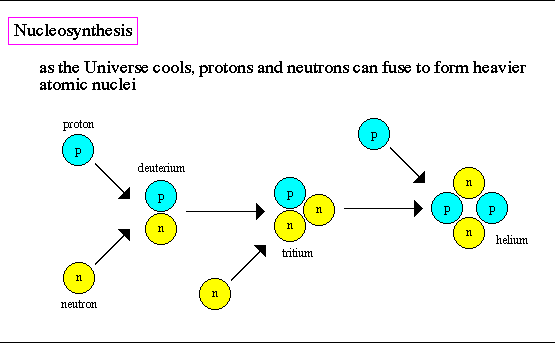
The term nucleosynthesis refers to the formation of heavier elements, atomic nuclei with many protons and neutrons, from the fusion of lighter elements. The Big Bang theory predicts that the early universe was a very hot place. One second after the Big Bang, the temperature of the universe was roughly 10 billion degrees and was filled with a sea of neutrons, protons, electrons, anti-electrons (positrons), photons and neutrinos. As the universe cooled, the neutrons either decayed into protons and electrons or combined with protons to make deuterium (an isotope of hydrogen). During the first three minutes of the universe, most of the deuterium combined to make helium. Trace amounts of lithium were also produced at this time. This process of light element formation in the early universe is called “Big Bang nucleosynthesis” (BBN).

The creation hypothesis predicts that there will be specific amounts of these light elements formed as the universe cools down. Do the predictions match with observations?

Yes they do:

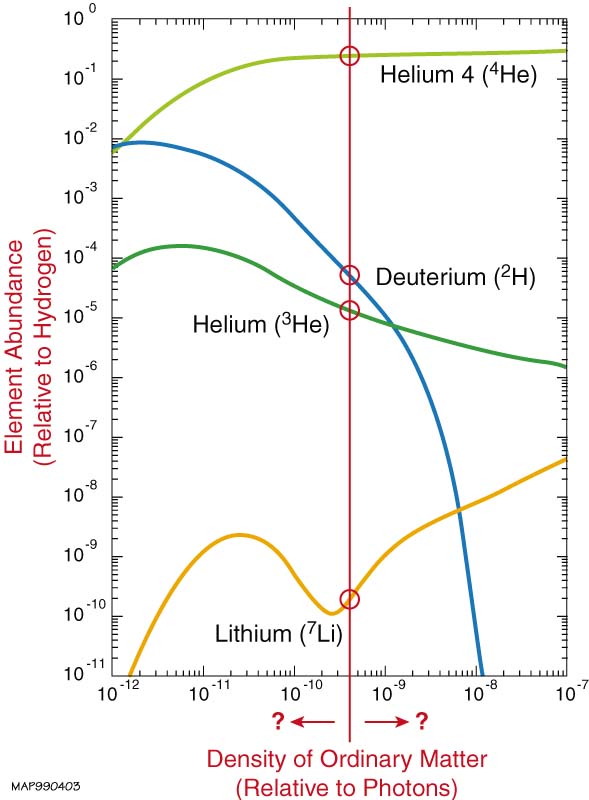
The predicted abundance of deuterium, helium and lithium depends on the density of ordinary matter in the early universe, as shown in the figure at left. These results indicate that the yield of helium is relatively insensitive to the abundance of ordinary matter, above a certain threshold. We generically expect about 24% of the ordinary matter in the universe to be helium produced in the Big Bang. This is in very good agreement with observations and is another major triumph for the Big Bang theory.

Moreover, WMAP satellite measurements of mass density agree with our observations of these light element abundances.

Here are the observations from the WMAP satellite:

Scientific observations match predictions

And here is how those WMAP measurements confirm the Big Bang creation event:

However, the Big Bang model can be tested further. Given a precise measurement of the abundance of ordinary matter, the predicted abundances of the other light elements becomes highly constrained. The WMAP satellite is able to directly measure the ordinary matter density and finds a value of 4.6% (±0.2%), indicated by the vertical red line in the graph. This leads to predicted abundances shown by the circles in the graph, which are in good agreement with observed abundances. This is an important and detailed test of nucleosynthesis and is further evidence in support of the Big Bang theory. 

“An important and detailed test”.

For completeness, we should learn how elements heavier than these light elements are formed:

Elements heavier than lithium are all synthesized in stars. During the late stages of stellar evolution, massive stars burn helium to carbon, oxygen, silicon, sulfur, and iron. Elements heavier than iron are produced in two ways: in the outer envelopes of super-giant stars and in the explosion of a supernovae. All carbon-based life on Earth is literally composed of stardust.

That’s a wonderful thing to tell a young lady when you are on a date: “your body is made of stardust”. In fact, as I have argued before, this star formation, which creates the elements necessary for intelligent life, can only be built if the fundamental constants and quantities in the universe are finely-tuned.

Now, you would think that atheists would be happy to find observations that confirm the origin of the universe out of nothing, but they are not. Actually, they are in denial.

Here’s a statement from the Secular Humanist Manifesto, which explains what atheists believe about the universe:

Religious humanists regard the universe as self-existing and not created.

For a couple of examples of how atheistic scientists respond to the evidence for a cosmic beginning, you can check out this post, where we get responses from cosmologist Lawrence Krauss, and physical chemist Peter Atkins.

You cannot have the creation of the universe be true AND a self-existing, eternal universe ALSO be true. Someone has to be wrong. Either the science is wrong, or the atheist manifesto is wrong. I know where I stand.

Positive arguments for Christian theism