Study: remaining a virgin longer leads to more satisfying relationships

Boys and girls playing the famous co-operative board game
Boys and girls playing the famous co-operative board game “Pandemic”

OK, so this week I got to be a facilitator between a man and a woman in a relationship. I got to hear a bit about what they thought was appropriate in the area of physical touching. These two had made great decisions, and it protected them both. Anyway, thinking about them caused me to think about the studies I had posted about boundaries in sexual matters a few years back. So I’m going to re-post them to remind everyone not to be in a rush to say yes to premarital sex.

The first article from the UK Daily Mail is about study showing the benefits of abstinence for relationship quality.

Excerpt:

People who lose their virginity later than their teenage years are more likely to enjoy satisfying relationships later in life, according to a new study.

Researchers found that people who didn’t have sex until they turned 20 or even later are more likely to end up in a happy relationship.

[…]Previous research suggests that there may be cause for concern, as timing of sexual development can have significant immediate consequences for adolescents’ physical and mental health.

However, until now little had been done to study long-term outcomes, and how early sexual initiation might affect romantic relationships in adulthood.

Psychological scientist Paige Harden, of the University of Texas in the United States, set about changing this.

She wanted to investigate whether the timing of sexual initiation in adolescence might predict romantic outcomes – such as whether people get married or live with their partners, how many romantic partners they’ve had, and whether they’re satisfied with their relationship – later in adulthood.

Doctor Harden used data from the National Longitudinal Study on Adolescent Health to look at 1,659 same-sex sibling pairs who were followed from around the age of 16 to about the age of 29.

Each sibling was classified as having an ‘early’ (younger than 15), ‘on-time’ (age 15 to 19), or ‘late’ (older than 19) first experience with sexual intercourse.

Those who lost their virginity later on in life were more likely to have a well-paid job.

They found, as expected, later timing of first sexual experience was associated with higher educational attainment and higher household income in adulthood when compared with the early and on-time groups.

People who had a later first sexual experience were also less likely to be married and they had fewer romantic partners in adulthood.

Among the participants who were married or living with a partner, later sexual initiation was linked with significantly lower levels of relationship dissatisfaction in adulthood.

This sounds a lot like the results from the previous studies that were featured in this UK Daily Mail article.

Excerpt:

“Courtship is a time for exploration and decision-making about the relationship, when partners assess compatibility, make commitments and build on emotional and physical intimacy.”

“The rapid entry into sexual relationships may, however, cut short this process, setting the stage for “sliding” rather than “deciding” to enter co-habiting unions.”

“Around a third of the men and women said they’d had sex within the first month of dating, while about 28 per cent waited at least six months, the Journal of Marriage and Family reported.”

“Analysis of the data clearly showed the women who had waited to have sex to be happier. And those who waited at least six months scored more highly in every category measured than those who got intimate within the first month. Even their sex lives were better.”

“The link was weaker for men. However, those who waited to get physically involved had fewer rows.

[…]‘A strong sexual desire may thwart the development of other key ingredients of a healthy relationship such as commitment, mutual understanding or shared values,’ the report said. ‘Good sex is sometimes confused with love; some couples overlook problematic aspects of their relationship that ultimately matter more in the long run.’”

So, it looks like you lose some stability if you push too hard on the premarital sex. Is stability important to you? Well, divorce is a financial disaster for men and women – so that’s one reason to care about stability. If your plan for marriage is to provide a stable environment for your kids, then that’s another good reason to care about stability. If you are getting married in part to advance your cause through effective children, then you have to control yourself now in order to be the person who can give them what they need later. This is not out of your control, this is not unpredictable. There are best practices.

If you keep rushing into things and experiencing painful break-ups, you will naturally stop the behaviors that allow you commit out of self-preservation. You will begin to resent having to care for that other person, except maybe when it makes you feel good. When you invest a lot and break up, you become less willing to invest in that other person. You retreat into your shell. You resent having responsibilities and obligations to that other person. You expect things to work on their own, apart from your efforts to make them work, because that’s how you avoid getting hurt. You try not to invest too much, because you imagine that things will fall apart and you’ll get hurt again. You focus on just feeling good now, so that when the relationship fails, you come out “ahead”. But this is not the way to make a stable marriage.

Marriage requires you to give 100% and regardless of how you feel. That’s what a commitment is – it’s a decision to perform regardless of feelings. To get stability, you want to be comfortable with investing in that other person – taking on responsibilities, satisfying expectations, performing obligations. Both of you have to be comfortable with the selflessness of commitment, and be ruled by your own decisions, instead of your feelings. And your goal here is not to find someone who gives you good feelings right now. Your goal is to find someone who will not hurt you the more that you give of yourself, up to an including marriage. It’s not good feelings that you are looking for, it’s the safety to commit everything you have to this other person, and not get hurt. The real joy of a relationship is not fun and thrills, it’s giving everything you have to another person, and knowing that if you fall, they will catch you.

If you choose candidates carefully, involve wise mentors, and set proper boundaries, you’ll find that relationships are a lot less painful, and that when you really want to commit, then you will be able to commit with your whole heart, and to be content with the commitment. There are plenty of ways to love and serve another person other than sex, as you both get to know each other and size each other up for a life-long commitment. Premarital sex is counterproductive… it’s speaking in a language that is designed for two people who have already made a lifelong commitment to have a common plan and a common purpose. Sex makes sense when you have that commitment, but it undermines communication and objective evaluation if it’s done before that commitment commitment is in place.

Freeman Dyson: the last 10 years have proven climate change models wrong

Apologetics and the progress of science

This interview with liberal scientist Freeman Dyson appeared in the UK Register.

Introduction:

The life of physicist Freeman Dyson spans advising bomber command in World War II, working at Princeton University in the States as a contemporary of Einstein, and providing advice to the US government on a wide range of scientific and technical issues.

He is a rare public intellectual who writes prolifically for a wide audience. He has also campaigned against nuclear weapons proliferation.

At America’s Oak Ridge National Laboratory, Dyson was looking at the climate system before it became a hot political issue, over 25 years ago. He provides a robust foreword to a report written by Intergovernmental Panel on Climate Change cofounder Indur Goklany on CO2 – a report published[PDF] today by the Global Warming Policy Foundation (GWPF).

An Obama supporter who describes himself as “100 per cent Democrat,” Dyson says he is disappointed that the President “chose the wrong side.” Increasing CO2 in the atmosphere does more good than harm, he argues, but it is not an insurmountable crisis. Climate change, he tells us, “is not a scientific mystery but a human mystery. How does it happen that a whole generation of scientific experts is blind to obvious facts?”

Excerpt:

What has happened in the past 10 years is that the discrepancies between what’s observed and what’s predicted have become much stronger. It’s clear now the models are wrong, but it wasn’t so clear 10 years ago. I can’t say if they’ll always be wrong, but the observations are improving and so the models are becoming more verifiable.

[…]It’s very sad that in this country, political opinion parted [people’s views on climate change]. I’m 100 per cent Democrat myself, and I like Obama. But he took the wrong side on this issue, and the Republicans took the right side.

Is carbon dioxide as bad as the politicians say?

Nope:

To any unprejudiced person reading this account, the facts should be obvious: that the non-climatic effects of carbon dioxide as a sustainer of wildlife and crop plants are enormously beneficial, that the possibly harmful climatic effects of carbon dioxide have been greatly exaggerated, and that the benefits clearly outweigh the possible damage.

I consider myself an unprejudiced person and to me these facts are obvious. But the same facts are not obvious to the majority of scientists and politicians who consider carbon dioxide to be evil and dangerous. The people who are supposed to be experts and who claim to understand the science are precisely the people who are blind to the evidence.

[…]The scientists and politicians who have been blindly demonizing carbon dioxide for 37 years will one day open their eyes and look at the evidence.”

E. Calvin Beisner had more to say about beneficial effects of CO2 on agriculture in an article on the Stream.

He writes:

To call CO2 “carbon pollution” is not only bad chemistry and bad toxicology but also bad biology. Carbon dioxide is essential to all plant growth. The higher its concentration, the better plants grow. Below 170 ppm, plants die. At the roughly 280 ppm at the start of the Industrial Revolution, plants are “sucking air,” so to speak — barely getting enough. At today’s 400 ppm, plants grow much better — so much better that a study by researchers at the Technische Universität München found forests around the world growing up to 70 percent faster today than 50 years ago because of it. Earth is literally greening because of added CO2.

Plants will grow still better as CO2 concentration continues to rise. Thousands of empirical studies, as opposed to mere models, have found that, on average, for every doubling of CO2 concentration in the atmosphere, there is about a 35 percent increase in the efficiency of plant growth. Plants grow better in wetter and drier soils and in warmer and colder temperatures, widening their ranges and increasing their adaptability to climate changes, reducing the risk of biodiversity loss. They make better use of soil nutrients, better resist diseases and pests, and improve the ratio of fruit to fiber.

The consequence is more food for plant-eaters and eaters of plant eaters — i.e., for pretty much everything. Most importantly, it means more affordable food for the world’s poor.

A review of the refereed literature on the subject found “the … monetary value of this benefit amount[ed] to a total sum of $3.2 trillion over the 50-year period 1961–2011. Projecting the monetary value … forward … reveals it will likely bestow an additional $9.8 trillion on crop production between now and 2050.”

So honest, well-informed discussion of any policy — cap and trade, “carbon tax,” renewable mandates, etc. — to reduce CO2 emissions should first recognize the benefits of increasing its concentration in the atmosphere, not just for people but for all animals. Any rationale for reducing emissions must prove that they exact a cost that outweighs this benefit.

Ah, but being honest about the benefits would not allow our democratic socialist betters to have the platform they need to convince us to let them rule us, and control our lives down to the temperatures in our homes, what cars we drive and how much we can drive.


Information Enigma: 21-minute video explains intelligent design

Can random mutation and natural selection create new functional information?

The video is here:

I have read and listened and watched a lot of material on intelligent design, but I have never seen so much value packed into such a short lecture. I really hope you’ll watch this and that it’s helpful to you.

Summary:

  • the big question when discussing the origin of life: where did the information in living systems come from?
  • Until 530 million years ago, the oceans were largely devoid of life
  • In a 10 million year period, many new forms of animal life emerged
  • New biological forms of life require new information
  • the discovery of DNA shows that living systems work because cells have information that allows them to build the components of molecular machines: cell types, proteins, etc.
  • can random mutation and natural selection create new functional information?
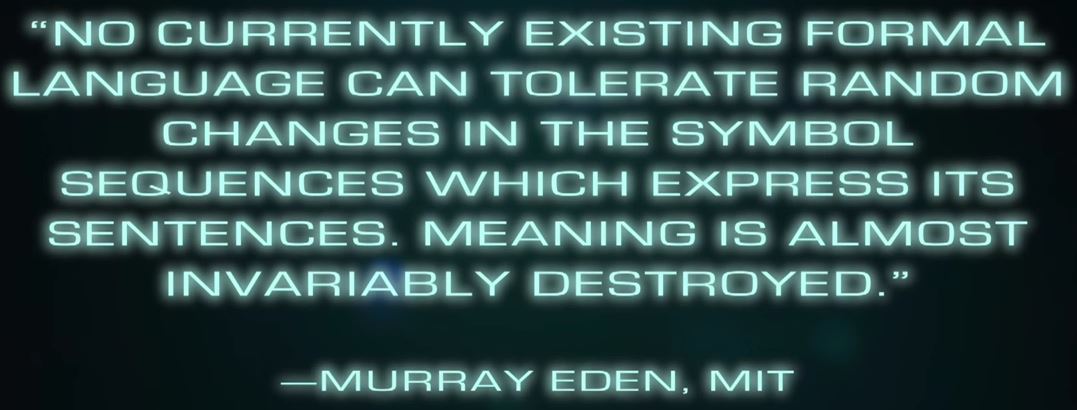
  • normally, random mutations tend to degrade the functionality of information, e.g. – randomly changing symbols in an applications code does not usually introduce useful new functions, it usually renders what is there non-functional
  • the majority of possible sequences will NOT have functions, so random mutations will more likely give you non-functional code, rather than functional code
  • example: a bicycle lock  with 4 numbers has many possible sequences for the 4 numbers, and only one of them has unlock functionality, the rest have no functionality
  • if you have lots of time, then you might be able to guess the combination, but if the lock as has 10 billion numbers, and only one combination that unlocks, you can spend your whole life trying to unlock it and won’t succeed
  • how likely is it to arrive at a functional protein or gene by chance? Is it more like the 4-dial lock (can be done with lots of time) or the 10 billion dial lock (amount of time required exceeds the time available)?
  • the probability is LOW because there is only one sequence of numbers that has unlock function
  • consider a short protein of 150 amino acids has 10 to the 195th power possible sequences
  • if many of these sequences of amino acides had biological function, then it might be easier to get to one by random mutation and selection than it is with a lock that only unlocks for ONE sequence
  • how many of the possible sequences have biological function?
  • Thanks to research done by Douglas Axe, we now know that the number of functional amino acid sequences for even a short protein is incredibly small…
  • Axe found that the odds of getting a functional sequence of amino acids that will fold and have biological function is 1 in 10 to the 77th power
  • Is that number too improbable to reach by chance? well, there are 10 to 65th atoms in the entire Milky Way galaxy… so yes, this is a very improbable outcome
  • can random genetic mutations search through all the sequences in order to find the one in 10 to the 77th power one that has biological function? It depends on how much guessers we have and how many guesses we get in the time available
  • even with the entire 3.5 billion year history of life on Earth, only about 10 to the 40th organisms have ever lived, which far smaller fraction of the 10 to the 77th total sequences
  • even with a very fast mutation rate, you would not be able to reach a functional protein even with all that time, and even with all those organisms

I was once having a discussion with a woman about the research that Axe did at the Cambridge University lab. He published four articles in the Journal of Molecular Biology. I held out one of the papers to her and showed her the numbers. She said over and over “I hate the Discovery Institute! I hate the Discovery Institute!” Well, yeah, but you can’t make the Journal of Molecular Biology go away with hating the Discovery Institute. JMB is peer-reviewed, and this was experimental evidence – not a theory, not a hypothesis.

We have been blessed by the Creator and Designer of the universe in this time and place with overwhelming evidence – an abundance of riches. For those who have an open mind, this is what you’ve been waiting for to make your decision. For the naturalists who struggle so mightily to block out the progress of experimental science, they’ll need to shout louder and shut their eyes tighter and push harder to block their ears. Maybe if they keep screaming “Star Trek” and “Star Wars” over and over to themselves, they will be able to ignore the real science a little longer.