Robin Collins lectures on fine-tuning for discoverability from particle physics

This lecture is 29 minutes long, the Q&A is 15 minutes. I highly recommend this lecture to all audiences of all levels of ability, for the simple reasons that apart from the content, this lecture is a how-to clinic in the tone, body language, slides and so on for you to use when trying to be persuasive when making your case. Science is king in this lecture. The scientific method is defined and applied in a winsome way. Making science understandable should be the bread and butter approach to Christian apologetics, and this lecture rivals the Mike Strauss lecture at Stanford University and the Mike Strauss lecture at the University of Texas – Dallas as the ideal lectures for showing that. It’s not just the scientific material that makes this lecture by Collins work, it’s the narrative and the style that make the lecture work.

About Robin Collins:

Robin Collins (PhD, University of Notre Dame, 1993), is professor of philosophy at Messiah College, Grantham, PA specializing in the area of science and religion.  He has written over twenty-five articles and book chapters on a wide range of topics, such as the fine-tuning of the cosmos as evidence for the existence of God, evolution and original sin, the Doctrine of Atonement, Asian religions and Christianity, and Bohm’s theory of quantum mechanics.  Some of his most recent articles/book chapters are “Philosophy of Science and Religion” in The Oxford Handbook of Science and Religion, “Divine Action and Evolution” in The Oxford Handbook of Philosophical Theology (2009)  “The Multiverse Hypothesis: A Theistic Perspective,” in Universe or Multiverse? (Cambridge University Press), and “God and the Laws of Nature,” in Theism or Naturalism: New Philosophical Perspectives (Oxford University Press, forthcoming).  He recently received a grant from the John Templeton Foundation to finish a book that presents the case for design based on physics and cosmology,  tentatively entitled The Well-Tempered Universe: God, Cosmic Fine-tuning, and the Laws of Nature.

His thesis in one slide:
Fine-tuning for discoverability
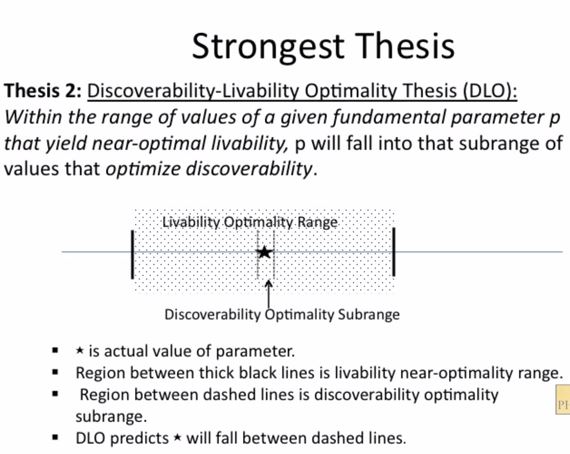
Fine-tuning for discoverability – the DLO thesis

Summary:

  • Thesis: the universe is more intelligible than we would expect it by chance
  • The regular fine-tuning argument says that complex embodied observers are very rare
  • But the number of highly-discoverable universes that have complex embodied observers is rarer still
  • Why do we exist in a highly-discoverable universe?
  • Can we quantify and test discoverability?
  • Yes: by varying fundamental parameters and seeing how it affects discoverability
  • Conclusion of his calculations: The Discoverability-Liveability Optimality range is an even smaller range within the Liveablity Optimality range of the standard fine-tuning argument
  • Fine-tuning #1: the fine structure constant, governs the strength of the electro-magnetic force
  • If larger, wood-burning fire becomes impossible because fires won’t stay lit, and therefore forging metals becomes unlikely
  • If smaller, wood-burning fires won’t go out, e.g. – from lightning strikes, so that wood would be less accessible
  • Other constraints: smaller value decreases effectiveness of light microscopes, drastically lowers efficiency of transformers and motors
  • Fine-tuning #2: the cosmic microwave background radiation (CMBR), radiation left over from the Big Bang
  • humans need to discover the CMBR in order to confirm the Big Bang creation out of nothing, and it depends on baryon/pothon ratio
  • his calculations show that the actual value of CMBR is exactly at the peak for detectability by humans
  • if baryon/photon ratio larger, CMBR is less discoverable
  • if baryon/photon ratio smaller, CMBR is less discoverable
  • Fine-tuning #3: parameters related to subatomic particles are fine-tuned for their discovery and usefulness, e.g. – the bottom quark, the charm quark, the tau lepton and the Higgs Boson
  • the lifetime of the particles affects their usefulness to scientists who want to investigate the Standard Model of physics
  • decay rates of these subatomic particles are related to several of the finely-tuned parameters
  • for example, the mass of the bottom quark is finely-tuned for its discoverability by scientists
  • the tau lepton and the charm quark are similarly fine-tuned for disoverability
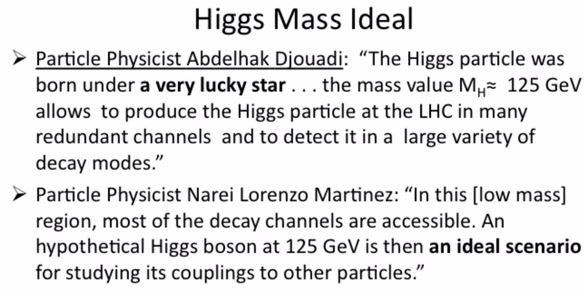
  • the mass of the Higgs boson is finely-tuned for discoverability and for making further discoveries
  • Conclusion: the DLO thesis is strongly confirmed – this is an even greater degree of fine-tuning that the already astonishing probabilities of the fine-tuning for complex, embodied intelligent beings
  • The formalized version of the philosophical argument based on this evidence is impervious with some of the traditional objections to the standard fine-tuning argument
  • #1 multiverse/selection effect: it is not subject to multiverse / observer selection objections
  • #2 normalizeability: it is not subject to the McGrew-Vestrup objection because the range of possible values is finite not infinite
  • #3 falsifiability: it makes falsifiable predictions, and in fact Collins’ earlier calculations of the CMBR discoverability contained an error that falsified the thesis – until he found the error and corrected for it
  • #4 usefulness: it gives clues about the Creator’s purpose for us, namely that the universe was created for us to be able to do science and find evidence of the Creator’s existence – there is no expectation for us to exercise blind faith, trust in God is meant to be a plausible deduction from the progress of experimental science

Sample slide:
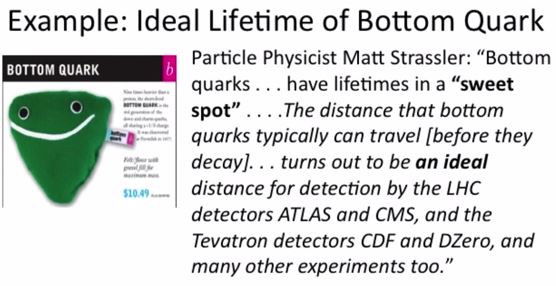
Fine-tuning of the bottom quark for discoverability
Bottom quark lifetime is finely-tuned for discoverability

And another:

Higgs boson mass is finely-tuned for discoverability

Earlier, I blogged about a Robin Collins lecture on the fine-tuning that allows complex, embodied life to exist. Another must-see lecture. If you are looking for something to study in university, and you have funding, then physics, mathematics and philosophy are the best places to be for a Christian scholar.

Public schools implanting IUDs in sixth-grade girls without parent’s knowledge

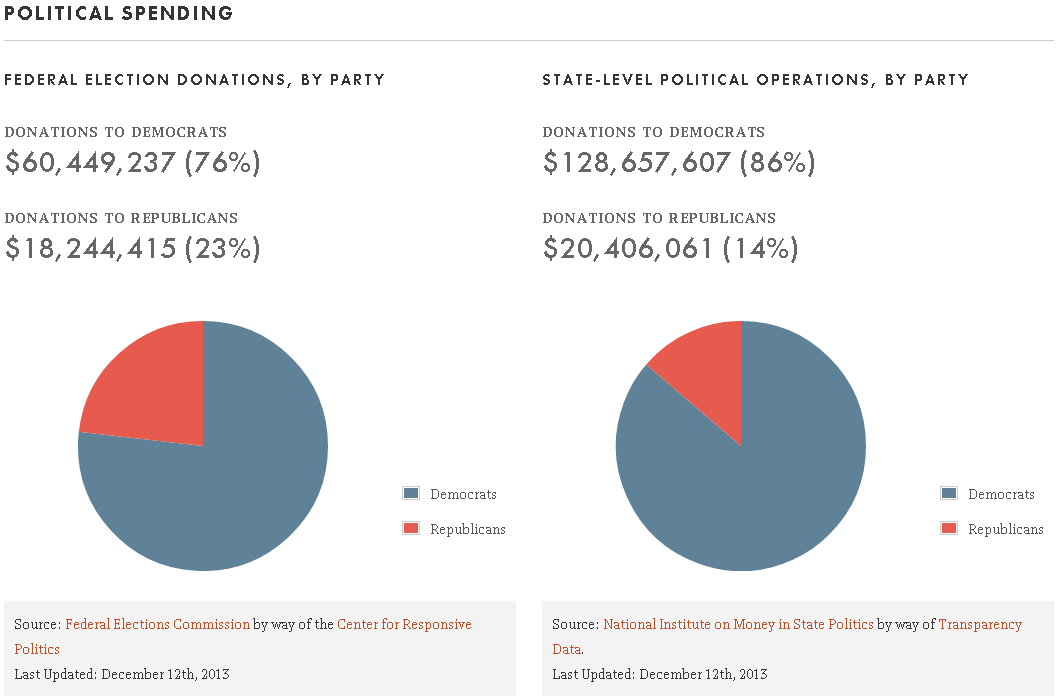
Political spending by the NEA in 2013
Political spending by the National Education Association in 2013

What does big government really look like? What does it mean for individuals, families, businesses and churches to give their money to the government so that the government can distribute it as they see fit?

Well, Seattle is one of the most liberal cities in America and they embody the idea of big government. Let’s see how they spend the massive amounts of money they extract from individuals, families, businesses and churches.

Life News reports.

Excerpt:

Earlier this month, LifeNews.com reported on a high school in Seattle, Washington that is now implanting intrauterine devices (IUD), as well as other forms of birth control and doing so without parental knowledge or permission.

The IUD is known as a long acting reversible contraception, and may even act as an abortifacient. So, a young teen in Seattle can’t get a coke at her high school, but she can have a device implanted into her uterus, which can unknowingly kill her unborn child immediately after conception. Or, if she uses another method, she can increase her chances of health risks for herself, especially if using a new method.

The high school, Chief Sealth International, a public school, began offering the devices in 2010, made possible by a Medicaid program known as Take Charge and a non-profit, Neighborcare. Students can receive the device or other method free of cost and without their parent’s insurance. And while it’s lauded that the contraception is confidential, how can it be beneficial for a parent-child relationship when the parents don’t even know the devices or medication their daughter is using?

As it turns out, Chief Sealth isn’t the only school in Seattle doing this. As CNS News reports, more schools are fitting young girls — as young as 6th grade — with the devices and doing so without their parents knowing.

Now how did this happen? Where did the public schools get the authority to have control of these children? And where did the money come from to pay for these schools?

The answer is that the money was taken from individuals, families, businesses and churches and given to the government. And how does a secular government spend this money? Do they spend it the same way that individuals, families, businesses and churches spend this money? No. They spend the money advancing their secular agenda, which, in this case, is to advance feminism and the sexual revolution. They want young girls to be available for sex, because they helps them to be less capable of life-long married love. A woman who has had a large number of break-ups, abortions, etc. at a young age is more likely to look to government, not to a husband, for support.  Undermining her father’s authority in the area of sexuality is exactly what they are trying to achieve. And the father is paying to be undermined with his tax dollars.

In Canada, Trinity Western University’s law school loses accreditation

Canada election 2011: Consersvatives in Blue, Socialists in Red, Communists in Orange
2011 election: Conservatives in Blue, Socialists in Red, Communists in Orange

Canada legalized gay marriage in 2005, and they are about 10 years ahead of us in destroying religious liberty. Want to know what comes after a country legalizes same-sex marriage? Then look to Canada. Specifically, look to the financial hub of Canada, the very liberal province of Ontario.

The Daily Caller reports on it.

A court in Canada has upheld the denial of accreditation to a Christian law school, holding the private school’s prohibition of homosexual behavior is sufficiently discriminatory that its degrees can be invalidated for that reason alone.

Trinity Western University is a 4,000-student, evangelical Protestant college in the Vancouver suburb of Langley. It has been seeking to open a law school, but has struggled to obtain accreditation in several provinces. This difficulty is not based on the school’s academics, but rather is based on outside objections to the covenant the school makes all students and professors sign. The covenant, among other things, forbids all sex other than that within heterosexual marriage, a rule opponents say discriminates against both gays and those who do not believe in marriage.

The actual regulation says nothing about gay anything. It is just as much opposed to heterosexual extra-marital sex as it is to homosexual extra-marital sex. But somehow, in Canada, if you believe what the Bible teaches about sex, then you can’t practice law. Because rainbow flag, tolerance and diversity.

More:

Based on the rule, the Law Society of Upper Canada, which governs bar admission in Ontario, refused to accredit the school, meaning graduates would not be allowed to practice law in the province. Trinity sued, leading to Thursday’s decision.

In its ruling, the Ontario Superior Court found that the denial of accreditation did violate Trinity’s freedom of religion, but that this violation was acceptable because of the greater good of protecting equality.

[…]The court also held that individual evangelical Christians could not claim to have had their freedom violated by the ruling, because they could still attend law school elsewhere.

Got that? So gay people who want a wedding cake, wedding flowers, wedding venue, wedding photography, etc. ARE having their rights violated even though they can go elsewhere. But Christian students who want to attend Trinity ARE NOT having their rights violated when they have to go elsewhere. It’s “equal”, in the eyes of the secular left.

Let’s take a look at two 5-minute clips of the Ontario decision from two Canadian journalists.

Ezra Levant (who is Jewish):

Brian Lilley (who is Catholic):

In Canada, gay rights trump religious liberty rights.

But Canada is a different country, would the Democrats really be able to go after Christian schools the same way here?

This article from Campus Reform says yes.

Excerpt:

The recent Supreme Court opinion threatens the operations of religious colleges, according to a constitutional lawyer.

“If same-sex marriage is really the law of the land, if it’s really constitutionally required, isn’t there a risk that accrediting bodies are going to start pressuring religious colleges to recognize same-sex marriages for all purposes on their campuses as a condition of accreditation?” constitutional lawyer Gene Schaerr rhetorically asked Tuesday in his analysis of Obergefell v Hodges.

By the way, I don’t need to mention that many Christians in Canada voted for the bigger government over the last two decades, and that’s conservative Christianity is almost dead there. Why would “Christians” vote to expand for bigger secular government? Because Christians in Canada thought that it was the government’s job to take care of poverty and to give everyone “free health care”. When you ask a secular government to control more and more of our lives, this is what you get. Let me be clear: a “Christian” who favors bigger government favors the end of Christianity. Period. That clear enough for you?