Islamic terrorists murder nearly 150 mostly Christian students in Kenya

Map of Africa
Map of Africa

While the mainstream media was protesting religious freedom laws, they neglected to make a big deal out of a terrorist attack by Islamic terrorists against Christian students in Kenya.

Let’s read about it in the radically leftist New York Times, of all places.

It says:

Elosy Karimi curled up in a crawl space, immobilized by fear.

Her classmates were flooding out of the dorms, in boxer shorts and thin nightgowns. Gunfire was ringing all around her. People were screaming. It was predawn and pitch black.

“If you want to survive, come out!” the militants yelled. “If you want to die, stay inside!”

In the terrifying confusion, Ms. Karimi, 23, decided to risk it inside, she said, and stayed hidden in the ceiling above her bunk bed for the next 28 and a half hours.

“I knew those guys were lying,” she said at the hospital, having just arrived to be checked after the ordeal.

New details emerged on Friday about how a handful of fighters from the Shabab militant group, with just a few light weapons, managed to kill nearly 150 students in Kenya’s worst terrorist attack since the 1998 bombing of the United States Embassy in Nairobi.

Survivors said many students had fallen for the militants’ trick, voluntarily leaving their dorm rooms and obeying commands to lie down in neat rows, only to be shot in the back of the head.

One of the militants appeared to be a trained sniper, some witnesses said, picking off several Kenyan soldiers and critically hampering the rescue effort, giving the gunmen hours more to keep killing.

The militants seemed especially cruel and gleeful, ordering some students to call their parents on their cellphones and tell them that the attack was payback for Kenya’s military intervention in Somalia.

Students who hid during the attack said they had heard their classmates whimpering as the militants taunted them. Then a single gunshot. Then silence.

“They were shooting people as they came out; they were making others lie down,” said a doctor who was not authorized to speak publicly. “They had so many people lying in one place, it was easy killing.”

I am contrasting this story with the photos of the people marching around in Indiana for their right not to be refused gay marriage services from Christians. They were not marching for the Christian students who were murdered by terrorists in Kenya. Oh no – they have much higher priorities. The journalists who spent hours and hours lying about the religious liberty law also had different priorities. What a strange world where people think that it is more important to compel others to celebrate their behavior instead of condemning something that is truly evil. I guess it’s too much to ask that entitle secular leftist bullies would care about the basic human rights of others. They want a happy life for themselves, but there is no morality underlying any of their rhetoric.

As an aside, I think this story shows the important of America having a strong military and having the will to use it. It’s one thing to read about stories like this, but if you go to the polls and vote for Democrats to cut our defense budget and neuter the army with politically correct policies, then there is nothing we can do when things like this happen. The bad guys in this story only understand one thing, and that’s men with guns standing between them and their intended victims. No shrieking anti-war activist in pink could have helped the victims, but our military could have.
When speaking to non-Christians, do you use any of these Christianese terms?

I found this article by J. Warner Wallace and thought it was appropriate because it’s Easter, and there are always questions.

First, the list of Christianese: (not his term)

  • #1. “God has put you (or something) on my heart. / God told me.”
  • #2. “Be ‘born again.’ / Have a spiritual rebirth.”
  • #3. “You need to come to repentance. / Experience a conversion.”
  • #4. “Deal with your sin.”
  • #5. “Invite Jesus into your heart.”
  • #6. “Make Jesus the Lord of your life.”
  • #7. “Have faith.”
  • #8. “Be saved.”
  • #9. “Be washed by the blood of the Lamb.”
  • #10. “Be Sanctified.”
  • Bonus Expression #11. “Enjoy fellowship.”

This article is pretty funny, but it ought to be because I think we really need to shame church Christians when they talk like this.

Here’s the one I liked best:

#5. “Invite Jesus into your heart.”
You mean like a boyfriend? What exactly does that mean to have “Jesus in my heart?” I’m not an emotional kind of guy, so please don’t ask me to sing songs or hold hands with Jesus, especially in public. Do I have to emasculate myself to become a Christian? If so, thanks for reminding me why I’m not a Christian.

Try this instead: “When we admit our imperfections, believe Jesus died on the cross to pay the price for our mistakes, and accept His sacrifice, we can start a new relationship with God.”

Indeed. It’s a wonder that any rough and tough men become Christians after what they find in church.

I think that a lot of Christians struggle with explaining “sin” to non-Christians, but I have an approach that works for me. I just ask them how much effort they have put into looking for the evidence for and against God. How much effort into cosmology, especially. How much into the origin of life. How much into the fine-tuning. Usually, the answer is “I watched every episode of Star Trek” or “I watched a documentary on the Pyramids on the Discovery Channel”. I try to show them that God has left fingerprints in the natural world, and by avoiding that evidence they are, in fact, avoiding God. Keeping him at arm’s length by dancing away from the evidence and focusing instead on having good feelings. Collecting stuff. Having thrills and adventures. Making people like them. Etc. I call this refusal to try to seek God and adjust to him “sin”. It’s rebellion against the obligation to know God. And to know God is to love God. And to love God is to make decisions that reflect his character, even when it’s difficult.

Wallace concludes:

I understand the importance of our theologically rich Christian language, and as a Christian I often use similar words when talking with Christians. But when I’m talking with unbelievers, I try to think about how I used to hear and interpret these words before I became a Christian. How do I share what I believe? I take the time to translate important Christian concepts for those who might be willing to entertain the ideas if only I was willing to speak their language.

I think that there is a real need for churches to train Christians in how to bring up topics that are of interest to Christians in public. The approach I’ve always taken is to have a broad worldview, including areas like economics and policy, so that I wouldn’t just sit there silent while other people are talking. I can ease into discussing spiritual things much more easily because I can start the conversation from politics, economics and current events. You have to show that you have knowledge in real-world areas before anyone will listen to you about other things. That’s my approach anyway. You really have to establish your credentials before you start to speak about spiritual things.

What should you say when a co-worker asks you if you believe in evolution?

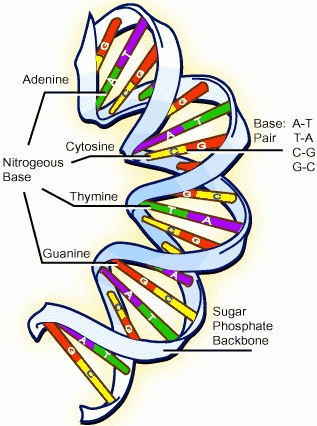
How did life begin?
How did life begin?

You only have a few minutes to respond, and your answer is going to go all around the office. So what should you say?

Stephen C. Meyer has the answer at Evolution News.

He writes:

I spoke recently to the Faith and Law group on Capitol Hill in D.C., a regular meeting of congressional staffers. At their request, I addressed the topic: “What Should Politicians Say When Asked About Evolution?”

[…]In my talk, I not only gave an answer to the question “What Should Politicians Say When Asked About Evolution?” but I first explained why it is a difficult question for many politicians, especially conservative ones, to answer. There are three main reasons.

I’m only going to give the first reason:

First, the term “evolution” can mean several different things, ranging from (1) the scientifically uncontroversial idea of “change over time” (think of small-scale variations in the shape and size of Galapagos finch beaks) to (2) the more controversial notion of universal common ancestry (think of Darwin’s tree of life) to (3) the increasingly controversial idea that the mechanism of natural selection and random mutation have produced all the forms of life we see today without any guidance or design. The last meaning of “evolution” is what Richard Dawkins calls the “Blind Watchmaker” thesis.

Equivocation in the definition of evolution can make it difficult for a politician to express legitimate skepticism about the controversial meanings of evolution without being presented to the public as being ignorant of established fact, or “anti-science.” In Walker’s recent case, media coverage traded on precisely this ambiguity to present him as being at odds with the majority of the American public, not to mention the scientific establishment. Media outlets repeatedly cited a poll showing that 65 percent of the American people believe that “human beings have changed over time” — i.e., the first and non-controversial meaning of evolution — without mentioning that a huge majority of Americans (and many scientists) reject the third and distinctly controversial meaning of evolution — the idea that the cause of the change over time is an unguided and undirected mechanism.

You can click through and read the other two, but for now, let’s jump to the right way to answer the question:

Most politicians, of course, don’t know about this tumult in the field or of any of the scientific problems with modern Darwinism. They are thus often unnecessarily intimidated by the consensus that supposedly exists in its favor.

In light of all this, any candidate asked about “the theory of evolution” would be well advised to give an answer that affirms the need to teach about contemporary evolutionary theory, but one that also makes clear distinctions between the different meanings of evolution and indicates an awareness of the scientific problems with the standard theory as demonstrated in the scientific literature. And frankly this is not party-specific advice. The scientific literature says what it says, whether consulted by Democrats or Republicans.

Politicians can also say that they think students should learn about those problems since they regard knowledge of the actual status of the theory as a matter of basic scientific literacy. They should not frame the issue as one of “Science versus the Bible,” or answer as if they were being asked about their personal religious beliefs, or as if they think the only alternative to current dogmatic teaching of Darwinian evolution (with its strict insistence on undirected evolution) is to teach Bible-based creationism. They can challenge the dogmatic (and often ideological) way the topic is currently taught and at the same time affirm their commitment to scientific literacy, academic freedom, and critical thinking.

And here’s a sample question and answer:

Reporter: “Do you believe in evolution?”

Candidate: “Of course, I believe that organisms have changed over time. I certainly believe in evolution in that sense. But I am skeptical about unguided evolution — the idea that natural selection and random mutations have produced the major changes in the history of life we observe without any guidance or design. In fact, in peer-reviewed scientific publications, many scientists have expressed doubts about the creative power of natural selection and random mutation. I think that students in learning about the modern version of Darwin’s theory should learn why scientists have these doubts. Understanding the strengths and weaknesses of scientific theories is a matter of basic scientific literacy. And there are scientific weaknesses in modern Darwinian theory.”

This is the right answer because you pull in the majority of people – the young Earth creationists, the intelligent designists and the guided evolutionists. The only people you leave out are the flat-out materialist naturalists, and they are in the minority. So that’s how you answer the question. It would probably help a great deal if you had read both of Meyer’s books on biological evolution, since he writes at the highest level – far higher than left-wing journalists who probably dropped biology because it was too much work.