
How the left uses “bullying” to restrict free speech that offends them

From Hans Bader at the Competitive Enterprise Institute.

Full text: (links removed)

A school superintendant has labeled a column in a school newspaper thatcriticized homosexuality as “bullying.” (The Shawano High School newspaper decided to run dueling student opinion pieces on whether same-sex couples should be able to adopt children; the student article that was labeled as “bullying” answered the question “no.” The school district also publicly apologized for the column, and said that it is “taking steps to prevent items of this nature from happening in the future.”)

Whatever the wisdom (or lack thereof) of featuring something like that in a school newspaper, it seems strange to argue that a viewpoint in a student newspaper is “bullying.” (The Shawano School District’s bullying policy provides that “bullying” may lead to “warning, suspension,” “expulsion,” etc.) A conservative Christian who thought that homosexuality was immoral successfully challenged a school “harassment” code that punished students with such viewpoints in Saxe v. State College Area School District(2001), a case in which a federal appeals court ruled that there is no “harassment” exception to the First Amendment for speech which offends members of minority groups. Speech cannot be banned simply by labeling it as violence, either: for example, in Bauer v.Sampson, another federal appeals court ruled that a campus newspaper’s illustration depicting a college official’s imaginary death was protected by the First Amendment, even though the college declared it a violation of its policy against “workplace violence.”

But schools and anti-bullying activists have adopted incredibly overbroad definitions of bullying. The anti-bullying website NoBully.com, and schools like Fox Hill and Alvarado Elementary, define even “eye rolling” and other expressions of displeasure or hostility as bullying, even though doing so raises First Amendment problems.

The Obama administration claims bullying is an “epidemic” and a “pandemic.” But in reality, bullying and violence have steadily gone down in the nation’s schools, as studies funded by the Justice Department have shown. The Obama administration’s StopBullying.gov website defines a vast array of speech and conduct as bullying: it classifies “teasing” as a form of “bullying,” and “rude” or “hurtful” “text messages” as “cyberbullying.” Since “creating web sites” that “make fun of others” also is deemed “cyberbullying,” conservative websites that poke fun at the president are presumably guilty of cyberbullying under this strange definition. (Law professors such as UCLA’s Eugene Volokh have criticized bills by liberal lawmakers like Congresswoman Linda Sanchez (D-Calif.) that would ban some criticism of politicians as cyberbullying.)

It’s very important to understand what liberals mean when they say “bullying” and how they use it to silence those who might offend them. It’s using government power to force individuals to accept the morality of the state. There’s a word for that.
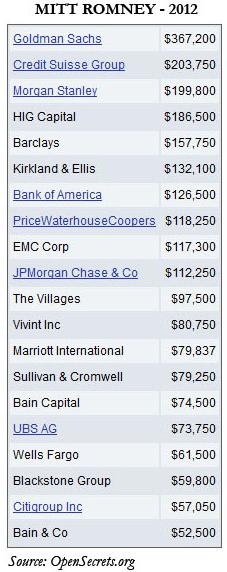
Mitt Romney’s tax returns would make him lose the election to Obama

Wall Street Banks contributions to Mitt Romney
Wall Street banks make huge contributions to Mitt Romney

From The Hill. (H/T Riehl Worldview)

Excerpt:

It’s important not to overstate the perils Romney faces. He is still by far the best-funded candidate in the race. He has a state-by-state infrastructure that is the envy of his rivals. Even if he were to lose Saturday’s South Carolina primary, he would  likely remain the overall favorite to clinch the nomination.

But the procession of errors has been striking nonetheless — and it has raised concerns among many in the GOP about his vulnerabilities in a general election contest with President Obama.

Most of Romney’s awkwardness has revolved around questions about his wealth. During a heated exchange during a debate last month, he ill-advisedly offered to bet Perry $10,000 that his own account of what he had written in one of his books was correct. Perry declined, saying he was “not in the betting business,” but the episode heightened perceptions that Romney is out of touch with most Americans.

The same pattern keeps cropping up. Earlier this week, he was asked about the effective tax rate he pays on his income, and managed to injure himself twice in the space of a few sentences. First, he acknowledged that his tax rate was “probably closer to the 15 percent rate than anything.” He then added: “I get speaker’s fees from time to time, but not very much.”

The first claim was almost certainly true. Romney’s income is believed to come chiefly from long-term investments rather than earned income, and that would indeed make him liable for capital gains tax levied at a 15 percent rate. But it still places the multimillionaire in a more lightly taxed band than many voters — something which Newt Gingrich tried to take advantage of with his mocking proposal to introduce a “Mitt Romney 15 percent flat tax.”

Perhaps even worse was Romney’s “not very much” comment. His latest financial disclosure form, which covered the period from February 2010 to February 2011, revealed that he earned $374,327 for speeches. The sum is approximately seven times the median household income in the United States.

Those remarks had been preceded by a televised debate at which he gave a muddled response about whether he would release his tax returns.

Romney flubbed the tax-return question for a second time at a debate last Thursday, eliciting boos from the crowd when he said he would “maybe” follow the example of his late father, former Michigan Gov. George Romney, who released 12 years of tax returns when running for the presidency in 1968.

Romney’s mangled syntax on these occasions seems symptomatic of a wider personal unease in discussing his finances. GOP consultants say he needs to get over that discomfort if he is to prove an effective candidate.

Another concern that I have is that Mitt Romney has $20-100 million dollars in his retirement account.

Excerpt:

Like many Americans, Mitt Romney has an individual retirement account. Unlike most Americans, Mr. Romney has between $20.7 million and $101.6 million in it, a big chunk of his fortune.

Experts on estate planning said it is highly unusual to accumulate such a considerable sum in an IRA, an investment vehicle restricted by annual contribution limits. It appears that Mr. Romney’s grew so large mostly because it holds investments in Bain Capital, the private-equity firm he helped start.

[…]Mr. Romney is one of the richest presidential candidates in decades, and his GOP opponents increasingly are trying to turn wealth into a liability. President Barack Obama is expected to do the same if the former Massachusetts governor wraps up the nomination. Mr. Romney’s tax liability has emerged as a debating point in the GOP nominating contest, a proxy for a bigger argument over who should shoulder the nation’s tax burden.

In recent days, Mr. Romney’s rivals have pressed him to release his tax returns. They have attacked him for his role at Bain Capital, the source of his wealth. When Mr. Romney revealed Tuesday that his effective federal income-tax rate had been about 15% in recent years, both the White House and GOP candidates used the number as a cudgel.

[…]Michael Whitty, a lawyer at Vedder Price in Chicago who advises private-equity executives, said it is impossible to determine from Mr. Romney’s public disclosures how the IRA grew so large. Based on its listed holdings, which include many Bain Capital vehicles, Mr. Whitty theorizes Mr. Romney may have invested in Bain funds through a 401(k)-type plan, or directed some of his Bain holdings into such a plan, which he then rolled into an IRA.

How is he going to explain that? This might be one of the reasons why Romney is not releasing his tax returns. He needs to be pounded on this by Gingrich and Santorum until he drops out – we can’t afford to choose a nominee who has no hope of beating Barack Obama.

Related posts

Scott Klusendorf: Five questions for pro-life candidates

Pro-lifer Scott Klusendorf on pro-life issues and candidate selection. (H/T Scott)

Summary:

In 2008, a handful of notable pro-life evangelicals and Catholics threw their support behind a presidential candidate sworn to uphold elective abortion as a fundamental right. They argued that doing so constituted an enlightened pro-life vote that was morally superior to the narrow party politics of religious conservatives. Instead of passing laws against abortion, so the argument went, the candidate and his party would “reduce” it by addressing its underlying causes.1 True, he was mistaken on abortion, but he was right on other, important “whole-of-life” issues such as opposition to war, concern for the poor, and care for the environment. The candidate’s political strategy was simple: shrink the significance of abortion so it was more or less equal with other issues.2

It worked. Twice as many white evangelicals age eighteen through forty-four voted for Barack Obama in 2008 than voted for John Kerry in 2004. Catholics, meanwhile, supported Obama at fifty-four percent, up seven points from what they gave Kerry four years earlier. The candidate got just enough pro-life votes from these groups to tip the election his way.3

I submit that each of these alleged pro-life votes represents a profound misunderstanding of the pro-life position. The fundamental issue before us is not merely how to reduce abortion, but who counts as one of us. How we answer will determine whether embryos and fetuses enjoy the protection of law or remain candidates for the dumpster. As Francis Beckwith points out, a society that has fewer abortions but protects the legal killing of unborn humans is still deeply immoral.4 Given what’s at stake, it’s vital that pro-life Christians persuasively answer five key questions before the 2012 election

He makes 5 points in the article.

Here’s point #4:

4. Instead of passing laws against abortion, shouldn’t pro-life Christians focus on reducing its underlying causes?

First and foremost, the abortion debate turns on the question of human equality. That is, in a nation dedicated to the proposition that all men are created equal, do the unborn count as members of the human family? With that fundamental question in mind, it’s unreasonable for liberals to insist that pro-lifers surrender the legal fight to focus on underlying causes. As my colleague Steve Weimar points out, this is like saying the “underlying cause” of spousal abuse is psychological, so instead of making it illegal for husbands to beat their wives, the solution is to provide counseling for men. There are “underlying causes” for rape, murder, theft, and so on, but that in no way makes it misguided to have laws banning such actions.8

Moreover, why are liberals even concerned about reducing the number of abortions in the first place? If destroying a human fetus is morally no different than cutting one’s fingernails, then who cares how many abortions there are? The reason to reduce elective abortion is that human life is unjustly taken-but if that’s the case, then restricting the practice makes perfect sense. Imagine a nineteenth-century lawmaker who said that slavery was a bad idea and we ought to reduce it, but owning slaves should remain legal. If those in power adopted his thinking, would this be a good society? True, politics isn’t a sufficient answer to injustice, but it’s certainly a necessary one. Martin Luther King, Jr., once said, “The law can’t make the white man love me, but it can stop him from lynching me.”9 Frankly, if Christians don’t think the government-sanctioned killing of unborn children merits a political response, then they not only misunderstand the moral gravity of the situation, but also their mandate to love their neighbor as themselves.

Underlying causes talk reminds me of how liberals, once in power, push contraception as a way of preventing unwanted pregnancy. The numbers from the UK show that this is like throwing gasoline on a fire – the number of abortions just goes up because contraception is not foolproof,  and it just normalizes sex all the more.

Point #5 is really worth reading, but too long to excerpt here.

Related posts