Tag Archives: Wealth Redistribution

Should Christians support social justice? Is wealth redistribution good for the poor?

Discovery Institute fellow Jonathan Witt pens this article in the American Spectator on the Gospel, business and social justice.

Excerpt:

The third term, social justice, is unlike the other two in its having a justifiable raison d’être. It stretches back to 19th century Catholic social thought and was used in the context of nuanced explorations of law, ethics, and justice. Unfortunately, this nuance and precision usually falls away in popular usage, and the term has been co-opted by the left to imply that ordinary justice is a mere tool of the ruling elite, with the real deal being “social justice.”

This impoverished meaning needs to be addressed. If a society extends justice to the rich and well-connected but allows the poor to be bullied and swindled by corrupt players inside and outside of the government, the problem isn’t unsocial justice but a lack of justice. If the poor in many developing nations can’t get access to credit or the courts because they can’t register their businesses, and they can’t register their businesses because they don’t have the bribe money and connections to navigate a byzantine regulatory maze, the problem is injustice, plain and simple. Such a society doesn’t need a social brand of justice any more than a poor neighborhood without stores needs a social grocery store. The neighborhood needs an ordinary grocery store, and the unjust society needs basic justice. Grocery stores and justice are already intrinsically social.

More than accurate semantics is at stake here. Often the popular call for “social justice” boils down to an ill-conceived call for coercive wealth transfers — for instance, getting rich countries to transfer more of their tax revenues to the governments of poor countries as foreign aid. It’d be nice if this approach actually helped the poor, since we’ve been using it for the past 60 years. Unfortunately, the statistical and narrative testimony on this strategy hovers between mixed and scandalous.

The reasons for this are complex but not so complex as to excuse the status quo. Much of the aid money gets quietly funneled into the pockets of corrupt politicians. In other cases the aid money reaches its intended target but, since the aid money is fungible, it still supports bad actors. It does so by freeing a regime of the political necessity of paying for the schools, road projects and emergency relief already covered by the foreign assistance. This, in turn, allows the regimes to spend more of their tax revenues for enhancing their own wealth and power.

Worse, the small fraction of aid money that actually reaches its intended destination often puts indigenous producers out of business, since it’s difficult to compete against free goods from abroad. Haiti’s rice farmers, for instance, once exported rice, but today their livelihoods have been all but wiped out by subsidized U.S. rice dumped on the country as foreign aid.

Add to all of this international “social justice” the devastating cultural effects of America’s welfare state. The neighborhoods flooded with 50 years of this domestic “social justice” now face far higher levels of criminal injustice and anti-social behavior than before the justice arrived.

Much of the problem stems from welfare’s effect on the institution of the family. The percentage of children being raised by both of their biological parents in America’s poorest neighborhoods used to be low and fairly comparable to what was found in middle and upper class neighborhoods, but the Great Society programs of the 1960s changed that.

As George Gilder put it in Wealth and Poverty, the underclass husband and father was “cuckolded by the compassionate state,” a violation which has incited “that very combination of resignation and rage, escapism and violence, short horizons and promiscuous sexuality that characterizes everywhere the life of the poor.”

Yale University sociologist Elijah Anderson put it almost as bluntly in a 1989 journal article: “It has become increasingly socially acceptable for a young woman to have children out of wedlock — significantly, with the help of a regular welfare check.”

The plain testimony of history is that the left’s strategy for saving the poor has been a tragic failure. It has stifled development in poor countries, bred a fatherless underclass in the United States, and all but bankrupted the European Union. Cloaking all of this in the guise of “social justice” serves only to perpetuate the tragedy.

It turns out that the very people who cry the loudest about wanting to help the poor – by redistributing wealth from those who produce to those who don’t – are the ones who incentivize people to make decisions that will make them poorer and expose them to more violence. Sure, there is a certain amount of uncertainty in life, but when you reward failure and punish success, you get more takers and fewer makers. The alternative to taxation and redistribution is to leave wealth in the hands of the individuals and businesses and trust them to make the decision about sharing. When businesses pay less in taxes, they expand – and more people start up new businesses, because they are attracted by the chance to make higher profits. Although letting individuals and business keep their own money is frowned on by the secular left, that’s because they themselves project their tendency not to give to charity and create jobs onto everyone else. They don’t understand charity and entrepreneurialism, that’s why they take money away from people who work and who create wealth.

I do want to say one other thing. I find it troubling when Christians present themselves to me as being social conservative, and fiscally liberal. There is no such thing as a social conservative and a fiscal liberal. If a person demands that the state provide cheese sandwiches to the children of single mothers in public schools, then  it creates more of an incentive to become a single mother, and less of an incentive to marry. That redistribution lowers the cost of single motherhood and raises the cost of marriage. It has been shown that single motherhood is the leading cause of child poverty – so why would we put into place incentives that encourage people to not make good decisions about sex? Why subsidize people who refuse to exercise self-control in sexual matters? Why make it encourage people to inflict fatherlessness on their own innocent children? Marriage is correlated with increased safety for women and children. Lowering the moral standards and paying people to make mistakes isn’t good for them. And it’s not good for their children.

The more you tax those who produce, the fewer of them you get. And the more you subsidize those who collect, the more of them you get. When men see themselves as slaves of the state – working only to be plundered – they stop working and they stop marrying. Why would a man work to feed the children of someone who could not even bother to get married before having babies? Why would a man get married knowing that half of what he earns will go to the state? Let families keep more of their own money, so that families are empowered – and not government. Let families keep their own money so they decide how to spend it, instead of depending on government. Let single mothers have to face the cost of their decisions. Let them ask charities for help, not the government. When people have to ask their neighbors for help, they know that they have done wrong, and that the money they get came from someone who worked for it. That is not there when government taxes and writes them a no-guilt check. Then it’s an entitlement, and they don’t learn their lesson.

Instead, let individuals and businesses make the decision to help those who they think are truly willing to try to improve their lot in life. Those are the ones who need support. When you leave wealth distribution to the government, no one is there to make those moral judgments. And it’s worse than that. When government takes over industries like health care, they are often supported by naive pro-lifers who think that wealth redistribution is compassion. But a secular government has no interest in women who stay home to raise their children – they want women to get out into the work force and pay income taxes. A single-payer health care system is always going to be pro-abortion for that reason. And any pro-lifer who votes “with their heart” for single-payer health care is a fool. They are, in effect, pro-abortion. Think before you vote.
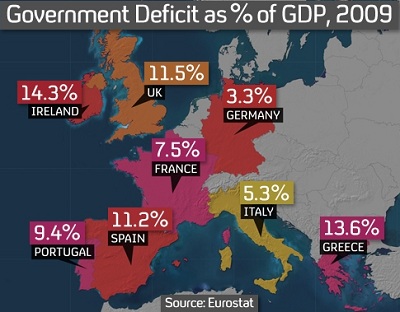
Bank run in socialist Europe begins

Europe: Annual Budget Deficit as % of GDP

From CNBC.

Excerpt:

Money-market funds in the United States have quite dramatically slammed shut their lending windows to European banks. According to the Economist, Fitch estimates U.S. money market funds have withdrawn 42 percent of their money from European banks in general.

And for France that number is even higher — 69 percent. European money-market funds are also getting in on the act.

Bond issuance by banks has seized up because buyers have gone on strike.

From the Economist’s Free Exchange Blog:

In the third quarter bonds issues by European banks only reached 15 percent of the amount they raised over the same period in the past two years, reckon analysts at Citi Group. It is unlikely that European banks have sold many more bonds since.

Corporate depositors are also pulling their cash.

Free Exchange:

“We are starting to witness signs that corporates are withdrawing deposits from banks in Spain, Italy, France and Belgium,” an analyst at Citi Group wrote in a recent report. “This is a worrying development.”

And there are troubling signs that banks are even running out of collateral to back their borrowings from the European Central Bank .

So far the liquidity of the European Central Bank (ECB) has kept the system alive. Only one large European bank, Dexia, has collapsed because of a funding shortage. Yet what happens if banks run out of collateral to borrow against?

And from the leftist New York Times.

Excerpt:

The flight from European sovereign debt and banks has spanned the globe. European institutions like the Royal Bank of Scotland and pension funds in the Netherlands have been heavy sellers in recent days. And earlier this month, Kokusai Asset Management in Japan unloaded nearly $1 billion in Italian debt.

At the same time, American institutions are pulling back on loans to even the sturdiest banks in Europe. When a $300 million certificate of deposit held by Vanguard’s $114 billion Prime Money Market Fund from Rabobank in the Netherlands came due on Nov. 9, Vanguard decided to let the loan expire and move the money out of Europe. Rabobank enjoys a AAA-credit rating and is considered one of the strongest banks in the world.

American money market funds, long a key supplier of dollars to European banks through short-term loans, have also become nervous. Fund managers have cut their holdings of notes issued by euro zone banks by $261 billion from around its peak in May, a 54 percent drop, according to JPMorgan Chase research.

This is really disturbing. I wonder if any of my economics-minded commenters can explain to me what happens when there is a run on banks. I am guessing that there will be some rioting over benefits as austerity measures are imposed, and interest rates will go up.

Real greed is when adults force children to give them a bailout from debt

This is a must-read by Mark Steyn.

Excerpt:

While President Obama was making his latest pitch for a brand new, even more unsustainable entitlement at the health care “summit,” thousands of Greeks took to the streets to riot. An enterprising cable network might have shown the two scenes on a continuous split screen – because they’re part of the same story. It’s just that Greece is a little further along in the plot: They’re at the point where the canoe is about to plunge over the falls. America is further upstream and can still pull for shore, but has decided instead that what it needs to do is catch up with the Greek canoe. Chapter One (the introduction of unsustainable entitlements) leads eventually to Chapter 20 (total societal collapse): The Greeks are at Chapter 17 or 18.

What’s happening in the developed world today isn’t so very hard to understand: The 20th century Bismarckian welfare state has run out of people to stick it to. In America, the feckless insatiable boobs in Washington, Sacramento, Albany and elsewhere are screwing over our kids and grandkids. In Europe, they’ve reached the next stage in social democratic evolution: There are no kids or grandkids to screw over. The United States has a fertility rate of around 2.1, or just over two kids per couple. Greece has a fertility rate of about 1.3: 10 grandparents have six kids have four grandkids – i.e., the family tree is upside down. Demographers call 1.3 “lowest-low” fertility – the point from which no society has ever recovered. And compared to Spain and Italy, Greece has the least worst fertility rate in Mediterranean Europe.

So you can’t borrow against the future because, in the most basic sense, you don’t have one. Greeks in the public sector retire at 58, which sounds great. But, when 10 grandparents have four grandchildren, who pays for you to spend the last third of your adult life loafing around?

By the way, you don’t have to go to Greece to experience Greek-style retirement: The Athenian “public service” of California has been metaphorically face-down in the ouzo for a generation. Still, America as a whole is not yet Greece. A couple of years ago, when I wrote my book “America Alone,” I put the Social Security debate in a bit of perspective: On 2005 figures, projected public pensions liabilities were expected to rise by 2040 to about 6.8 percent of GDP. In Greece, the figure was 25 percent. In other words, head for the hills, Armageddon, outta here, The End. Since then, the situation has worsened in both countries. And really the comparison is academic: Whereas America still has a choice, Greece isn’t going to have a 2040 – not without a massive shot of Reality Juice.

Is that likely to happen? At such moments, I like to modify Gerald Ford. When seeking to ingratiate himself with conservative audiences, President Ford liked to say: “A government big enough to give you everything you want is big enough to take away everything you have.” Which is true enough. But there’s an intermediate stage: A government big enough to give you everything you want isn’t big enough to get you to give any of it back. That’s the point Greece is at. Its socialist government has been forced into supporting a package of austerity measures. The Greek people’s response is: Nuts to that. Public sector workers have succeeded in redefining time itself: Every year, they receive 14 monthly payments. You do the math. And for about seven months’ work – for many of them the workday ends at 2:30 p.m. When they retire, they get 14 monthly pension payments. In other words: Economic reality is not my problem. I want my benefits. And, if it bankrupts the entire state a generation from now, who cares as long as they keep the checks coming until I croak?

We hard-hearted, small-government guys are often damned as selfish types who care nothing for the general welfare. But, as the Greek protests make plain, nothing makes an individual more selfish than the socially equitable communitarianism of big government. Once a chap’s enjoying the fruits of government health care, government-paid vacation, government-funded early retirement, and all the rest, he couldn’t give a hoot about the general societal interest. He’s got his, and to hell with everyone else. People’s sense of entitlement endures long after the entitlement has ceased to make sense.

The perfect spokesman for the entitlement mentality is the deputy prime minister of Greece. The European Union has concluded that the Greek government’s austerity measures are insufficient and, as a condition of bailout, has demanded something more robust. Greece is no longer a sovereign state: It’s General Motors, and the EU is Washington, and the Greek electorate is happy to play the part of the United Auto Workers – everything’s on the table except anything that would actually make a difference. In practice, because Spain, Portugal, Italy and Ireland are also on the brink of the abyss, a “European” bailout will be paid for by Germany. So the aforementioned Greek deputy prime minister, Theodoros Pangalos, has denounced the conditions of the EU deal on the grounds that the Germans stole all the bullion from the Bank of Greece during the Second World War. Welfare always breeds contempt, in nations as much as inner-city housing projects. How dare you tell us how to live! Just give us your money and push off.

This is the real character of people who avoid having to care about producing goods and services to please customers – people who join public sector unions and work for the government. They elect candidates who will provide them with a standard of living much higher than what they can produce by their own efforts, and pass the bill down to real workers in the private sector, or worse, workers who are not even born. It’s a shame. It’s a shame that parasites should enslave children who are not yet born so that they can have a standard of living they haven’t paid for. And it’s laughable that they impugn the character of productive private sector workers and business owners by talking about “Greed”. The parasites in the public sector unions are the greedy ones. What could be more greedy than intergenerational theft?