
Tag Archives: Wages

Graduate students with non-STEM degrees increasingly dependent on welfare programs

From the Chronicle of Higher Education.

Excerpt:

Melissa Bruninga-Matteau, a medieval-history Ph.D. and adjunct professor who gets food stamps: “I’ve been able to make enough to live on. Until now.”

“I am not a welfare queen,” says Melissa Bruninga-Matteau.

That’s how she feels compelled to start a conversation about how she, a white woman with a Ph.D. in medieval history and an adjunct professor, came to rely on food stamps and Medicaid. Ms. Bruninga-Matteau, a 43-year-old single mother who teaches two humanities courses at Yavapai College, in Prescott, Ariz., says the stereotype of the people receiving such aid does not reflect reality. Recipients include growing numbers of people like her, the highly educated, whose advanced degrees have not insulated them from financial hardship.

“I find it horrifying that someone who stands in front of college classes and teaches is on welfare,” she says.

Ms. Bruninga-Matteau grew up in an upper-middle class family in Montana that valued hard work and saw educational achievement as the pathway to a successful career and a prosperous life. She entered graduate school at the University of California at Irvine in 2002, idealistic about landing a tenure-track job in her field. She never imagined that she’d end up trying to eke out a living, teaching college for poverty wages, with no benefits or job security.

Ms. Bruninga-Matteau always wanted to teach. She started working as an adjunct in graduate school. This semester she is working 20 hours each week, prepping, teaching, advising, and grading papers for two courses at Yavapai, a community college with campuses in Chino Valley, Clarkdale, Prescott, Prescott Valley, and Sedona. Her take-home pay is $900 a month, of which $750 goes to rent. Each week, she spends $40 on gas to get her to the campus; she lives 43 miles away, where housing is cheaper.

Ms. Bruninga-Matteau does not blame Yavapai College for her situation but rather the “systematic defunding of higher education.” In Arizona last year, Gov. Jan Brewer, a Republican, signed a budget that cut the state’s allocation to Yavapai’s operating budget from $4.3-million to $900,000, which represented a 7.6 percent reduction in the college’s operating budget. The cut led to an 18,000-hour reduction in the use of part-time faculty like Ms. Bruninga-Matteau.

“The media gives us this image that people who are on public assistance are dropouts, on drugs or alcohol, and are irresponsible,” she says. “I’m not irresponsible. I’m highly educated. I have a whole lot of skills besides knowing about medieval history, and I’ve had other jobs. I’ve never made a lot of money, but I’ve been able to make enough to live on. Until now.”

She’s irresponsible, because she expects the people who choose to study rather difficult and unpleasant subjects like nursing and computer science and economics to pay for her lifestyle through taxation and “higher education funding”. I do think it’s important to point out that the main driver of higher tuition is increasing government funding of education, and that this increasing funding of higher education is nothing but corporate welfare.

Excerpt:

The most obvious way that colleges might capture federal student aid is by raising tuition. Research to date has been inconclusive, but Stephanie Riegg Cellini of George Washington University and Claudia Goldin of Harvard have provided compelling new analysis. Cellini and Goldin looked at for-profit colleges, utilizing the key distinction that only some for-profit schools are eligible for federal aid. Riegg and Goldin find that that aid-eligible institutions “charge much higher tuition … across all states, samples, and specifications,” even when controlling for the content and quality of courses. The 75 percent difference in tuition between aid-eligible and ineligible for-profit colleges — an amount comparable to average per-student federal assistance — suggests that “institutions may indeed raise tuition to capture the maximum grant aid available.”

Here are some of the comments that I posted in a Facebook discussion about the CHE story:

I know that some may disagree with me, but this is why people need to focus on STEM fields and stay away from artsy stuff and Ph.Ds in general. We are in a recession. Trade school and STEM degrees only until things improve.

Also, no single motherhood by choice. Get married before you have children, and make sure you vet the husband carefully for his ability to protect, provide, commit and lead on moral and spiritual issues. This woman is not a victim. She chose her life, and the rest of us are paying for it. Nice tattoos by the way – that will really help when she’s looking for a job.

I am actually better at English than computer science, but I find myself with a BS and MS in computer science. We don’t get to do what we like. We do what we have to in order to be effective as Christians. According to the Bible, men have an obligation to not engage in premarital sex, and to marry before having children, and to provide for their families, or they have denied the faith. I would like to have studied English, but the Bible says no way.

I have no problem with people who can make a career out of the arts, like a Robert George or a William Lane Craig. But you can’t just go crazy. And I think men have a lot less freedom than women to choose their major, we have the obligation to be providers and we have to be selected by women based on whether we can fulfill that role (among other roles).

Women have more freedom because they are not saddled with the provider role like men are. However, I think that the times now are different than before. There is more discrimination against conservatives on campus in non-STEM fields and fewer non-STEM jobs in a competitive global economy. The safest fields are things like petroleum engineering, software engineering, etc.

If [people who major in the humanities] can make a living and support a family without relying on government-controlled redistribution of wealth, then I salute and encourage you. If you rely on the government, know that this money is being taken away from those who are doing things they don’t like at all in order to be independent and self-reliant. It is never good to be dependent on government. That money comes from people like me.

In response to an artsy challenger:

I am happy to be scorned by those who make poor choices so long as I can have my money back from them so that I can pursue my dreams. I didn’t see any of these artsy people in the lab at 4 AM completing their operating system class assignments, nor do I see them here working overtime on the weekend in the office. They can say anything and feel anything they want, and write plays and poetry all about their feelings, too. Just give me the money I earned back first. It’s not their money. They have no right to it.

One person asked why I was “always winter, never Christmas, and I replied:

It is Christmas for the Christians who I send books and DVDs to, as well as for the Christian scholars I support, and the Christian conferences, debates and lectures I underwrite across the world. Unfortunately, every dollar taken from me is a dollar less for that Ph.D tuition of a Christian debater, a dollar less for the flight of that Christian apologetics speaker, a dollar less for that textbook for that Christian biology student, and a dollar less for the flowers being sent to that post-abortive woman who I counseled who is now in law school. I have a need for the money I earn, and when it’s sent to Planned Parenthood to pay for abortions by the government, my plan to serve God suffers. And finally, should I ever get married, I would like my wife to have the option of staying home with the children and even homeschooling them. That costs money. Somehow, I feel that given the choice between my homeschooling wife and the public school unions, the government will choose to give my money to the unions. Just a hunch.

I think that people should go into the humanities when they are serious about making a career of it and can get the highest grades. But if they are coasting and only getting Bs and Cs and not paying attention in class, then drop out and go to trade school. Don’t complain later when you can’t find a job. STEM careers pay the most.

Top-earning degrees / college majors

Here’s my previous post on the woman who accumulated $185,000 of student debt studying the humanities and is likewise demanding handouts and claiming not to be responsible.
1 in 2 new graduates are jobless or underemployed

From CNS News.

Excerpt:

 The college class of 2012 is in for a rude welcome to the world of work.

A weak labor market already has left half of young college graduates either jobless or underemployed in positions that don’t fully use their skills and knowledge.

Young adults with bachelor’s degrees are increasingly scraping by in lower-wage jobs — waiter or waitress, bartender, retail clerk or receptionist, for example — and that’s confounding their hopes a degree would pay off despite higher tuition and mounting student loans.

An analysis of government data conducted for The Associated Press lays bare the highly uneven prospects for holders of bachelor’s degrees.

Opportunities for college graduates vary widely.

While there’s strong demand in science, education and health fields, arts and humanities flounder. Median wages for those with bachelor’s degrees are down from 2000, hit by technological changes that are eliminating midlevel jobs such as bank tellers. Most future job openings are projected to be in lower-skilled positions such as home health aides, who can provide personalized attention as the U.S. population ages.

Taking underemployment into consideration, the job prospects for bachelor’s degree holders fell last year to the lowest level in more than a decade.

[…]You can make more money on average if you go to college, but it’s not true for everybody,” says Harvard economist Richard Freeman, noting the growing risk of a debt bubble with total U.S. student loan debt surpassing $1 trillion. “If you’re not sure what you’re going to be doing, it probably bodes well to take some job, if you can get one, and get a sense first of what you want from college.”

Andrew Sum, director of the Center for Labor Market Studies at Northeastern University who analyzed the numbers, said many people with a bachelor’s degree face a double whammy of rising tuition and poor job outcomes. “Simply put, we’re failing kids coming out of college,” he said, emphasizing that when it comes to jobs, a college major can make all the difference. “We’re going to need a lot better job growth and connections to the labor market, otherwise college debt will grow.”

That bit about getting a job so you know what you need to study. It’s important to get a job – any job – so that you understand what you are supposed to be learning in high school and college – what employers want! The next most important thing is to have a career mentor – someone to steer you away from subjects like English and ballet and into engineering and science. A trade school is another good choice: nursing or electrical wiring or something like that. Something valuable that employers need – that should be the deciding factor – what employers want you to do for them. Here’s a page listing degrees and expected incomes. Engineering, medicine and computer science are the three best fields.

I am still trying to puzzle out why young people vote for Democrats so much. I think that they have been brainwashed to think that making moral judgments is wrong, so they keep voting against Republicans who pro-life, pro-marriage, pro-family and pro-personal responsibility. That’s what teachers tell them in school – don’t have any moral standards, don’t make any moral judgments, let the government spend your money for you to be more “fair”, etc. So young people vote for Democrats. But voting for Democrats doesn’t just weaken the social fabric, it also wrecks the economy. Who do young people expect to work for when they keep voting to bash corporations all the time? Corporations hire young people. It seems stupid to vote against the people who want to pay you to do work.

Now that I think about it, it might be a good idea for social conservatives to be ready to make a case for free market capitalism and limited government, using evidence like this that shows how socialism fails to create economic growth and jobs. Even if people vote for conservatism based on fiscal concerns or foreign policy concerns, it’s still going to be helpful to social conservatives. We need to be like Paul and be able to speak intelligently to any audience on a wider variety of topics. Also, I think it helps social conservatives to be seen as competent in areas outside of social conservatism – it’s important to have a well-rounded worldview in order to not be perceived as being narrow-minded and ideologically motivated.

New paper on income inequality: Does taxing the rich hurt the middle class?

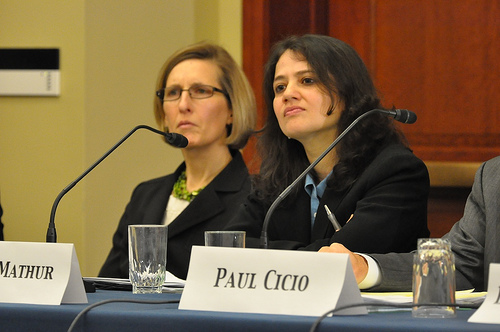
Aparna Mathur (right)

Here’s an article by Indian economist Aparna Mathur.

She writes (in part):

In a recent paper that I co-authored with Kevin Hassett, we explored the effect of high corporate taxes on worker wages. The motivation for the paper came from the international tax literature (summarized by Roger Gordon and Jim Hines in a 2002 paper1) that suggested that mobile capital flows from high tax to low tax jurisdictions. In other words, in any set of competing countries, investment flows are determined by relative rates of taxation. The current U.S. headline rate of corporate tax is 35 percent. The combined federal and state statutory rate of 39 percent is second only to Japan in the OECD. With Japan set to lower its statutory rate later this year, the U.S. rate will soon be the highest in the OECD and one of the highest in the world. What effect do these high rates have on worker wages?

When capital flows out of a high tax country, such as the United States, it leads to lower domestic investment, as firms decide against adding a new machine or building a factory. The lower levels of investment affect the productivity of the American worker, because they may not have the best machines or enough machines to work with. This leads to lower wages, as there is a tight link between workers’ productivity and their pay. It could also lead to less demand for workers, since the firms have decided to carry out investment activities elsewhere.

Our paper was one of the first to explore the adverse effect of corporate taxes on worker wages. Using data on more than 100 countries, we found that higher corporate taxes lead to lower wages. In fact, workers shoulder a much larger share of the corporate tax burden (more than 100 percent) than had previously been assumed. The reason the incidence can be higher than 100 percent is neatly explained in a 2006 paper by the famous economist Arnold Harberger.2 Simply put, when taxes are imposed on a corporation, wages are lowered not only for the workers in that firm, but for all workers in the economy since otherwise competition would drive workers away from the low-wage firms. As a result, a $1 corporate income tax on a firm could lead to a $1 loss in wages for workers in that firm, but could also lead to more than a $1 loss overall when we look at the lower wages across all workers.

Following our paper, several academic economists substantiated our results, using different data sets and applying varied econometric modeling and techniques. Some examples of these studies include a 2007 paper by Mihir A. Desai and C. Fritz Foley of Harvard Business School and James Hines Jr. of Michigan University Law School, a 2007 paper by R. Alison Felix of the Federal Reserve Bank of Kansas City, a 2009 paper by Robert Carroll of The Tax Foundation, and a 2010 paper by Wiji Arulampalam of the University of Warwick and Michael Devereux and Giorgia Maffini of Oxford.3 A recent Tax Notes article that I co-authored summarizes these various studies and also the lessons from the theoretical literature on the topic. The general consensus from theory and empirical work is that while we may argue academically about the size of the effect, there is no disagreement among economists that a sizeable burden of the corporate income tax is disproportionately felt by working Americans. On average, a $1 increase in corporate tax revenues could lead to a dollar or more decline in the wage bill.

Conservatives and liberals have the same goal. We both want to help the poor. Liberals think that taking money from the rich and giving it to the poor helps, but all it does it cause the rich to move their capital and jobs elsewhere, leaving the poor poorer. Conservatives let the rich keep their money and encourage them to risk it trying to make more money by engaging in enterprises that create wealth – creating products and services from less valuable raw materials. In a socialist system, the rich get poorer, but so do the poor. In a capitalist system, the rich get very rich, but the poor also gain more wealth. That’s what happens when corporations like Apple make IPads out of junky raw materials. That’s how wealth is created – by letting people who want to make things keep more of what they earn. We all benefit from encouraging people to make new things and provide value for their neighbors.

Related articles