

Tag Archives: Wages

As senator, Hillary Clinton paid women 72 cents for every dollar she paid men

Hillary Clinton and Planned Parenthood

I already knew that Hillary Clinton was pro-gay-marriage, and radically pro-abortion, but it turns out that she is a hypocrite on women’s issues, as well.

The Washington Times reports:

During her time as senator of New York, Hillary Rodham Clinton paid her female staffers 72 cents for every dollar she paid men, according to a new Washington Free Beacon report.

From 2002 to 2008, the median annual salary for Mrs. Clinton’s female staffers was $15,708.38 less than what was paid to men, the report said. Women earned a slightly higher median salary than men in 2005, coming in at $1.04. But in 2006, they earned 65 cents for each dollar men earned, and in 2008, they earned only 63 cents on the dollar, The Free Beacon reported.

[…]Mrs. Clinton has spoken against wage inequality in the past. In April, she ironically tweeted that “20 years ago, women made 72 cents on the dollar to men. Today it’s still just 77 cents. More work to do. #EqualPay #NoCeilings.”

Meanwhile, she is making “equal pay for women” her top priority.

CBS News reports:

Hillary Clinton lamented the number of women in the fields of science, technology, engineering and math at a Silicon Valley women’s conference on Tuesday, and called for more action to close the wage gap.

[…]In advocating for closing the pay gap, Clinton also endorsed the impassioned plea for wage equality made by Patricia Arquette in her Oscars acceptance speech for Best Supporting Actress.

“Up and down the ladder many women are paid less for the same work, which is why we all cheered at Patricia Arquette’s speech at the Oscars — because she’s right, it’s time to have wage equality once and for all,” Clinton said.

All right, let’s take a look at the facts on the so-called “pay gap” between men and women.

The facts

This article is from the very left-wing Slate, of all places.

Excerpt:

The official Bureau of Labor Department statistics show that the median earnings of full-time female workers is 77 percent of the median earnings of full-time male workers. But that is very different than “77 cents on the dollar for doing the same work as men.” The latter gives the impression that a man and a woman standing next to each other doing the same job for the same number of hours get paid different salaries. That’s not at all the case. “Full time” officially means 35 hours, but men work more hours than women. That’s the first problem: We could be comparing men working 40 hours to women working 35.

How to get a more accurate measure? First, instead of comparing annual wages, start by comparing average weekly wages. This is considered a slightly more accurate measure because it eliminates variables like time off during the year or annual bonuses (and yes, men get higher bonuses, but let’s shelve that for a moment in our quest for a pure wage gap number). By this measure, women earn 81 percent of what men earn, although it varies widely by race. African-American women, for example, earn 94 percent of what African-American men earn in a typical week. Then, when you restrict the comparison to men and women working 40 hours a week, the gap narrows to 87 percent.

But we’re still not close to measuring women “doing the same work as men.” For that, we’d have to adjust for many other factors that go into determining salary. Economists Francine Blau and Lawrence Kahn did that in a recent paper, “The Gender Pay Gap.”.”They first accounted for education and experience. That didn’t shift the gap very much, because women generally have at least as much and usually more education than men, and since the 1980s they have been gaining the experience. The fact that men are more likely to be in unions and have their salaries protected accounts for about 4 percent of the gap. The big differences are in occupation and industry. Women congregate in different professions than men do, and the largely male professions tend to be higher-paying. If you account for those differences, and then compare a woman and a man doing the same job, the pay gap narrows to 91 percent. So, you could accurately say in that Obama ad that, “women get paid 91 cents on the dollar for doing the same work as men.”

I believe that the remainder of the gap can be accounted for by looking at other voluntary factors that differentiate men and women.

The Heritage Foundation says that a recent study puts the number at 95 cents per dollar.

Excerpt:

Women are more likely than men to work in industries with more flexible schedules. Women are also more likely to spend time outside the labor force to care for children. These choices have benefits, but they also reduce pay—for both men and women. When economists control for such factors, they find the gender gap largely disappears.

A 2009 study commissioned by the Department of Labor found that after controlling for occupation, experience, and other choices, women earn 95 percent as much as men do. In 2005, June O’Neil, the former director of the Congressional Budget Office, found that “There is no gender gap in wages among men and women with similar family roles.” Different choices—not discrimination—account for different employment and wage outcomes.

A popular article by Carrie Lukas in the Wall Street Journal agrees.

Excerpt:

The Department of Labor’s Time Use survey shows that full-time working women spend an average of 8.01 hours per day on the job, compared to 8.75 hours for full-time working men. One would expect that someone who works 9% more would also earn more. This one fact alone accounts for more than a third of the wage gap.

[…]Recent studies have shown that the wage gap shrinks—or even reverses—when relevant factors are taken into account and comparisons are made between men and women in similar circumstances. In a 2010 study of single, childless urban workers between the ages of 22 and 30, the research firm Reach Advisors found that women earned an average of 8% more than their male counterparts. Given that women are outpacing men in educational attainment, and that our economy is increasingly geared toward knowledge-based jobs, it makes sense that women’s earnings are going up compared to men’s.

When women make different choices about education and labor that are more like what men choose, they earn just as much or more than men.
Technological advances make the Keystone XL pipeline safer than alternatives

My Dad loves to read Fox News, and he sent me this article about the technology behind the Keystone XL pipeline. We got into a good discussion on this article, too. My Dad used to be a big believer in big government, but now he only cares about what problems the private sector can solve.

The article says:

The Obama administration continues to block the controversial Keystone XL pipeline that would transport nearly 35 million gallons of oil a day from Canada to the U.S., citing environmental concerns as the reason. But according to pipeline advocates, it would use the latest technology and best safety features to prevent spills.

Advanced steel is part of it. The current part of the Keystone pipeline that already exists uses 2,638 miles of hardened steel built to “withstand  impact from a 65-ton excavator with 3.5-inch teeth,” according to TransCanada, the company behind the Keystone pipeline.

The steel is also coated with alloys to prevent it from wearing out.

“They use all kinds of methodologies to reduce friction. Corrosion inhibition is pretty sexy stuff in this business,” Eric Smith, associate director of Tulane University’s Energy Institute, told FoxNews.com

Pumping stations are another critical part. All along the pipeline, pumps move the oil using centrifugal force: a motor spins and forces oil to the edges of the pump, which causes more oil to rush forward to take the place of the oil pulled to the edges.

Each pump has 6,500 horsepower – meaning that the pump exerts an amount of power roughly equivalent to that of 6,500 horses. Total pumping power on the existing pipeline is nearly half a million horsepower, according to TransCanada.

Another critical technology is leak detection systems. The existing Keystone pipeline, for instance, has sensors that collect data from 20,000 different points along the pipeline.

If a leak occurs anywhere along the pipeline, the pressure in the pipeline changes, and TransCanada notes that such changes travel through the pipeline at the speed of sound and so can be detected nearly instantly.

The company adds that the pipeline has “fail-safe” mechanisms that automatically reduce oil pressure in the pipeline to safe levels.

TransCanada also has airplanes monitor the pipeline from the sky, using both the eyes of human pilots and a “Laser Spectroscopy Unit” that shoots a laser near the pipeline and then analyzes the reaction of whatever material is hit by the laser beam. TransCanada says this is “capable of identifying tiny methane leaks at patrol altitudes.”

The human pilots also catch things. TransCanada reports that one of its pilots once noticed that a circus in Kansas had tethered an elephant to a pipeline stake, which posed a potential threat.

All the layers of security help, say experts.

“It’s a belt-and-suspenders kind of approach. You just don’t want even minute leaks,” Smith said, adding that pipelines are the safest way of moving oil across land.

Pipelines are actually much safer than transporting the oil by train, which is the method favored by environmentalist opponents to Keystone XL:

According to a 2006 study by Environmental Research Consulting using Department of Transportation data, pipelines have spilled far less than trucks or railroads per ton of oil transported.

Critics of President Obama’s delay of the Keystone XL construction say the holdup actually makes everyone less safe, as oil producers instead rely on comparatively dangerous railroads for transportation. From 2008 to 2013, the amount of oil transported by rail skyrocketed from 9,500 carloads in 2008 to 41 times that – 407,642 – in 2013.

My big point to my Dad about this is how the private sector responds to the desires of customers on their own, developing solutions for the people who they expect to buy their products. The government spends 2 billion on the Obamacare web site, and forces people to use it. They can never develop anything people actually want to buy. Government just taxes, regulates and restricts the businesses who seek to solve problems for customers.

It’s the private sector businesses who are the real heroes to customers – making the things that we want and need and competing with other businesses to sell the most quality at the lowest price. They even find solutions to our concerns about the environment, if we let them, because that is part of pleasing the customer, too. If we had to wait on public school teachers, politicians, Hollywood clowns and academics to innovate, we would be waiting a long time indeed. I stand with private sector business, and the free-market system in general.

UPDATE: Holy snouts. For the first time in 6 years I am actually proud of Obama for doing something:

The Obama administration has opened a new front in the global battle for oil market share, effectively clearing the way for the shipment of as much as a million barrels per day of ultra-light U.S. crude to the rest of the world.

The Department of Commerce on Tuesday ended a year-long silence on a contentious, four-decade ban on oil exports, saying it had begun approving a backlog of requests to sell processed light oil abroad. It also issued a long-awaited document outlining exactly what kinds of oil other would-be exporters can ship.

The administration’s first serious effort to clarify an issue that has caused confusion and consternation in energy markets for more than a year will likely please domestic oil drillers, foreign trade partners and some Republicans who have urged Obama to loosen the export ban, which they see as an outdated holdover from the 1970s Arab oil embargo.

The latest measures were wrapped in regulatory jargon and couched by some as a basic clarification of existing rules, but analysts said the message was unambiguous: a green light for any company willing and able to process their light condensate crude through a distillation tower, a simple piece of oilfield kit.

“In practice this long-awaited move can open up the floodgates to substantial increases in exports by end 2015,” Ed Morse, global head of commodities research at Citigroup in New York said in a research note.

[…]By opening the door to U.S. crude exports, the administration is offering a bit of relief to some domestic drillers that have said that they are forced to sell their shale oil at a discount of as much as $15 a barrel versus global markets as fast-rising domestic supplies overwhelm local demand.

Let’s hope Obama signs the Keystone XL pipeline in the new year, too. That will help people so much and hurt our enemies, Russia, Venezuela and Iran. There are ways to fight wars without firing a shot, and this is how you do it – he looks like Ronald Reagan, now. Well done, Barack Obama! Finally!

Should young Americans feel confident about their economic prospects?

Wages of Young Americans (Source: The Atlantic)

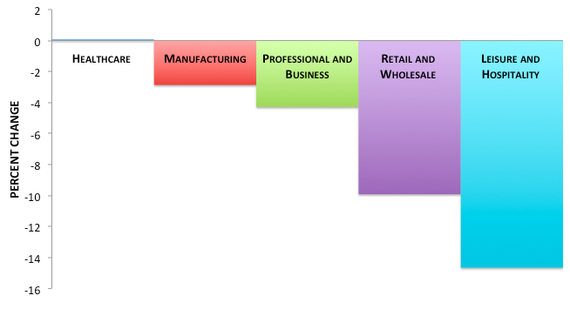
Graph: Young People’s Wages Have Fallen Across Industries Between 2007 and 2013.

Young Americans are taking longer to graduate and graduating with more debt, but that’s not all – they aren’t find jobs, and the jobs they do find typically don’t allow them to pay back their loans.

Here’s an article from The Atlantic, which leans left.

Excerpt:

American families are grappling with stagnant wage growth, as the costs of health care, education, and housing continue to climb. But for many of America’s younger workers, “stagnant” wages shouldn’t sound so bad. In fact, they might sound like a massive raise.

Since the Great Recession struck in 2007, the median wage for people between the ages of 25 and 34, adjusted for inflation, has fallen in every major industry except for health care.

These numbers come from an analysis of the Census Current Population Surveyby Konrad Mugglestone, an economist with Young Invincibles.

In retail, wholesale, leisure, and hospitality—which together employ more than one quarter of this age group—real wages have fallen more than 10 percent since 2007. To be clear, this doesn’t mean that most of this cohort are seeing their pay slashed, year after year. Instead it suggests that wage growth is failing to keep up with inflation, and that, as twentysomethings pass into their thirties, they are earning less than their older peers did before the recession.

The picture isn’t much better for the youngest group of workers between 18 and 24. Besides health care, the industries employing the vast majority of part-time students and recent graduates are also watching wages fall behind inflation. (40 percent of this group is enrolled in college.)

It’s not just that – the Democrats are doing a pretty good job of wrecking other parts of the economy, from energy development to health care to entitlement programs to college tuition, which rises higher as government throws more money into the system. They are doing everything they can to wreck the economy with higher taxes and burdensome regulations.

As a result of our headlong rush towards socialism, the U.S. economy has now fallen to number 2 in the worldbehind China.

Look:

We’re no longer No. 1. Today, we’re No. 2. Yes, it’s official. The Chinese economy just overtook the United States economy to become the largest in the world. For the first time since Ulysses S. Grant was president, America is not the leading economic power on the planet.

It just happened — and almost nobody noticed.

The International Monetary Fund recently released the latest numbers for the world economy. And when you measure national economic output in “real” terms of goods and services, China will this year produce $17.6 trillion — compared with $17.4 trillion for the U.S.A.

As recently as 2000, we produced nearly three times as much as the Chinese.

To put the numbers slightly differently, China now accounts for 16.5% of the global economy when measured in real purchasing-power terms, compared with 16.3% for the U.S.

This latest economic earthquake follows the development last year when China surpassed the U.S. for the first time in terms of global trade.

So things are bad for young people, and it’s going to get worse.

It’s important to check what major you are studying to make sure you get a return on your investment, and don’t be scared to study something you hate if it means that you can make your career work. Your education and career choices are not about fulfillment and thrills. You have to make hard choices in order to make ends meet so that you have freedom to do the things you ought to do, especially if you want to get married and start a family. Those marriage and family plans start the day you step into high school, in my opinion.

UPDATE: 17.7% Teen Unemployment in America – Still Above Rate of 6 Years Ago and Labor Force Participation Remains at 36-Year Low.