
Tag Archives: Theistic Evolution

Darwinian apologists absent from conference on evolution research

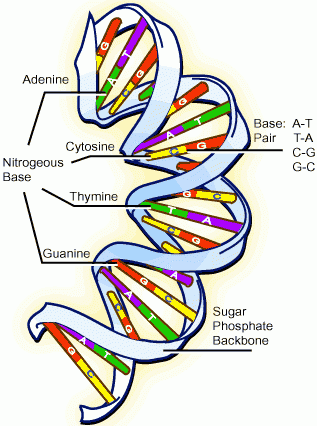
Structure of DNA
Where do you get your information?

Thomas Cudworth explains at Uncommon Descent.

Excerpt:

From June 17 to June 21, 2011, at the University of Oklahoma (Norman) campus, the conference “Evolution 2011” was in session.  It was co-sponsored by three scientific societies – The Society for the Study of Evolution, The Society of Systematic Biologists, and the American Society of Naturalists.  It was billed by its promoters as “the premier annual international conference of evolutionary biologists on the planet.”

That billing may be somewhat hyperbolic, yet two things are clear:  the conference was huge, with an expected turnout of 1400-1500 people; and many of the big names of evolutionary biology were to be there.  Jerry Coyne was to give an address; H. Allen Orr was to chair a session; and Gunter Wagner and Sergey Gavrilets, cutting-edge biologists from the famed 2008 Altenberg conference, were to be there as well.  Hundreds of papers were scheduled, and the research contributors to the various papers and presentations, according to the index for the conference, numbered something like 2,000.

[…]Let’s start with those Darwin defenders who are actively anti-religious or show contempt for religion in their writings and internet remarks.  Conspicuously absent from the list of conference contributors were evolutionary champions Richard Dawkins, P. Z. Myers, Larry Moran, and Eugenie Scott.

Among those who have not attacked religious belief, but have violently bashed ID and/or passionately upheld neo-Darwinian theory, Paul Gross (co-author of Creationism’s Trojan Horse) and plant scientist Arthur Hunt (who has debated ID people live and on the internet) were not listed as contributors to any of the papers.

Among those who were active in the Dover ID trial, as witnesses for the plaintiffs, the no-shows include Kevin Padian, Robert Pennock, and Brian Alters.

Among the prominent Christian Darwinists, i.e., theistic evolutionists/evolutionary creationists, only Ken Miller was going to be there, and not to read a scientific paper, but to issue a cultural manifesto on why evolution matters in America today.  The leading figures of Biologos – Darrel Falk, Dennis Venema, Kathryn Applegate, David Ussery, David Kerk, Denis Lamoureux – who have so often been presented, explicitly or implicitly, as experts on evolutionary biology – produced no papers for this conference.    British scientists Oliver Barclay and Denis Alexander, who have posted several guest columns on Biologos, are not mentioned.  The frequent UD commenter and Quaker TE Allan MacNeill, who has penned hundreds of thousands of words on UD and on his own blogs, apparently couldn’t manage 5,000 or so words for an original research paper for the conference, nor could the belligerent Calvinist TE and almost as prolific anti-ID blogger Steve Matheson.

Here’s why I think this is significant. The people who are the most aware of what intelligent design scholars are publishing in their books and research papers are these Darwinian apologists. They are the ones who know what has to be proven by the Darwinian side in order to counter the research being done by the intelligent design side, e.g. – the protein synthesis papers by Ann Gauger and Doug Axe. So at a major research conference on evolution, you would expect that they would have some research to present to counter the pro-ID research. But there isn’t any.

What I suspect is that the Darwinian side is going to be focused on proving the things that the ID already agrees with as being naturalistic – micro-evolution, adaptation and so forth. That’s what the conference will be about. But the conference will not be about responding to the really hard questions that are required for evolution to be a seamless explanation for all that we see. And that is telling. I see P.Z. Myers writing blog posts that are read by atheists and accepted as true. But what I don’t see is PZ Myers presenting the research to back up his blog posts in a real academic conference. And I especially don’t see PZ Myers agreeing to participate in public debates against pro-ID scholars.

Here are some papers from pro-intelligent design Biologic Institute researchers:

D’Andrea-Winslow L, Novitski AK (2008) Active bleb formation is abated in Lytechinus variegatus red spherule coelomocytes after disruption of acto-myosin contractility. Integrative Zoology 3: 106-113. doi:10.1111/j.1749-4877.2008.00086.x

Axe DD, Dixon BW, Lu P (2008) Stylus: A system for evolutionary experimentation based on a protein/proteome model with non-arbitrary functional constraints. PLoS ONE 3: e2246. doi:10.1371/journal.pone.0002246

Sternberg RV (2008) DNA codes and information: Formal structures and relational causes. Acta Biotheoretica doi:10.1007/s10441-008-9049-6. PMID: 18465197

Gonzalez G (2008) Parent stars of extrasolar planets – IX. Lithium abundances. Monthly Notices of the Royal Astronomical Society, Online Early Articles doi:10.1111/j.1365-2966.2008.13067.x

Duren RW, Marks II RJ, Reynolds PD, Trumbo ML (2007) Real-time neural network inversion on the SRC-6e reconfigurable computer. IEEE Transactions on Neural Networks 18: 889-901. PMID: 17526353

Gonzalez G, Laws C (2007) Parent stars of extrasolar planets VIII. Chemical abundances for 18 elements in 31 stars. Monthly Notices of the Royal Astronomical Society 378: 1141-1152. doi:10.1111/j.1365-2966.2007.11867.x

Gravagne IA, Marks II RJ (2007) Emergent behaviors of protector, refugee and aggressor swarms. IEEE Transactions on Systems, Man and Cybernetics, Part B: Cybernetics 37: 471- 476. PMID: 17416173

Weinschenk JJ, Combs WE, Marks II RJ (2007) On the avoidance of rule explosion in fuzzy inference engines. International Journal of Information Technology and Intelligent Computing 1, #4.

Gonzalez G (2006) Condensation temperatures trends among stars with planets. Monthly Notices of the Royal Astronomical Society: Letters 367: L37-L41. doi:10.1111/j.1745-3933.2005.00136.x

Gonzalez G (2006) The sun’s interior metallicity constrained by neutrinos. Monthly Notices of the Royal Astronomical Society: Letters 370 : L90–L93.
doi:10.1111/j.1745-3933.2006.00197.x

Gonzalez G (2006) The chemical compositions of stars with planets: A review.
Publications of the Astronomical Society of the Pacific 118: 1494-1505 (invited review paper). doi:10.1086/509792

Gonzalez G (2005) Habitable zones in the universe. Origins of Life and Evolution of Biospheres 35: 555-606. doi:10.1007/s11084-005-5010-8

Keller D, Brozik JA (2005) Framework model for DNA polymerases. Biochemistry 44: 6877-6888. PMID: 15865433

Shapiro JA, von Sternberg R (2005) Why repetitive DNA is essential to genome function. Biological Reviews 80: 227-250. Review. PMID: 15921050

von Sternberg R, Shapiro JA (2005) How repeated retroelements format genome function. Cytogenetic and Genome Research 110: 108-116. PMID: 16093662

Axe DD (2004) Estimating the prevalence of protein sequences adopting functional enzyme folds. Journal of Molecular Biology 341: 1295-1315. PMID: 15321723

Lu H, Macosko J, Habel-Rodriguez D, Keller RW, Brozik JA, Keller D (2004) Closing of the fingers domain generates motor forces in the HIV reverse transcriptase. Journal of Biological Chemistry 279: 54529-54532. PMID: 15385563

Keller D, Swigon D, Bustamante C (2003) Relating single-molecule measurements to thermodynamics. Biophysical Journal 84: 733-738. PMID: 12547757

von Sternberg R, Cumberlidge N (2003) Autapomorphies of the endophragmal system in trichodactylid freshwater crabs (Crustacea: Decapoda: Eubrachyura). Journal of Morphology 256: 23-28. PMID: 12616572

Bustamante C, Keller D, Oster G (2001) The physics of molecular motors. Accounts of Chemical Research 34: 412-420. PMID: 11412078

D’Andrea-Winslow L, Strohmeier G, Rossi B, and Hofman P (2001) Identification of a Na/K/2Cl cotransporter (NKCC) in sea urchin coelomocytes: microfilament dependent surface expression mediated by hypotonic shock and cAMP. Journal of Experimental Biology 204: 147-156. PMID: 11104718

Gonzalez G, Brownlee D, Ward P (2001) The Galactic Habitable Zone: Galactic chemical evolution. Icarus 152: 185-200. doi:10.1006/icar.2001.6617

Axe DD (2000) Extreme functional sensitivity to conservative amino acid changes on enzyme exteriors. Journal of Molecular Biology 301: 585-595. PMID: 10966772

von Sternberg R (2000) Genomes and form. The case for teleomorphic recursivity.
Annals of the New York Academy of Sciences 901: 224-236. PMID: 10818573

Wuite GJ, Smith SB, Young M, Keller D, Bustamante C (2000) Single-molecule studies of the effect of template tension on T7 DNA polymerase activity. Nature 404: 103-106. PMID: 10716452

Axe DD, Foster NW, Fersht AR (1998) A search for single substitutions that eliminate enzymatic function in a bacterial ribonuclease. Biochemistry 37: 7157-7166. PMID: 9585527

Axe DD, Foster NW, Fersht AR (1996) Active barnase variants with completely random hydrophobic cores. Proceedings of the National Academy of Sciences USA. 93: 5590-5594. PMID: 8643620

Gauger AK, Goldstein LS (1993) The Drosophila kinesin light chain. Primary structure and interaction with kinesin heavy chain. Journal of Biological Chemistry 268: 13657-13666. PMID: 8514798

So there is plenty there to refute – if there were refutations available.

Michael Behe and Keith Fox debate theistic evolution vs intelligent design

Michael Behe and Keith Fox debate evolution and intelligent design. (See below for link to MP3 file)

Details:

Michael Behe is professor of biochemistry at Lehigh University, Pennsylvania and the founder of the modern Intelligent Design movement. His book “Darwin’s Black Box” ignited the controversy 14 years ago when it claimed that certain molecular machines and biological processes are “irreducibly complex” and cannot be explained by Darwinian evolution.

His new book “The Edge of Evolution” takes his conclusions further, arguing that the Darwinian processes of random mutation and natural selection are incapable of producing the variation and complexity we see in most of life.

So can we conclude that life was intelligently designed by a creator?

Keith Fox is Professor of biochemistry at the University of Southampton and chairman of Christians in Science. As a theistic evolutionist he believes that Evolution is the best explanation going for the complexity we see and that ID is a blind scientific alley and theologically unappealing to boot.

They debate whether micromachines in the cell such as the “bacterial flagellum” could have evolved by a Darwinian process of evolution. When inference to design is and isn’t acceptable in science. Whether random mutation can mathematically stack up to complex life, and whether God is reduced to a divine “tinkerer” by ID.

I get the impression that Fox learned everything he knows about ID by reading Darwinists.

The MP3 file is here.

This post was linked by:

The summary below is rated VERY SNARKY.

Summary

Michael Behe:

  • ID is not Biblical creationism
  • ID is not religion
  • ID is a scientific research program
  • People refuse to discuss ID because of personal philosophical assumptions
  • ID is like the Big Bang – it is based on evidence, but it has broad religious implications

Keith Fox:

  • ID is not Biblical creationism, but it isn’t science

Michael Behe:

  • ID is compatible with common descent
  • ID is only opposed to unplanned, unguided evolution (Darwinism)
  • ID is not necessarily opposed to long periods of time

Behe’s first book – the bacterial flagellum

Keith Fox:

  • Here are a couple of papers that show how parts of the flagellum evolved
  • They are possible pathways

Michael Behe

  • No, those are studies that show that there are similarities between bacterial flagella in multiple organisms
  • Similarities of proteins between different organisms do not necessarily imply a developmental pathway
  • The problem of having the instructions to BUILD the flagellum still remains

Keith Fox:

  • Maybe parts of the flagellum had other functions before they were used in the flagellum
  • Maybe you can use the parts of the flagellum for other purposes
  • Maybe, one can imagine, it’s possible that!

Michael Behe:

  • No, parts have to be modified and re-purposed in order to be used for other functions

Keith Fox:

  • But maybe the proteins can be used in other systems for other things
  • I re-purpose parts from of designed things to other purposes in my house when I do maintenance

Michael Behe

  • Uh, yeah – but aren’t you an intelligent designer? What does your home maintenance have to do with Darwinian evolution?

Is ID another God-of-the-gaps argument?

Michael Behe:

  • Well consider the Big Bang… there was a build-up of scientific evidence for that theory
  • Just because a theory has religious implications, doesn’t mean that it isn’t true
  • You really have to look at the specific evidence for a theory, and not decide in advance

Keith Fox: (I’m paraphrasing/inventing/mocking from now on)

  • But the Big Bang is based on discoveries, and intelligent design is based on gaps in our scientific knowledge
  • What if I did have evidence of a step by step pathway (which I don’t right now)? Then I would win the argument – what would you do then?

Michael Behe:

  • Well, if tomorrow you do manage to find expiremental evidence of a pathway, which you don’t have today, then I would be wrong
  • ID is falsifiable by experimental evidence
  • But what about your your view? Is that falsifiable by experimental evidence?
  • What if someone goes into a lab (someone like Scott Minnich?) and performs gene knockout experiments, and publishes the results
  • You knock out a gene from the bacterial flagellum, you wait for a large number of generations, and it never develops the missing gene
  • You repeat this with every one of the 50 genes in the bacterial flagellum and it never recovers for any of the 50 genes
  • There is no pathway to build up even one of the 50 genes – according to actual experiments
  • What do Darwinists do with experimental evidence that falsifies Darwinism?

Keith Fox:

  • No, I would not accept that experimental evidence could falsify Darwinism
  • Just because known published experimental evidence that we have today falsifies Darwinism, it doesn’t mean Darwinism is false because it’s not falsifiable
  • We don’t know how Darwinism even works – it happened so long ago, and it’s not repeatable or testable, so how could lab ,experiments falsify it?
  • Darwinism is science and intelligent design is faith, though

Which side has the experimental evidence?

Michael Behe:

  • Consider the largest longest-running lab experiment of evolution, Richard Lenski’s experiments on e. coli
  • Lenski has presided over 50,000 generations, (millions of years of evolution)
  • The bacterium did evolve and they did get better but not by evolving features, but by disabling features

Keith Fox:

  • But those are just LAB EXPERIMENTS! What do lab experiments prove?
  • What if? What if? What if? You don’t know, it happened so long ago, and you weren’t there! You weren’t there!
  • (clutches Flying Spaghetti Monster idol tighter and sobs pitifully)

Michael Behe:

  • See, the thing is that I have actual experiements, and here’s some more evidence that just got published last week
  • So I’ve got evidence and then some more evidence and them some other evidence – experimental evidence
  • And all the evidence shows that adaptation is done losing traits not by gaining traits
  • And the published observations are what we see in nature as well

Keith Fox:

  • But doesn’t Darwinism explain some things that we observe?

Michael Behe:

  • Well, I am not saying that micro-evolution doesn’t explain some things – it explains bacterial resistance, and other micro-evolution
  • it just doesn’t explain macro-evolution, and that’s what the experiments show

Keith Fox:

  • But ID is a science stopper! It stops science! You can’t produce experimental evidence to falsify Darwinism – that would stop science!

Michael Behe:

  • Well, you have to understand that the Big Bang postulated a non-material cause to the entire physical universe and yet the experimental evidence was allowed to stand because it was testable and verifiable evidence, even if the theory does have religious implications
  • All explanations in science are design to settle a question and it stops rival explanations that are not as good at explaining the observations
  • Finding the best explanation stops further study because it is better than rival explanations

Keith Fox:

  • Well you have to come up with a materialist explanation because that’s the only kind that a functional atheist like me will allow

Michael Behe:

  • Well, what if the best explanation for an observed effect in nature is non-material, as with the Big Bang?

Keith Fox:

  • But I have to have a material explanation because I am a functional atheist! (i.e. – a theistic evolutionist = functional atheist)

Michael Behe:

  • Well what about the cosmic fine-tuning argument? Do you accept that?
  • That’s an inference to design based on the latest scientific discoveries

Keith Fox:

  • Well I do accept that argument, but I don’t accept design in biology
  • When you apply it to biology, somehow it’s bad and you can’t do that or you losing research money and get fired
  • Anyway, your argument is based on a gap in our current knowledge

Michael Behe:

  • No, back in Darwin’s time we had a gap in our knowledge – we didn’t know what the cell was – we thought it was jello
  • Now, we know what the cell is really like, it’s irreducibly complex, and you can’t build up those molecular machines in a step-wise manner
  • The inference to design is based on the progress of science revealing the increasing levels of complexity
  • In experiments, Darwinian mechanisms cannot build anything useful, instead genes are disabled or dropped
  • You guys don’t have the evidence to prove your view that naturalistic mechanisms can do the creating
  • You keep issuing promissory notes

Keith Fox:

  • Well, you’re just seeing design subjectively, because you are a non-scientist
  • I’m being objective when I tell you that we will discover a materialist explanation later on – really really soon now, maybe even tomorrow, yeah
  • You won’t accept my speculations and you insist on these published experiments
  • You’re subjective and I’m objective
  • Just give me more research money so I can hide the decline better

Michael Behe:

  • Uh, you’re the one who is subjective – I cited evidence, and you are the one who is speculating
  • You have arguments from credulity, and I’ve got the lab experiments
  • You refuse to be skeptical, I am the one who is being skeptical

Keith Fox:

  • Maybe, maybe, maybe! Maybe tomorrow! Maybe in a parallel universe! Maybe aliens from Planet X!
  • Who knows! I certainly don’t know! And that somehow means you don’t know either! See?

Michael Behe:

  • Well, to prove me wrong, go into the lab, and run experiments and evolve some new genes (using Darwinian mechanisms) that have new useful functionality

Are there limits to what evolution can do?

Michael Behe:

  • You need multiple changes in the genome to get a new helpful feature (let’s say two specific mutations)
  • One specific change is possible
  • the odds are against getting multiple beneficial changes are really really small – you need two SPECIFIC changes to occur in order

Keith Fox:

  • Well, lots of things are really unlikely – any permutation of dice rolls is as unlikely as any other

Michael Behe:

  • Well, we are talking about TWO SPECIFIC mutations that are needed to get a beneficial function – lots of other mutations are possible, but we are looking for a specific outcome that requires two SPECIFIC mutations out of the whole genome
  • You aren’t going to get useful outcomes unless you direct the mutations

Keith Fox:

  • But then why does God allow evil!!!!1!1!!one!!!

Seven videos from the Biola University conference on God and evolution

I have been weaseling out of my apologetics posting this week, and this is my last chance to get something good up so I can make it onto Brian Auten’s weekly apologetics bonus links at Apologetics 315, the best Christian apologetics site ever.

So I am posting SEVEN video clips from a recent Biola University conference on theistic evolution. (H/T Mysterious Jonathan)

Conference details:

Can you believe in God and Darwinian evolution at the same time? Scientists and scholars have an answer that may surprise the audience as they explore this and related questions at the God & Evolution conference on Saturday, October 16, 2010 at Biola University in La Mirada, California.

The conference will focus on the conflict between neo-Darwinism and traditional theological views of Protestants, Catholics and Jews.

What is “theistic” evolution, and how consistent is it with traditional theism?

What challenges does Darwin’s theory pose for Protestants, Catholics, and Jews?

Is it “anti-science” to question Darwinian Theory?

These questions and more will be addressed at the one-day conference by Marvin Olasky, editor of World magazine, biologist Jonathan Wells, political scientist John West, philosopher Jay Richards, attorney and science writer Casey Luskin and authors David Klinghoffer and Denyse O’Leary.

In the century and a half since Charles Darwin first proposed his theory of evolution, Christians, Jews, and other religious believers have grappled with how to make sense of it. Most have understood that Darwin’s theory has profound theological implications, but responses have varied dramatically.

Some believers have rejected it outright; others, including “theistic evolutionists” such as Francis Collins and Karl Giberson, have sought to reconcile Darwin’s theory with their religious beliefs, often at the cost of clarity, orthodoxy, or both. As a result, the whole subject of God and evolution is a source of confusion for many believers.

Join us for this one-day seminar, featuring contributors to the new book, God and Evolution, exploring these issues and offering a wide-ranging critique of those who seek to reconcile materialistic theories such as Darwinism with belief in God.

Here is the playlist for all SEVEN video clips.

Clip 1 of 7: Jay W. Richards: The Central Issues (34 minutes)

Clip 2 of 7: John G. West: Three Big Questions (22 minutes)

Clip 3 of 7: Casey Luskin: Why the New Atheists Won’t Be Appeased (21 minutes)

Clip 4 of 7: Denyse O’Leary: Catholics & Evolution (29 minutes)

Clip 5 of 7: David Klinghoffer: Judaism & Evolution (17 minutes)

Clip 6 of 7: Jonathan Wells: Science and Theistic Evolution (26 minutes)

Clip 7 of 7: Panel Discussion with Marvin Olasky (99 minutes)

So it looks like there are 2 Catholics (Richards, O’Leary), 2 Jews (Luskin, Klinghoffer), 2 Protestants (West, Olasky) and 1 “Other” (Wells) in that list. It’s a diverse group.