
Tag Archives: Theistic Atheism

Darwinist Karl Giberson uses photo-shopped image of baby with tail in evolution debate

Evolution News reports.

Excerpt:

OK, if there was any doubt that Karl Giberson’s tailed-baby photo is a Photoshop creation, that doubt is now dispelled. I emailed the creator of the image, photographer Larry Dunstan, to make sure I hadn’t misunderstood. Yes, confirmed the helpful and candid Mr. Dunstan, it was created with Photoshop using a photo of a tail-free two-week-old baby. The tail is not genuine. It was generated by a computer, not by, as Giberson thought, a “gene for tails.”

The reader who found the source image on the Internet for me, over at Science Photo Library, works in graphic design and 3D modeling. Says reader Ryan, what made him leery was “the lack of shadow from the tail,” and the “framing and composition,” which don’t match what you’d expect from “a photo intended to document a mutation.”

Right. Casey and I had that same gut reaction, but it’s good to have our response confirmed by professionals — again.

[…]Why do I keep harping on this? Only because human origins is an ultimate question and using human “tails” as evidence for common descent is a mainstay of Darwin defenders.

Theistic evolutionist Dr. Giberson is noted for having criticized and broken with other Evangelical Christians over issues having to do with, according to his characterization, intellectual and scientific integrity. See his book The Anointed: Evangelical Truth in a Secular Age.

Is Giberson right to be up on a high horse that way? I’m not a Christian so I don’t have his personal stake in the question. But Giberson, after complaining that my querying his use of this photo was “ad hominem” — which it obviously isn’t — characterizes me (and Casey Luskin) in a way that clearly is ad hominem.

Lest you think I am tricking you about this being used as evidence for evolution, here is Giberson in the Daily Beast reflecting on his debate performance.

Excerpt:

I showed pictures of otherwise healthy humans who had been born with webbed feet and tails. I asked the challenging question: “Why does the human genome contain instructions for the production of features we don’t use?” The scientific explanation is that we inherited these instructions from our tailed ancestors but the instructions for producing them have been shut off in our genomes, which is why Shallow Hal is the only person most people know who has a tail. Sometimes the “ignore these genes” message gets lost in fetal development, however, and babies are born with perfectly formed, even functional tails.

Is he right about any of this?

Evolution News explains that he is not:

For now, here’s a crucial fact: even such so-called “tails” aren’t anything like those found in tailed mammals. That is for the simple reason that “true tails” in humans entirely lack vertebrae — or any kind of bone, cartilage, notochord, or spinal cord. As the aforementioned paper in the Journal of Neurosurgery explains:

In all reported cases, the vestigial human tail lacks bone, cartilage, notochord, and spinal cord. It is unique in this feature.2

Other prominent medical research journals agree:

  • A 2013 paper in the Journal of Child Neurology states: “True tails are boneless, midline protrusion usually attached to the skin of the sacrococcygeal region and capable of spontaneous or reflex motion. They consist of normal skin, connective tissue, muscle, vessels, and nerves and are covered by skin. Bone, cartilage, notochord, and spinal cord are lacking.”3
  • A paper from the Journal of Pediatric Surgery states: “The human vestigial tail lacks bone, cartilage, notochord, and spinal cord. It contains a central core of mature fatty tissue divided into small lobules by thin fibrous septa. Small blood vessels and nerve fibers are scattered throughout. Bundles of striated muscle fibers, sometimes degenerated, tend to aggregate in the center.”4
  • An article in the British Journal of Neurosurgery explains: “A true tail in humans is vestigial and never contains vertebrae in contrast to other vertebrate animals.”5
  • Most striking of all, perhaps, are the words of a famous paper on tails in The New England Journal of Medicine: “When the caudal appendage is critically examined, however, it is evident that there are major morphologic differences between the caudal appendage and the tails of other vertebrates. First of all, the caudal appendage does not contain even rudimentary vertebral structures. There are no well-documented cases of caudal appendages containing caudal vertebrae or an increased number of vertebrae in the medical literature, and there is no zoological precedent for a vertebral tail without caudal vertebrae.”6
  • Finally, an article in Human Pathology explains: “In humans a true tail, is vestigial, however, and never contains vertebrae. … Bona-fide cases of human tails containing bone have not been documented.”7

These observations certainly don’t make it sound like humans can have “perfectly formed, even functional tails.” In fact, it’s difficult to argue that any tail could be called “bona fide” if it isn’t “bone-fied.”

Where did Giberson find the image? In the humor magazine “Cracked”. That’s… chutzpah. I wonder if he used Dilbert comics as evidence in his PhD thesis?

Standard Operating Procedure

I think it’s a bad idea to use images from humor magazines as evidence for your point of view, but I think it’s par for the course with Darwinists, who are still using things like Haeckel’s embryos in science textbooks as evidence of evolution.

Who says? One of the top peer-reviewed science journals “Science“:

Using modern techniques, a British researcher has photographed embryos like those pictured in the famous, century-old drawings by Ernst Haeckel–proving that Haeckel’s images were falsified. Haeckel once admitted to his peers that he doctored the drawings, but that confession was forgotten.

Still used in textbooks, though. It’s “fake, but accurate”.
What is theistic evolution? Can a person believe in God and evolution at the same time?

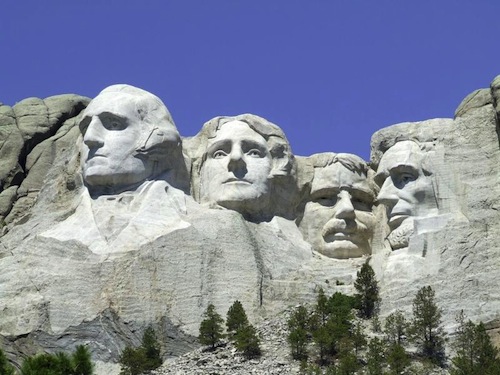
Was Mount Rushmore designed?

Here’s a post on Evolution News that explains what theistic evolution is:

Three geologists stand at the foot of Mt. Rushmore. The first geologist says, “This mountain depicts perfectly the faces of four U.S. Presidents, it must be the work of a master sculptor.” The second says, “You are a geologist, you should know that all mountains were created by natural forces, such as volcanoes and plate movements, the details were then sculpted by erosion from water and wind. How could you possibly think this was the work of an intelligent sculptor? Only a person completely ignorant of geophysics could think those faces were designed.”

The third geologist says to himself, “I don’t want to be seen as ignorant, but the faces in this mountain sure do look like they were designed.” So he thinks a moment and says to the second geologist, “Of course you are right, these faces were sculpted by natural forces such as erosion. Only an ignorant person would think they were designed.” Then he turns to the first and says, “But what a magnificent result, there obviously must have been a master sculptor standing by and watching.”

The third geologist is a theistic evolutionist. Someone who thinks that God did nothing detectable by science in the whole history of the universe, but who also loves to talk about their religious experience and what hymns they like to sing in church. Synonyms for this definition of theistic evolution are “supernaturalist naturalism” and “theistic atheism”. I like the latter, myself. Theistic atheism. Atheism at work for my colleagues on Monday, and theism in the church for my pastor on Sundays.

Now if you call yourself a theistic evolutionist, but you think that intelligent design is detectable in nature by non-theists doing ordinary science with ordinary scientific methods, then you are not a theistic evolutionist according to this definition. This post is not describing you.

You can listen to a debate on theistic evolution between Michael Behe and theistic evolutionist Keith Fox right here to decide if theistic evolution is true. A summary is provided for those who prefer to read instead of listen.

Is Darwinian evolution compatible with belief in God and robust religion?

Here’s Casey Luskin to explain the facts about God and evolution: (21 minutes)

About Casey Luskin: (just a snippet)

Casey Luskin is an attorney with graduate degrees in both science and law. He earned his B.S. and M.S. in Earth Sciences from the University of California, San Diego. His Law Degree is from the University of San Diego. In his role at Discovery Institute, Mr. Luskin works as Research Coordinator for the Center for Science and Culture. He formerly conducted geological research at Scripps Institution for Oceanography (1997-2002).

Luskin is also co-founder of the Intelligent Design and Evolution Awareness (IDEA) Center, a non-profit helping students to investigate evolution by starting “IDEA Clubs” on college and high school campuses across the country. For his work with IDEA, the Intelligent Design and Undergraduate Research Center named an award honoring college graduates for excellence in student advocacy of intelligent design (ID) the “Casey Luskin Graduate Award.”

If you can’t see the video, then you can check out this article by Casey from Salvo magazine.

Excerpt:

Whenever someone avers belief in “God-guided evolution,” it’s important to clarify what is meant by “evolution.” It can mean something as benign as (1) “Life has changed over time,” or it can entail more controversial ideas, like (2) “All living things have a universal common ancestry,” or (3) “Natural selection acting upon random mutations produced the complexity of life.”

When the average theistic evolutionist says he believes that “God used evolution,” what he often actually means is that God supernaturally intervened at various points in Earth’s history to direct the course of life. He accepts evolution in sense 1 above, and maybe sense 2 as well, but has doubts about sense 3. This viewpoint differs dramatically from the standard neo-Darwinian paradigm that currently reigns in biology.

As defined by its proponents, neo-Darwinism is a blind process of natural selection acting upon random mutations without any guidance by an external agent. According to the architects of this theory, the evolutionary process has no goals or predetermined outcome, and is by definition unguided. Under this view of life, human beings are accidents of history—and not just their bodies, but their brains and behaviors as well, including their moral and religious impulses. Thus, true neo-Darwinian theistic evolutionists (and they are out there) claim that, somehow, God guided an unguided process.

But many of those who adopt the “theistic evolutionist” moniker actually reject neo-Darwinism and hold a view that’s much closer to intelligent design, that is, to the belief that an intelligent agent has actively intervened—in a meaningful and detectable manner—to guide the development of life. The Evolution Lobby, however, will never be satisfied until such people fully capitulate to the Darwinian view.

And a bit later in that same paper:

Evolutionary biologist Francisco Ayala makes this argument, stating, “Mutations are random or chance events because . . . [they] are unoriented with respect to adaptation.”

[…]Ayala continues:

The scientific account of these events does not necessitate recourse to a preordained plan, whether imprinted from the beginning or through successive interventions by an omniscient and almighty Designer. Biological evolution differs from a painting or an artifact in that it is not the outcome of preconceived design.

Ayala concludes that, “in evolution, there is no entity or person who is selecting adaptive combinations.”12 Again, that doesn’t sound like a religiously neutral model of biological origins.

Indeed, in surveying how mainstream biology textbooks define Darwinian evolution, we learn it is a “random,” “blind,” “uncaring,” “heartless,” “undirected,” “purposeless,” and “chance” process that acts “without plan” or “any goals”; that we are “not created for any special purpose or as part of any universal design,” and that “a god of design and purpose is not necessary.”13 If those don’t entail claims that cut against theism, what would?

Moreover, if Darwinian evolution is irrelevant to faith, why do so many atheists cite it as a reason for abandoning religion? A 2007 poll of 149 evolutionary biologists found that only two “described themselves as full theists.”14 Likewise, a survey of biologist members of the NAS found that over 94 percent were atheists or agnostics.15 It’s no coincidence that Eugenie Scott—the de facto head of the Evolution Lobby—signed the Third Humanist Manifesto, or that the world’s most famous evolutionary biologist, Richard Dawkins, is also the world’s most famous atheist. In Dawkins’s own words, “Darwin made it possible to be an intellectually fulfilled atheist.”16

He is one of my favorite people to listen to, because he is very very direct and definitely is not clouding the issues, the combatants and what each side is really trying to achieve. There is a lot of noise and obfuscation in this debate. But if you watch Casey’s video, you will get everything as it really is.