
Tag Archives: Theism

Cosmologist Luke Barnes answers 11 objections to the fine-tuning argument

Christianity and the progress of science

This is from the blog Common Sense Atheism.

Atheist Luke Muehlhauser interviews well-respect cosmologist Luke Barnes about the fine-tuning argument, and the naturalistic response to it.

Luke M. did a good job explaining what was in the podcast. (I wish more people who put out podcasts would do that).

Details:

In one of my funniest and most useful episodes yet, I interview astronomer Luke Barnes about the plausibility of 11 responses to the fine-tuning of the universe. Frankly, once you listen to this episode you will be better equipped to discuss fine-tuning than 90% of the people who discuss it on the internet. This episode will help clarify the thinking of anyone – including and perhaps especially professional philosophers – about the fine-tuning of the universe.

The 11 responses to fine-tuning we discuss are:

  1. “It’s just a coincidence.”
  2. “We’ve only observed one universe, and it’s got life. So as far as we know, the probability that a universe will support life is one out of one!”
  3. “However the universe was configured, evolution would have eventually found a way.”
  4. “There could be other forms of life.”
  5. “It’s impossible for life to observe a universe not fine-tuned for life.”
  6. “Maybe there are deeper laws; the universe must be this way, even though it looks like it could be other ways.”
  7. “Maybe there are bajillions of universes, and we happen to be in one of the few that supports life.”
  8. “Maybe a physics student in another universe created our universe in an attempt to design a universe that would evolve intelligent life.”
  9. “This universe with intelligent life is just as unlikely as any other universe, so what’s the big deal?”
  10. “The universe doesn’t look like it was designed for life, but rather for empty space or maybe black holes.”
  11. “Fine-tuning shows there must be an intelligent designer beyond physical reality that tuned the universe so it would produce intelligent life.”

Download CPBD episode 040 with Luke Barnes. Total time is 1:16:31.

There is a very good explanation of some of the cases of fine-tuning that I talk about most on this blog – the force of gravity, the strong force, etc. as well as many other examples. Dr. Barnes is an expert, but he is also very very easy to listen to even when talking about difficult issues. Luke M. is very likeable as the interviewer.
Stephen C. Meyer: does the Big Bang cosmology disprove the existence of God?

Christianity and the progress of science

Here’s the 66-minute video featuring Dr. Stephen C. Meyer, who holds the Ph.D in philosophy of science from Cambridge University, and other degrees in the hard sciences.

The lecture starts really, really slowly. You can just fast-forward to the 12 minute mark, or you might die of boredom.

Topics:

  • Up until the the last 100 years or so, everyone agreed that the universe was eternal
  • This is at odds with the traditional Christian view that God created the universe
  • Materialism, the view that matter is all there is, requires eternally existing matter
  • Discovery #1: Hubble discovers that the universe is expanding (redshift observation)
  • The expanding universe was resisted by proponents of the eternal universe, like Einstein
  • Some naturalists even proposed speculative static models like the steady-state model
  • However, not of the speculative models fit with observations and experimental results
  • Discovery #2: Penzias and Wilson discover the cosmic microwave background radiation
  • Measurements of this background radiation confirmed a prediction of the Big Bang theory
  • The steady-state theory was falsified of by the discovery of this background radiation
  • The oscillating model was proposed to prevent the need for an absolute beginning
  • But the oscillating model is not eternal, it loses energy on each “bounce”
  • A paper by Alan Guth and Marc Sher from 1982 proved that our universe will not bounce
  • In addition, experiments reveal that the universe will expand forever, and not contract
  • The beginning of the universe is more at home in a theistic worldview than an atheistic one
  • The beginning of the universe fits in well with the Bible, e.g. – Genesis 1, Titus 1, etc.

In case you are wondering about what the evidence is for the Big Bang, here are 3 of the evidences that are most commonly offered:

Three main observational results over the past century led astronomers to become certain that the universe began with the big bang. First, they found out that the universe is expanding—meaning that the separations between galaxies are becoming larger and larger. This led them to deduce that everything used to be extremely close together before some kind of explosion. Second, the big bang perfectly explains the abundance of helium and other nuclei like deuterium (an isotope of hydrogen) in the universe. A hot, dense, and expanding environment at the beginning could produce these nuclei in the abundance we observe today. Third, astronomers could actually observe the cosmic background radiation—the afterglow of the explosion—from every direction in the universe. This last evidence so conclusively confirmed the theory of the universe’s beginning that Stephen Hawking said, “It is the discovery of the century, if not of all time.”

By the way, Dr. Meyer also does a great job of explaining the problem of proteins, DNA and the origin of life in this lecture. And you can hear him defend his views in this debate podcast with Keith Fox and in this debate podcast with Peter Atkins. He does a great job in these debates.

Positive arguments for Christian theism

William Lane Craig lectures on naturalistic alternatives to the Big Bang

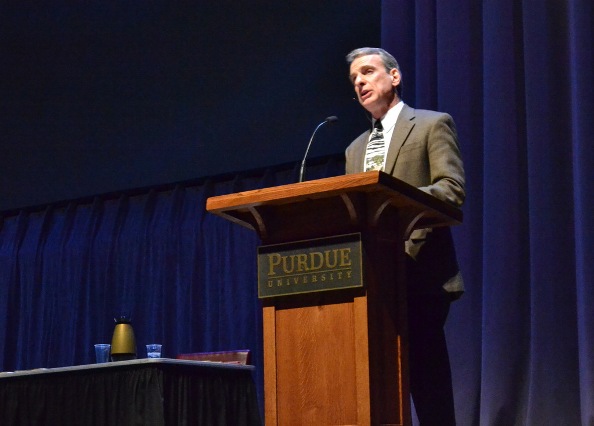
William Lane Craig lecturing to university students

Here’s the lecture, which was given in 2004 at the University of Colorado, Boulder.

This lecture might be a little advanced for beginners, but if you stretch your mind first, you shouldn’t tear anything. (Note: standard disclaimers apply if you do tear something!)

The description of the video states:

This is quite simply one of the best lectures William Lane Craig (a philosopher of science) has given. Craig explores the origins of the universe. He argues for a beginning of the universe, while refuting scientific models like the Steady State Theory, the Oscillating Theory, Quantum Vacuum Fluctuation Model, Chaotic Inflationary Theory, Quantum Gravity Theory, String Theory, M-Theory and Cyclic Ekpyrotic Theory.

And here is the description of the lecture from Reasonable Faith:

A Templeton Foundation lecture at the University of Colorado, Boulder, laying out the case from contemporary cosmology for the beginning of the universe and its theological implications. Includes a lengthy Q & A period which features previous critics and debate opponents of Dr. Craig who were in attendance, including Michael Tooley, Victor Stenger, and Arnold Guminski.

Craig has previously debated famous atheists Stenger and Tooley previously. And they both asked him questions in the Q&A time of this lecture. Imagine – having laid out your entire case to two people who have debated you before and who know your arguments well. What did they ask Craig, and how did he respond?

The scientific evidence

The Big Bang cosmology that Dr. Craig presents is the standard model for how the universe came into being. It is a theory based on six lines of experimental evidence.

Scientific evidence:

  1. Einstein’s theory of general relativity (GTR)
  2. the red-shifting of light from distant galaxies implies an expanding universe
  3. the cosmic background radiation (which also disproves the oscillating model of the universe)
  4. the second law of thermodynamics applied to star formation theory
  5. hydrogen-helium abundance predictions
  6. radioactive element abundance predictions

It’s probably a good idea to be familiar with these if you are presenting this argument, because experimental science is a reliable way of knowing about reality.

Published research paper

This lecture by Dr. Craig is based on a research paper published in an astrophysics journal, and was delivered to an audience of students and faculty, including atheist physicist Victor Stenger and prominent atheist philosopher Michael Tooley, at the University of Colorado at Boulder.

Here’s the peer-reviewed article that the lecture is based on.

Here’s the abstract:

Both cosmology and philosophy trace their roots to the wonder felt by the ancient Greeks as they contemplated the universe. The ultimate question remains why the universe exists rather than nothing. This question led Leibniz to postulate the existence of a metaphysically necessary being, which he identified as God. Leibniz’s critics, however, disputed this identification, claiming that the space-time universe itself may be the metaphysically necessary being. The discovery during this century that the universe began to exist, however, calls into question the universe’s status as metaphysically necessary, since any necessary being must be eternal in its existence. Although various cosmogonic models claiming to avert the beginning of the universe predicted by the standard model have been and continue to be offered, no model involving an eternal universe has proved as plausible as the standard model. Unless we are to assert that the universe simply sprang into being uncaused out of nothing, we are thus led to Leibniz’s conclusion. Several objections to inferring a supernatural cause of the origin of the universe are considered and found to be unsound.

The whole text of the article is posted online here.

If you want something to post on your Twitter or Facebook that is much shorter than this lecture, then you should check out this quick 4-minute explanation of the kalam argument.