Tag Archives: Tax

New study on education quality of universal day care programs

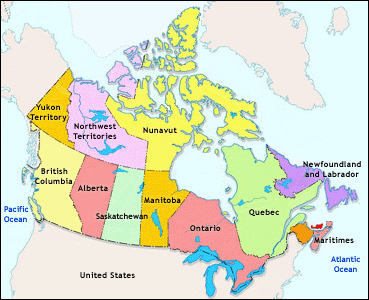
Map of Canada
Map of Canada

This article from the Toronto Sun talks about the government-run day care system in Quebec. (H/T Luis)

Excerpt:

Quebec’s $7-a-day daycare system is failing to improve children’s educational outcomes, an economics professor from Montreal says.

In a new paper, Pierre Lefebvre of the Universite du Quebec a Montreal explains that when the system was created, Quebecers were told “it would promote children’s development so they would perform better in school later.”

“This never happened,” he says.

The researcher studied children under the age of five from Quebec and children of the same age from the rest of Canada and compared their progress at various points between 1994 and 2006. He found Quebec’s family policy did nothing to improve cognitive skills in children.

According to Lefebvre, it’s because the Quebec government program is doing a lousy job.

“There is a serious quality problem. I would go as far as to say that daycare quality is very low, both in terms of educators’ formation and in terms of the quality of interactions between educators and children.”

The program receives taxpayer money from all working people. So working husbands with stay-at-home wives have to pay for a day care system that they will never use.

Here’s a second article from the National Post about Sweden’s government-run universal day care system. (H/T Luis)

Excerpt:

True, parental leave in Sweden is a generous 16 months. There are no babies in daycare. But when parental leave ends, practically the reverse is true: A full 92% of all children aged 18 months to five years are in daycare. Parents pay only a symbolic amount for this; tax subsidies for daycare are $20,000 per child, annually. Swedish taxes are among the highest in the world, and the tax system was designed to make both parents seek employment in the work force.

[…]Then there are the questions about the social toll Sweden’s childcare system is taking. Sweden has offered a comprehensive daycare system since 1975; since the early ‘90s, negative outcomes for children and adolescents are on the rise in areas of health and behaviour. While direct causation has been difficult to prove, many Swedish health-care professionals point to the lack of parent involvement beyond the first 16 months as a primary contributing factor. Psychosomatic disorders and mild psychological problems are escalating among Swedish youth at a faster rate than in any of 11 comparable European countries. Such disorders have tripled among girls over the last 25 years. Education outcomes in Swedish schools have fallen from the top position 30 years ago, to merely average amongst OECD nations today. Behaviour problems in Swedish classrooms are among the worst in Europe.

This isn’t surprising. After a generation of inexperience, Swedish parenting abilities are deteriorating. A study sponsored by the European Union showed many middle-class parents lack the ability to set limits and sense their children’s needs.

Recently, Swedish public service radio investigated the state of Swedish daycares. Parents, psychologists and daycare staff expressed deep concern. In spite of high funding levels, group size and the child-to-adult ratio continue to increase. An experienced pre-school teacher recalls that in 1980 the group size for small children was 10 kids with four adults. For older children, that ratio was five kids per adult. But after the Swedish financial crisis 20 years ago, this changed. Today younger children face ratios of up to 17 kids to three adults and older children face ratios of up to 10 to one. Staff on sick leave are not replaced. “We can’t give quality care today,” one teacher reported. Only one person interviewed contended that Swedish daycare is still top quality — the Swedish Deputy Minister of Education, Nyamko Sabuni.

Again, this program is taxpayer funded. Working husbands with stay-at-home wives will be paying for something that they don’t even use.

I think parents need to consider what happens in other countries to see how good these universal day care programs really are.

New study finds that US rich pay a larger share of taxes than in any other country

Michele Bachmann posted this Wall Street Journal article about a new OECD study that shows how the rich pay most of the total tax burden.

Excerpt:

As President Barack Obama pushes to raise income taxes on high earners, opponents are seizing on data that indicates these U.S. households already pay a large and growing share of taxes, even compared with high-tax European countries. And a new congressional study concludes that the percentage of U.S. households owing no federal income tax climbed to 51% for 2009.

Republicans are expected to highlight these figures at a congressional hearing Tuesday. They oppose Mr. Obama’s proposal to increase taxes for high earners, defined as families making more than $250,000 per year, as a way to help close large federal budget deficits.

[…]Upper-income taxpayers have paid a growing share of the federal tax burden over the last 25 years.

A 2008 study by the Organization for Economic Cooperation and Development, for example, found that the highest-earning 10% of the U.S. population paid the largest share among 24 countries examined, even after adjusting for their relatively higher incomes. “Taxation is most progressively distributed in the United States,” the OECD study concluded.

Meanwhile, the percentage of U.S. households paying no federal income tax has been climbing, and reached 51% for 2009, according to a new analysis by the Joint Committee on Taxation. That was the first time since at least 1992 that more than half of households owed no federal income tax, according to JCT estimates.; earlier data were unavailable on Monday.

Here’s a useful graphic that shows who really pays the most taxes.

When 51% of the population doesn’t pay federal taxes, you have a situation where the majority of the people have no incentive to cut spending. This is a bad situation.

New Michele Bachmann interviews on the economy

Let Americans spend their own money

Time to prioritize spending

Obama’s plan is to raise your taxes

Can we pay for Obama’s deficits by taxing ONLY the “rich”?

No, and George Mason University economist Walter Williams explains why.

Excerpt:

This year, Congress will spend $3.7 trillion dollars. That turns out to be about $10 billion per day. Can we prey upon the rich to cough up the money? According to IRS statistics, roughly 2 percent of U.S. households have an income of $250,000 and above. By the way, $250,000 per year hardly qualifies one as being rich. It’s not even yacht and Lear jet money. All told, households earning $250,000 and above account for 25 percent, or $1.97 trillion, of the nearly $8 trillion of total household income. If Congress imposed a 100 percent tax, taking all earnings above $250,000 per year, it would yield the princely sum of $1.4 trillion. That would keep the government running for 141 days, but there’s a problem because there are 224 more days left in the year.

How about corporate profits to fill the gap? Fortune 500 companies earn nearly $400 billion in profits. Since leftists think profits are little less than theft and greed, Congress might confiscate these ill-gotten gains so that they can be returned to their rightful owners. Taking corporate profits would keep the government running for another 40 days, but that along with confiscating all income above $250,000 would only get us to the end of June. Congress must search elsewhere.

According to Forbes 400, America has 400 billionaires with a combined net worth of $1.3 trillion. Congress could confiscate their stocks and bonds, and force them to sell their businesses, yachts, airplanes, mansions and jewelry. The problem is that after fleecing the rich of their income and net worth, and the Fortune 500 corporations of their profits, it would only get us to mid-August. The fact of the matter is there are not enough rich people to come anywhere close to satisfying Congress’ voracious spending appetite. They’re going to have to go after the non-rich.

Obama is going to have to tax you and me to pay for his trillions of dollars in spending.