Tag Archives: Speculation

Stephen C. Meyer and Keith Fox debate intelligent design and evolution

From Justin Brierley’s “Unbelievable” podcast.

Details:

Stephen Meyer is a leading proponent of Intelligent Design who directs the Centre for Science and Culture at the Discovery Institute in Seattle. His most recent book “Signature in the Cell” claims to show that the DNA code is the product of intelligent mind, not naturalistic processes. Keith Fox is Professor of Biochemistry at Southampton University. He chairs the UK Christians in Science network but disagrees strongly with ID. They debate how life could have originated and whether design is allowed as an explanation in science.

The MP3 file is here.

Summary: (stuff in italics is my snarky paraphrase)

Meyer:

  • background and how he got interested in intelligent design
  • his research focus is on the origin of life – the first replicator
  • summarizes the history of origin of life studies
  • authored the book “Signature in the Cell”
  • the DNA enigma: where did the information in DNA come from?
  • naturalistic explanations of the DNA information have failed
  • but intelligent agents are known to be able to produce information
  • the best explanation of the information in DNA is that an intelligent agent authored it
  • Meyer’s book was named by atheist philosopher of science Thomas Nagel as a Times Literary Supplement Book of the Year in 2010
  • why is design so controversial? Many people think that Darwin explained why nature appears design
  • the Darwinian view is that nature can create the appearance of design using mutation and selection
  • however, Darwinian mechanisms cannot explain the origin of the first living cell, it assumes replication, and the origin of life is about where the first replicator comes from

Fox:

  • Meyer’s argument is not about the evolution of life after the first cell
  • Meyer’s case for design is about the origin of life
  • naturalists do not know a naturalistic explanation for the origin of life
  • there are a number of naturalistic hypotheses for the origin of life, like the RNA-first hypothesis
  • maybe in a few years one of them will turn out to be correct
  • what intelligent design is arguing from a gap in our current naturalistic knowledge to infer that God intervened in nature

Meyer:

  • that’s not what intelligent design is at all
  • the approach ID theorists use is the inference to best explanation
  • you evaluate all explanations, non-intelligent causes and intelligent causes
  • you prefer the best possible explanation
  • we know that minds are capable of producing information just like the information we find in DNA

Fox:

  • living cells replicate, so they have the ability to introduce mutations as they replicate and then some of those mutations can be selected
  • so maybe the process of replicating that living cells do created the first living cell
  • maybe the first living cell created itself, X brought X into being, self-creation, what’s irrational about that?

Meyer:

  • the issue is the origin of life – where did the first living cell come from?
  • you cannot appeal to the operations that a living cell can perform to explain the origin of the first living cell
  • there was no first living cell operating before the first living cell
  • there was no replication, mutation or selection before the first living cell
  • in fact, in my book I show that there is no known naturalistic mechanism that is able to produce the information needed for the first living cell
  • nothing can create itself, that is self-contradictory
Fox:
  • Well, you are just saying that because something is complex that God did it
Meyer:
  • Sadly, no. What I actually said needed to be explained was the information, not complexity
  • And we know from software engineering that the process of adding information to code is performed by programmers
  • in the absence of any adequate naturalistic explanation for information, we are justified in taking the explanation that we are familiar with – namely, intelligent agency – based on our uniform, universal experience of what causes information
Fox:
  • well, maybe we can appeal to the mutation and selection in existing living cells to explain the origin of the first living cell
  • maybe there were living cells before the first living cell, and then these other living cells created the first living cell
Meyer:
  • we can’t keep invoking mutation and selection when those processes are not operating prior to the origin of the first living cell
Fox:
  • well maybe some bare-bones self-replication molecule was a precursor to the first living cell
Meyer:
  • even to generate very limited replicator would require a large amount of information
  • the argument I am making is – where does the evolution come from?
Fox:
  • well, maybe we will think of an explanation for information that is naturalistic in 20 years
  • we’ve thought of explanations to things that were NOT information before
  • so maybe we will be able to think of something to explain information based on our ability to explain NOT information before

Moderator: Change topics: the Dover decision

Meyer:

  • the Discovery Institute opposed the policy that causes the trial
  • the wording of the statute was poor
  • the judge was completely wrong in his decision
  • young earth creationists used the phrase “intelligent design” to cover their agenda
  • intelligent design is an inference using the normal methods of science
Fox:
  • intelligent design is a science stopper because it stops looking for a naturalistic explanation
  • everything in nature must have a naturalistic explanation
  • everything has to be explained using matter and time and chance
  • it just has to be that way!!!!
Meyer:
  • well, what luck would you have explaining an effect like Mt. Rushmore?
  • can you explain that using matter,time and chance?
  • Mt. Rushmore was the product of intelligence, not wind and erosion
  • similarly, there is information in the cell, and we know that intelligence causes information
Fox:
  • So you are saying that we don’t understand and therefore an intelligence is necessary?

Meyer:

  • no I am saying we DO understand and we are making an inference based on that understanding
  • you are the one who is insisting on a material explanation because you pre-suppose materialism
  • we know that minds have causal powers, and we can infer mind as an explanation from information
Fox:
  • well nature is a seamless chain of material causes and effects
Meyer:
  • agents can act without violating the laws of nature
  • even humans can act as intelligent agents to create information in books, and they don’t violate the laws of nature
  • intelligent causes are real, and they explain effects in nature
Fox:
  • you’re trying to impose on science something to do with meaning and purpose
Meyer:
  • no that’s not what we’re doing, we’re inferring from from the fact that we ourselves are known causes of information to the fact that an intelligence cause is the best explanation for information in the cell
Fox:
  • but I am a materialist, I need a materialist explanation
Meyer:
  • mind IS an answer to the how question
  • we infer to mind in many other scientific disciplines, like cryptography, archaeology, etc.
  • a materialist might accuse an archaeologist of engaging in a “scribe-of-the-gaps” argument, but the best explanation of an artifact with information is a scribe
  • we are inferring that mind is the cause from the nature of the effect: information
Moderator: is it appropriate to call DNA “information”

Fox:

  • well DNA is just a molecular polymer, any reference to information is just by analogy
Meyer:
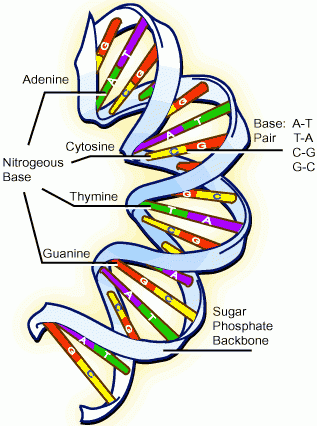
  • DNA is a molecular polymer, but it also exhibits the property of specified complexity
  • the arrangement of bases, which function as machine instructions in a software program, for performings task in the cell
  • we have observed that the property of specified complexity always comes from an intelligence
Fox:
  • well, maybe there are other sequences that would work, so maybe it’s really not uncommon to develop functioning sequences by chance alone, without an intelligence
Meyer:
  • you can measure how precise the functional specificity is in DNA and proteins

Moderator: is Shannon information the same as functional information

Meyer:

  • Shannon information refers to the sequences of digits or symbols that do not necessarily have any function, i.e. – a four character string QSZX has as much Shannon information as WORD. However, only the latter is functional against the pattern of the English language. There are arrangements of DNA bases and amino acids that have the same number of symbols/characters as a functional sequence would have, but they have no biological function – they do not exhibit specified complexity
Fox:
  • Well, maybe there are lots and lots of sequences of DNA and proteins so that it is fairly easy to get a functional one by chance

Meyer:

  • DNA sequences that are functional are extremely rare, protein sequences are even more rare
  • this is not my opinion, this is what the research shows – functional protein sequences are rare
Fox:
  • well maybe there are other functional sequences that are occur before the first functional sequence that are precursors to the first functional sequence
  • maybe there are billions of years of replication, mutation and selection before the first replication, mutation and selection

Meyer:

  • you can’t get to the first selectable functional sequence by appealing to precursor selectable functional sequences – there are no selectable functional sequences before the FIRST one
  • you have to get the first selectable functional sequence by chance alone, because there is nothing to mutate or select before the first replicator
  • the chance hypothesis has been rejected because the minimal amount of information for the simplest replicator is too high to get by chance alone, given the resources, including time, that are available

Moderator: Keith are you confident that naturalism will be able to substantiate these naturalism-of-the-gap speculations that you offer in response to Meyer’s actual science that we have today? 

Fox:

  • well, it is hard to know for sure because it was just a fluke event
  • but there’s nothing irrational or unscientific or miraculous about it – the fluke would have a material explanation
  • there is nothing that we can detect that would implicate God, my speculations about a fluke which I cannot observe or measure or test would all be compatible with an atheistic worldview that omits God as a causal entity

Meyer:

  • where are those material processes that could account for this fluke then?
  • the whole point of this argument is that the information in DNA transcends the material components in the sequence
  • it’s the arrangement of the material parts/letters/characters/symbols/instructions that needs to be explained
Fox:
  • Well, I just have a different philosophy of science that rules out intelligent causation a priori

Meyer:

  • Yes, that’s the difference between us – you pre-suppose that all explanations of natural phenomena must exclude intelligent causes

There is a bit more where Meyer talks about how parts of the cell are implementations of various design patterns (Gang of Four design patterns) that are used by software architects who design software.
Find more posts on Stephen C. Meyer here.

The long war: a history of the conflict between religion and science

Let’s start with an example of a famous battle in the long war between science and religion.

Canadian science writer Denyse O’Leary writes about the history of cosmology at Evolution News.

Excerpt:

What help has materialism been in understanding the universe’s beginnings?

Many in cosmology have never made any secret of their dislike of the Big Bang, the generally accepted start to our universe first suggested by Belgian priest Georges Lemaître (1894-1966).

On the face of it, that is odd. The theory accounts well enough for the evidence. Nothing ever completely accounts for all the evidence, of course, because evidence is always changing a bit. But the Big Bang has enabled accurate prediction.

In which case, its hostile reception might surprise you. British astronomer Fred Hoyle (1915-2001) gave the theory its name in one of his papers — as a joke. Another noted astronomer, Arthur Eddington (1882-1944), exclaimed in 1933, “I feel almost an indignation that anyone should believe in it — except myself.” Why? Because “The beginning seems to present insuperable difficulties unless we agree to look on it as frankly supernatural.”

One team of astrophysicists (1973) opined that it “involves a certain metaphysical aspect which may be either appealing or revolting.” Robert Jastrow (1925-2008), head of NASA’s Goddard Institute for Space Studies, initially remarked, “On both scientific and philosophical grounds, the concept of an eternal Universe seems more acceptable than the concept of a transient Universe that springs into being suddenly, and then fades slowly into darkness.” And Templeton Prize winner (2011) Martin Rees recalls his mentor Dennis Sciama’s dogged commitment to an eternal universe, no-Big Bang model:

For him, as for its inventors, it had a deep philosophical appeal — the universe existed, from everlasting to everlasting, in a uniquely self-consistent state. When conflicting evidence emerged, Sciama therefore sought a loophole (even an unlikely seeming one) rather as a defense lawyer clutches at any argument to rebut the prosecution case.

Evidence forced theorists to abandon their preferred eternal-universe model. From the mid 1940s, Hoyle attempted to disprove the theory he named. Until 1964, when his preferred theory, the Steady State, lost an evidence test.

Here is a a quick summary of some of the experimental evidence that emerged in the last few decades that caused naturalists to abandon the eternal universe that they loved so much when they were younger.

The importance of having a narrative

Now I want to make a very, very important point about Christianity and the progress of science. And that point is that it is very important that Christians present the evidence in exactly the way that Denyse presented it in that article – in its historical context, featuring the conflict between naturalists and the experimental evidence.

All Christians should be familiar with the following basic pieces of evidence which fit the war between science and naturalism narrative:

  1. The origin of the universe
  2. The cosmic fine-tuning
  3. The origin of life (biological information)
  4. The sudden origin of the Cambrian phyla
  5. The habitability/observability correlation

When you talk about these evidences as a Christian theist to non-Christians, you have to have cultivated a genuine interest in reconciling your beliefs with science. You have to accept that there are two books that reveal God’s character and attributes. The book of nature, and the book of Scripture. And you need to be flexible about getting these two books to fit together. The book of nature gives us natural theology (see Romans 1). It tells us that God is Creator and Designer. The book of Scripture tells us that God stepped into history as a man to save us by taking the punishment for our headlong rush away from God, which the Bible calls sin. Science is one way that humans can recover some of basic knowledge about God. Knowledge that is only possible because God created and designed the universe (and us) in such a way that we are capable of making discoveries, and that the universe is capable of being explored and understood.

It’s very important to present these five basic evidences to non-Christians in the historical context. And here is the story you must tell: “In the beginning, there was the naturalism, and the naturalism tried to argue from ignorance that God was not Creator and God was not Designer. And then came the science, and now people have to give up their naturalism in order to not be crazy and irrational”. That’s the narrative you use when talking to non-Christians about science.

In the beginning was the naturalism:

  1. In pre-scientific times, atheists maintained that the universe was eternal
  2. In pre-scientific times, atheists maintained that a life-permitting universe was as likely as a life-prohibiting universe
  3. In pre-scientific times, atheists maintained that the cell was a simple blob of jello that could spontaneously emerge in some warm pond
  4. In pre-scientific times, atheists maintained that the sudden origin of the Cambrian phyla would be explained by subsequent fossil discoveries
  5. In pre-scientific times, atheists maintained that there was nothing special about our galaxy, solar system, planet or moon

But then science progressed by doing experiments and making observations:

  1. Scientists discovered redshift and the cosmic microwave background radiation and more!
  2. Scientists discovered the fine-tuning of gravity and of the cosmological constant and more!
  3. Scientists discovered protein sequencing and exposed the myth of “junk DNA” and more!
  4. Scientists discovered an even shorter Cambrian explosion period and the absence of precursor fossils and more!
  5. Scientists discovered galactic habitable zones and circumstellar habitable zones and more!

And now rational people – people who want to have true beliefs about reality – need to abandon a false religion (naturalism).

Now naturally, science is in a state of flux and things change. But you have to look at the trend of discoveries, and those trends are clearly going against naturalism, and in favor of Christian theism. No one is arguing for a deductive proof here, we are simply looking at the evidence we have today and proportioning our belief to the concrete evidence we have today. People who are guided by reason should not seek to construct a worldview by leveraging speculations about future discoveries and mere possibilities. We should instead believe what is more probable than not. That’s what a rational seeker of truth ought to do. Proportion belief to probabilities based on current, concrete knowledge.

It is very important that Christians keep abreast of the progress of science, and give proper respect to science when forming our worldviews, and keep in mind what is really going on with atheism. There is a lot of loud worshiping of science by people like Dawkins and Atkins and Krauss, but if you dig into things a little, you’ll find that they are actually filled with rage and enmity against what science has revealed about nature. And not just in one area, but in many, many areas.

Atheism, as a worldview, is not rooted in an honest assessment about what science tells us about reality. Atheism is rooted in a religion: naturalism. And the troubling thing we learn from looking at the history of science is that this religion of naturalism is insulated from correction from the progress of science. Nothing that science reveals about nature seems to be able to put a dent in the religion of naturalism, at least for most atheists. Their belief in naturalism is so strong that it repels all scientific evidence that falsifies it. Atheists simply don’t let science inform and correct their worldview.

It falls to us Christian theists, then, to hold them accountable for their abuse and misrepresentation of science. And that means telling the story of the progress of science accurately, and accurately calling out the religion of naturalism for what it is – a religion rooted in blind faith and ignorance that has been repeatedly and convincingly falsified by the progress of science in the modern era.

Positive arguments for Christian theism

Moshe Averick: the origin of life and atheism-of-the-gaps

Can atheism explain the origin of life?

An amazing must-read article from a Jewish scholar named Moshe Averick, published in the Times of Israel. (H/T Mysterious Jacob via Mysterious Chris)

This is literally the greatest thing you will read all day, so everyone reading this sentence – please click the link, after you read my excerpts and snarky comments below.

His thesis:

The history of scientific endeavor to discover a naturalistic origin of life reads like a laboratory version of a demolition derby. A researcher roars into the arena to propose a new theory and is summarily rammed and demolished by another theory driven by its respective theoretician who in turn is rammed and demolished by the next eager contestant.

Here are some of the naturalistic theories that have been proposed and demolished… frequently by other naturalists!

RNA-world theory:

  • Dr. Robert Shapiro, Professor Emeritus of Chemistry at NYU on the popular RNA-World theory: “Picture a gorilla at an immense keyboard [that] contains not only the symbols used in English and European languages but also…from every other known language and all of the symbol sets stored in a typical computer. The chances [of functional RNA molecules forming by themselves] can be compared to those of the gorilla composing, in English, a coherent recipe for the preparation of chili con carne…the spontaneous appearance of RNA chains on the lifeless Earth would have been a near miracle.”

Shapiro is a naturalist himself.

Metabolism First theory:

  • Dr. Leslie Orgel – a proponent of the RNA-World theory – on the Metabolism First theory proposed by the aforementioned Dr. Shapiro: “Theories of the origin of life based on metabolic cycles cannot be justified by the inadequacy of competing theories: they must stand on their own…solutions offered by supporters of …metabolist scenarios that are dependent on ‘if pigs could fly’ chemistry are unlikely to help.” Dr. George Whitesides of Harvard University, one of the world’s greatest living chemists, made the following comment on the Metabolism First theory: “It seems to me to be astonishingly improbable.”

For details on why these naturalistic theories are dismissed by naturalists, you should read Stephen C. Meyer’s absolutely amazing book “Signature in the Cell” will recognize much in this article. Please if you don’t have Dr. Meyer’s two books on the origin of life and the Cambrian explosion (“Darwin’s Doubt”), you really need to get them.

The article continues smashing a few more lame naturalistic scenarios, and then this tour-de-force:

The present state of Origin of Life research is best summed up by Dr. Eugene Koonin, a highly respected microbiologist and veteran researcher in the field. From his 2011 book, The Logic of Chance:The Nature and Origin of Biological Evolution: “The origin of life is one of the hardest problems in all of science…Origin of Life research has evolved into a lively, interdisciplinary field, but other scientists often view it with skepticism and even derision. This attitude is understandable and, in a sense, perhaps justified, given the “dirty” rarely mentioned secret: Despite many interesting results to its credit, when judged by the straightforward criterion of reaching (or even approaching) the ultimate goal, the origin of life field is a failure – we still do not have even a plausible coherent model, let alone a validated scenario, for the emergence of life on Earth. Certainly, this is due not to a lack of experimental and theoretical effort, but to the extraordinary intrinsic difficulty and complexity of the problem. A succession of exceedingly unlikely steps is essential for the origin of lifethese make the final outcome seem almost like a miracle.”  Dr. Paul Davies, Origin of Life expert and physicist at Arizona State University concurs: “You might get the impression from what I have written not only that the origin of life is virtually impossible, but that life itself is impossible…so what is the answer? Is life a miracle after all?”

Put quite simply: The proposition that the gaping chasm between non-living, inorganic chemicals and a living bacterium could be bridged by an unguided naturalistic process is so patently absurd that it can be rejected out of hand. Despite the abundant availability of raw materials such as mud, stones, straw and rocks in a rain forest, one does not need to “prove” that a mud hut in a clearing in that forest is the product of intelligent intervention. An appropriate metaphor for a bacterium would be more like finding Buckingham Palace.

It is obvious that life was created by an intelligent designer outside of the natural world and the reason why the origin of life “seems almost like a miracle,” is because itis a miracle.

However, atheist/materialist scientists refuse to give up so easily. Dr. Koonin himself has proposed a possible solution and escape hatch from having to accept a Creator of life: “The Many Worlds in One version of the cosmological model of eternal inflation might suggest a way out of the origin of life conundrum because, in an infinite multiverse with a finite number of macroscopic histories (each repeated an infinite number of times), the emergence of even highly complex systems by chance is not just possible, but inevitable.” (The Logic of Chance)

“The way out of the origin of life conundrum [is that] in an infinite multiverse…the emergence of even highly complex systems by chance is not just possible, but inevitable.”

Translation: The odds of rolling a six a thousand times in a row with a single die is 1 in 6 to the 1000th power, or 1 chance in 6 x 10 to the 999th power. The size of this number is beyond our comprehension but to provide some kind of baseline keep in mind that the number of atoms in the entire universe is roughly 10 to the 80th power. Despite this, as Koonin points out, if I am able to roll the die an infinite number of times, it is not only possible, but inevitable that it will happen. Although reason and scientific investigation have informed us of the virtual impossibility of life having formed on our planet by an undirected naturalistic process, the “way out of the origin of life conundrum” – that is to say, the way to avoid the obvious answer that life was created – is to propose a multiverse. With an infinite number of trials and errors available, it is not only possible but inevitable that life will form no matter how fantastic the odds against.

He is right of course. With an infinite number of trials and errors not only is the formation of life inevitable but it is just as inevitable that at least one of each of the following has formed by pure chance and can be found on our planet today: iPhone 5, Toshiba Satellite Laptop Computer, Schwinn Discover Men’s Hybrid Bike, full color poster of Jimmy Hendrix playing at Woodstock, Martin D-35 Acoustic Guitar, Mylec Eclipse Jet-Flow Hockey Stick, Revell 1:48 scale P-51D Mustang model airplane, and last but not least, a 2013 Rolls Royce Phantom Sedan (retail price- $465,000). I don’t believe it, no one reading this article believes it, Eugene Koonin does not believe it, and even Richard Dawkins doesn’t believe it.

Read the whole thing.

In my opinion, all of this loud worship of science from people like Dawkins, Atkins and Krauss is just a smokescreen. Atheism is first and foremost about dispensing with cosmic authority and moral accountability. If they have to believe in eternal universes, unseen aliens, untestable multiverses, undiscovered Cambrian precursor fossils, and even the freaking Flying Spaghetti Monster in order to see God’s handiwork in nature, then they will do it.

Note: this concluding rant applies to village atheists like Christopher Hitchens, Lawrence Krauss and Richard Dawkins, not to exceptional academic non-theists like Peter Millican and Graham Oppy.

If you want to read a really good article on exactly how improbable the simplest living organism is, click here.

The really astonishing about the case for theism is that we have a half-dozen scientific arguments like this… this isn’t even our best one! It’s so strange because I find myself living in a world filled with atheists who basically believe in the Easter bunny even as they profess this great affection for the very thing that is exposing their madness – science! Like a person jealously hugging a chunk of radioactive material to himself and then claiming that it protects him from radiation sickness. So surreal. 

Shabbat shalom, Moshe Averick, and Mazel Tov!