According to [Sen. James] Inhofe, the administration’s proposed CO2/greenhouse gas-emission regulations—due out in November—could chop $300 billion to $400 billion alone off the nation’s gross domestic product (GDP) each year. Estimates from the Senate Energy and Public Works Committee’s Republican staff estimates this regulation could cost in excess of the 2 million jobs that would have been lost as a result of Waxman-Markey Climate Change Bill.
Other estimates suggest that the EPA’s Utility MACT and Transport Rule could cost $184 billion and 1.4 million jobs. Statistics Inhofe provided suggest the rule could shutter hundreds of coal-fired power plants around the country—equaling as much as 20% of the nation’s total energy output.
[…]“We are relying on coal for as much as 45% of our nation’s energy,” Inhofe said. “He’s intentionally passed a rule that will shut down coal in America, and there are lots of jobs that either directly or indirectly rely on coal. It’s going to make it a lot much more expensive.”
These increased costs are underscored by a Bernstein Research report that found: “We expect the loss of this generation to translate into higher wholesale energy and capacity prices. … We estimate that this will raise the price of electricity during on-peak hours by $3 to $5 per MWh.”
The rule’s impact hit closer to home for 120 workers at a Cincinnati-area coal-fired power plant when Duke Energy announced it would be closing the plant if the rule is approved in November.
“The anticipated retirement date is contingent on potential changes to the implementation [of the] EPA’s MACT rule and other environmental regulations,” Duke Energy said in a statement released in July.
And Texas-based Luminant followed suit last week, announcing it would be laying off 500 workers in anticipation of the implementation of the EPA’s cross-state air pollution rule, set to take effect on Jan. 1, 2012.
[…]The National Associations of Manufacturers estimates the Utility MACT and cross-state air pollution rules will cost its members $18 billion annually, and drive its members’ electricity costs up by 11.5%. It also shares Inhofe’s analysis that these regulations could cost 1.4 million jobs annually.
The U.S. House of Representatives declared another victory today in its ongoing battle against destructive regulation with passage of H.R. 2681, the Cement Sector Regulatory Relief Act. The measure passed the full House with strong bipartisan support by a vote of 262 to 161.
H.R. 2681, authored by Reps. John Sullivan (R-OK) and Mike Ross (D-AR), will protect the domestic cement manufacturing industry from costly new rules issued by the EPA, which currently threaten widespread plant closures and thousands of American jobs. This legislation provides a remedy to EPA’s flawed cement MACT rules with a directive to EPA to propose achievable standards and timelines. This legislation will ensure public health and the environment is protected without sacrificing jobs.
“President Obama likes to talk about the need to invest in our nation’s infrastructure and this bipartisan legislation will remove regulatory barriers to growth in the construction and cement manufacturing industries,” said Sullivan. “The bottom line is that if EPA’s Cement MACT rules are not revised, thousands of jobs will be lost due to cement plant closures and higher construction costs. These rules threaten to shut down up to 20 percent of the nation’s cement manufacturing plants in the next two years, sending thousands of jobs permanently overseas and driving up cement and construction costs across the country. Additionally, the Portland Cement Association estimates it will cost $3.4 billion – half of the industry’s annual revenues – just to comply with EPA’s current Cement MACT rule.”
I was surprised that a Democrat supported this bill, but it’s really important to protect American jobs.
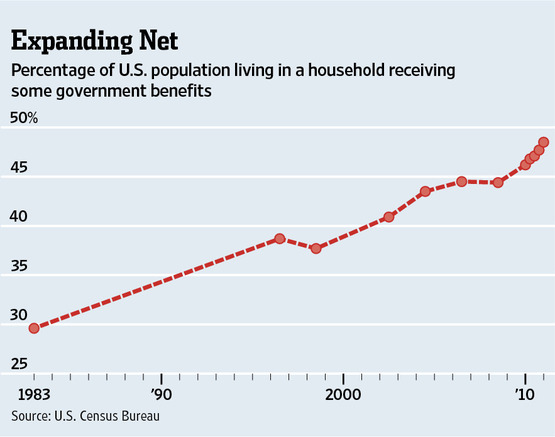
Families were more dependent on government programs than ever last year.
Nearly half, 48.5%, of the population lived in a household that received some type of government benefit in the first quarter of 2010, according to Census data. Those numbers have risen since the middle of the recession when 44.4% lived households receiving benefits in the third quarter of 2008.
The share of people relying on government benefits has reached a historic high, in large part from the deep recession and meager recovery, but also because of the expansion of government programs over the years. (See a timeline on the history of government benefits programs here.)
Means-tested programs, designed to help the needy, accounted for the largest share of recipients last year. Some 34.2% of Americans lived in a household that received benefits such as food stamps, subsidized housing, cash welfare or Medicaid (the federal-state health care program for the poor).
Another 14.5% lived in homes where someone was on Medicare (the health care program for the elderly). Nearly 16% lived in households receiving Social Security.
High unemployment and increased reliance on government programs has also shrunk the nation’s share of taxpayers. Some 46.4% of households will pay no federal income tax this year, according to the nonpartisan Tax Policy Center. That’s up from 39.9% in 2007, the year the recession began.
A plan like Herman Cain’s 9-9-9 plan would make sure that everybody is paying their fair share of taxes, and maybe then people who collect these benefits without paying their fair share would have a reason to want to cut government spending.
As part of his liberal phase when governor of Massachusetts — political principles have been ever-flexible for Romney — he orchestrated passage of legislation with eerie similarities to ObamaCare. Massachusetts mandates purchase of insurance, decides what benefits must be offered, and maintains a complex system of subsidies and penalties. Declared Boston Globe columnist Adrian Walker, the two programs are “not identical, but they’re certainly close kin.” MIT economist Jonathan Gruber, who advised both Gov. Romney and President Obama on health care, asserted: “Basically, it’s the same thing.”[…]Alas, even the former governor’s constitutional scruples are suspect. In 1994 he backed a federal mandate. His concern about the overweening federal government apparently was not so finely developed then.
[…]However, paying for more benefits for more people inevitably makes medicine more expensive. Costs for Commonwealth Care, the Massachusetts government’s subsidized insurance program alone are up a fifth over initial projections. Last year State Treasurer Timothy P. Cahill wrote: “The universal insurance coverage we adopted in 2006 was projected to cost taxpayers $88 million a year. However, since this program was adopted in 2006, our health-care costs have in total exceeded $4 billion. The cost of Massachusetts’ plan has blown a hole in the Commonwealth’s budget.”
[…]State finances have not collapsed only because RomneyCare spread the costs widely, forcing virtually everyone in and out of the state to share the pain. Cahill cited federal subsidies as keeping the state afloat financially. Indeed, a June study from the Beacon Hill Institute concluded that “The state has been able to shift the majority of the costs to the federal government.” The Institute pointed to higher costs of $8.6 billion since the law was implemented. Just $414 million was paid by Massachusetts. Medicaid (federal payments) covered $2.4 billion. Medicare took care of $1.4 billion.
But even more costs, $4.3 billion, have been imposed on the private sector — employers, insurers, and residents. This estimate is in line with an earlier study by the Massachusetts Taxpayers Foundation, which figured that 60% of the new costs fell on individuals and businesses.
As expenses have risen, so have premiums. Noted Kuttner, “because serious cost containment was not part of the original package, premium costs in the commonwealth have risen far faster than nationally — by 10.3%, the most recent year available.” Economists John F. Cogan, Glenn Hubbard, and Daniel Kessler figured that RomneyCare inflated premiums by 6% from 2006 to 2008. This at a time where the state-subsidized Commonwealth Care was displacing private insurance for many people, thereby reducing demand, which should have reduced cost pressures.
Unfortunately, noted the Beacon Hill Institute, “private companies have no choice but to pass the higher costs onto the insured. Some of these costs fall in the double-digit range.” That naturally displeased public officials, since it undercut their claim to have solved Massachusetts’ health care problems.
The Bay State’s controversial 2006 universal health-care plan — also known as “Romneycare” — has cost Massachusetts more than 18,000 jobs, according to an exclusive blockbuster study that could provide ammo to GOP rivals of former Gov. Mitt Romney as he touts his job-creating chops on the campaign trail.
“Mandating health insurance coverage and expanding the demand for health services without increasing supply drove up costs. Economics 101 tells us that,” said Paul Bachman, research director at Suffolk University’s Beacon Hill Institute, the conservative think tank that conducted the study. The Herald obtained an exclusive copy of the findings.
“The ‘shared sacrifice’ needed to provide universal health care includes a net loss of jobs, which is attributable to the higher costs that the measure imposed,” said David Tuerck, the institute’s executive director.
…Despite Romney’s vaunted business acumen as a successful venture capitalist, Bachman said the former governor “was a little naive about what would become of the law.”
The Beacon Hill Institute study found that, on average, Romneycare:
cost the Bay State 18,313 jobs;
drove up total health insurance costs in Massachusetts by $4.311 billion;
slowed the growth of disposable income per person by $376; and
reduced investment in Massachusetts by $25.06 million.
The 2006 reform jeopardized the solvency of private health plans in the Bay State. Unfortunately, insurers’ solvency is not something patients, physicians, and voters have reason to observe closely, so the political class suffers from perverse incentives once it starts micromanaging health insurance. As a result, higher costs have been passed on through higher per capita spending and premium growth.
According to the state’s 2010 annual report, today “per capita spending on health care in Massachusetts is 15 percent higher than the rest of the nation, even when accounting for wages and spending on medical research and education in Massachusetts.” Indeed, Professor John F. Cogan of Stanford University has concluded the 2006 reform led to premium growth 6 percent higher in Massachusetts than in the rest of the United States between 2006 and 2008.
Because it was politically intolerable to allow premiums to rise in line with the costs of Romneycare, the state’s insurance commissioner denied 235 of 276 rate increase requests in April 2010. For a short time, no new policies were offered, and plans suffered significant losses. The next month, Blue Cross Blue Shield of Massachusetts, the state’s largest carrier, announced a $55 million provision for anticipated losses in the second quarter alone.
Of the 12 largest carriers, five were already operating at a loss. At this point, even if the state allows Blue Cross Blue Shield of Massachusetts to increase rates in line with medical costs, my analysis concludes the carrier will become insolvent in the vicinity of 2017. Other carriers will soon follow.
Campaign speeches and debate zingers today don’t cancel out a liberal leftist record on policy yesterday.
He often claims to have balanced the Massachusetts budget without raising taxes. The first part of that claim is true, but the second part is a matter of semantics.
As Cato pointed out in a 2006 report, while Romney didn’t raise general tax revenues, he raised various fees by $500 million and then proposed $140 million in business tax hikes by closing “loopholes.” His health care plan also increased spending, prompting tax increases after he left office to cover cost overruns.
This time around, by sticking by his health care law, Romney is attempting to avoid the “flip flopper” label that dogged his last campaign. But this shift in tactics isn’t going to make the problem of his past positions suddenly disappear.
As governor, Romney was no friend of gun owners. In 2004, when the Clinton-era federal assault weapons ban expired, he signed a permanent one at the state level.
Despite his tough talk on immigration during his last campaign, in 2005 Romney told the Boston Globe that reform along the lines that McCain proposed was “reasonable.”
Romney also, at various times, supported campaign finance regulations far more sweeping than McCain-Feingold, even though he subsequently blasted that law as an attack on free speech.
Romney’s support for “No Child Left Behind,” President Bush’s expansion of the federal government’s role in education, not only puts him at odds with conservatives, but it also undercuts the federalist defense of his health care law. If a one-size-fits-all approach doesn’t work for health care, why should it work for education?
Furthermore, there’s no reason to believe that social conservatives who were suspicious of Romney’s conveniently timed conversion from pro-choice to pro-life before his last presidential run will see him as any more authentic this time around.
“I don’t speak for the scientific community, of course,” Romney said, in response to the first question of the morning. “But I believe the world’s getting warmer. I can’t prove that, but I believe based on what I read that the world is getting warmer. And number two, I believe that humans contribute to that.”
He also said he wanted to wean the country from its dependence on foreign oil by seeking alternative sources of energy, and said that Americans should do more to conserve.
“I’m told that we use almost twice as much energy per person as does a European, and more like three times as much energy as does a Japanese citizen,” Romney said. “We can do a lot better.”
Mitt Romney position on abortion, gun control, gay marriage
(Image: H/T Robert)
Mitt Romney’s record on social issues
From the 1994 Massachusetts Senate debate between Mitt Romney and Edward Kennedy.
Here he is again in 2002 in his run for government of Massachusetts:
And again in May 2005, as governor of Massachusetts:
And on embryonic stem cell research in 2005:
And on gun control in 2002:
Mitt Romney is not a social conservative. He is a center-leftist who will say anything in order to get elected in 2012. Nothing he says can be trusted – he adapts himself to any environment when campaigning – he says what people want to hear, and it is not at all what his actual record shows.
Mitt Romney political views in 2012
What do conservatives think of Mitt Romney’s record?
8. Gov. Mitt Romney (Mass.)
Has said, “I believe that abortion should be safe and legal in this country.” Supports civil unions and stringent gun laws. After visiting Houston, he criticized the city’s aesthetics, saying, “This is what happens when you don’t have zoning.”