
Tag Archives: Social Programs

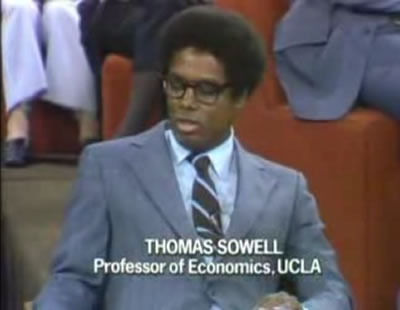
Thomas Sowell explains the concept of “moral hazard”

Young Thomas Sowell

From Real Clear Politics. (H/T Jojo)

Excerpt:

One of the things that makes it tough to figure out how much has to be charged for insurance is that people behave differently when they are insured from the way they behave when they are not insured.

In other words, if one person out of 10,000 has his car set on fire, and it costs an average of $10,000 to restore the car to its previous condition, then it might seem as if charging one dollar to all 10,000 people would be enough to cover the cost of paying $10,000 to the one person whose car that will need to be repaired. But the joker in this deal is that people whose cars are insured may not be as cautious as other people are about what kinds of neighborhoods they park their car in.

[…]Although “moral hazard” is an insurance term, it applies to other government policies besides insurance. International studies show that people in countries with more generous and long-lasting unemployment compensation spend less time looking for jobs. In the United States, where unemployment compensation is less generous than in Western Europe, unemployed Americans spend more hours looking for work than do unemployed Europeans in countries with more generous unemployment compensation.

People change their behavior in other ways when the government pays with the taxpayers’ money. After welfare became more readily available in the 1960s, unwed motherhood skyrocketed. The country is still paying the price for that– of which the money is the least of it. Children raised by single mothers on welfare have far higher rates of crime, welfare and other social pathology.

San Francisco has been one of the most generous cities in the country when it comes to subsidizing the homeless. Should we be surprised that homelessness is a big problem in San Francisco?

[…]We also hear a lot of talk about “the uninsured,” for whose benefit we are to drastically change the whole medical-care system. But income data show that many of those uninsured people have incomes from which they could easily afford insurance. But they can live it up instead, because the government has mandated that hospital emergency rooms treat everyone.

And here’s another Tom Sowell column making a related point.

Excerpt:

Much has been made of the fact that families making less than $250,000 a year will not see their taxes raised. Of course they won’t see it, because what they see could affect how they vote.

But when huge tax increases are put on electric utility companies, the public will see their electricity bills go up. When huge taxes are put on other businesses as well, they will see the prices of the things those businesses sell go up.

If you are not in that “rich” category, you will not see your own taxes go up. But you will be paying someone else’s higher taxes, unless of course you can do without electricity and other products of heavily taxed businesses. If you don’t see this, so much the better for the Obama administration politically.

This country has been changed in a more profound way by corrupting its fundamental values. The Obama administration has begun bribing people with the promise of getting their medical care and other benefits paid for by other people, so long as those other people can be called “the rich.” Incidentally, most of those who are called “the rich” are nowhere close to being rich.

[…]There was a time when most Americans would have resented the suggestion that they wanted someone else to pay their bills. But now, envy and resentment have been cultivated to the point where even people who contribute nothing to society feel that they have a right to a “fair share” of what others have produced.

The most dangerous corruption is a corruption of a nation’s soul. That is what this administration is doing.

Republicans prefer private voluntary charity as the best way to provide a safety net. Just because people on the left give less to charity than people on the right, it doesn’t mean that no one one gives to charity. Europe has the highest taxes, and they give the least in charity. Why not LOWER taxes for people who want to give MORE in charity? When government hands out money, it encourages people to be more dependent. But when a person in trouble has to go to a neighbor or a charity in their own community, it sends the right message – “this should be temporary – don’t let this become a habit”. It’s not GOOD for someone to depend on the government. People need to work in order to be happy.

Having the government take over the role of provider in the home is an insult to men. It’s not government’s job to replace men. They ought to stay right out of it. Leave money in the pockets of the working man so he can save for a rainy day himself. If you subsidize a behavior, you get more of it. If you tax a behavior, you get less of it. It makes no sense to subsidize irresponsible lifestyle choices and tax productive and moral lifestyle choices. You don’t want to make the rescue from bad decisions an anonymous and automatic affair. You want people to worry, so that they won’t want to make risky and irresponsible choices. Everybody goes through though times, but we shouldn’t make it normal. People ought to know that it’s not normal.

You may want to read about how government dependence makes people less happy than having a job. Don’t make people depend on government by taxing businesses and investment. We need more companies hiring – not less. And that means letting the profit motive provide an incentive for entrepreneurs to engage in more risk-taking and enterprise.

Feminist wants UK government to provide free IVF

From the UK Telegraph, an editorial by Theodore Dalrymple. (H/T RuthBlog)

Excerpt:

[The chairman of the Human Fertilisation and Embryology Authority, Suzi Leather] …has suggested that, henceforth, the clause requiring doctors to take account of the need of a child for a father, when offering in vitro fertilisation to infertile women, should be removed from the law. The idea that fathers are necessary or even desirable in the lives of children is, in the opinion of Ms Leather, too old-fashioned to be entertained any longer.

[…]In Ms Leather’s brave new world, women are to have children merely because they want them, as is their government-given right, irrespective of their ability to bring them up, or who has to pay for them, or the consequences to the children themselves. Men are to be permanently infantilised, their income being in essence pocket money for them to spend on their enjoyments, having no serious responsibilities at all (beyond paying tax). Henceforth, the state will be father to the child, and the father will be child of the state.

This paper from the Heritage Foundation cites a very interesting study.

A seminal British study confirms that a child is safest when his biological parents are married and least safe when his mother is cohabiting with a man other than her husband. Specifically, the family Court Reporter Survey for England and Wales presents concrete evidence that children are 20 to 33 times safer living with their biological married parents than in other family configurations.

I think that if you take taxpayer money from working fathers and pay for unmarried women to have fatherless children, you will get fewer fathers and more fatherless children.

Are biological fathers or unrelated men more dangerous for children?

This article from the Weekly Standard answers the question.

Excerpt:

A March 1996 study by the Bureau of Justice Statistics contains some interesting findings that indicate just how widespread the problem may be. In a nationally representative survey of state prisoners jailed for assaults against or murders of children, fully one-half of respondents reported the victim was a friend, acquaintance, or relative other than offspring. (All but 3 percent of those who committed violent crimes against children were men.) A close relationship between victim and victimizer is also suggested by the fact that three-quarters of all the crimes occurred in either the perpetrator’s home or the victim’s.

A 1994 paper published in the Journal of Comparative Family Studies looked at 32,000 documented cases of child abuse. Of the victims, only 28 percent lived with both biological parents (far fewer than the 68 percent of all children who live with both parents); 44 percent lived with their mother only (as do 25 percent of all children); and 18 percent lived with their mother and an unrelated adult (double the 9 percent of all children who live with their mother and an unrelated adult).

These findings mirror a 1993 British study by the Family Education Trust, which meticulously explored the relationship between family structure and child abuse. Using data on documented cases of abuse in Britain between 1982 and 1988, the report found a high correlation between child abuse and the marital status of the parents.

Specifically, the British study found that the incidence of abuse was an astounding 33 times higher in homes where the mother was cohabiting with an unrelated boyfriend than in stable nuclear families. Even when the boyfriend was the children’s biological father, the chances of abuse were twice as high.

These findings are consonant with those published a year earlier by Leslie Margolin of the University of Iowa in the journal Child Abuse and Neglect. Prof. Margolin found that boyfriends were 27 times more likely than natural parents to abuse a child. The next-riskiest group, siblings, were only twice as likely as parents to abuse a child.

More recently, a report by Dr. Michael Stiffman presented at the latest meeting of the American Academy of Pediatrics, in October, studied the 175 Missouri children under the age of 5 who were murdered between 1992 and 1994. It found that the risk of a child’s dying at the hands of an adult living in the child’s own household was eight times higher if the adult was biologically unrelated.

The Heritage Foundation’s Patrick Fagan discovered that the number of child-abuse cases appeared to rise in the 1980s along with the general societal acceptance of cohabitation before, or instead of, marriage. That runs counter to the radical-feminist view, which holds that marriage is an oppressive male institution of which violence is an integral feature. If that were true, then child abuse and domestic violence should have decreased along with the rise in cohabitation.

Heritage also found that in the case of very poor children (those in households earning less than $ 15,000 per year), 75 percent lived in a household where the biological father was absent. And 50 percent of adults with less than a high-school education lived in cohabitation arrangements. “This mix — poverty, lack of education, children, and cohabitation — is an incubator for violence,” Fagan says.

Why, then, do we ignore the problem? Fagan has a theory: “It is extremely politically incorrect to suggest that living together might not be the best living arrangement.”

The moral of the story is that it is a lot safer for children if we promote marriage as a way of attaching mothers and fathers to their children. Fathers who have a biological connection to children are a lot less likely to harm them. And a lot of social problems like child poverty, promiscuity and violence cannot be solved by replacing a father with a check from the government. We need to support fathers by empowering them in their traditional roles. Let the men lead.