
Tag Archives: Social Programs

What working at Wal-Mart taught a young conservative woman about the poor

My friend Jose sent me this wonderful article from The College Conservative.

Excerpt:

During the 2010 and 2011 summers, I was a cashier at Wal-Mart #1788 in Scarborough, Maine. I spent hours upon hours toiling away at a register, scanning, bagging, and dealing with questionable clientele. These were all expected parts of the job, and I was okay with it. What I didn’t expect to be part of my job at Wal-Mart was to witness massive amounts of welfare fraud and abuse.

I understand that sometimes, people are destitute. They need help, and they accept help from the state in order to feed their families. This is fine. It happens. I’m not against temporary aid helping those who truly need it. What I saw at Wal-Mart, however, was not temporary aid. I witnessed generations of families all relying on the state to buy food and other items.  I literally witnessed mothers of small children asking their mothers if they could borrow their EBT cards. I once had a man show me his welfare card for an ID to buy alcohol. The man was from Massachusetts. Governor Michael Dukakis’ signature was on his welfare card. Dukakis’ last gubernatorial term ended in January of 1991. I was born in June of 1991. The man had been on welfare my entire life. That’s not how welfare was intended, but sadly, it is what it has become.

Here are just two short anecdotes:

a) People ignoring me on their iPhones while the state paid for their food. (For those of you keeping score at home, an iPhone is at least $200, and requires a data package of at least $25 a month. If a person can spend $25+ a month so they can watch YouTube 24/7, I don’t see why they can’t spend that money on food.)

d) A man who ran a hotdog stand on the pier in Portland, Maine used to come through my line. He would always discuss his hotdog stand and encourage me to “come visit him for lunch some day.” What would he buy? Hotdogs, buns, mustard, ketchup, etc. How would he pay for it? Food stamps. Either that man really likes hotdogs, or the state is paying for his business. Not okay.

I urge you with every fiber of my body to click through and read the true story of Welfare Queen #1 and Welfare Queen #2. Read them, and weep. Just because someone is poor, it doesn’t mean that they are automatically a good person. Maybe they are poor because they are irresponsible and selfish. Had you ever considered that? In any case, it’s not the government’s job to hand out money without knowing anything about the person who is getting the money. Government should leave the money in the hands of people who earn it, and let us decide who deserves to receive charity. (At the most, they should give us a tax deduction for charity up to 10% of our gross income to encourage more private charity)

But wait! There’s more!

From Human Events, toll workers being paid over $100,000 a year by the government.

Excerpt:

Ladies and gentlemen, meet Princesella Smith, who raked in $89,599 for operating the toll lanes at the George Washington Bridge in 2011.

Smith isn’t alone.  An investigation by the New York Post revealed that another toll booth operator pulled in a whopping $102,670 in 2011, $40K of that money coming in overtime.  In total, as the Post notes, there are at least 24 New York and New Jersey workers who have raked in more than $80,000 as “public” workers at a job that requires us to hand them even more of our money.

[…]Besides excessive wages to people whose only skill requirement is to sit on a stool and count and collect dollar bills, tax dollars reserved for transportation uses have gone to a panoply of nonessential programs.  As Ronald Utt of The Heritage Foundation points out, the “highway trust fund” has been raided to pay for Indian reservations, historic preservation sites, Appalachian and Mississippi Delta development, roadside beautification, bicycles, hiking paths, university research, and—the granddaddy of all expenses—feeding the $425 million beast that is the Department of Transportation.

The Port Authority (PA), for instance, employees a gardener for $94,000 and a blacksmith for $146,000 a year.  Heck, there are even retired PA employees who are making around that amount by cashing in on unused vacation and comp time.  (Here’s an idea:  As we’re facing budget deficits well into our future, how about requiring public employees to use their vaca time … or lose it.  No cashing in allowed.)

The larger problem highlighted with transportation spending, as Ronald Utt underscores, is the concept of public ownership.  A paltry 65% of highway taxes collected actually go to making driving a more pleasant experience for commuters.  The rest is squandered on whatever fancies a politician’s spending appetite at a given moment.  As the number of people driving has increased on the nation’s roads and highways (up 71% since 1970), lawmakers in Washington, D.C., and around the country have funneled money to stupid bike lines and high-speed rail debacles.

If I were President, I would immediately cancel all pensions for retired public sector workers and outlaw public sector unions.  What a colossal waste of money.

UPDATE: John Hawkins just posted a column entitled “The Five Things You Can Learn From Wal-Mart“.
Real greed is when adults force children to give them a bailout from debt

This is a must-read by Mark Steyn.

Excerpt:

While President Obama was making his latest pitch for a brand new, even more unsustainable entitlement at the health care “summit,” thousands of Greeks took to the streets to riot. An enterprising cable network might have shown the two scenes on a continuous split screen – because they’re part of the same story. It’s just that Greece is a little further along in the plot: They’re at the point where the canoe is about to plunge over the falls. America is further upstream and can still pull for shore, but has decided instead that what it needs to do is catch up with the Greek canoe. Chapter One (the introduction of unsustainable entitlements) leads eventually to Chapter 20 (total societal collapse): The Greeks are at Chapter 17 or 18.

What’s happening in the developed world today isn’t so very hard to understand: The 20th century Bismarckian welfare state has run out of people to stick it to. In America, the feckless insatiable boobs in Washington, Sacramento, Albany and elsewhere are screwing over our kids and grandkids. In Europe, they’ve reached the next stage in social democratic evolution: There are no kids or grandkids to screw over. The United States has a fertility rate of around 2.1, or just over two kids per couple. Greece has a fertility rate of about 1.3: 10 grandparents have six kids have four grandkids – i.e., the family tree is upside down. Demographers call 1.3 “lowest-low” fertility – the point from which no society has ever recovered. And compared to Spain and Italy, Greece has the least worst fertility rate in Mediterranean Europe.

So you can’t borrow against the future because, in the most basic sense, you don’t have one. Greeks in the public sector retire at 58, which sounds great. But, when 10 grandparents have four grandchildren, who pays for you to spend the last third of your adult life loafing around?

By the way, you don’t have to go to Greece to experience Greek-style retirement: The Athenian “public service” of California has been metaphorically face-down in the ouzo for a generation. Still, America as a whole is not yet Greece. A couple of years ago, when I wrote my book “America Alone,” I put the Social Security debate in a bit of perspective: On 2005 figures, projected public pensions liabilities were expected to rise by 2040 to about 6.8 percent of GDP. In Greece, the figure was 25 percent. In other words, head for the hills, Armageddon, outta here, The End. Since then, the situation has worsened in both countries. And really the comparison is academic: Whereas America still has a choice, Greece isn’t going to have a 2040 – not without a massive shot of Reality Juice.

Is that likely to happen? At such moments, I like to modify Gerald Ford. When seeking to ingratiate himself with conservative audiences, President Ford liked to say: “A government big enough to give you everything you want is big enough to take away everything you have.” Which is true enough. But there’s an intermediate stage: A government big enough to give you everything you want isn’t big enough to get you to give any of it back. That’s the point Greece is at. Its socialist government has been forced into supporting a package of austerity measures. The Greek people’s response is: Nuts to that. Public sector workers have succeeded in redefining time itself: Every year, they receive 14 monthly payments. You do the math. And for about seven months’ work – for many of them the workday ends at 2:30 p.m. When they retire, they get 14 monthly pension payments. In other words: Economic reality is not my problem. I want my benefits. And, if it bankrupts the entire state a generation from now, who cares as long as they keep the checks coming until I croak?

We hard-hearted, small-government guys are often damned as selfish types who care nothing for the general welfare. But, as the Greek protests make plain, nothing makes an individual more selfish than the socially equitable communitarianism of big government. Once a chap’s enjoying the fruits of government health care, government-paid vacation, government-funded early retirement, and all the rest, he couldn’t give a hoot about the general societal interest. He’s got his, and to hell with everyone else. People’s sense of entitlement endures long after the entitlement has ceased to make sense.

The perfect spokesman for the entitlement mentality is the deputy prime minister of Greece. The European Union has concluded that the Greek government’s austerity measures are insufficient and, as a condition of bailout, has demanded something more robust. Greece is no longer a sovereign state: It’s General Motors, and the EU is Washington, and the Greek electorate is happy to play the part of the United Auto Workers – everything’s on the table except anything that would actually make a difference. In practice, because Spain, Portugal, Italy and Ireland are also on the brink of the abyss, a “European” bailout will be paid for by Germany. So the aforementioned Greek deputy prime minister, Theodoros Pangalos, has denounced the conditions of the EU deal on the grounds that the Germans stole all the bullion from the Bank of Greece during the Second World War. Welfare always breeds contempt, in nations as much as inner-city housing projects. How dare you tell us how to live! Just give us your money and push off.

This is the real character of people who avoid having to care about producing goods and services to please customers – people who join public sector unions and work for the government. They elect candidates who will provide them with a standard of living much higher than what they can produce by their own efforts, and pass the bill down to real workers in the private sector, or worse, workers who are not even born. It’s a shame. It’s a shame that parasites should enslave children who are not yet born so that they can have a standard of living they haven’t paid for. And it’s laughable that they impugn the character of productive private sector workers and business owners by talking about “Greed”. The parasites in the public sector unions are the greedy ones. What could be more greedy than intergenerational theft?

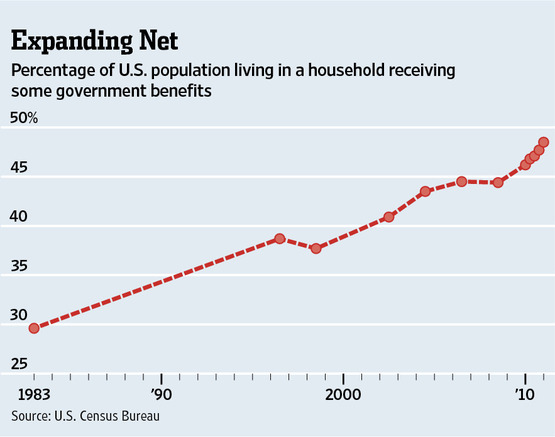
Nearly half of U.S. households are receiving some government benefits

Percentage of households receiving some government benefits

(Click for larger image)

This is the top story on the Wall Street Journal at the time I am writing this (Thursday at midnight).

Excerpt:

Families were more dependent on government programs than ever last year.

Nearly half, 48.5%, of the population lived in a household that received some type of government benefit in the first quarter of 2010, according to Census data. Those numbers have risen since the middle of the recession when 44.4% lived households receiving benefits in the third quarter of 2008.

The share of people relying on government benefits has reached a historic high, in large part from the deep recession and meager recovery, but also because of the expansion of government programs over the years. (See a timeline on the history of government benefits programs here.)

Means-tested programs, designed to help the needy, accounted for the largest share of recipients last year. Some 34.2% of Americans lived in a household that received benefits such as food stamps, subsidized housing, cash welfare or Medicaid (the federal-state health care program for the poor).

Another 14.5% lived in homes where someone was on Medicare (the health care program for the elderly). Nearly 16% lived in households receiving Social Security.

High unemployment and increased reliance on government programs has also shrunk the nation’s share of taxpayers. Some 46.4% of households will pay no federal income tax this year, according to the nonpartisan Tax Policy Center. That’s up from 39.9% in 2007, the year the recession began.

A plan like Herman Cain’s 9-9-9 plan would make sure that everybody is paying their fair share of taxes, and maybe then people who collect these benefits without paying their fair share would have a reason to want to cut government spending.