Tag Archives: Sin

The importance of having a narrative when confronting the assumption of naturalism

Apologetics and the progress of science

How do you present theism as a rational belief to a person who thinks that the progress of science has removed the need for God?

Canadian science writer Denyse O’Leary writes about the history of cosmology at Evolution News.

Excerpt:

What help has materialism been in understanding the universe’s beginnings?

Many in cosmology have never made any secret of their dislike of the Big Bang, the generally accepted start to our universe first suggested by Belgian priest Georges Lemaître (1894-1966).

On the face of it, that is odd. The theory accounts well enough for the evidence. Nothing ever completely accounts for all the evidence, of course, because evidence is always changing a bit. But the Big Bang has enabled accurate prediction.

In which case, its hostile reception might surprise you. British astronomer Fred Hoyle (1915-2001) gave the theory its name in one of his papers — as a joke. Another noted astronomer, Arthur Eddington (1882-1944), exclaimed in 1933, “I feel almost an indignation that anyone should believe in it — except myself.” Why? Because “The beginning seems to present insuperable difficulties unless we agree to look on it as frankly supernatural.”

One team of astrophysicists (1973) opined that it “involves a certain metaphysical aspect which may be either appealing or revolting.” Robert Jastrow (1925-2008), head of NASA’s Goddard Institute for Space Studies, initially remarked, “On both scientific and philosophical grounds, the concept of an eternal Universe seems more acceptable than the concept of a transient Universe that springs into being suddenly, and then fades slowly into darkness.” And Templeton Prize winner (2011) Martin Rees recalls his mentor Dennis Sciama’s dogged commitment to an eternal universe, no-Big Bang model:

For him, as for its inventors, it had a deep philosophical appeal — the universe existed, from everlasting to everlasting, in a uniquely self-consistent state. When conflicting evidence emerged, Sciama therefore sought a loophole (even an unlikely seeming one) rather as a defense lawyer clutches at any argument to rebut the prosecution case.

Evidence forced theorists to abandon their preferred eternal-universe model. From the mid 1940s, Hoyle attempted to disprove the theory he named. Until 1964, when his preferred theory, the Steady State, lost an evidence test.

Here is a quick summary of some of the experimental evidence that emerged in the last few decades that caused naturalists to abandon the eternal universe that they loved so much when they were younger.

The importance of having a narrative

Now I want to make a very, very important point about Christianity and the progress of science. And that point is that it is very important that Christians present the evidence in exactly the way that Denyse presented it in that article – in its historical context, featuring the conflict between naturalists and the experimental evidence.

All Christians should be familiar with the following basic pieces of evidence which fit the war between science and naturalism narrative:

  1. The origin of the universe
  2. The cosmic fine-tuning
  3. The origin of life (biological information)
  4. The sudden origin of the Cambrian phyla
  5. The habitability/observability correlation

When you talk about these evidences as a Christian theist to non-Christians, you have to have cultivated a genuine interest in reconciling your beliefs with science. You have to accept that there are two books that reveal God’s character and attributes. The book of nature, and the book of Scripture. And you need to be flexible about getting these two books to fit together. The book of nature gives us natural theology (see Romans 1). It tells us that God is Creator and Designer. The book of Scripture tells us that God stepped into history as a man to save us by taking the punishment for our headlong rush away from God, which the Bible calls sin. Science is one way that humans can recover some of basic knowledge about God. Knowledge that is only possible because God created and designed the universe (and us) in such a way that we are capable of making discoveries, and that the universe is capable of being explored and understood.

It’s very important to present these five basic evidences to non-Christians in the historical context. And here is the story you must tell: “In the beginning, there was the naturalism, and the naturalism tried to argue from ignorance that God was not Creator and God was not Designer. And then came the science, and now people have to give up their naturalism in order to not be crazy and irrational”. That’s the narrative you use when talking to non-Christians about science.

In the beginning was the naturalism:

  1. In pre-scientific times, atheists maintained that the universe was eternal
  2. In pre-scientific times, atheists maintained that a life-permitting universe was as likely as a life-prohibiting universe
  3. In pre-scientific times, atheists maintained that the cell was a simple blob of jello that could spontaneously emerge in some warm pond
  4. In pre-scientific times, atheists maintained that the sudden origin of the Cambrian phyla would be explained by subsequent fossil discoveries
  5. In pre-scientific times, atheists maintained that there was nothing special about our galaxy, solar system, planet or moon

But then science progressed by doing experiments and making observations:

  1. Scientists discovered redshift and the cosmic microwave background radiation (evidence for a cosmic beginning) and more!
  2. Scientists discovered the fine-tuning of gravity and of the cosmological constant and more!
  3. Scientists discovered protein sequencing and exposed the myth of “junk DNA” and more!
  4. Scientists discovered an even shorter Cambrian explosion period and the absence of precursor fossils and more!
  5. Scientists discovered galactic habitable zones and circumstellar habitable zones and more!

And now rational people – people who want to have true beliefs about reality – need to abandon a false religion (naturalism).

Now naturally, science is in a state of flux and things change. But you have to look at the trend of discoveries, and those trends are clearly going against naturalism, and in favor of Christian theism. No one is arguing for a deductive proof here, we are simply looking at the evidence we have today and proportioning our belief to the concrete evidence we have today. People who are guided by reason should not seek to construct a worldview by leveraging speculations about future discoveries and mere possibilities. We should instead believe what is more probable than not. That’s what a rational seeker of truth ought to do. Proportion belief to probabilities based on current, concrete knowledge.

Atheism, as a worldview, is not rooted in an honest assessment about what science tells us about reality. Atheism is rooted in a religion: naturalism. And the troubling thing we learn from looking at the history of science is that this religion of naturalism is insulated from correction from the progress of science. Nothing that science reveals about nature seems to be able to put a dent in the religion of naturalism, at least for most atheists.

It falls to us Christian theists, then, to hold them accountable for their abuse and misrepresentation of science. And that means telling the story of the progress of science accurately, and accurately calling out the religion of naturalism for what it is – a religion rooted in blind faith and ignorance that has been repeatedly and convincingly falsified by the progress of science in the modern era.

Positive arguments for Christian theism

Why do famous atheists believe that God does not exist?

Here’s a lecture by New York University professor Paul Vitz to explain a connection between atheism and fatherlessness:

Here’s an article by Paul Copan (related to the lecture) which points out how father presence/absence and father quality affects belief and disbelief in God.

Excerpt:

Seventh, the attempt to psychologize believers applies more readily to the hardened atheist.It is interesting that while atheists and skeptics often psychoanalyze the religious believer, they regularly fail to psychoanalyze their ownrejection of God. Why are believers subject to such scrutiny and not atheists? Remember another feature of Freud’s psychoanalysis — namely, an underlying resentment that desires to kill the father figure.

Why presume atheism is the rational, psychologically sound, and default position while theism is somehow psychologically deficient? New York University psychology professor Paul Vitz turns the tables on such thinking. He essentially says, “Let’s look into the lives of leading atheists and skeptics in the past. What do they have in common?” The result is interesting: virtually all of these leading figures lacked a positive fatherly role model — or had no father at all.11

Let’s look at some of them.

  • Voltaire(1694–1778): This biting critic of religion, though not an atheist, strongly rejected his father and rejected his birth name of Francois-Marie Arouet.
  • David Hume(1711–76): The father of this Scottish skeptic died when Hume was only 2 years old. Hume’s biographers mention no relatives or family friends who could have served as father figures.
  • Baron d’Holbach(1723–89): This French atheist became an orphan at age 13 and lived with his uncle.
  • Ludwig Feuerbach (1804–72): At age 13, his father left his family and took up living with another woman in a different town.
  • Karl Marx(1818–83): Marx’s father, a Jew, converted to being a Lutheran under pressure — not out of any religious conviction. Marx, therefore, did not respect his father.
  • Friedrich Nietzsche(1844–1900): He was 4 when he lost his father.
  • Sigmund Freud(1856–1939): His father, Jacob, was a great disappointment to him; his father was passive and weak. Freud also mentioned that his father was a sexual pervert and that his children suffered for it.
  • Bertrand Russell(1872–1970): His father died when he was 4.
  • Albert Camus(1913–60): His father died when he was 1 year old, and in his autobiographical novel The First Man, his father is the central figure preoccupation of his work.
  • Jean-Paul Sartre(1905–80): The famous existentialist’s father died before he was born.12
  • Madeleine Murray-O’Hair (1919–95): She hated her father and even tried to kill him with a butcher knife.
  • We could throw in a few more prominent contemporary atheists not mentioned by Vitz with similar childhood challenges:
  • Daniel Dennett (1942–): His father died when he was 5 years of age and had little influence on Dennett.13
  • Christopher Hitchens (1949–): His father (“the Commander”) was a good man, according to Hitchens, but he and Hitchens “didn’t hold much converse.” Once having “a respectful distance,” their relationship took on a “definite coolness” with an “occasional thaw.” Hitchens adds: “I am rather barren of paternal recollections.”14
  • Richard Dawkins (1941–): Though encouraged by his parents to study science, he mentions being molested as a child — no insignificant event, though Dawkins dismisses it as merely embarrassing.15

Moreover, Vitz’s study notes how many prominent theists in the past — such as Blaise Pascal, G.K. Chesterton, Karl Barth, and Dietrich Bonhoeffer — have had in common a loving, caring father in their lives.16

Here are some corrections to the list:

1) Voltaire was not an atheist but a deist who rejected claims of the Bible’s inspiration, like Paine. Voltaire’s aphorism, “If God did not exist, it would be necessary to invent him,” far from being the cynical remark it is often taken for, it was meant as a retort to the atheistic clique of d’Holbach, Grimm, and others.

2) David Hume’s religious views remain uncertain. He never said he was an atheist. A gentle skeptic suits him more.

3) Bertrand Russell was an agnostic.

Not only is there that anecdotal evidence of a psychological explanation for atheism, but there is also statistical evidence.

Excerpt:

In 1994 the Swiss carried out an extra survey that the researchers for our masters in Europe (I write from England) were happy to record. The question was asked to determine whether a person’s religion carried through to the next generation, and if so, why, or if not, why not. The result is dynamite. There is one critical factor. It is overwhelming, and it is this: It is the religious practice of the father of the family that, above all, determines the future attendance at or absence from church of the children.

If both father and mother attend regularly, 33 percent of their children will end up as regular churchgoers, and 41 percent will end up attending irregularly. Only a quarter of their children will end up not practicing at all. If the father is irregular and mother regular, only 3 percent of the children will subsequently become regulars themselves, while a further 59 percent will become irregulars. Thirty-eight percent will be lost.

If the father is non-practicing and mother regular, only 2 percent of children will become regular worshippers, and 37 percent will attend irregularly. Over 60 percent of their children will be lost completely to the church.

Let us look at the figures the other way round. What happens if the father is regular but the mother irregular or non-practicing? Extraordinarily, the percentage of children becoming regular goesupfrom 33 percent to 38 percent with the irregular mother and to 44 percent with the non-practicing, as if loyalty to father’s commitment grows in proportion to mother’s laxity, indifference, or hostility.

[…]In short, if a father does not go to church, no matter how faithful his wife’s devotions, only one child in 50 will become a regular worshipper. If a father does go regularly, regardless of the practice of the mother, between two-thirds and three-quarters of their children will become churchgoers (regular and irregular). If a father goes but irregularly to church, regardless of his wife’s devotion, between a half and two-thirds of their offspring will find themselves coming to church regularly or occasionally.

A non-practicing mother with a regular father will see a minimum of two-thirds of her children ending up at church. In contrast, a non-practicing father with a regular mother will see two-thirds of his children never darken the church door. If his wife is similarly negligent that figure rises to 80 percent!

The results are shocking, but they should not be surprising. They are about as politically incorrect as it is possible to be; but they simply confirm what psychologists, criminologists, educationalists, and traditional Christians know. You cannot buck the biology of the created order. Father’s influence, from the determination of a child’s sex by the implantation of his seed to the funerary rites surrounding his passing, is out of all proportion to his allotted, and severely diminished role, in Western liberal society.

Basically, anyone who doesn’t have a benevolent, involved father is going to have an enormously difficult time believing that moral boundaries set by an authority are for the benefit of the person who is being bounded. The best way to make moral boundaries stick is to see that they apply to the person making the boundaries as well – and that these moral boundaries are rational, evidentially-grounded and not arbitrary.

By the way, isn’t it interesting to note that Barack Obama also grew up fatherless and has issues with God and morality.

Atheist Richard Carrier, who divorced his wife to go polyamorous, seeks new sex partner

Goodness Without God: is it possible?

Is atheism a rational worldview, or is it just rationalizing sexual misbehavior?

A while back, prominent atheist Dr. Richard Carrier explained how he was divorcing his wife – who supported him financially – in order to go polyamorous full-time.

The Yeti’s Roar, a libertarian atheist blog reacted to the news: (link removed)

In a recent blog post, entitled “Coming Out Poly + A Change of Life Venue”, the esteemed Dr. Richard Carrier PhD, discusses his “coming out” as polyamorous, an “orientation” that he just discovered at the young age of 47.

[…]Carrier claims that after 17 years of marriage, he cheated on his wife multiple times, for reasons that he won’t disclose.  In the midst of his infidelity, he suddenly “discovered” (as a middle aged man) that he was polyamorous.  Even though his wife attempted to make the marriage work by allowing him to see other women under the guise of an “open marriage”, Carrier still decided to kick her to the curb.   So in Carrier’s view, his affairs were not a mistake, but rather a fun new “lifestyle choice” that he will pursue, regardless of the past commitment to his wife.

What is even more despicable about Carrier’s behavior toward his wife is the fact that she supported him financially.

[…] The only reason he has been able to live a comfortable lifestyle while blogging and writing obscure books is due to his wife’s financial support.  The reason that he could afford to invest his time in getting graduate degrees from Columbia in subjects that will never land him a decent paying job is due to the support of his wife.  The reason he was able to travel around the country for low paying speaking engagements instead of having to get a real job is due to his wife’s financial support.  And how does he repay his wife for the support she has given him?  He cheats on her, waits until he is making enough money where he no longer needs her income, and kicks her to the curb.

So, whenever Richard Carrier was talking about morality without God, now we know what he meant. He even dedicated his book on morality without God to his now ex-wife. How ironic.

But the new polyamoratheism news is that Carrier is actually searching for a new “date”.

I am not linking to his blog post, but it says: (H/T The Yeti’s Roar)

I’ll start by making sure anyone considering this is up to speed. I am polyamorous. I currently have many girlfriends. All I consider my friends. Some are just occasional lovers. Some I am more involved with. They are also polyamorous, or near enough (not all of them identify that way, but all of them enjoy open relationships). And I will always have relationships with them, as long as they’ll have me in their life.

Many different things can be meant by the following terms, but just for the present purpose, if by a primary relationship is meant someone you live with or just about as good as live with, a secondary as someone you date regularly, and a tertiary as someone you date occasionally, all my relationships are tertiary, but only because of geography. I live just below Sacramento, California, where the rents are cheap, which means, where no one wants to live. And I’m unlikely to move anytime soon. So relationships with me, at best, are likely to be tertiary—long distance chatting with occasional being together throughout the year. Even so, I always take such friendships seriously.

[…]I’m 0.5 on the Kinsey scale. Not heavy into kink (but get along well with people who are). I have an unusual fetish or two but don’t expect any of my partners to share them. I’m pro sex worker, and though I personally find strip clubs and brothels uninteresting at best (uncomfortable at worst), I like partners who are or who have been sex workers. I also like women who have or pursue a lot of partners or who love to boast of their sexual exploits, especially over wine or whiskey or equivalent. I’m not going to get all butt-hurt or angsty over how high Your Number is. It very much has the opposite effect on me.

[…]I am also planning to have a hotel room, and am comfortable sharing it platonically. Certainly I would enjoy sharing it non-platonically, but I don’t expect it. I can’t believe (even though I know) there are still guys who assume the other sh*t buys them sex, thus necessitating I say this: if you are going to have sex with me, it has to be because it’s fun and you want to, not because it’s something you owe me. On the same understanding, if you have a place for me to crash in town (platonically or not), and are happy to have me over to spare me the cost of hiring a room, that would be lovely. And yes, if you are poly or open and live with a partner or two, I’m comfortable with that as well.

This also means you don’t have to live in the LA area to join me for this. If you can get to LA, and don’t mind sharing a room (at my expense), the opportunity remains.

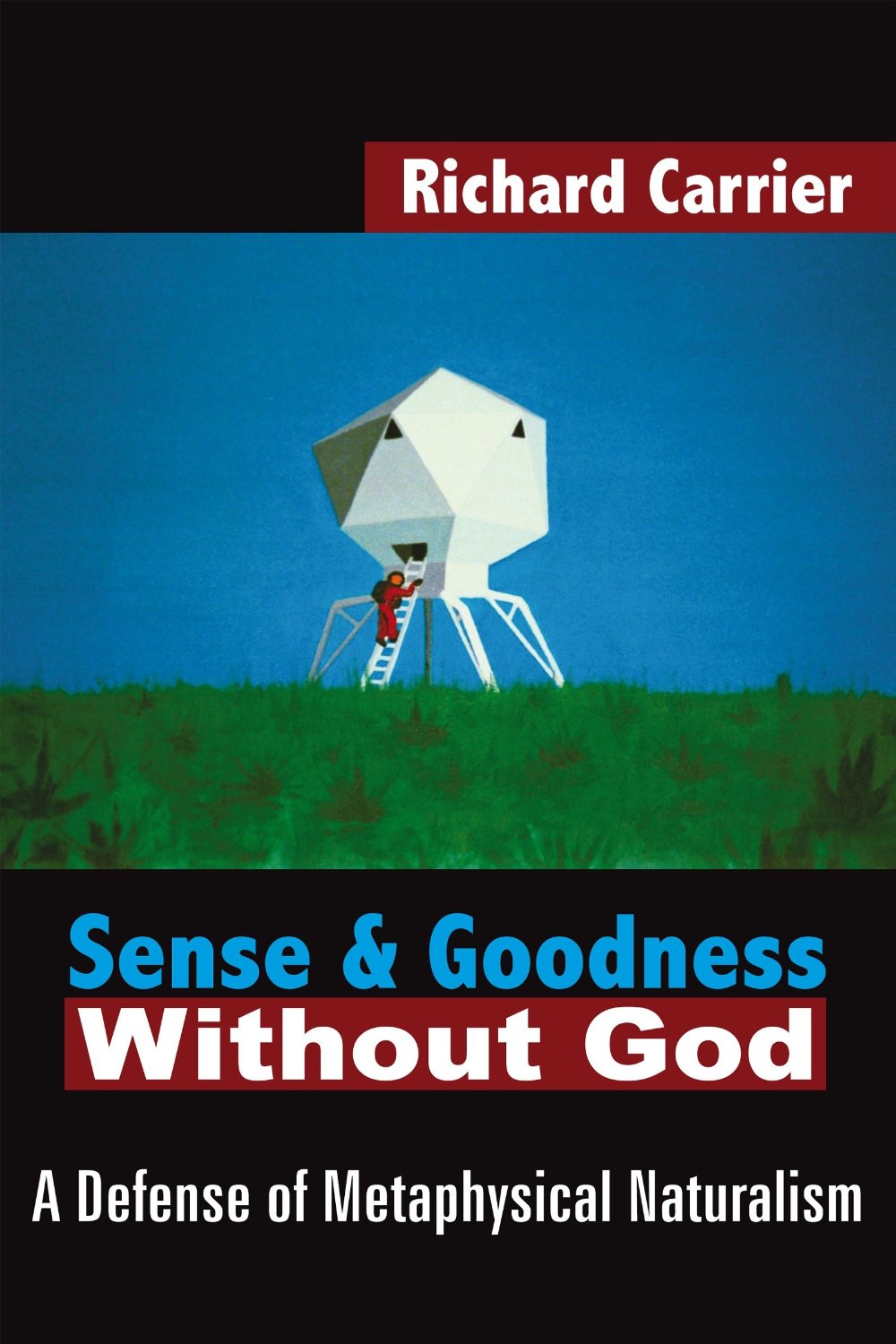
This is Richard Carrier’s book on morality without God:

Goodness Without God: Now we know what it looks like
Goodness without God: Now we know what he was talking about

And the book is dedicated to his wife, now ex-wife:

For Jen…

My buxom brunette
My wellspring of joy
My north star of sanity

Indeed.

You can read a multi-part review of the book here on Deeper Waters (Nick Peters’ site)

I trust that everyone now understands what I was saying about the reasons why atheists jettison God and objective morality. Sexual freedom is definitely a big one, and probably the biggest. This is not a worldview, people, it’s not something that is derived from logic and evidence. It starts and ends with getting rid of moral accountability to the Creator. Period. End of issue.

Not that all atheists are as immoral as Carrier, and not all atheists are motivated by sexual perversion. But the primary motivation is always to be able to get God out of the morality business. There’s no denying that atheists look pretty normal in a society that is still running on the fumes of a declining Judeo -Christian value system. But if you look at how they vote, e.g. – for abortion, for gay marriage, against religious liberty, etc., it’s very clear that they want the society to move away from Judeo-Christian values. And it is this desire that more and more human beings not respect the moral oughts that God prescribes that is the real rebellion.

Romans 1:18-21 nails this:

18The wrath of God is being revealed from heaven against all the godlessness and wickedness of men who suppress the truth by their wickedness,

19since what may be known about God is plain to them, because God has made it plain to them.

20For since the creation of the world God’s invisible qualities—his eternal power and divine nature—have been clearly seen, being understood from what has been made, so that men are without excuse.

21For although they knew God, they neither glorified him as God nor gave thanks to him, but their thinking became futile and their foolish hearts were darkened.

What is expected in the Christian worldview is not to pick and choose a few moral behaviors here and there. Individual moral values are not the issue. When Christ calls a man, he call him to die to himself and his own self-interest, and to take up his moral positions and champion them. Have you ever tried to champion the pro-life cause in an increasingly secular society? How about championing the pro-marriage cause? In order to be a Christian, you don’t just accept the sacrifice of Jesus as atonement for sin, but you also let him lead. And one of those areas of letting him lead is in defining what is and is not moral. It’s very easy for a man to not murder unborn children himself, and to marry someone of the opposite sex, and congratulate himself on how moral he is. Personal morality is not the issue. Inventing your own arbitrary  moral code and then following it might make you feel good, but that is not what God requires. The real challenge of Christianity has to do with standing up for the truth claims, including the moral values, in the face of a society that will not approve of you.

What is required of a man on the Christian worldview is total abandonment to God’s calling and a 100% re-prioritization of his life. It’s not about doing X and Y, but not A and B, and getting a passing grade. It’s about putting Jesus Christ in as your commanding officer in every area of your life.