Tag Archives: Scientific Method

Has Christianity held back the progress of science? What about Galileo?

First, here’s an article from the peer-reviewed journal Nature, probably the best peer-reviewed journal on science in the world. (H/T Letitia)

The article is written by James Hannam. He has a PhD in the History and Philosophy of Science from the University of Cambridge and is the author of The Genesis of Science: How the Christian Middle Ages Launched the Scientific Revolution (published in the UK as God’s Philosophers: How the Medieval World Laid the Foundations of Modern Science).

Excerpt:

Few topics are as open to misunderstanding as the relationship between faith and reason. The ongoing clash of creationism with evolution obscures the fact that Christianity has actually had a far more positive role to play in the history of science than commonly believed. Indeed, many of the alleged examples of religion holding back scientific progress turn out to be bogus. For instance, the Church has never taught that the Earth is flat and, in the Middle Ages, no one thought so anyway. Popes haven’t tried to ban zero, human dissection or lightening rods, let alone excommunicate Halley’s Comet. No one, I am pleased to say, was ever burnt at the stake for scientific ideas. Yet, all these stories are still regularly trotted out as examples of clerical intransigence in the face of scientific progress.

Admittedly, Galileo was put on trial for claiming it is a fact that the Earth goes around the sun, rather than just a hypothesis as the Catholic Church demanded. Still, historians have found that even his trial was as much a case of papal egotism as scientific conservatism. It hardly deserves to overshadow all the support that the Church has given to scientific investigation over the centuries.

That support took several forms. One was simply financial. Until the French Revolution, the Catholic Church was the leading sponsor of scientific research. Starting in the Middle Ages, it paid for priests, monks and friars to study at the universities. The church even insisted that science and mathematics should be a compulsory part of the syllabus. And after some debate, it accepted that Greek and Arabic natural philosophy were essential tools for defending the faith. By the seventeenth century, the Jesuit order had become the leading scientific organisation in Europe, publishing thousands of papers and spreading new discoveries around the world. The cathedrals themselves were designed to double up as astronomical observatories to allow ever more accurate determination of the calendar. And of course, modern genetics was founded by a future abbot growing peas in the monastic garden.

But religious support for science took deeper forms as well. It was only during the nineteenth century that science began to have any practical applications. Technology had ploughed its own furrow up until the 1830s when the German chemical industry started to employ their first PhDs. Before then, the only reason to study science was curiosity or religious piety. Christians believed that God created the universe and ordained the laws of nature. To study the natural world was to admire the work of God. This could be a religious duty and inspire science when there were few other reasons to bother with it. It was faith that led Copernicus to reject the ugly Ptolemaic universe; that drove Johannes Kepler to discover the constitution of the solar system; and that convinced James Clerk Maxwell he could reduce electromagnetism to a set of equations so elegant they take the breathe away.

Given that the Church has not been an enemy to science, it is less surprising to find that the era which was most dominated by Christian faith, the Middle Ages, was a time of innovation and progress. Inventions like the mechanical clock, glasses, printing and accountancy all burst onto the scene in the late medieval period. In the field of physics, scholars have now found medieval theories about accelerated motion, the rotation of the earth and inertia embedded in the works of Copernicus and Galileo. Even the so-called “dark ages” from 500AD to 1000AD were actually a time of advance after the trough that followed the fall of Rome. Agricultural productivity soared with the use of heavy ploughs, horse collars, crop rotation and watermills, leading to a rapid increase in population.

I hope this will set the record straight – monotheism created experimental science. If you want atheistic science, you’re looking at things like the steady-state model, directed panspermia and man-made global warming. You could call that speculative science, I guess.

Related posts

Has the progress of science vindicated Mike Behe or Ken Miller?

ECM send me a couple of articles recently from Uncommon Descent and Evolution News that I wanted to write about.

The topic is Junk DNA, which is the name given by naturalists to the portions of the DNA code that do not code for proteins. Is Junk DNA really just leftover junk from a blind, purposeless process of fully naturalistic evolution? Or does it have a function, like intelligent design theorists say? Let’s put these predictions to the test and then update our worldviews to fit with the scientific evidence.

The prediction of Ken Miller

Anti-theistic biologist Ken Miller said in 1994 that DNA is filled with junk left over from naturalistic, random evolution:

…the designer made serious errors, wasting millions of bases of DNA on a blueprint full of junk and scribbles.

Ken Miller

One thing you have to like about Ken is that he manages to fit in some predictions along with his factually incorrect statements under oath.

The prediction of Michael Behe

Theistic biologist Michael Behe said in 2002 that DNA isn’t as junky some people think, because of the evidence:

As a public skeptic of the ability of Darwinian processes to account for complex cellular systems and a proponent of the hypothesis of intelligent design, (1) I often encounter a rebuttal that can be paraphrased as “no designer would have done it that way.” …
If at least some pseudogenes have unsuspected functions, however, might not other biological features that strike us as odd also have functions we have not yet discovered? Might even the backwards wiring of the vertebrate eye serve some useful purpose?
….
Hirotsune et al’s (3) work has forcefully shown that our intuitions about what is functionless in biology are not to be trusted.

Sincerely, Michael J. Behe
An Open Letter to Nature

Those are the two predictions.

So, what does the progress of science say to confirm one prediction or the other? Well, let’s see what Nature, the most prestigious peer-reviewed science journal, has to say.

In 1961, French biologists François Jacob and Jacques Monod proposed the idea that ‘regulator’ proteins bind to DNA to control the expression of genes. Five years later, American biochemist Walter Gilbert confirmed this model by discovering the lac repressor protein, which binds to DNA to control lactose metabolism in Escherichia colibacteria1. For the rest of the twentieth century, scientists expanded on the details of the model, but they were confident that they understood the basics. “The crux of regulation,” says the 1997 genetics textbook Genes VI (Oxford Univ. Press), “is that a regulator gene codes for a regulator protein that controls transcription by binding to particular site(s) on DNA.”

Just one decade of post-genome biology has exploded that view. Biology’s new glimpse at a universe of non-coding DNA — what used to be called ‘junk’ DNA — has been fascinating and befuddling. Researchers from an international collaborative project called the Encyclopedia of DNA Elements (ENCODE) showed that in a selected portion of the genome containing just a few per cent of protein-coding sequence, between 74% and 93% of DNA was transcribed into RNA2. Much non-coding DNA has a regulatory role; small RNAs of different varieties seem to control gene expression at the level of both DNA and RNA transcripts in ways that are still only beginning to become clear. “Just the sheer existence of these exotic regulators suggests that our understanding about the most basic things — such as how a cell turns on and off — is incredibly naive,” says Joshua Plotkin, a mathematical biologist at the University of Pennsylvania in Philadelphia.

On the Evolution News post, pro-ID guy Rob Crowther writes:

…not that long ago, junk DNA was being defended as an important element of the Darwinian evolution paradigm… The question now seems to be whether Ayala, Dawkins, Collins, Falk and other junk DNA proponents will continue to defend junk DNA, whatever they call it?

The post by Rob Crowther has more information on this story.

If you are one of those people who thinks that naturalistic molecules-to-man evolution is as proved as is the fact that the Earth goes around the Sun, then check out the links below – ESPECIALLY the debates. Peter Atkins, Michael Shermer and Lewis Wolpert are some of the most prominent prominent proponents of naturalism and materialism out there. Watch the debates. Have an open mind. If science can be hijacked by global warmists, then it can be hijacked by evolutionists, too. We need to guard against that.

I know there is a lot of pressure on people to just believe in naturalism, especially when their degree or career depends on a public profession of faith in the power of chance and material processes. But we have to follow the evidence – science is about evidence, not ideology. Science is about testing to see what is true, not forcing the evidence to confirm what you want to believe (e.g. – materialism). There is a difference between the religious assumption of naturalism/materialism and the scientific method of predicting and testing.

Related posts

Learn more about intelligent design

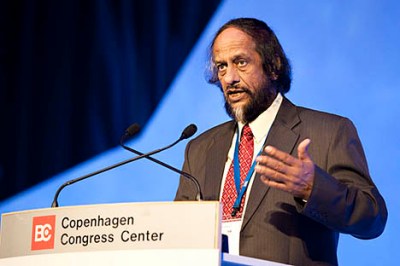
How the UN’s IPCC cites non-scientific claims from the World Wildlife Fund

Rajendra Pachauri

Here’s an article from the BBC about the IPCC’s latest shenanigans. (H/T Neil Simpson‘s latest round-up)

Excerpt:

But the flood gates really opened after the IPCC had to withdraw its claim that the Himalayan glaciers would likely all have melted by 2035, maybe even sooner.

This turned out to have no basis in scientific fact, even though everything the IPCC produces is meant to be rigorously peer-reviewed, but simply an error recycled by the [World Wildlife Fund], which the IPCC swallowed whole….

Then at the weekend another howler was exposed. The IPCC 2007 report claimed that global warming was leading to an increase in extreme weather, such as hurricanes and floods. Like its claims about the glaciers, this was also based on an unpublished report which had not been subject to scientific scrutiny — indeed several experts warned the IPCC not to rely on it.

Now after Climate-gate, Glacier-gate and Hurricane-gate — how many “gates” can one report contain? — comes Amazon-gate. The IPCC claimed that up to 40 percent of the Amazonian forests were risk from global warming and would likely be replaced by “tropical savannas” if temperatures continued to rise.

This claim is backed up by a scientific-looking reference but on closer investigation turns out to be yet another non-peer reviewed piece of work from the WWF. Indeed the two authors are not even scientists or specialists on the Amazon: one is an Australian policy analyst, the other a freelance journalist for the Guardian and a green activist.

Got that? The United Nations’ Intergovernmental Panel on Climate Change is publicizing conclusions that are designed to re-organize our entire way of life, and their evidence for this is not rooted in any repeatable scientific study.

More details are emerging

Consider this article from the UK Daily Mail. (H/T Secondhand Smoke)

Excerpt:

The scientist behind the bogus claim in a Nobel Prize-winning UN report that Himalayan glaciers will have melted by 2035 last night admitted it was included purely to put political pressure on world leaders. Dr Murari Lal also said he was well aware the statement, in the 2007 report by the Intergovernmental Panel on Climate Change (IPCC), did not rest on peer-reviewed scientific research. In an interview with The Mail on Sunday, Dr Lal, the co-ordinating lead author of the report’s chapter on Asia, said: ‘It related to several countries in this region and their water sources. We thought that if we can highlight it, it will impact policy-makers and politicians and encourage them to take some concrete action. ‘It had importance for the region, so we thought we should put it in.’

And this one from the Vancouver Sun. (H/T Secondhand Smoke)

Excerpt:

In the 1970s, nearly 600 Canadian weather stations fed surface temperature readings into a global database assembled by the U.S. National Oceanic and Atmospheric Administration (NOAA). Today, NOAA only collects data from 35 stations across Canada. Worse, only one station — at Eureka on Ellesmere Island — is now used by NOAA as a temperature gauge for all Canadian territory above the Arctic Circle.

The Canadian government, meanwhile, operates 1,400 surface weather stations across the country, and more than 100 above the Arctic Circle, according to Environment Canada. Yet as American researchers Joseph D’Aleo, a meteorologist, and E. Michael Smith, a computer programmer, point out in a study published on the website of the Science and Public Policy Institute, NOAA uses “just one thermometer [for measuring] everything north of latitude 65 degrees.”

Is that science?

What counts as knowledge?

Plato, in his dialogue Theatetus, says that knowledge is justified, true belief. And one of the ways you know that you are justified in your belief is by listening to the best arguments from the best scholars who disagree with you.

The American Spectator writes:

Yep, this is the “scientific consensus” that Al Gore based his post-VP life upon; the imagined groundswell that so many politicians used to justify government growth; the nonexistent evidence that journalists cited to justify their alarmism activism. It’s the two words that every global warmist (whether lying or deceived themselves) threw in the face of skeptics in an attempt to intimidate. Didn’t work!

No wonder why hardly any of them wanted to debate and those who did got slaughtered. We tried to explain that the “consensus” was an illusion. You — yes, I’m talking about you, Society of Environmental Journalists — would have none of it.

If you can’t make a case against your own point of view by citing the best scholars on the other side respectfully, then you don’t have knowledge. You just have an opinion. Even scientism, empiricism and naturalism need to be justified in order to be counted as knowledge. You don’t have to agree with those opposing scholars, you just have to understand them, and you have to not hate them, and you have to not believe nonsense about their motives just because you hate them so much. The job of journalists and educators is to present EVERY claim to knowledge as a conflict between opposing views, regardless of whether it’s global warming, abortion, same-sex marriage, or Darwinism.

For my Christian readers, this epistemology comes straight from the Bible in Proverbs 18:17:

17 The first to present his case seems right, till another comes forward and questions him.

For God’s sake, please read that verse and think about it. Apply it to your lives. Find someone who disagrees with you and talk to them about why they believe what they believe. It’s OK to think you’re right, it’s OK to think you have the truth. But it’s not OK to be ignorant and dismissive of the best case against your view.