
Tag Archives: Science

New book on intelligent design by molecular biologist Douglas Axe

Undeniable: How Biology Confirms Our Intuition That Life Is Designed

It’s not out yet, but the Kindle edition is only $12.99, so I pre-ordered it. That helps to get the book up in the bestseller lists. I’ll add it to my list of books that I am reading for the third quarter later, and maybe feature it in the coveted spot in the right column of the blog.

Anyway, here is the description:

Throughout his distinguished and unconventional career, engineer-turned-molecular-biologist Douglas Axe has been asking the questions that much of the scientific community would rather silence. Now, he presents his conclusions in this brave and pioneering book. Axe argues that the key to understanding our origin is the “design intuition”—the innate belief held by all humans that tasks we would need knowledge to accomplish can only be accomplished by someone who has that knowledge. For the ingenious task of inventing life, this knower can only be God.

Starting with the hallowed halls of academic science, Axe dismantles the widespread belief that Darwin’s theory of evolution is indisputably true, showing instead that a gaping hole has been at its center from the beginning. He then explains in plain English the science that proves our design intuition scientifically valid. Lastly, he uses everyday experience to empower ordinary people to defend their design intuition, giving them the confidence and courage to explain why it has to be true and the vision to imagine what biology will become when people stand up for this truth.

Armed with that confidence, readers will affirm what once seemed obvious to all of us—that living creatures, from single-celled cyanobacteria to orca whales and human beings, are brilliantly conceived, utterly beyond the reach of accident.

Our intuition was right all along.

Trailer is here:

Evolution News has a deal for those who pre-order:

A remarkable thing about evolutionary theory is the way it demands that we deny our intuition at almost every step. Evolutionists then assure us that the science is all figured out, so we needn’t trouble our silly heads about the relevant biology.

In a new book, Douglas Axe of Biologic Institute turns this standard assurance on its head. In Undeniable: How Biology Confirms Our Intuition That Life Is Designed, Dr. Axe restores the place of intuition alongside intellect in considering the question of life’s origins.

Undeniable will be published on July 12 by HarperOne, but you can pre-order before then and participate in an exclusive, private conference call with Dr. Axe and talk- show host Michael Medved. You’ll also receive digital versions of three complete books from Discovery Institute Press: Debating Darwin’s Doubt, The Unofficial Guide to Cosmos, and Science & Human Origins. See here for easy instructions.

And now, I have a secret story to tell you. I met Doug Axe face to face way back in the late 1990s. He told me and some other people about the post-doctoral work he was doing at Cambridge University on the probabilities of getting a functional protein by chance. He made me promise not to tell anyone, and I never did. It was from conversations like that with the intelligent design scholars that I decided to start using an alias.

From his research at Cambrudge, Dr. Axe found that the number of functional amino acid sequences is tiny:

Doug Axe’s research likewise studies genes that it turns out show great evidence of design. Axe studied the sensitivities of protein function to mutations. In these “mutational sensitivity” tests, Dr. Axe mutated certain amino acids in various proteins, or studied the differences between similar proteins, to see how mutations or changes affected their ability to function properly. He found that protein function was highly sensitive to mutation, and that proteins are not very tolerant to changes in their amino acid sequences. In other words, when you mutate, tweak, or change these proteins slightly, they stopped working. In one of his papers, he thus concludes that “functional folds require highly extraordinary sequences,” and that functional protein folds “may be as low as 1 in 10^77.”

The problem of forming DNA by sequencing nucleotides faces similar difficulties. And remember, mutation and selection cannot explain the origin of the first sequence, because mutation and selection require replication, which does not exist until that first living cell is already in place.

He published his findings in four separate publications with the prestigious Journal of Molecular Biology, and got his PhD with it. To get a PhD from Caltech, and then do post-doctoral work at Cambridge, you have to be good. And Dr. Axe is very, very good.

I have used the papers he wrote in many, many conversations with engineers in different companies where I have worked. He hit a home run with that research. You could never look at the evidence for intelligent design the same way again. Christian parents, if you have any children, be sure that you tell them about Doug Axe’s story.
Four ways the Earth is fine-tuned for life, and one more

Circumstellar Habitable Zone

This is a post from J. Warner Wallace, over at Cold Case Christianity.

Let’s see his four ways first, then I’ll add one that I know.

He writes:

  1. The Earth’s Relationship to the Sun Is Favorable to Life
  2. The Earth’s Atmospheric Conditions Are Favorable to Life
  3. The Earth’s Terrestrial Nature Is Favorable to Life
  4. The Earth’s Relationship to the Moon Is Favorable to Life

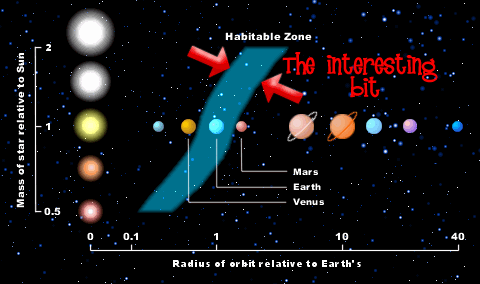
I’ve blogged about the moon and plate tectonics before, so we won’t pick #3 and #4 to look at. And I blogged about the stellar habitable zone before, so we won’t pick #1, either.

Let’s look at #2:

The Earth’s Atmospheric Conditions Are Favorable to Life:
The surface gravity of Earth is critical to its ability to retain an atmosphere friendly to life. If Earth’s gravity were stronger, our atmosphere would contain too much methane and ammonia. If our planet’s gravity were weaker, Earth wouldn’t be able to retain enough water. As it is, Earth’s atmosphere has a finely calibrated ratio of oxygen to nitrogen—just enough carbon dioxide and adequate water vapor levels to promote advanced life, allow photosynthesis (without an excessive greenhouse effect), and to allow for sufficient rainfall.

Ok, that’s very good.

Now here is one from me… well, it’s from Science Daily, but I found it. Actually, ECM found it. But he told me.

Excerpt:

They suggest that the size and location of an asteroid belt, shaped by the evolution of the Sun’s protoplanetary disk and by the gravitational influence of a nearby giant Jupiter-like planet, may determine whether complex life will evolve on an Earth-like planet.

This might sound surprising because asteroids are considered a nuisance due to their potential to impact Earth and trigger mass extinctions. But an emerging view proposes that asteroid collisions with planets may provide a boost to the birth and evolution of complex life.

Asteroids may have delivered water and organic compounds to the early Earth. According to the theory of punctuated equilibrium, occasional asteroid impacts might accelerate the rate of biological evolution by disrupting a planet’s environment to the point where species must try new adaptation strategies.

The astronomers based their conclusion on an analysis of theoretical models and archival observations of extrasolar Jupiter-sized planets and debris disks around young stars. “Our study shows that only a tiny fraction of planetary systems observed to date seem to have giant planets in the right location to produce an asteroid belt of the appropriate size, offering the potential for life on a nearby rocky planet,” said Martin, the study’s lead author. “Our study suggests that our solar system may be rather special.”

So, that’s 5 ways that the Earth and our solar system are fine-tuned to be habitable for complex, embodied minds. Somebody is looking out for you, so be thankful and recognize.


William Lane Craig debates Austin Dacey: Does God Exist?

Two tough rams butt heads, and may the best ram win!

Here is the video and summary of a debate between Christian theist William Lane Craig and Austin Dacey at Purdue University in 2004 about the existence of God.

The debaters:

The video: (2 hours)

The video shows the speakers and powerpoint slides of their arguments. Austin Dacey is one of the top atheist debaters, and I would put him second to Peter Millican alone, with Walter Sinnott-Armstrong in third place. This is the debate to show people who are new to apologetics. The debate with Peter Millican is better for advanced students, and that’s no surprise since he teaches at Oxford University and is familiar with all of Dr. Craig’s work. The Craig-Dacey debate is the one that I give to my co-workers.

By the way, you can get the DVDs and CDs for the first Craig-Dacey debate and the second Craig-Dacey debate and the second Craig-Sinnott-Armstrong debate. The Peter Millican debate is not available on DVD, but the link above (Peter Millican) has the video and my summary.

Dr. Dacey’s 5 arguments below are all good arguments that you find in the academic literature. He is also an effective and engaging speaker, This is a great debate to watch!

SUMMARY of the opening speeches:

Dr. Craig’s opening statement:

Dr. Craig will present six reasons why God exists:

  1. (Contingency argument) God is the best explanation of why something exists rather than nothing
  2. (Cosmological argument)  God’s existence is implied by the origin of the universe
  3. (Fine-tuning argument) The fine-tuning of the universe for intelligent life points to a designer of the cosmos
  4. (Moral argument) God is the best explanation for the existence of objective moral values and objective moral duties
  5. (Miracles argument) The historical facts surrounding the life, death and resurrection of Jesus
  6. (Religious experience) God’s existence is directly knowable even apart from arguments

Dr. Dacey’s opening argument:

There are two ways to disprove God’s existence, by showing that the concept of God is self-contradictory, or by showing that certain facts about ourselves and the world are incompatible with what we would expect to be true if God did exist. Dr. Dacey will focus on the second kind of argument.

  1. The hiddenness of God
  2. The success of science in explaining nature without needing a supernatural agency
  3. The dependence of mind on physical processes in the brain
  4. Naturalistic evolution
  5. The existence of gratuitous / pointless evil and suffering

One final point:

One thing that I have to point out is that Dr. Dacey quotes Brian Greene during the debate to counter Dr. Craig’s cosmological argument. Dr. Craig could not respond because he can’t see the context of the quote. However, Dr. Craig had a rematch with Dr. Dacey where was able to read the context of the quote and defuse Dr. Dacey’s objection. This is what he wrote in his August 2005 newsletter after the re-match:

The following week, I was off an another three-day trip, this time to California State University at Fresno. As part of a week of campus outreach the Veritas Forum scheduled a debate on the existence of God between me and Austin Dacey, whom I had debated last spring at Purdue University. In preparation for the rematch I adopted two strategies: (1) Since Dacey had come to the Purdue debate with prepared speeches, I decided to throw him for a loop by offering a different set of arguments for God, so that his canned objections wouldn’t apply. I chose to focus on the cosmological argument, giving four separate arguments for the beginning of the universe, and on the evidence for Jesus’ resurrection. (2) I reviewed our previous debate carefully, preparing critiques of his five atheistic arguments. In the process I found that he had seriously misunderstood or misrepresented a statement by a scientist on the Big Bang; so I brought along the book itself in case Dacey quoted this source again. I figured he might change his arguments just as I was doing; but I wanted to be ready in case he used his old arguments again.

[…]The auditorium was packed that night for the debate, and I later learned that there were overflow rooms, too. To my surprise Dr. Dacey gave the very same case he had presented at Purdue; so he really got clobbered on those arguments. Because he wasn’t prepared for my new arguments, he didn’t even respond to two of my arguments for the beginning of the universe, though he did a credible job responding to the others. I was pleased when he attacked the Big Bang by quoting the same scientist as before, because I then held up the book, specified the page number, and proceeded to quote the context to show what the scientist really meant.

Dr. Craig is always prepared!