Whenever you discuss origins with naturalists, it’s very important to get them to explain how the first living organism emerged without any help from an intelligent agent. The origin of life is an information problem. A certain minimal amount of biological information for minimum life function has to be thrown together by chance. No evolutionary mechanisms have the potential to work until replication is already in place.
Evolution News reports on a new study that makes the window for naturalistic forces to create the first self-replicating organism even smaller.
Excerpt:
A paper in Nature reports the discovery of fossil microbes possibly older, even much older, than any found previously. The lead author is biogeochemist Matthew Dodd, a PhD student at University College London. If the paper is right, these Canadian fossils could be 3.77 billion years old, or even as old as — hold onto your hat, in case you’re wearing one — 4.28 billion years.
From the Abstract:
Although it is not known when or where life on Earth began, some of the earliest habitable environments may have been submarine-hydrothermal vents. Here we describe putative fossilized microorganisms that are at least 3,770 million and possibly 4,280 million years old in ferruginous sedimentary rocks, interpreted as seafloor-hydrothermal vent-related precipitates, from the Nuvvuagittuq belt in Quebec, Canada. These structures occur as micrometre-scale haematite tubes and filaments with morphologies and mineral assemblages similar to those of filamentous microorganisms from modern hydrothermal vent precipitates and analogous microfossils in younger rocks. The Nuvvuagittuq rocks contain isotopically light carbon in carbonate and carbonaceous material, which occurs as graphitic inclusions in diagenetic carbonate rosettes, apatite blades intergrown among carbonate rosettes and magnetite–haematite granules, and is associated with carbonate in direct contact with the putative microfossils.
This new paper is interesting to compare with a paper from last year, Nutman et al., “Rapid emergence of life shown by discovery of 3,700-million-year-old microbial structures,” also in Nature, which found microbial structures that are a bit younger.
But the “microbial structures” from Nutman et al. 2016 are different from these new “microfossils” presented by Dodd et al. 2017. In Nutman et al., they only found stromatolite-type structures rather than actual microfossils. Some stromatolite experts were a bit skeptical that what they found were really stromatolites.
But the new paper by Dodd and his colleagues, “Evidence for early life in Earth’s oldest hydrothermal vent precipitates,” seems to offer potential bacteria-like microfossils. They are tiny black carbonaceous spheres and “hematite tubes” which the authors think are biogenically created. We’ve seen more convincing ancient microfossils, but these aren’t bad.
According to Dodd et al., these new finds would be the oldest known microfossils, if that is in fact what they are. Very interesting. If so, that just keeps pushing unquestionable evidence of life’s existence on Earth further and further back, which leaves less and less time for the origin of life to have occurred by unguided chemical evolution after Earth became habitable.
If they are in fact 4.28 billion years old, then that would mean there was life very, very early in Earth’s history — as Cyril Ponnamperuma said, it’s like “instant life.”
Instant life is “rational” for naturalistic fideists, but for evidence-driven people who understand the long odds on generating even a simple protein by chance, it’s irrationality.
Let’s recall exactly how hard it is to make even a simple protein without intelligent agency to select the elements of the sequence.
The odds of creating even a single functional protein
Let’s calculate the odds of building a protein composed of a functional chain of 100 amino acids, by chance. (Think of a meaningful English sentence built with 100 scrabble letters, held together with glue)
Sub-problems:
BONDING: You need 99 peptide bonds between the 100 amino acids. The odds of getting a peptide bond is 50%. The probability of building a chain of one hundred amino acids in which all linkages involve peptide bonds is roughly (1/2)^99 or 1 chance in 10^30.
CHIRALITY: You need 100 left-handed amino acids. The odds of getting a left-handed amino acid is 50%. The probability of attaining at random only L–amino acids in a hypothetical peptide chain one hundred amino acids long is (1/2)^100 or again roughly 1 chance in 10^30.
SEQUENCE: You need to choose the correct amino acid for each of the 100 links. The odds of getting the right one are 1 in 20. Even if you allow for some variation, the odds of getting a functional sequence is (1/20)^100 or 1 in 10^65.
The final probability of getting a functional protein composed of 100 amino acids is 1 in 10^125. Even if you fill the universe with pre-biotic soup, and react amino acids at Planck time (very fast!) for 14 billion years, you are probably not going to get even 1 such protein. And you need at least 100 of them for minimal life functions, plus DNA and RNA.
Research performed by Doug Axe at Cambridge University, and published in the peer-reviewed Journal of Molecular Biology, has shown that the number of functional amino acid sequences is tiny:
Doug Axe’s research likewise studies genes that it turns out show great evidence of design. Axe studied the sensitivities of protein function to mutations. In these “mutational sensitivity” tests, Dr. Axe mutated certain amino acids in various proteins, or studied the differences between similar proteins, to see how mutations or changes affected their ability to function properly. He found that protein function was highly sensitive to mutation, and that proteins are not very tolerant to changes in their amino acid sequences. In other words, when you mutate, tweak, or change these proteins slightly, they stopped working. In one of his papers, he thus concludes that “functional folds require highly extraordinary sequences,” and that functional protein folds “may be as low as 1 in 10^77.”
The problem of forming DNA by sequencing nucleotides faces similar difficulties. And remember, mutation and selection cannot explain the origin of the first sequence, because mutation and selection require replication, which does not exist until that first living cell is already in place.
The topic: What are the arguments that make belief in God reasonable or unreasonable?
First speech: arguments for reasonableness of belief in God
Second speech: respond to arguments against reasonableness of belief in God
Eight arguments:
Contingency argument: God – a transcendent, personal being – is the explanation of why a contingent universe exists.
Cosmological argument: God is the cause of the beginning of the universe, which is attested by physics and cosmology.
Applicability of mathematics to nature: God is the best explanation for the applicability of mathematics to nature.
Fine-tuning argument: God is the best explanation of the fine-tuning of the universe to permit life.
Intentionality of conscious states: God is the best explanation of the intentionality of our mental states.
The moral argument: God is the best explanation for the existence of objective moral values and duties.
The resurrection of Jesus: God is the best explanation for the core of historical facts accepted by most ancient historians across the ideological spectrum.
Religious experience: God is the best explanation of our immediate experience and knowledge of his existence.
Dr. Rosenberg’s opening speech
First argument: The fallacy of ad hominem
I don’t know whether to laugh or to cry
Dr. Craig has said all of that before in other debates
You didn’t need to come out on this cold night
Craig’s arguments have all been refuted
Dr. Craig just doesn’t listen
Dr. Craig is not interested in getting at the truth
Dr. Craig is just interested in scoring debate points
The adversarial system is the wrong approach to decide truth
Dr. Craig is very confident about his take of physics
Second argument: The fallacy of arguing from authority
95% of members of the NAS are atheists
Therefore Dr. Craig cannot use science
Third argument: Effects don’t require causes
I am going to pretend that Craig said that “every effect requires a cause”
Quantum mechanics shows that some effects occur without causes
A particle of uranium (which is not nothing, it is something) decays without a cause
This uncaused effect is the same as the universe coming into being out of nothing uncaused
Therefore the principle of sufficient reason is false
Fourth argument: Silicon-based life and the multiverse
If these constants had been different, maybe we would have other kinds of intelligent life, like silicon-based life
Carbon-based life is not the only kind of life, maybe you can have other kinds of life, none of which have been observed
There could be different kinds of life in other areas of the universe that we can’t see
There are things we can’t see that disprove the current physics that we can see
Quantum foam is evidence that a multiverse exists
The multiverse would solve the problem of fine-tuning
Fifth argument: The Euthyphro dilemma
The moral argument is refuted by Euthyphro dilemma
Dr. Craig is such a moron that he has never heard of the Euthyphro dilemma ever before
This is found in the first and simplest of Plato’s dialogs
Why is Dr. Craig so stupid that he has not read this simple dialog ever before?
Evolution explains why humans evolve arbitrary customs and conventions that vary by time and place
Alternative moral theories: utilitarianism, social contract, etc. that don’t require God
Sixth argument: Mormonism undermines Dr. Craig’s three minimal facts about Jesus
Why is Dr. Craig so stupid and ignorant to persist in pushing such an ignorant, stupid argument?
Mormonism is a silly religion that is not historically well founded
Therefore, Jesus was not buried
Islam is a silly religion that is not historically grounded
Therefore, the tomb was not found empty
Scientology is a silly religion that is not historically grounded
Therefore, the eyewitnesses didn’t have post-mortem appearances
Eyewitness testimony is unreliable in some cases
Therefore, eyewitness testimony was unreliable in this case
Apparitions of Mary are bizarre
Therefore, the majority of historians are wrong to think that the disciples saw post-mortem appearances
Seventh argument: Deductive problem of evil
Evil and suffering are logically incompatible with an all good, all powerful God
Eight argument: God is not just to allow evil and suffering
God cannot make the evils of this life right in the afterlife
Dr. Craig’s first rebuttal
Dr. Rosenberg sketched the deductive argument from evil.
Dr. Rosenberg presupposes naturalism. Naturalism is a false theory of knowledge:
1. It’s too restrictive: There are truths that cannot be proved by natural science.
2. It’s self-refuting: no scientific proof for naturalism exists.
That’s why epistemological naturalism is considered false by most philosophers of science.
But more importantly than that: Epistemological naturalism does not imply metaphysical naturalism. (E.g. – W. Quine)
Dr. Rosenberg has to present arguments in favor of (metaphysical) naturalism, not just assume that (metaphysical) naturalism is true.
Dr. Craig presented eight arguments against metaphysical naturalism taken from Rosenberg’s own book:
1. The argument from the intentionality (aboutness) of mental states implies non-physical minds (dualism), which is incompatible with naturalism
2. The existence of meaning in language is incompatible with naturalism, Rosenberg even says that all the sentences in his own book are meaningless
3. The existence of truth is incompatible with naturalism
4. The argument from moral praise and blame is incompatible with naturalism
5. Libertarian freedom (free will) is incompatible with naturalism
6. Purpose is incompatible with naturalism
7. The enduring concept of self is incompatible with naturalism
8. The experience of first-person subjectivity (“I”) is incompatible with naturalism
Metaphysical naturalism is false: it is irrational and it contradicts our experience of ourselves.
And epistemological naturalism is compatible with theism.
Rebutting Dr. Rosenberg’s responses:
1. Contingency: no response
2. Cosmological: he mis-states the first premise to say every effect… when it is whatever begins to exist…, the origin of the universe was not from a vacuum, virtual particles come from a vacuum not nothing, there are interpretations of QM that are compatible with determinism. Rosenberg has to believe that the entire universe popped into being from non-being.
3. Mathematics: no response
4. Fine-tuning: the multiverse is refuted by empirical observations of the universe. Without fine-tuning, it’s not that we still have silicon to make life out of. It’s that we lose basic minimal things like chemical diversity, matter, stars, planets, etc. No life of any kind, not just no carbon-based life.
5. Intentionality: no response.
6. Moral argument: the answer to the dilemma is that you split the dilemma: God is the standard of good, and the commands flow from his unchanging moral nature. The commands are not arbitrary, and the standard is not external to God. Dr. Rosenberg is a nihilist and he cannot ground good and evil on his nihilistic view.
7. Resurrection: The Gospels are early eyewitness testimony. Mormonism and Islam have nothing to do with the minimal set of historical facts about Jesus agreed to by the majority of ancient historians across the ideological spectrum, general statements against eyewitnesses do not refute the specific eyewitness testimony in this case.
8. Religious experience: No response.
Dr. Rosenberg’s first rebuttal
I wrote a book and you should buy it, because it got me invited to this debate. Let me repeat the title a few times for you. Please buy it.
Dr. Craig is right, there are multiple interpretations of QM, not just the one I presented, including deterministic ones.
All the disturbing implications of naturalism that Dr. Craig stated follow from metaphysical naturalism, and metaphysical naturalism is true. (Note: he equates science with metaphysical naturalism)
Science proves that metaphysical naturalism is true, but I won’t say what specific scientific tests prove my philosophical assumption of metaphysical naturalism.
I’ll pretend that the Big Bang (science) doesn’t disprove naturalism, like Dr. Craig said. Again. (covers ears) La la la, there is no Big Bang.
We didn’t come here to debate epistemological naturalism and metaphysical naturalism.
Let me explain the problem of intentionality since I’m so smart and no one knows what it means.
There are many answers to this problem of intentionality.
My answer is that most scientists are naturalists, therefore naturalism is true, regardless of the argument from intentionality of mental states.
That’s how I would respond to one of the eight problems with naturalism that Dr. Craig raised. I won’t answer the other seven problems.
It is an argument from ignorance to argue that the applicability of mathematics to the universe requires a designer, because there are non-Euclidean geometries. Craig’s argument, which he gets from people like respected physicists like Eugene Wigner, is bizarre. It is bizarre, therefore I refute Eugene Wigner and all the other scholars who make that argument. It is bizarre! Bizarre!
Deductive problem of evil: there is no response to this argument, certainly not Alvin Plantinga’s free will defense. The deductive argument from evil has not been entirely abandoned at all! It’s not like arch-atheist J.L. Mackie himself admits that the deductive problem of evil doesn’t lead to a logical inconsistency between evil and God.
Dr. Craig has to tell me why God allows evil or God doesn’t exist.
It is offensive that Dr. Craig cannot tell me why God allows every evil and suffering that occurs.
He literally said this: “I will become a Christian if Dr. Craig can tell me why God allowed EVERY EVIL THAT OCCURRED IN THE LAST 3.5 BILLION YEARS”
Dr. Craig’s second rebuttal
We are not in a position to know why God allows specific instances of evil and suffering.
God cannot force people to freely do anything – freedom is not compatible with determinism. Freedom is a good, but freedom opens up the possibility of moral evil. You cannot have the good of free will without allowing people to choose to do morally evil things.
God can permit evil and suffering in order to bring more people into a relationship with him.
The atheist has to show that God could allow less evil and achieve more knowledge of God in order to say there is too much evil.
The purpose of life is not happiness, but knowledge of God.
Dr. Craig quotes agnostic Paul Draper (Purdue) and Peter Van Inwagen (Notre Dame) to state that the deductive problem of evil is dead because of free will and morally sufficient reasons for permitting evil.
1. Contingency: no response.
2. Cosmological: QM does not apply, because the universe came from nothing, not a vacuum, and QM only works in a vacuum.
3. Mathematics: He mentions alternatives like non-Euclidean geometry, but we have to explain the structure of THIS universe.
4. Fine-tuning: ???
5. Intentional states: intentional mental states proves that minds exist, which fits with theism better than it fits with atheism.
6. Moral argument: You need God to ground morality, and Dr. Rosenberg believes in morality. He needs God to ground objective moral values and duties.
7. Historical argument: He has to respond to the minimal facts supported by the consensus of ancient historians across the ideological spectrum.
8. The problems of naturalism: He says that you can’t have science without naturalism, but you can have science with EPISTEMOLOGICAL NATURALISM, and theists accept science and methodological naturalism. We don’t accept METAPHYSCIAL NATURALISM because of the eight problems Craig presented, like intentionality, first-person, persistence of self, etc. You can believe in both science and theism, by embracing epistemological naturalism, while rejecting methaphysical naturalism.
Dr. Rosenberg’s second rebuttal
Dr. Craig hasn’t answered many of my points, I won’t say which ones though.
Debates don’t work as a way of deciding what’s true, so we should overturn the entire criminal justice system.
The principle of sufficient reason is false because it is disconfirmed by quantum mechanics. And quantum mechanics (vacuum and virtual particles that exist for a short time) is similar to the origin of the universe (nothing and entire universe and 14 billion years).
We know that alpha particles come into being without cause all the time from a quantum vacuum for a tiny sub-second duration before going out of existence, so we can say that the entire physical universe came into being for 14 billion years from absolute nothing which is not a quantum vacuum.
Peter Van Inwagen is the best metaphysician working today, and he says that my deductive argument from evil is not decisive, it’s not a successful argument. (Why is he undermining his own problem of evil argument????!)
Dr. Craig invoked Plantinga’s free will defense to the deductive POE. Freedom allows us to do evil. God could have given us free will without evil and suffering. I won’t show how, but I’ll just assert it, because debates are such a bad forum for supplying evidence for my speculative assertions.
If you answer the question 3 + 5 as being 8, then you don’t have free will – you are biologically determined if you answer 8, because everyone answers 8, and that means everyone is biologically determined with no free will.
Why can’t God give us free will and then prevent us from making a free choice?
No scholars date the gospels earlier than 60-70 AD, especially not atheists like James Crossley who dates Mark to 40 AD. Therefore Jesus’ burial isn’t historical, like the majority of scholars across the broad spectrum of scholarship agree it is.
The original New Testament documents were written in Aramaic.
All New Testament scholars are orthodox Christians, like atheist Robert Funk for example.
Dr. Craig’s concluding speech
In order to sustain the deductive argument from evil, Dr. Rosenberg must show that God could create a world of free creatures with less evil.
Principle of Sufficient Reason: not using the general principle of sufficient reason, but a more modest version of this states that contingent things should have an explanation for their existence. And we know that the universe is a contingent.
The New Testament was not written in Aramaic, they were written in Greek. Dr. Rosenberg is wrong there too.
(Dr. Craig spends the rest of his concluding speech giving his testimony and urging people to investigate the New testament).
Dr. Rosenberg’s concluding speech
Some long-dead French guy named Laplace said that he has no need of that (God) hypothesis. He did not know about any of Dr. Craig’s arguments made in this debate tonight when he said that, though.
There is no need to explain how the universe began or how the universe is finely-tuned if you just assume metaphysical naturalism on faith.
The Easter Bunny, therefore atheism.
Most scientists are atheists, therefore atheism.
You can do a lot of science without God, just don’t look at the origin of the universe, the fine-tuning of the universe, or the other parts of science that Craig mentioned, as well as the origin of life, the Cambrian explosion, the habitability argument, and so on.
You can be a Christian, but good Christians should not use arguments and evidence.
Good Christians should be irrational and ignorant. Bad Christians look for arguments and evidence from science and history.
Good Christians should embrace the absurd. Bad Christians want to search for truth and use logic and evidence.
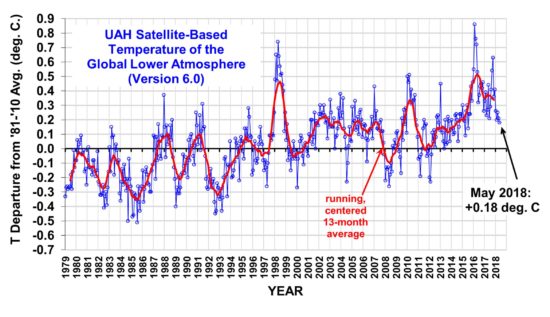
Satellite measurements of global climate from U of Alabama Huntsville
My friend Bruce posted this article from the the Daily Wire, and I think it’s a good summary of the scientific evidence against global warming alarmism. After we go over this, I’ll take a stab at explaining why so many non-scientists desperately want to believe that global warming is true, and why they try to push everyone else to believe it, too.
First, the list:
Temperature records from around the world do not support the assumption that today’s temperatures are unusual.
Satellite temperature data does not support the assumption that temperatures are rising rapidly
Current temperatures are always compared to the temperatures of the 1980’s, but for many parts of the world the 1980’s was the coldest decade of the last 100+ years
The world experienced a significant cooling trend between 1940 and 1980
Urban heat island effect skews the temperature data of a significant number of weather stations
There is a natural inverse relationship between global temperatures and atmospheric CO2 levels
The CO2 cannot, from a scientific perspective, be the cause of significant global temperature changes
There have been many periods during our recent history that a warmer climate was prevalent long before the industrial revolution
Glaciers have been melting for more than 150 years
“Data adjustment” is used to continue the perception of global warming
So, we can’t look at all of these in one post. Obviously, the satellite measurements are the best thing to look at, since they cannot be tampered with as easily as the ground measurements, and they show no warming for 18 years.
But let’s look at number 8 instead:
Even in the 1990 IPCC report a chart appeared that showed the medieval warm period as having had warmer temperatures than those currently being experienced. But it is hard to convince people about global warming with that information, so five years later a new graph was presented, now known as the famous hockey stick graph, which did away with the medieval warm period. Yet the evidence is overwhelming at so many levels that warmer periods existed on Earth during the medieval warm period as well as during Roman Times and other time periods during the last 10,000 years. There is plenty of evidence found in the Dutch archives that shows that over the centuries, parts of the Netherlands disappeared beneath the water during these warm periods, only to appear again when the climate turned colder. The famous Belgian city of Brugge, once known as “Venice of the North,” was a sea port during the warm period that set Europe free from the dark ages (when temperatures were much colder), but when temperatures began to drop with the onset of the little ice age, the ocean receded and now Brugge is ten miles away from the coastline. Consequently, during the medieval warm period the Vikings settled in Iceland and Greenland and even along the coast of Canada, where they enjoyed the warmer temperatures, until the climate turned cold again, after which they perished from Greenland and Iceland became ice-locked again during the bitter cold winters. The camps promoting global warming have been systematically erasing mention of these events in order to bolster the notion that today’s climate is unusual compared to our recent history.
That’s right, the world was much warmer than it is now during the Medieval Warming Period… so warm that you could actually farm on Greenland. But now it’s all frozen over.
Bruce also posted this article from Forbes magazine about the so-called consensus about global warming among scientists.
It says:
It is becoming clear that not only do many scientists dispute the asserted global warming crisis, but these skeptical scientists may indeed form a scientific consensus.
[…]Only 36 percent of geoscientists and engineers believe that humans are creating a global warming crisis, according to a survey reported in the peer-reviewed Organization Studies. By contrast, a strong majority of the 1,077 respondents believe that nature is the primary cause of recent global warming and/or that future global warming will not be a very serious problem.
The survey results show geoscientists (also known as earth scientists) and engineers hold similar views as meteorologists. Two recent surveys of meteorologists (summarized here and here) revealed similar skepticism of alarmist global warming claims.
According to the newly published survey of geoscientists and engineers, merely 36 percent of respondents fit the “Comply with Kyoto” model. The scientists in this group “express the strong belief that climate change is happening, that it is not a normal cycle of nature, and humans are the main or central cause.”
The authors of the survey report, however, note that the overwhelming majority of scientists fall within four other models, each of which is skeptical of alarmist global warming claims.
[…]Taken together, these four skeptical groups numerically blow away the 36 percent of scientists who believe global warming is human caused and a serious concern.
Most people who get excited about the threat of global warming have something to gain financially from the hysteria. For example, Democrat campaign donors who own stock in solar or wind power companies that get fat government subsidies. Solyndra was one example of that.
Why do people believe weird things?
So why do people believe these things? People believe these things for the same reason that primitive people would sacrifice animals in order to get a bountiful harvest or be spared being struck by lightning. They fear the future, and they want to believe that they are doing something in order to save themselves from doom. There is something credulous in us that seeks to know and control the future. When we are told a noble lie by grant-seeking, attention-craving academics, we believe it because we want to believe it. We want to believe that the future is going to be OK, especially when all we have to do to make it OK is recycle cans and turn off our lights when we are not using them.
This is the real psychological motivation behind the desperate desire to believe in the global warming myth. We are scared, and we want someone to save us from the future. And we jump at the chance of controlling the future, especially when it means recycling cans, rather than having to deal with our own sinfulness. We invent a new morality that justifies us rather than having to comply with the old morality. Freedom to commit adultery, as long as we recycle cans to save the planet. Sanctification through purchasing carbon credits, instead of sanctification through chastity, sobriety and self-control.