Tag Archives: Science

Physicist Michael Strauss discusses Christianity and science at Stanford University

This is one of my favorite lectures, by one of the people I admire the most for his scientific work and robust, evangelical Christian faith.

About Michael Strauss:

His full biography is here. (I removed his links from my excerpt text below)

Excerpt:

I had an interest in science and theology, so in 1977 I chose to go to Biola University where I could study both subjects in detail. I thoroughly enjoyed college and participated in intramural sports, was elected to student government, served as a resident assistant, competed in forensics, and studied a lot. As I neared college graduation my dual interest continued so I applied to seminary and to graduate school. After graduating summa cum laude from Biola, I decided to pursue a graduate degree in physics at UCLA.

During my first few years of graduate school, I developed an increased interest in quantum mechanics and subatomic physics and decided to do research in a field that dealt with these subjects. I joined a High Energy Physics experimental group doing research at the Stanford Linear Accelerator Center (SLAC) and moved to the San Francisco Bay Area to actively participate in research at SLAC. I graduated in 1988 with my Ph.D in High Energy Physics (a.k.a. Elementary Particle Physics). If you would like to know more about High Energy Physics, the Particle Data Group at Lawrence Berkeley Laboratory has a very nice interactive adventure that teaches you all about the subject. My research advisor was professor Charles Buchanan and my disertation was titled “A Study of Lambda Polarization and Phi Spin Alignment in Electron-Positron Annihilation at 29 GeV as a Probe of Color Field Behavior.”

After graduation, I accepted a post-doctoral research position with the University of Massachusetts at Amherst. I continued to do research at SLAC where I joined the SLD experiment. My research interests centered on the SLD silicon pixel vertex detector. I wrote most of the offline software for this device, and did physics analysis which used the vertex detector, including tagging b quark events for flavor specific QCD (Quantum Chromodynamics) analysis. In the seven years I was employed by UMASS, I only spent 3 days on the Amherst campus. The rest of the time was spent in California.

[…]In August 1995, I accepted a job as an Assistant Professor of Physics at the University of Oklahoma (OU) in Norman, Oklahoma. The University of Oklahoma has a vibrant high energy physics research group involved in experiments at the Fermi National Accelerator Center (Fermilab), and CERN. I joined the DØ experiment at Fermilab where I continue to do research in elementary particle physics. As a member of the DØ collaboration I have made contributions to the testing of silicon sensors for the upgraded vertex detector, to the track finding algorithms, to a measurement of the photon production cross section which probes the gluon content of protons, and to other QCD measurements. I am currently studying properties of B mesons that contain a b-quark, the production cross section of jets coming from quarks and gluons, and other QCD analyses. At CERN, I am a collaborator on the ATLAS detector.

I received tenure in 2001 and was promoted to the rank of Professor in the summer of 2010. Most of the time at OU I have taught introductory physics classes to physics majors, engineers, and life science majors. In these classes I have used a number of interactive techniques to facilitate student participation and learning. I have been privileged to win a few awards for my teaching. In 1999, the Associated Students selected me as the Outstanding Professor in the College of Arts and Science, and in 2000 I was awarded the BP AMOCO Foundation Good Teaching Award. In 2002, I was given the Regents Award for Superior Teaching. I received the Carlisle Mabrey and Lurine Mabrey Presidential Professorship in 2006 which is given to “faculty members who excel in all their professional activities and who relate those activities to the students they teach and mentor.”

He seems to have done a fine job of integrating his faith with a solid career in physics research. It would be nice if we were churning out more like him, but that would require the church to get serious about the integration between science and faith.

The lecture:

Dr. Strauss delivered this lecture at Stanford University in 1999. It is fairly easy to understand, and it even includes useful dating tips, one of which I was able to try out recently at IHOP, and it worked.

UPDATE: I pulled the MP3 audio from the lecture in case anyone wants just the audio.

Summary:

What does science tell us about God?
– the discoveries of Copernicus made humans less significant in the universe
– the discoveries of Darwin should that humans are an accident
– but this all pre-modern science
– what do the latest findings of science say about God?

Evidence #1: the origin of the universe
– the steady state model supports atheism, but was disproved by the latest discoveries
– the oscillating model supports atheism, but was disproved by the latest discoveries
– the big bang model supports theism, and it is supported by multiple recent discoveries
– the quantum gravity model supports atheism, but it pure theory and has never been tested or confirmed by experiment and observation

Evidence #2: the fine-tuning of physical constants for life
– there are over 100 examples of constants that must be selected within a narrow range in order for the universe to support the minimal requirements for life
– example: mass density
– example: strong nuclear force (what he studies)
– example: carbon formation

Evidence #3: the fine-tuning of our planet for habitability
– the type of galaxy and our location in it
– our solar system and our star
– our planet
– our moon

Positive arguments for Christian theism

New study of tar pits shows absence of evolutionary change

Doug Axe has a new post up about a new paper that challenges the Darwinian narrative. (H/T J Warner Wallace)

Full text:

The textbooks say that evolution happens most rapidly in response to environmental changes. You would think, then, that the cycling from glacial periods to warmer interglacial periods would be accompanied by significant changes in the species that survive the change.

Not so, according to a new paper by Donald Prothero and colleagues. After examining all the comon bird and mammal species preserved in the Rancho La Brea tar pits in California, the authors conclude:

the data show that birds and mammals at Rancho La Brea show complete stasis and were unresponsive to the major climate change that occurred at 20 ka, consistent with other studies of Pleistocene animals and plants. Most explanations for such stasis (stabilizing selection, canalization) fail in this setting where climate is changing. One possible explanation is that most large birds and mammals are very broadly adapted and relatively insensitive to changes in their environments, although even the small mammals of the Pleistocene show stasis during climate change, too.

I work at the other end of the size spectrum, on protein molecules rather than whole animals. It’s interesting that attempts to catch evolution in the act of doing the amazing things that the textbooks attribute to it seem to fail at both ends of the spectrum.

Interesting because Prothero has debated against ID – this man is not friendly to our view.

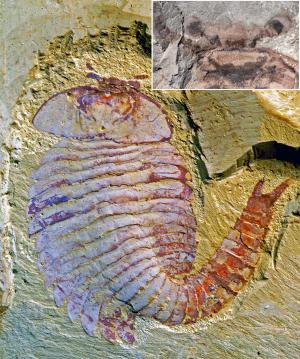
Nature publishes discovery of fossil with complex brain dated just after the Cambrian explosion

New fossil discovery shows advanced brain structures

Casey Luskin writes about it at Uncommon Descent.

Excerpt:

Over at PhysOrg.com, there’s a study being reported highlighting a 520 million year old fossil arthropod with a highly-developed brain. So soon in evolutionary time, and an already developed brain??? (To go beside the very complex eye of the Trilobites)

Here’s what one scientist said:

“No one expected such an advanced brain would have evolved so early in the history of multicellular animals,” said Strausfeld, a Regents Professor in the UA department of neuroscience.

Sorry, Darwinists, but IDers would expect it.

Let’s keep track of the problems that this good scientific discovery creates for naturalists.

Problem #1: Darwinism does not support rapid change from single-celled organisms just before the Cambrian explosion to complex brains just after the Cambrian explosion. Darwinian evolution has to go gradually from simple to complex.

Now for some more:

And, to add insult to injury for our Darwinist brethren, here’s this confirmation of “genetic entropy” and Behe’s QRB “rule”:

“The shape [of the fossilized brain] matches that of a comparable sized modern malacostracan,” the authors write in Nature. They argue the fossil supports the hypothesis that branchiopod brains evolved from a previously complex to a more simple architecture instead of the other way around.

So, that’s another problem.

Problem #2: Darwinism does not support going from more complex to less complex organisms, in general. This is especially true for complex biological systems like brains. Darwnists must explain how complex brains can be built from simpler parts through a long sequence of likely mutations. 

And more:

Here’s how the article ends:

The fossil supports the idea that once a basic brain design had evolved, it changed little over time[Translation: ID is completely correct!!!], he explained. Instead, peripheral components such as the eyes, the antennae and other appendages, sensory organs, etc., underwent great diversification and specialized in different tasks but all plugged into the same basic circuitry. “It is remarkable how constant the ground pattern of the nervous system has remained for probably more than 550 million years,” Strausfeld added. “The basic organization of the computational circuitry that deals, say, with smelling, appears to be the same as the one that deals with vision, or mechanical sensation.”

Yet another problem.

Problem #3: Darwinism does not work if organisms are observed to remain changeless and static over time. Darwinism requires change over time from simple to complex. Backwards change or no change falsifies Darwinism.

Read the whole post.

It’s just another prediction of Darwinian orthodoxy falsified by experimental evidence published in the top scientific peer-reviewed journal. Will this cause Darwinians to revise their theory to fit the evidence? Not likely. Their motivations for clinging to naturalism, the religion that undergirds Darwinism, are entirely beyond correction by evidence.

I wonder what people like P.Z. Myers and Larry Moran do when their religion comes into conflict with scientific evidence? Do they bitterly cling to their mythology from the 19th century? Or do they adjust their worldview to be in line with the progress of science?

Let Richard Dawkins explain evolution and the role of evidence:

“My argument will be that Darwinism is the only known theory that is in principle capable of explaining certain aspects of life. If I am right it means that, even if there were no actual evidence in favour of the Darwinian theory (there is, of course) we should still be justified in preferring it over all rival theories.” — p. 287, Blind Watchmaker” (1986)

Or Richard Lewontin:

“Our willingness to accept [naturalistic]  scientific claims that are against common sense is the key to an understanding of the real struggle between science and the supernatural. We take the side of science in spite of the patent absurdity of some of its constructs, in spite of its failure to fulfill many of its extravagant promises of health and life, in spite of the tolerance of the scientific community for unsubstantiated just-so stories, because we have a prior commitment, a commitment to materialism. It is not that the methods and institutions of science somehow compel us to accept a material explanation of the phenomenal world but, on the contrary, that we are forced by our own a priori adherence to material causes to create an apparatus of investigation and a set of concepts that produce material explanations, not matter how counterintuitive, no matter how mystifying to the uninitiated. Moreover, that materialism is absolute, for we cannot allow a divine foot in the door.” (Richard Lewontin in New York Review of Books, January 9, 1997, p. 28)

Last month, we saw a peer-reviewed published paper that falsified the Darwinian predictions about junk DNA. Recently, the Darwnists were proven wrong again about vestigial organs. Before that, we had another discovery of oxygen on the early Earth’s atmosphere, which blocks naturalistic origin of life scenarios. Did these scientific discoveries stop the worship of the Flying Spaghetti Monster by the Darwinian faithful? Of course not. And they don’t want to debate it with you, either.

Naturalists don’t want to have to explain why they are always believing things that are falsified by the progress of science. Naturalists fought the Big Bang tooth and nail, trying to save their eternal universe from the progress of science. Naturalists invented the now discredited oscillating model of the universe in order to “explain” the evidence for a cosmic beginning. Naturalists invented the unobservable, untestable multiverse to “explain” the cosmic fine-tuning. Unobservable aliens were posited in order to “explain” the origin of life so soon after the cooling of the Earth. Precursor fossils are invented without evidence in order to “explain” the Cambrian era explosion in biological complexity. And so on.

Evidence doesn’t matter to people who are motivated by naturalistic faith. Like belief in a flat-Earth, the delusion of naturalism is not accountable to scientific evidence. They believe what they want to believe. It’s not up for debate. For some people like Richard Dawkins, a prior lifestyle commitment makes theism (and the moral law!) an impossibility a priori. But rational people know that believing something just so that your actions are “justified” doesn’t make what you believe true.

Speaking of Richard Dawkins, if you haven’t seen the video of that coward being “Eastwooded” by William Lane Craig, here’s the link. Dr. Craig has obviously seen a lot of Clint Eastwood movies, and he manages to work in about a half-dozen Clint Eastwood lines into a careful philosophical and scientific refutation of Dawkins’ faith-based atheist delusions. I don’t mind if Dawkins wants to have his religious beliefs for comfort in the privacy of his home or church, but I don’t think that we should be making policy off of his subjective preferences. In the public square we need to be guided by public evidence – like the evidence from science.