Tag Archives: Science

Brian Auten interviews Dr. Angus Menuge on philosophy of mind

Click here for the interview. It’s up at Apologetics 315!

Details:

Today’s interview is with Dr. Angus Menuge, Professor of Philosophy  at Concordia University, and author of Agents Under Fire: Materialism and the Rationality of Science. He talks about his background and work, the philosophy of mind, what reason (or reasoning) is, what materialism is as a worldview, things excluded from a materialistic worldview, methodological naturalism and materialism, accounting for free will, materialistic accounts of reason, the epistemological argument from reason, the ontological argument from reason, finding the best explanation for reason, problems with methodological naturalism, implications of materialism, practical application of the argument from reason, advice for apologists, the International Academy of Apologetics, and more.

If what Dr. Menuge says in this interview is true, and I think it is, then a person who believes in materialism can neither ground free will nor rationality! So atheism wouldn’t really be freethought so much as it would be… un-free… non-thought.

In case people don’t want to listen to the podcast, then I’ve got some things for you to read below.

The ontological argument from reason

Dr. Menuge presented a paper at the real Evangelical Philosophical Society conference for students and professors of philosophy, and you can download the paper here in Word format. (here’s a PDF version I made)

Here is the introduction to the paper that Dr. Menuge read at the EPS conference:

The argument from reason is really a family of arguments to show that reasoning is incompatible with naturalism. Here, naturalism is understood as the idea that foundationally, there are only physical objects, properties and relations, and anything else reduces to, supervenes on, or emerges from that. For our purposes, one of the most important claims of naturalism is that all causation is passive, automatic, event causation (an earthquake automatically causes a tidal wave; the tidal wave responds passively): there are no agent causes, where something does not happen automatically but only because the agent exerts his active power by choosing to do it. The most famous version of the argument from reason is epistemological: if naturalism were true, we could not be justified in believing it. Today, I want to focus on the ontological argument from reason, which asserts that there cannot be reasoning in a naturalistic world, because reasoning requires libertarian free will, and this in turn requires a unified, enduring self with active power.

The two most promising ways out of this argument are: (1) Compatibilism—even in a deterministic, naturalistic world, humans are capable of free acts of reason if their minds are responsive to rational causes; (2) Libertarian Naturalism—a self with libertarian free will emerges from the brain. I argue that neither of these moves works, and so, unless someone has a better idea, the ontological argument from reason stands.

The paper is 11 pages long, and it is helpful for those of you looking for some good discussion of one of the issues in the area of philosophy of mind.

You may also be interested in Alvin Plantinga’s epistemological argument from reason, which is related to this argument. It shows that even to have the ability to think, you have to have a certain anthropology and you have to have mental faculties that are designed for reason, not survival.

Methodological naturalism

Dr. Menuge also wrote an article entitled “Is methodological materialism good for science?”.

Intro:

Should science by governed by methodological materialism? That is, should scientists assume that only undirected causes can figure in their theories and explanations? If the answer to these questions is yes, then there can be no such thing as teleological science or intelligent design. But is methodological materialism a defensible approach to science, or might it prevent scientists from discovering important truths about the natural world? In my contribution to The Waning of Materialism (Oxford University Press, 2010), edited by Robert Koons and George Bealer, I consider twelve of the most common arguments in favor of methodological materialism and show that none of them is convincing.

Of these arguments, perhaps the most prevalent is the “God of the gaps” charge, according to which invoking something other than a material cause is an argument from ignorance which, like a bad script writer, cites a deus ex machina to save our account from difficulty. Not only materialists, but also many Christian thinkers, like Francis Collins, worry that appeal to intelligent design commits the God of the gaps fallacy.

As I argue, however, not only is an inference to an intelligent cause not the same as an inference to the supernatural, it is a mistake to assume that all gap arguments are bad, or that only theists make them. If a gap argument is based solely on ignorance of what might explain some phenomenon, then indeed it is a bad argument. But there are many good gap arguments which are made both by scientific materialists and proponents of intelligent design.

So how do you make an argument like that?

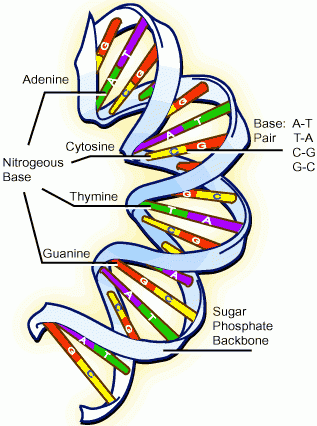
As Stephen Meyer has argued in his Signature in the Cell, intelligent design argues in just the same way, claiming not merely that the material categories of chance and necessity (singly or in combination) are unable to explain the complex specified information in DNA, but also that in our experience, intelligent agents are the only known causes of such information. The argument is based on what we know about causal powers, not on what we do not know about them.

Since the inference is based on known causal powers, we learn that the cause is intelligent, but only further assumptions or data can tell us whether that intelligence is immanent in nature or supernatural. It is a serious mistake to confuse intelligent design with theistic science, and the argument that since some proponents of design believe that the designer is God, that is what they are claiming can be inferred from the data, is a sophomoric intensional fallacy.

If you think this is interesting, then do have a listen to the podcast. Dr. Menuge is not an ordinary academic – he is very direct. He calls materialism “a catastrophe” in the podcast!
Moshe Averick: the origin of life and atheism-of-the-gaps

Can atheism explain the origin of life?

An amazing must-read article from a Jewish scholar named Moshe Averick, published in the Times of Israel. (H/T Mysterious Jacob via Mysterious Chris)

This is literally the greatest thing you will read all day, so everyone reading this sentence – please click the link, after you read my excerpts and snarky comments below.

His thesis:

The history of scientific endeavor to discover a naturalistic origin of life reads like a laboratory version of a demolition derby. A researcher roars into the arena to propose a new theory and is summarily rammed and demolished by another theory driven by its respective theoretician who in turn is rammed and demolished by the next eager contestant.

Here are some of the naturalistic theories that have been proposed and demolished… frequently by other naturalists!

RNA-world theory:

  • Dr. Robert Shapiro, Professor Emeritus of Chemistry at NYU on the popular RNA-World theory: “Picture a gorilla at an immense keyboard [that] contains not only the symbols used in English and European languages but also…from every other known language and all of the symbol sets stored in a typical computer. The chances [of functional RNA molecules forming by themselves] can be compared to those of the gorilla composing, in English, a coherent recipe for the preparation of chili con carne…the spontaneous appearance of RNA chains on the lifeless Earth would have been a near miracle.”

Shapiro is a naturalist himself.

Metabolism First theory:

  • Dr. Leslie Orgel – a proponent of the RNA-World theory – on the Metabolism First theory proposed by the aforementioned Dr. Shapiro: “Theories of the origin of life based on metabolic cycles cannot be justified by the inadequacy of competing theories: they must stand on their own…solutions offered by supporters of …metabolist scenarios that are dependent on ‘if pigs could fly’ chemistry are unlikely to help.” Dr. George Whitesides of Harvard University, one of the world’s greatest living chemists, made the following comment on the Metabolism First theory: “It seems to me to be astonishingly improbable.”

For details on why these naturalistic theories are dismissed by naturalists, you should read Stephen C. Meyer’s absolutely amazing book “Signature in the Cell” will recognize much in this article. Please if you don’t have Dr. Meyer’s two books on the origin of life and the Cambrian explosion (“Darwin’s Doubt”), you really need to get them.

The article continues smashing a few more lame naturalistic scenarios, and then this tour-de-force:

The present state of Origin of Life research is best summed up by Dr. Eugene Koonin, a highly respected microbiologist and veteran researcher in the field. From his 2011 book, The Logic of Chance:The Nature and Origin of Biological Evolution: “The origin of life is one of the hardest problems in all of science…Origin of Life research has evolved into a lively, interdisciplinary field, but other scientists often view it with skepticism and even derision. This attitude is understandable and, in a sense, perhaps justified, given the “dirty” rarely mentioned secret: Despite many interesting results to its credit, when judged by the straightforward criterion of reaching (or even approaching) the ultimate goal, the origin of life field is a failure – we still do not have even a plausible coherent model, let alone a validated scenario, for the emergence of life on Earth. Certainly, this is due not to a lack of experimental and theoretical effort, but to the extraordinary intrinsic difficulty and complexity of the problem. A succession of exceedingly unlikely steps is essential for the origin of lifethese make the final outcome seem almost like a miracle.”  Dr. Paul Davies, Origin of Life expert and physicist at Arizona State University concurs: “You might get the impression from what I have written not only that the origin of life is virtually impossible, but that life itself is impossible…so what is the answer? Is life a miracle after all?”

Put quite simply: The proposition that the gaping chasm between non-living, inorganic chemicals and a living bacterium could be bridged by an unguided naturalistic process is so patently absurd that it can be rejected out of hand. Despite the abundant availability of raw materials such as mud, stones, straw and rocks in a rain forest, one does not need to “prove” that a mud hut in a clearing in that forest is the product of intelligent intervention. An appropriate metaphor for a bacterium would be more like finding Buckingham Palace.

It is obvious that life was created by an intelligent designer outside of the natural world and the reason why the origin of life “seems almost like a miracle,” is because itis a miracle.

However, atheist/materialist scientists refuse to give up so easily. Dr. Koonin himself has proposed a possible solution and escape hatch from having to accept a Creator of life: “The Many Worlds in One version of the cosmological model of eternal inflation might suggest a way out of the origin of life conundrum because, in an infinite multiverse with a finite number of macroscopic histories (each repeated an infinite number of times), the emergence of even highly complex systems by chance is not just possible, but inevitable.” (The Logic of Chance)

“The way out of the origin of life conundrum [is that] in an infinite multiverse…the emergence of even highly complex systems by chance is not just possible, but inevitable.”

Translation: The odds of rolling a six a thousand times in a row with a single die is 1 in 6 to the 1000th power, or 1 chance in 6 x 10 to the 999th power. The size of this number is beyond our comprehension but to provide some kind of baseline keep in mind that the number of atoms in the entire universe is roughly 10 to the 80th power. Despite this, as Koonin points out, if I am able to roll the die an infinite number of times, it is not only possible, but inevitable that it will happen. Although reason and scientific investigation have informed us of the virtual impossibility of life having formed on our planet by an undirected naturalistic process, the “way out of the origin of life conundrum” – that is to say, the way to avoid the obvious answer that life was created – is to propose a multiverse. With an infinite number of trials and errors available, it is not only possible but inevitable that life will form no matter how fantastic the odds against.

He is right of course. With an infinite number of trials and errors not only is the formation of life inevitable but it is just as inevitable that at least one of each of the following has formed by pure chance and can be found on our planet today: iPhone 5, Toshiba Satellite Laptop Computer, Schwinn Discover Men’s Hybrid Bike, full color poster of Jimmy Hendrix playing at Woodstock, Martin D-35 Acoustic Guitar, Mylec Eclipse Jet-Flow Hockey Stick, Revell 1:48 scale P-51D Mustang model airplane, and last but not least, a 2013 Rolls Royce Phantom Sedan (retail price- $465,000). I don’t believe it, no one reading this article believes it, Eugene Koonin does not believe it, and even Richard Dawkins doesn’t believe it.

Read the whole thing.

In my opinion, all of this loud worship of science from people like Dawkins, Atkins and Krauss is just a smokescreen. Atheism is first and foremost about dispensing with cosmic authority and moral accountability. If they have to believe in eternal universes, unseen aliens, untestable multiverses, undiscovered Cambrian precursor fossils, and even the freaking Flying Spaghetti Monster in order to see God’s handiwork in nature, then they will do it.

Note: this concluding rant applies to village atheists like Christopher Hitchens, Lawrence Krauss and Richard Dawkins, not to exceptional academic non-theists like Peter Millican and Graham Oppy.

If you want to read a really good article on exactly how improbable the simplest living organism is, click here.

The really astonishing about the case for theism is that we have a half-dozen scientific arguments like this… this isn’t even our best one! It’s so strange because I find myself living in a world filled with atheists who basically believe in the Easter bunny even as they profess this great affection for the very thing that is exposing their madness – science! Like a person jealously hugging a chunk of radioactive material to himself and then claiming that it protects him from radiation sickness. So surreal. 

Shabbat shalom, Moshe Averick, and Mazel Tov!

Philip E. Johnson lectures on science, evolution and religion

I found this fun lecture by the grandfather of the big-tent intelligent design movement, Berkeley law professor Philip E. Johnson.

I’ll bet you guys have all heard of him, but you’ve never heard him speak, right? Well, I was a young man, I used to listen to Phil’s lectures and his debates with Eugenie Scott quite a bit. This is one of my favorite lectures. Very easy to understand, and boilerplate for anything else in the origins debate. This is a great lecture – funny, engaging and useful. You will definitely listen to this lecture several times if you listen to it once.

The MP3 is here. (91 minutes, 62 megabytes)

The Inherit the Wind stereotype

  • Many people get their understanding of origins by watching movies like “Inherit the Wind” (or reading science fiction)
  • The actual events of the Scopes trial are nothing like what the movie portrays
  • The law forbidding the teaching of evolution was symbolic, not meant to be enforced
  • The actual Scopes trial was a publicity stunt to attract attention to Dayton, TN to bring business to the town
  • The ACLU advertised for a teacher who would be willing to be sued
  • They found a substitute physical education teacher who would be willing to “break” the law
  • The movie is nothing like the actual events the movie is a morality play
  • The religious people are evil and stupid and ignorant and bigoted
  • The scientists and lawyers are all intelligent, romantic, and honest seekers of the truth
  • The religious people think that the Bible trumps science and science is not as reliable as the Bible
  • The movie argues that the reason why there is ANY dissent to evolution is because of Biblical fundamentalism
  • The movie presents the idea that there are no scientific problems with evolution
  • The movie says that ONLY Biblical fundamentalists who believe in 6 day, 24-hour creation doubt evolution
  • The movie says that Biblical fundamentalism are close-minded, and not open to scientific truth
  • The movie says that people who read the Bible as making factual claims are misinterpreting the Bible
  • The movie says that smart people read the Bible for comfort and feelings and arbitrary values, not for truth

Guided evolution and methodological naturalism

  • What scientists mean by evolution is that fully naturalistic, unguided, materialistic mechanisms caused the diversity of life
  • Scientists do not allow that God had any real objective effect on how life was created
  • Scientists think that nature did all the creating, and any mention of God is unnecessary opinion – God didn’t DO ANYTHING
  • Scientists operate with one overriding rule – you can only explain the physical world with physical and material causes
  • Scientists DO NOT allow that God could have done anything detectable by the sciences
  • Scientists WILL NOT consider the idea that natural, material processes might be INSUFFICIENT for explaining everything in nature
  • You cannot even ask the question about whether natural laws, matter and chance can explain something in nature
  • Intelligent causes can NEVER be the explanation for anything in nature, and you can’t even test experimentally to check that
  • Scientists ASSUME that everything can be explained with natural laws, matter and chance – no questioning of natural causes is allowed
  • Where no natural explanation of a natural phenomenon is available, scientists SPECULATE about undiscovered natural explanations
  • The assumption of naturalistic sufficiency is called “methodological naturalism”
  • To question the assumptions that natural is all there is, and that nature has to do its own creating, makes you an “enemy of science”
  • But Johnson says that naturalists are the enemies of science, because they are like the Biblical fundamentalists
  • Naturalists have a presumption that prevents them from being willing to follow the evidence where it is leading
  • Experiments are not even needed, because the presumption of naturalism overrides any experimental finding that falsifies the sufficiency of natural causes to explain some natural phenomenon

What can natural selection and mutation actually do?

  • what evolution has actually been observed to do is explain changing populations of moths and finches
  • finches with smaller or larger beaks are observed to have differential survival rates when there are droughts or floods
  • no new body plan or new organ type has been observed to emerge from these environmental pressures
  • the only kind of evolution that has been observed is evolution within types – no new genetic instructions are created
  • in textbooks, only confirming examples are presented – but what is required is a broad pattern of gradual development of species
  • if you look at the fossil record, what you see in most cases is variation within types based on changing environments
  • the real question is: can natural law and chance be observed to be doing any creating of body plans and organ types?

What kind of effect requires an intelligent cause?

  • the thing to be explained in the history of life is the functional information sequences
  • you need to have a sequence of symbols or characters that is sufficiently long
  • your long sequence of characters has to be sequenced in the right order to have biological function
  • the only thing that can create long sequences of functional information is an intelligent cause
  • intelligent design people accept micro-evolution – changes within types – because that’s been observed
  • the real thing to be explained is the first living cell’s functional information, and the creation of new functional information

Critical response

The next 15 minutes of the lecture contain a critical response from a philosophy professor who thinks that there have been no developments in design arguments since Aquinas and Paley. He basically confirms the stereotypes that Johnson outlined in the first part of the lecture. I recommend listening to this to see what opposition to intelligent design really looks like. It’s not concerned with answering scientific questions – they want to talk about God, the Bible and Noah’s ark. It’s our job to get people like this critic to focus on the science.

Here’s my snarky rendition of what he said:

1) Don’t take the Bible literally, even if the genre is literal.

  • all opposition to evolution is based on an ignorant, fundamentalist, literal reading of the Bible
  • the Bible really doesn’t communicate anything about the way the world really is
  • the Bible is just meant to suggest certain opinions and experiences which you may find fetching, or not, depending on your feelings and community
  • if Christians would just interpret the Bible as myths and opinions on par with other personal preferences, then evolution is no threat to religious belief

2) As long as you treat the design argument as divorced from evidence, it’s not very effective

  • the latest and best version of the design argument is the old Paley argument which involves no experimental data, so I’ll critique that
  • this 200-year old argument which doesn’t rely on science has serious problems, and unnamed Christians agree with me!
  • Christians should NOT try to prove God’s existence using evidence from the natural world (as Romans 1 says), and in fact it’s “Pelagianism” to even try
  • Christians should divorce their faith from logic and evidence even though the Bible presents faith as being rooted in reason and evidence
  • Christians should not tie their faith to the science of today, because science is always changing and the theism-friendly evidence of today might be overturned tomorrow
  • It’s a good idea for me to critique the arguments of 1000-year old people who did not know anything about the cosmic fine-tuning argument – that’s fair!
  • I find it very useful to tell people that the argument from design is false without mentioning any design arguments from DNA or cosmic fine-tuning
  • We need to assume that the natural world is explainable using only natural causes before we look at any evidence
  • We should assume that natural causes create all life, and then rule out all experimental evidence for intelligent causes that we have today
  • As long as you accept that God is a personal opinion that has nothing to do with reality, then you can do science
  • The non-Christian process theologian Teilhard de Chardin accepts evolution, and therefore so should you
  • Remember when theists said God caused thunder because he was bowling in the clouds and then we found out he didn’t? Yeah well – maybe tomorrow we’ll find out that functional sequences of amino acids and proteins have natural causes! What would you do then?

3) What the Bible really says is that you should be a political liberal

Q&A time

The lecture concludes with 13 minutes of questions.