Tag Archives: Saving

A third of Americans who have a savings plan have less than $1000 in it

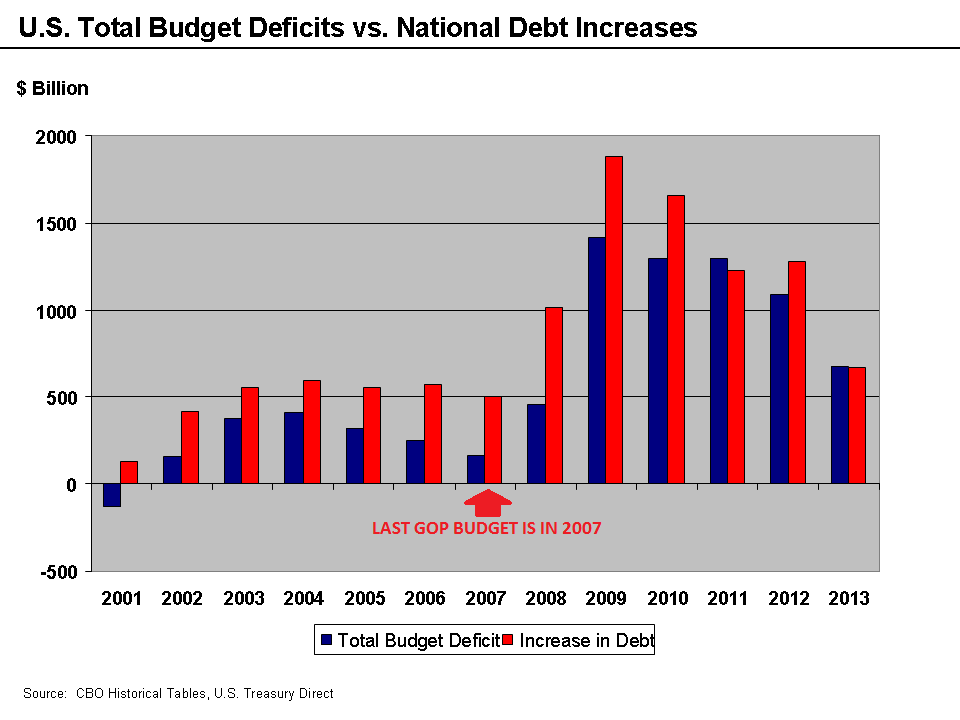
National Debt and Deficit 2007-2013

Let me start with the facts from Breitbart News, and then I’ll comment on the part in bold.

Excerpt:

Study after study shows that Americans are not saving for retirement like they should, and a new survey finds that nearly one third of people who have some sort of savings plan have amassed less than $1,000 for retirement.

The survey titled “Preparing for Retirement in America,” by Employee Benefit Research Institute (EBRI) and Greenwald and Associates, finds that only 65 percent of workers have any savings for retirement, a number that fell below the 75 percent figure from 2009.

But 28 percent of workers report that they have saved less than $1,000 for retirement, and almost 6 in 10 Americans say that their financial planning needs improvement.

Additionally, 34 percent say they have made no effort at all to saving anything or make a retirement plan. Still, most say that they intend to start saving at some point.

But intentions may not be enough. “Intending one thing and doing another is human, but it’s an impulse we should all fight hard to resist,” Rebekah Barsch, vice president of planning and sales at Northwestern Mutual, said in a press statement. “Intentions only get us so far. And when the stakes are high, it’s taking action that’s critical.”

Many say that the average person needs to save one million dollars for retirement, but a recent piece by David Marotta, president of Marotta Wealth Management in Charlottesville, VA, noted that a 20-year-old in 2015 may have to amass up to $7 million to retire comfortably.

“Someone retiring now in 2014 with $1 million at age 65 can safely withdraw $43,600 a year,” Marotta wrote last May. “However, [because of inflation], today’s 20-year-olds will need over $7 million to have that same lifestyle when they retire. In 1970, they would only have needed $166,000 in retirement to have a similar purchasing power for the rest of their life.”

Many Americans save for retirement using the 401K plans provided through their employer, but according to the federal government, around 50 million Americans don’t have the ability to enroll in such a savings plan.

Here’s a helpful article from CNBC that answers the question “how much do I need to retire?”.

It says:

You can’t feel secure in retirement if you don’t have a good idea of how much money you’ll need.

But if you believe a new Legg Mason survey, you may have to save far more than you think. Investors surveyed by the global investment management firm said they will require an average of $2.5 million in retirement to enjoy the quality of life they have today.

That’s about $2.2 million more than the average balance of $385,000 those investors actually had in 401(k)s and similar retirement plans, which might help explain why only 40 percent of the 458 investors surveyed said they are “very confident” in their ability to “retire at the age I want to.” (And the investors surveyed have set more aside than the average retirement saver. At Fidelity, the nation’s largest retirement plan provider, the average 401(k) balance was $91,300 at the end of 2014.)

[…]Fidelity estimates most investors require about eight times their ending salary to increase the chances that their savings will last during a 25-year retirement. But every retirement is different. People also tend to spend lavishly in their first years of retirement before their spending declines in later years.

Health care is the wild card in retirement planning, especially as Americans live longer. Fidelity projects a 65-year-old couple retiring will need an average of $220,000 to cover medical expenses in retirement.

So, according to Fidelity’s rule, if you are single and making $50K after taxes, then you need $400,000 to retire at age 65. You’ll need more the earlier you retire. That seems about right to me. The important thing to do when planning for the future is not to imagine a higher income than you have right now, though. Imagining that things will be better than they are right now is a terrible mistake. You can’t make the world change just by imagining things that make you feel good, or by looking at cherry-picked examples from people you know who got lucky.

The trouble with young people today is that they think that things tomorrow will be the same as they were yesterday. They don’t see the future implications of running our national debt up to $18.5 trillion dollars. They think entitlement programs will be solvent when they are ready to retire. They aren’t aware of what’s going on in the economies of other countries that we trade with. They aren’t aware of what’s going on in Greece, and how that will affect the European Union. They aren’t aware of the demographic crisis in Europe, and especially in Japan. They aren’t thinking about the implications for future wars as America withdraws from the world stage. And so on. And since they are not aware, they are delaying making a plan to save, so they can have more fun now. Their retirement plan is all future sunshine and rainbows, but no actions are being taken right now.

If I could give young people one piece of advice, it’s this. It’s much easier to shift your life out of a position of financial security to something lighter but more meaningful in the second half of your life. It’s harder to work back to earning and saving if you have squandered your early life on fun, thrills, travel, non-STEM degrees, etc. If you’re 30 years old and don’t have any savings, you are in serious, serious trouble. You need to get focused on a regular career as soon as possible, and start saving. Get those debts paid off now. Still think that your rosy picture of the future will obtain? Usually, you can tell how good you are at strategic forecasting by looking at your past decisions. Have you been wise before, or have you chosen poorly? If you’ve chosen poorly, then it’s a good idea to defer to people who haven’t made the same mistakes. If you’re an optimistic person who is always being surprised and disappointed, that’s a good sign you need to start saving now.
Republicans propose expansion of 529 college savings plans

I guess by now everyone has heard about Obama’s plan to eliminate college savings plans.

The left-leaning New York Times reported on it:

President Obama is proposing a radical change to the 529 college savings plans held by millions of families, which would require those who use them to rethink their approach to college savings.

As part of his plan to simplify the tax code and help the middle class, one of the 529 plan’s most attractive benefits would be eliminated: Money could no longer be withdrawn tax-free. (The new rules would apply only to new contributions.)

The accounts, many of which are run by the states, allow people to make contributions that grow tax-free. The money can be withdrawn without the paying of capital gains taxes as long as the proceeds are used for education expenses. Many states provide state income tax deductions for contributions as well.

The proposal has now been withdrawn after a huge uproar. The real question is, why would he propose such a stupid thing?

First, it’s important to understand that government raises the cost of higher education with subsidies, which the Democrats favor:

A new study by Dennis Epple, Richard Romano, Sinan Sarpca and Holger Sieg for the National Bureau of Economic Research suggests that the impact of these aid programs is clearly different from what federal policy makers intended. “We show that private colleges game the federal financial aid system,” they conclude. Every dollar in new financial aid to students leads to about 40 cents less spent by the colleges on institutional financial aid — so students benefit far less than federal policy makers intended.

In 1987, Secretary of Education William Bennett argued that more federal aid leads to higher tuitions, enabling schools to increase spending. This seems broadly consistent with the latest research results. The net attendance impact of these federal programs, according to the study for NBER, is “modest.” In short, these programs haven’t substantially spurred student access to colleges, all the while burdening taxpayers and student borrowers.

The ballooning federal aid increases schools’ spending. The researchers don’t analyze changes in university spending, but an examination of other evidence suggests that money isn’t going primarily into improving instruction. Colleges have gone on a building spree (financed in part by amassing large debt — more than $220 billion at schools whose bonds are rated by Moody’s alone), and pay and perquisites for top university administrators has risen sharply.

The Democrats already want higher education to be out of reach – that’s why they keep increasing subsidies. So, eliminating college savings plans is in line with this goal of putting higher education out of reach. It’s another way to cause people to have fewer children, something that Democrats are very passionate about. After all, if you can’t pay for higher education for four kids, you’ll only have two. Democrats have this terrible fear of over-population, and it drives a lot of their policies, including abortion.

But that’s not all – there’s another reason to stop people from saving for college.

Second, it stops people from saving their own money:

Megan McArdle suggests, quite reasonably, that this is a desperate move by those who need to finance ever bigger government and are simply going where the money is: the vast American middle class. You can understand why the champions of big government would be slavering over the very thing that defines the middle class, its savings. As she points out, 529s are not the first target. There have already been trial balloons about raiding 401(k)s and IRAs. The truly committed leftist looks upon our private savings as a vast reserve of capital unfairly withheld from its proper function of servicing the needs of the state.

I think that’s the real explanation. This is not so much a rational calculation about how to finance the behemoth state. This is an admission by a man who has no more election campaigns to run, and therefore no pragmatic constraints, about his real outlook and real preferences. A president who just a few weeks ago hailed the triumph of a supposed “middle-class economics” is revealing his hatred and contempt for the middle class.

Republicans would like to see people saving more and more money so that they are less and less dependent on the government. This is because the more independent you are, the more fre you are – and Republicans are for personal liberty.

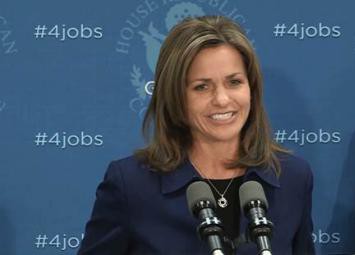
This is GOP Congressman Lynn Jenkins:

Kansas Congresswoman Lynn Jenkins

Here is her Republican response to Obama’s proposal to eliminate 529s:

Good morning. I’m Lynn Jenkins, Congresswoman from the Second District of Kansas and Vice-Chair of the House Republican Conference.

This is the time of year when high school seniors are putting the final touches on their college applications. That means it’s also the time when families are preparing to start paying for that education — whether it’s a 4-year college, community college, or a technical school. (Scroll down for video of these remarks.)

As a parent with two children in college, I know this can be one of the most rewarding, and at the same time challenging, aspects of being a parent — particularly at a time when costs are going up while wages stay about the same. All told, Americans now owe more than $1 trillion in student loan debt.

And so in the new Congress, Republicans are working to lower costs for middle-class families and empower folks with bottom-up solutions that help prepare you for the future.

That’s why, this week, I introduced a bipartisan plan to expand popular 529 college savings accounts.

As you know, these 529 plans were created to help middle-class families save and plan for college. Many parents open them not long after their children are born. And ever since Congress allowed folks to withdraw from these accounts tax-free for college expenses, 1 million account holders have turned into 12 million.

Unfortunately, instead of expanding 529s, the president recently proposed raising taxes on college savings. If implemented his scheme would have turned back the clock on middle-class families, and taken money from your savings to pay for more government. This would have discouraged families from using 529s, meaning less savings, more debt, and more government dependence.

This proposal increases middle-class independence from the government, and makes people more free to work, earn, save and chart their own course. It’s different from the Democrat proposals which increase dependence on government and reduces liberty.

Paul Ryan takes Obama’s State of the Union speech apart

Budget hawk Paul Ryan on Fox News Sunday.

Snippet 1:

“The irony of this is the president’s policies do the exact opposite.  We basically have this. The president can’t run on his record. It’s a miserable record. He is not going to change his tune and moderate like say Bill Clinton did in 1996 because he’s really stuck with his ideology so he has no choice but to divide. So he is going to run a very decisive campaign for political gain and he has this concept of fairness and equality where he uses the kind of rhetoric we use, but the policies he’s producing will result in crony capitalism will result in more power in the government to supervise our lives, to give us a stagnant economy where the rich and the powerful are the ones who are picking it. So what I’m trying to say is he is giving us a future of debt, doubt, and decline. “

And snippet 2:

“The president isn’t leading. The president isn’t truthful with the American people about what kind of fiscal train wreck is coming, we’re going to be. And we’ll pass budgets to show the country exactly how we propose to fix the problem. You know the thing that is frustrating about this, Chris, is there is an emerging bipartisan census on fixing these big problems. There are Democrats who do agree with us on how to do tax reform. Get the loopholes out, lower the rates. We’re getting a bipartisan consensus on Medicare reform. The problem is the president and his party leader are out on the left standing on the sidelines looking in. So what we clearly need is a new White House and a new Senate and then we can realize this emerging bipartisan consensus on how to fix these problems”.

It’s good that we have Paul Ryan to respond to Obama’s rhetoric.

Related posts