
Tag Archives: Reason

If unborn babies don’t have consciousness or don’t feel pain, may we kill them?

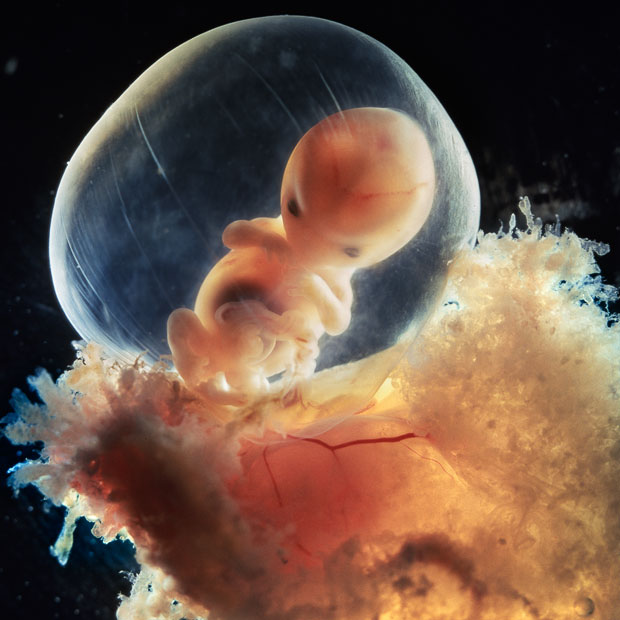
Unborn baby scheming about pro-life apologetics

Was having a conversation by e-mail yesterday with a pro-abortion atheist, and he gave two reasons why he supported abortion in the first and second trimester. First, he said that unborn babies can’t feel pain, so it’s OK to kill them. Second, he said that unborn babies don’t have consciousness, so it’s OK to kill them. I thought it might be useful to link to something that answers both of these objections.

Frank Beckwith is the author of “Defending Life: A Moral and Legal Case Against Abortion Choice“. He wrote that book for Cambridge University Press, a top academic press. But before Cambridge University Press, Beckwith wrote four easy-to-understand essays for the Christian Research Journal. Part IV is the one that has the response to the two questions raised by my atheist friend.

Part I. The Appeal to Pity

Part II. Arguments from Pity, Tolerance, and Ad Hominem

Part III. Is The Unborn Human Less Than Human?

Part IV. When Does a Human Become a Person?

Excerpt:

Some ethicists argue that the unborn becomes fully human sometime after brain development has begun, when it becomes sentient: capable of experiencing sensations such as pain. The reason for choosing sentience as the criterion is that a being that cannot experience anything (i.e., a presentient unborn entity) cannot be harmed. Of course, if this position is correct, then the unborn becomes fully human probably during the second trimester and at least by the third trimester. Therefore, one does not violate anyone’s rights when one aborts a nonsentient unborn entity. [13]

There are several problems with this argument. First, it confuses harm with hurt and the experience of harm with the reality of harm. [14] One can be harmed without experiencing the hurt that sometimes follows from that harm, and which we often mistake for the harm itself. For example, a temporarily comatose person who is suffocated to death “experiences no harm,” but he is nevertheless harmed. Hence, one does not have to experience harm, which is sometimes manifested in hurt, in order to be truly harmed.

Second, if sentience is the criterion of full humanness, then the reversibly comatose, the momentarily unconscious, and the sleeping would all have to be declared nonpersons. Like the presentient unborn, these individuals are all at the moment nonsentient though they have the natural inherent capacity to be sentient. Yet to countenance their executions would be morally reprehensible. Therefore, one cannot countenance the execution of some unborn entities simply because they are not currently sentient.

Someone may reply that while these objections make important points, there is a problem of false analogy in the second objection: the reversibly comatose, the momentarily unconscious, and the sleeping once functioned as sentient beings, though they are now in a temporary state of nonsentience. The presentient unborn, on the other hand, were never sentient. Hence, one is fully human if one was sentient “in the past” and will probably become sentient again in the future, but this cannot be said of the presentient unborn.

There are at least three problems with this response. First, to claim that a person can be sentient, become nonsentient, and then return to sentience is to assume there is some underlying personal unity to this individual that enables us to say that the person who has returned to sentience is the same person who was sentient prior to becoming nonsentient. But this would mean that sentience is not a necessary condition for personhood. (Neither is it a sufficient condition, for that matter, since nonhuman animals are sentient.) Consequently, it does not make sense to say that a person comes into existence when sentience arises, but it does make sense to say that a fully human entity is a person who has the natural inherent capacity to give rise to sentience. A presentient unborn human entity does have this capacity. Therefore, an ordinary unborn human entity is a person, and hence, fully human.

Second, Ray points out that this attempt to exclude many of the unborn from the class of the fully human is “ad hoc and counterintuitive.” He asks us to “consider the treatment of comatose patients. We would not discriminate against one merely for rarely or never having been sentient in the past while another otherwise comparable patient had been sentient….In such cases, potential counts for everything.” [15]

Third, why should sentience “in the past” be the decisive factor in deciding whether an entity is fully human when the presentient human being “is one with a natural, inherent capacity for performing personal acts?” [16] Since we have already seen that one does not have to experience harm in order to be harmed, it seems more consistent with our moral sensibilities to assert that what makes it wrong to kill the reversibly comatose, the sleeping, the momentarily unconscious, and the presentient unborn is that they all possess the natural inherent capacity to perform personal acts. And what makes it morally right to kill plants and to pull the plug on the respirator-dependent brain dead, who were sentient “in the past,” is that their deaths cannot deprive them of their natural inherent capacity to function as persons, since they do not possess such a capacity.

These four essays are a very good introduction to common responses to pro-abortion arguments. I recommend that people get familiar with this, as once you look into it, you will see that the abortion issue can be debated with as much confidence as William Lane Craig defends Christian theism. You will have the same access to scientific evidence and rational arguments on this topic, and so you will have the upper hand. And that’s fun.

The best introductory book on the abortion / right to life issue is “The Case for Life” by pro-life debater Scott Klusendorf. The best comprehensive book is a tie between “The Ethics of Abortion” by Christopher Kaczor, and Frank Beckwith’s “Defending Life: A Moral and Legal Case Against Abortion Choice“.
Study: the early Earth’s atmosphere contained oxygen

Apologetics and the progress of science

Here’s a paper published in the prestigious peer-reviewed science journal Nature, entitled “The oxidation state of Hadean magmas and implications for early Earth’s atmosphere”. This paper is significant because it undermines naturalistic scenarios for the origin of life.

Evolution News explains what the paper is about.

Excerpt:

A recent Nature publication reports a new technique for measuring the oxygen levels in Earth’s atmosphere some 4.4 billion years ago. The authors found that by studying cerium oxidation states in zircon, a compound formed from volcanic magma, they could ascertain the oxidation levels in the early earth. Their findings suggest that the early Earth’s oxygen levels were very close to current levels.

[…]Miller and Urey conducted experiments to show that under certain atmospheric conditions and with the right kind of electrical charge, several amino acids could form from inorganic compounds such as methane, ammonia, and water. Several experiments have been done using various inorganic starting materials, all yielding a few amino acids; however, one key aspect of all of these experiments was the lack of oxygen.

If the atmosphere has oxygen (or other oxidants) in it, then it is an oxidizing atmosphere. If the atmosphere lacks oxygen, then it is either inert or a reducing atmosphere. Think of a metal that has been left outside, maybe a piece of iron. That metal will eventually rust. Rusting is the result of the metal being oxidized. With organic reactions, such as the ones that produce amino acids, it is very important that no oxygen be present, or it will quench the reaction. Scientists, therefore, concluded that the early Earth must have been a reducing environment when life first formed (or the building blocks of life first formed) because that was the best environment for producing amino acids. The atmosphere eventually accumulated oxygen, but life did not form in an oxidative environment.

The problem with this hypothesis is that it is based on the assumption that organic life must have formed from inorganic materials. That is why the early Earth must have been a reducing atmosphere. Research has been accumulating for more than thirty years, however, suggesting that the early Earth likely did have oxygen present.

[…]Their findings not only showed that oxygen was present in the early Earth atmosphere, something that has been shown in other studies, but that oxygen was present as early as 4.4 billion years ago. This takes the window of time available for life to have begun, by an origin-of-life scenario like the RNA-first world, and reduces it to an incredibly short amount of time. Several factors need to coincide in order for nucleotides or amino acids to form from purely naturalistic circumstances (chance and chemistry). The specific conditions required already made purely naturalist origin-of-life scenarios highly unlikely. Drastically reducing the amount of time available, adding that to the other conditions needing to be fulfilled, makes the RNA world hypothesis or a Miller-Urey-like synthesis of amino acids simply impossible.

So here’s where we stand. If you are a materialist, then you need a reducing environment on the early Earth in order to get organic building blocks (amino acids) from inorganic materials. However, the production of these organic building blocks (amino acids) requires that the early Earth atmosphere be oxygen-free. And the problem with this new research, which confirms previous research, is that the early Earth contained huge amounts of oxygen – the same amount of oxygen as we have today. This is lethal to naturalistic scenarios for creating the building blocks of life on the Earth’s surface.

Other problems

If you would like to read a helpful overview of the problems with a naturalistic scenario for the origin of life, check out this article by Casey Luskin.

Excerpt:

The “origin of life” (OOL) is best described as the chemical and physical processes that brought into existence the first self-replicating molecule. It differs from the “evolution of life” because Darwinian evolution employs mutation and natural selection to change organisms, which requires reproduction. Since there was no reproduction before the first life, no “mutation – selection” mechanism was operating to build complexity. Hence, OOL theories cannot rely upon natural selection to increase complexity and must create the first life using only the laws of chemistry and physics.

There are so many problems with purely natural explanations for the chemical origin of life on earth that many scientists have already abandoned all hopes that life had a natural origin on earth. Skeptical scientists include Francis Crick (solved the 3-dimensional structure of DNA) and Fred Hoyle (famous British cosmologist and mathematician), who, in an attempt to retain their atheistic worldviews, then propose outrageously untestable cosmological models or easily falsifiable extra-terrestrial-origin-of-life / panspermia scenarios which still do not account for the natural origin of life. So drastic is the evidence that Scientific American editor John Horgan wrote, “[i]f I were a creationist, I would cease attacking the theory of evolution … and focus instead on the origin of life. This is by far the weakest strut of the chassis of modern biology.”3

The article goes over the standard problems with naturalistic scenarios of the origin of life: wrong atmosphere, harmful UV radiation, interfering cross-reactions, oxygen levels, meteorite impacts, chirality, etc.

Most people who are talking about intelligent design at the origin of life talk about the information problem – how do you get the amino acids to form proteins and how do you get nucleotide bases to code for amino acids? But the starting point for solving the sequencing problem is the construction of the amino acids – there has to be a plausible naturalistic scenario to form them.

Are atheists right to say that you can’t prove a universal negative?

Lets take a closer look at a puzzle

I hear a lot of atheists complaining that they shouldn’t have any burden of proof because it is impossible to prove a universal negative, i.e. – “there is no God”.

Here’s a post from William Lane Craig about it.

Excerpt:

The first claim is, ironically, usually found on the lips of atheists, who thereby seek to excuse themselves from bearing any share of the burden of proof in the discussion. Usually, the claim is that a universal negative cannot be proved, and therefore the claim that “There is no God” is unprovable. The second claim is typically given as the reason why a universal negative cannot be proved: no matter how much knowledge you have acquired, there will always be more facts that you do not yet know, and perhaps the exception is among them. So one can never prove that there is no God. Perversely, this is somehow interpreted, not as an admission that atheism is indefensible, but as a demonstration that it is in no need of defense!

Unfortunately, the argument is misconceived on a couple of counts.

First, negative, universally quantified statements can be proved. We do this all the time. When we make statements about “all” or “none,” we are speaking about what is the case with respect to a certain domain. We are saying that all or none of the members of that domain have or has a certain property. If the domain is not too large, I can confidently make universally quantified affirmative and negative statements. For example, I am quite confident that “No U.S. Senator is a Muslim.” Or again, if I have a typical sample of the domain, I can make inductive inferences on the basis of the evidence from the sample to the whole, even if the whole domain is too large for me to canvass; for example, taking as my domain all the microbes on Earth, I can confidently assert, “No microbes have brains.”

Now someone might say that while it is admittedly true that negative, universal statements can sometimes be proven, still the point remains that in the case of God, the domain is too large and our sample too small to come to any negative conclusion. But those who propound this argument seem to think that the way one determines whether God exists is by taking a sort of universal survey to see if anything answering to the description of God exists somewhere out there. There are, however, other ways of coming to a knowledge of negative, universally quantified statements than doing an inductive survey.

For example, we can have knowledge of negative, universally quantified statements on the basis of things’ essential properties; for example, “No water molecules are composed of CO2.” (Even if something looked and behaved just like water but was made of CO2 , it still would not be water but just a look-alike substance.) Or if we could show that a notion is logically impossible, we would know that it does not exist; for example, “There are no married bachelors.” Significantly, many atheists have tried just this route to proving that God does not exist, arguing that the idea of a being which is all-powerful or all-knowing is logically incoherent.

[…]Second, the statement that “God does not exist” is not a universally quantified statement. When the theist asserts that “God exists,” the word “God” is being used as a proper name, not as a common noun. It is not a statement like “Dogs exist” but rather like “Lassie exists.” In order to prove that God does not exist, one need not prove that there are no gods whatsoever. Our interest is in one specific being, not in all the other beings which may have been imagined or worshipped throughout the world. So the claim that “God does not exist” is really a singular claim, like “Sherlock Holmes does not exist” or “Harry Potter does not exist.” No one thinks that negative, singular claims cannot be proven.

So there are two ways to disprove a universal negative. Look where you expect the thing to be evident, and show that the evidence is not there. For example, show evidence that the universe is eternal. You can’t have a Creator if you can show evidence that the universe is eternal. The second way is to show that the concept of God is logically contradictory, e.g. – that the concept of a “timeless person” is self-contradictory. Scholarly atheists try to do this, but this has not filtered down to the rank and file, which is why they still hold to these atheist slogans like “you can’t prove a universal negative”. Of course you can.

And finally, Craig concludes with some good advice:

The bottom line is that we have no choice but to go on the basis of the knowledge and evidence that we do have—just we do in all other affairs of life.

WorldGoneCrazy found a video of William Lane Craig answering the universal negative objection:

Rank and file atheists seem to be very keen on holding out for today’s scientific and historical data to be overturned by Star Trek theories of the future. But the more we study the good, scientific arguments for God’s existence, the harder it is for naturalism to account for it. I am talking about the origin of the universe, the cosmic fine-tuning, the habitability argument, the origin of life, the origin of phyla, scientific evidence for consciousness and free will (e.g. – mental effort) and so on. Not to mention other arguments like the moral argument and the minimal facts case for the resurrection of Jesus.

We have to decide on the data we have now. And the data we have now fits better with a theistic worldview than an atheistic worldview. I can imagine all kinds of data that would argue against Christian theism. Finding the bones of Jesus. The universe being eternal. Experimental evidence for the multiverse. A probable naturalistic scenario for the origin of life. Etc. Arguing against Christian theism is not hard, it just takes work. That’s why intelligent and informed atheists like Peter Millican and Austin Dacey can do it, but rank and file atheists want to talk about “I lack a belief in God” and “I can’t prove a universal negative”.

No one is asking atheists to prove anything, just as theists don’t prove anything. We are asking them to give logical arguments with premises that are supported by the evidence. And that’s what we expect theists to do, too. Once we have all the arguments and evidence on both sides, then people can decide for themselves. You don’t have to “prove” anything in a debate, you just have to state your case as persuasively as possible and the other side does the same, then people decide. Simple.

Positive arguments for Christian theism