
Tag Archives: Prosperity

Ohio Issue 2: Should voters vote yes or vote no on Ohio State Issue 2?

In the 2010 mid-term elections, Republican John Kasich won the governorship and promised to balance the state’s budget by reining in the state’s spending on salaries and benefits for public sector union employees. To accomplish this, the Ohio legislature pass Senate Bill 5. However, an effort is on the ballot to repeal the law, and Ohio voters will get a chance to keep or scrap the law on Tuesday, November 8th, 2011.

Here’s what Ohio’s Issue 2 is all about:

Issue 2 makes some very fair and common sense requests of our government employees to give local communities the flexibility they need to get taxes and spending under control, while providing the essential services that we rely on.

  • It allows an employee’s job performance to be considered when determining compensation, rather than just awarding automatic pay increases based only on an employee’s length of service.
  • It asks that government employees pay at least 15 percent of the cost of their health insurance premium.  That’s less than half of what private sector workers are currently paying.
  • It requires that government health care benefits apply equally to all government employees, whether they work in management or non-management positions.  No special favors.
  • It asks our government employees to pay their own share of a generous pension contribution, rather than forcing taxpayers to pay both the employee and employer shares.
  • It keeps union bosses from protecting bad teachers and stops the outdated practice of laying off good teachers first just because they haven’t served long enough.
  • Finally, it preserves collective bargaining for government employees, but it also returns some basic control of our schools and services to the taxpayers who fund them, not the union bosses who thrive on their mismanagement.

Even under the reforms of State Issue 2, Ohio’s government employees will still receive better pay, better health care and better retirement benefits, on average, than the vast majority of Ohioans who work in the private sector.

There are a number of myths going around about Issue 2, and it’s important to set the record straight, so I’ll do that below.
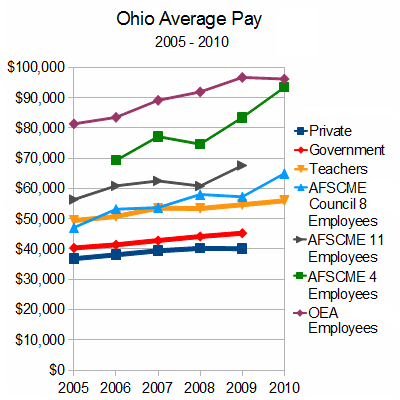
Ohio Average Pay: Public vs. Private
Ohio Average Pay: Public Unions vs. Private

Myths and truths about Ohio State Issue 2

Here’s a common myth:

State Issue 2 would “cut salaries and benefits.”

The truth:

Issue 2 would not cut salaries or benefits for any government employee. Employees would simply be asked to pay a modest share of their benefits, just like employees in the private sector do. For health care coverage, they would pay at least 15% of their overall plan. (Many local government employees currently pay less than 9% of their health care premium, while the average private sector worker pays upwards of 30%.) In addition, employees would be required to pay their personal share of a retirement plan (only 10%), rather than asking taxpayers to pay that share. That’s not too much to ask at a time when many private sector workers get no retirement benefit at all. Finally, Issue 2 requires that benefits apply equally to all public employees, so no one gets special treatment.

And another common myth:

State Issue 2 will eliminate government employee pensions.

The truth:

Government employees will still get a very generous pension benefit – an annual payment that averages their three highest annual salaries. That’s a pretty nice deal, when many private sector workers get no retirement benefit at all. State Issue 2 only ends a practice where some government union contracts require taxpayers to pick up the tab for BOTH the employer AND employee shares of a required pension contribution. In this economy, it’s simply not right to ask struggling taxpayers to foot the bill so government employees can get a free retirement. Issue 2 simply says government employees should pay their required share (10 percent) and taxpayers will contribute the employer share (14 percent).

Another myth:

State Issue 2 will cut teacher salaries.

The truth:

That’s one of the scare tactics government unions are using to turn people against these reforms. Nothing in Issue 2 determines salary levels. It only ends the practice of handing out automatic pay raises, or “step” increases, and longevity pay – or bonuses just for holding the job for a certain period of time. Issue 2 also asks that performance be added as a factor in teacher compensation, a goal President Barack Obama set out in his national education policy in 2009.

And another myth:

State Issue 2 will cost jobs

The truth:

Just the opposite is true. Ohio’s state and local tax burden ranks among the top third in the nation. As a result, companies large and small have left our state in pursuit of better tax incentives elsewhere, taking hundreds of thousands of jobs with them. If Ohio hopes to compete for new job growth, we have to make our state a more affordable place to live, work and do business. That starts with getting the cost of government under control so we can direct more of our limited resources into economic development, community revitalization and better schools.

More myths are corrected on this page.

Newspaper endorsements

So far, Issue 2 has been endorsed by several Ohio newspapers, including the biggest ones.

The Cleveland Plain Dealer:

The fiscal picture of local governments and school districts, especially, will improve as they are able to right-size their work forces and their expenditures on services. That will happen over time, not overnight, as new contracts are established.

Repeal SB 5, though, and it’s going to be awfully hard for local governments to manage their payrolls without resorting to larger-scale layoffs than would otherwise be necessary. And local governments will continue to be hamstrung by anti-merit seniority rules that lead to worker complacency and protect dead weight and time-servers.

Voting YES on Issue 2 will prevent layoffs by keeping public sector wages and benefits in line with what the private sector can afford to pay.

The Columbus Dispatch:

Despite the insistence of opponents, the effort to reform Ohio’s out-of-balance collective-bargaining law is not an expression of disrespect for or dissatisfaction with Ohio teachers, police officers, firefighters and other government employees. It is a much-needed attempt to restore control over public spending to the public officials elected to exercise that control.

It does not assert that public employees are worth less than the compensation they’re receiving, only that the compensation has grown faster than the public’s ability to pay for it.

[…]With more ability to control the escalation of salary and benefit costs, governments won’t be forced as often to impose layoffs, and might be able to afford to keep even more police and firefighters on the streets.

Again, no one is saying that public sector workers don’t matter – the question is whether we can afford to give them better wages and benefits than the private sector workers who are their customers and their employers. Public sector workers work for the public, and the public can only afford to pay so much.

Conclusion

Government employees are paid 43% more than private sector employees, in salary and benefits:

I think that people who care about the long-term prosperity of Ohio should vote “YES” on Issue 2 to make public and private salaries and benefits MORE EQUAL. Ohio is facing enormous economic pressure from the global recession, and everyone has to make sacrifices. Now is not the time for public sector workers to insist on higher wages and benefits, especially when the private sector workers who pay their salaries don’t make as much money, nor do they get the pensions, nor do they get the better job security. Ohio voters can certainly go back and renegotiate union salaries and benefits when Ohio is out of the recession.

Click here to learn more about Ohio Issue 2.

Marco Rubio’s finest speech yet… at the Reagan Forum

Greatness. He is everything that America has always been. (45 minutes)

Excerpt from the transcript: (scroll down)

And so, if defining the proper role of government was one of the central issues of the Reagan era, it remains that now. The truth is that people are going around saying that, well, we’re worried about – let me just add something to this because I think this is an important forum for candor.

I know that it is popular in my party to blame the president, the current president. But the truth is the only thing this president has done is accelerate policies that were already in place and were doomed to fail. All he is doing through his policies is making the day of reckoning come faster, but it was coming nonetheless.

What we have now is not sustainable. The role of government and the role that government plays now in America cannot be sustained the way it is. Now some are worried about how it has to change, we have to change it. The good news is it is going to change. It has to change. That’s not the issue.

The issue is not whether the role that government now plays in America will change. The question is how will it change. Will it change because we make the changes necessary? Or, will it change because our creditors force us to make these changes?

And over the next few moments I hope to advocate to you –- I don’t think that I have to given the make up of the crowd –- but I hope to advocate to you that, in fact, what we have before us is a golden opportunity afforded to few Americans.

We have the opportunity –- within our lifetime –- to actually craft a proper role for government in our nation that will allow us to come closer than any Americans have ever come to our collective vision of a nation where both prosperity and compassion exist side-by-side.

To do that, we must begin by embracing certain principles that are absolutely true. Number one: the free enterprise system does not create poverty. The free enterprise system does not leave people behind.

People are poor and people are left behind because they do not have access to the free enterprise system because something in their lives or in their community has denied them access to the free enterprise system. All over the world this truism is expressing itself every single day. Every nation on the Earth that embraces market economics and the free enterprise system is pulling millions of its people out of poverty. The free enterprise system creates prosperity, not denies it.

The second truism that we must understand is that poverty does not create our social problems, our social problems create our poverty. Let me give you an example. All across this country, at this very moment, there are children who are born into and are living with five strikes against them, already, through no fault of their own.

They’re born into substandard housing in dangerous neighborhoods, to broken families, being raised by their grandmothers because they never knew their father and their mom is either working two jobs to make ends meet or just not home. These kids are going to struggle to succeed unless something dramatic happens in their life.

These truisms are important because they lead the public policies that define the proper role of government. On the prosperity side, the number one objective of our economic policy, in fact the singular objective of our economic policy from a government perspective is simple — it’s growth. It’s not distribution of wealth; it’s not picking winners and losers.

The goal of our public policy should be growth. Growth in our economy, the creation of jobs and of opportunity, of equality of opportunity through our governmental policies.

And the most gripping part of the speech:

To me, this is extremely special, and I’ll tell you why. During the ’80s, politically especially, there were two people that deeply influenced me. One clearly was Ronald Reagan, the other was my grandfather, who lived with us most of the time in our home.

We lived part of our life, especially the key years, ’80-’84, in Las Vegas, Nev. And my grandfather loved to sit on the porch of our home and smoke cigars. He was Cuban. Three cigars a day, he lived to be 84. This is not an advertisement for cigar smoking, I’m just saying to you that …

He loved to talk about politics. My grandfather was born in 1899. He was born to an agricultural family in Cuba. He was stricken with polio when he was a very young man, he couldn’t work the fields, so they sent him to school. He was the only member of his family that could read. And because he could read, he got a job at the local cigar rolling factory.

They didn’t have radio or television, so they would hire someone to sit at the front of the cigar factory and read to the workers while they worked. So, the first thing he would read every day, of course, was the daily newspaper. Then he would read some novel to entertain them.

And then, when he was done reading things he actually went out and rolled the cigars because he needed the extra money. But through all of those years of reading, he became extremely knowledgeable about history, not to mention all the classics.

He loved to talk about history. My grandfather loved being Cuban. He loved being from Cuba. He never would have left Cuba if he didn’t have to. But he knew America was special. He knew that without America, Cuba would still be a Spanish colony. He knew that without America, the Nazis and Imperial Japan would have won World War II. When he was born in 1899 there weren’t even airplanes. By the time I was born, an American had walked on the surface of the moon.

And he knew something else. He knew that he had lost his country. And that the only thing from preventing other people in the world from losing theirs to communism was this country – this nation.

It is easy for us who are born here –- like me –- and so many of you, to take for granted how special and unique this place is. But when you come from somewhere else, when what you always knew and loved, you lost, you don’t have that luxury.

My grandfather didn’t know America was exceptional because he read about it in a book. He knew about it because he lived it and saw it with his eyes. That powerful lesson is the story of Ronald Reagan’s presidency. It’s our legacy as a people. And it’s who we have a chance to be again. And I think that’s important for all of us because being an American is not just a blessing, it’s a responsibility.

As we were commanded to do long ago, “Let your light shine before men” …

[PAUSE – he is overcome by emotion]

…“that they may see your good works and glorify your Father in heaven.”

Well, as we gather here today in this place, that pays homage and tribute to the greatest American of the twentieth century, we are reminded that for him and for our nation, being a light to the world, that’s not just our common history, it remains our common destiny.

I cried at the part in bold above.

Here’s the verse he cited – Matthew 5:16 – in context: [NASB]

13 “You are the salt of the earth; but if the salt has become tasteless, how can it be made salty again? It is no longer good for anything, except to be thrown out and trampled under foot by men.

14 “You are the light of the world. A city set on a hill cannot be hidden;

15 nor does anyone light a lamp and put it under a basket, but on the lampstand, and it gives light to all who are in the house.

16 Let your light shine before men in such a way that they may see your good works, and glorify your Father who is in heaven.

I notice that he cites the NASB, which is my favorite translation – the translation closest to the original Greek.

On my Facebook page, I have Matthew 5:13, which is the verse that comforts me when things look bad in my life – when my plans haven’t worked out the way I hoped they would. Things look bad for us right now as a nation. Maybe we need to reconsider these words.

This speech is being well-received everywhere. Permit me just one reaction from the UK Telegraph, which is still punch-drunk from socialism-induced rioting caused by the anti-marriage, anti-family, anti-father policies of the secular left Labour Party.

Excerpt:

Two of the brightest rising young stars in American conservatism today are Paul Ryan and Marco Rubio. Neither are running for president in 2012, but both will be strong contenders for the vice presidential running mate slot, whoever wins the Republican nomination. And I wouldn’t be surprised to see Ryan or Rubio eventually sitting in the Oval Office itself at some stage in the future. After all, Congressman Ryan of Wisconsin is only 41, and Senator Rubio of Florida is just 40; they have decades of public life ahead of them. They are both deeply principled politicians in the Reagan mould who grew up during the late Cold War years, and share a profound belief in American exceptionalism and the need for the United States to maintain its position as the world’s leading power.

A few weeks ago, I wrote about Congressman’s Ryan’s superb speech on foreign policy to the Alexander Hamilton Society in Washington, remarks which outlined in stark terms the challenges the United States faces if it is to avoid decline. Ryan’s address, which I attended, was probably one of the most important statements by a US politician on American leadership this year.

Senator Rubio’s speech yesterday at the Reagan Presidential Library in the presence of Nancy Reagan, was another key address by a Member of Congress that deserves to be widely read, both at home and abroad. Like Ryan, Rubio offers a powerful rejection of the Big Government approach that has crippled America’s economy, and outlines a firm defence of the free market, championed by Ronald Reagan.

There is something very different and special about America. And Marco Rubio reminds us all what it is in this speech. A speech heard ’round the world! A reminder of our principles – of our role – and of our responsibility to the world.

On a side note, Marco Rubio also rescued Nancy Reagan from a fall by alertly grabbing her arm when she slipped.