Tag Archives: Prosperity

Richard Epstein explains why economic inequality is required in order to promote innovation

My friend Matt, who blogs at The Conscience of  a Young Conservative, posted this on Facebook.

Epstein explains how the profit motive creates economic value that raises the standard of living of all people, who are able to exchange their money for valuable products and services that they did not create. He explains how wealth redistribution is wasteful and harmful to economic growth.

(Found here)

Now let’s look at some myths that Christians believe about economics.

We need to understand basic economics

Christian philosopher Jay Richards explains basic economics.

Excerpt:

THE ZERO-SUM GAME MYTH.

There are three kinds of games: win-lose, lose-lose, and win-win. Win-lose games, like basketball, are sometimes called “zero-sum games.” When the Celtics and the Bulls compete, if the Celtics are up, then the Bulls are down, and vice versa. The scales balance. It’s a zero-sum.

Besides lose-lose games, which most of us avoid, there are positive-sum, or win-win, games. In these games, some players may end up better off than others, but everyone ends up at least the same if not better off than they were at the beginning.

Millions of people think that the free trade in capitalism is a dog-eat-dog competition, where winners always create losers. This is the zero-sum game myth, which leads many to think that the government should somehow redistribute wealth. While some competition is a part of any economy, of course, an exchange that is free on both sides, in which no one is forced or tricked into participating, is a win-win game. When I pay my barber $18 for a haircut, I value the haircut more than the $18. My barber values the $18 more than the time and effort it took her to cut my hair. We’re both better off. Win-win.

THE MATERIALIST MYTH.

A similar myth leads people to think of the economy as some fixed amount of material stuff—money in safes or gold bars in a vault. Since two firms competing for one customer can’t both get the customer’s money, we might think the whole economy looks that way: wealth itself isn’t created, it’s merely transferred from one party to another.

A common image of this “Materialist Myth” is a pie. If one person gets too big a slice, someone else will get just a sliver. To serve it fairly, you have to slice equal pieces.

This isn’t how a free economy works, however. Over the long run, the total amount of wealth in free economies grows. We can create wealth that wasn’t there before. The “pie” doesn’t stay the same size. Under capitalism, someone can get wealthy not merely by having someone else’s wealth transferred to his account, but by creating new wealth, not only for himself, but for others as well.

THE GREED MYTH.

Friends and foes of capitalism often claim that it is based on greed. Writer Ayn Rand even claimed that selfishness is a virtue (see the accompanying feature article). But greed is one of the seven deadly sins. If capitalism is based on it, then Christians can’t be capitalists.

In truth, Adam Smith and other capitalist thinkers did not believe this “Greed Myth.” Rather, Smith argued that capitalism, unlike static economies, channels even greedy motives into socially beneficial outcomes. “In spite of their natural selfishness and rapacity,” Smith wrote, business people “are led by an invisible hand…and thus without intending it, without knowing it, advance the interest of the society.”3

Rather than inspire miserliness, capitalism encourages enterprise. Entrepreneurs, including greedy ones, succeed by delaying their own gratification, by investing their wealth in creative but risky ventures that may or may not pan out. Before they ever profit, they must first create.

In a fallen world, we should want an economic system that not only channels greed into productive purposes, but unleashes human ingenuity, creativity, and willingness to risk as well.

I think Christians who don’t understand economics really need to make the effort to understand the basics. I recommend Robert Murphy’s “The Politically Incorrect Guide to Capitalism” and Thomas Sowell’s “Basic Economics“. If you want to see how economics works together with Christianity, then you also want Jay Richards “Money, Greed and God” and Wayne Grudem’s “Politics According to the Bible“.
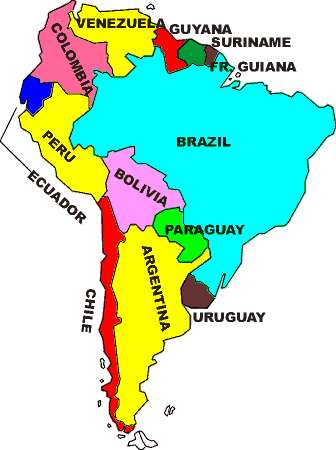
FARC terrorist leader Alfonso Cano killed by Colombian armed forces

Map of South America

From the Heritage Foundation.

Excerpt:

The armed forces of Colombia have scored a major battlefield victory. They finally hunted down, confronted, and killed the leader of the narco-terrorist Revolutionary Armed Forces of Colombia (FARC), Guillermo Leon Saenz, widely known by his alias Alfonso Cano.

A guerrilla for decades, Cano assumed the top leadership of the FARC following the natural death of founder Manuel Marulanda (2008) and the elimination of senior figures Raul Reyes (2008) and Jorge Briceno (aka Mono Jojoy, 2010).

Seen by some as a modern-day version of the “good revolutionary,” Cano—a life-long advocate of armed violence and terrorism—fell in combat with the Colombian armed forces as they rappelled their way into his secret jungle hideout. Cano was also indicted in a U.S. court for drug trafficking along with dozens of other FARC leaders and had a $5 million price on his head.

FARC is a Marxist terrorist group.

The Economist reports that the Colombian economy is also doing well.

Excerpt:

WHEN the figures are finally tallied, Colombia may prove to have weathered the world recession better than any other of the larger Latin American countries. After a slight contraction at the end of 2008, the economy has been growing modestly this year. This resilience stems from continued foreign investment, an increase in government spending on public works and easier money: since December the central bank has cut interest rates by six percentage points, to 4%, a steeper drop than anywhere in the region outside Chile.

[…]President Álvaro Uribe’s security policies have helped to restore confidence. Investment soared, from 15% of GDP in 2002 to 26% last year, says Mr Zuluaga. Private business has retooled. After many delays, the government has issued licences to expand several ports; this month it hopes to award a contract for the first of four big road schemes, costing a total of $7.5 billion over four years. It hopes for investment of up to $50 billion in mining and oil over the next decade.

And liberal MSNBC has more on the booming Colombian economy.

Excerpt:

…Colombia’s revival is benefiting U.S. economic and political rivals as much as or more than the U.S. itself.

The long delay in signing the treaty allowed Latin America’s fourth-largest economy to strengthen ties with China. It also damaged U.S. credibility in the region, says Eric Farnsworth, vice-president of the Council of the Americas in Washington. “The delay in passing this called into question the United States’ reliability as a partner,” Farnsworth says. “There’s a strategic component to this. It’s not just about economics and trade.”

[…]As talks between the U.S. and Colombia dragged on, Colombia and China forged plans for a rail link between the Pacific and Caribbean that could draw freight away from the Panama Canal. Colombian President Juan Manuel Santos aims for a trade deal with South Korea. To tighten his connections to high-growth Asia, he’s also seeking membership in the Asia-Pacific Economic Cooperation group. “While Washington was debating whether the accord with Colombia was opportune, we advanced in our foreign policy strategy,” says Trade Minister Sergio Diaz-Granados.

Santos has cooperated more with his South American neighbors, organizing a meeting of finance ministers to discuss ways to protect their currencies and economies from the debt crisis in the U.S. and Europe. He supports a stock trading platform with Colombia, Chile, and Peru and wants to bring Mexico and Panama on board. Exports to Brazil have surged tenfold. While the U.S. remains Colombia’s biggest export market, with $16.8 billion in 2010 sales, up 30 percent from a year earlier, sales to China more than doubled last year, to $1.2 billion. Sales to the European Union are also rising, to $5.4 billion this year through August, more than in all of 2010. An EU trade accord could come next year.

The government has reduced cocaine cultivation 37 percent and halved the number of insurgents to about 8,000. Improved security has spurred enough growth to win an investment-grade credit rating from Standard & Poor’s as well as investment from billionaires. Colombia’s victories over the guerrillas opened up swathes of countryside to exploration for oil, gold, and coal. Mexican billionaire Carlos Slim’s push into crude has helped fuel foreign investment that the government says may reach a record $12 billion this year. The economy grew 5.2 percent in the second quarter.

The U.S. faces more competition from Colombia’s neighbors and Canada. In 2010, U.S. agricultural exports to Colombia fell more than 50 percent from 2008, to $827 million, as Argentina’s more than doubled, to $1 billion, according to a report by Senator Richard Lugar’s staff. Diaz-Granados attributes the U.S. setback to the delay in the free-trade agreement.

An August accord reduces or ends Colombian tariffs on Canadian wheat, paper, and machinery. Bank of Nova Scotia, Canada’s third-largest lender, agreed in October to buy 51 percent of Banco Colpatria Red Multibanca Colpatria for about $1 billion—Scotiabank’s largest international takeover. “This is not the Colombia of old,” says Brian J. Porter, group head of international banking for Scotiabank. “The more we looked at Colombia, the more excited we got about the economic potential.”

We really should have signed that trade deal 3 years ago – it would have helped out economy a lot.  But unions got Obama elected, and the unions decided that the trade deal needed to be held up for 3 years. And that’s one of the reasons why we’ve had over 9% unemployment. Our economic policy is being set by unions, not by economists. But in Colombia, economic policy is set by economists, not unions.

What is issue 2? Should you vote no on Ohio issue 2?

In the 2010 mid-term elections, Republican John Kasich won the governorship and promised to balance the state’s budget by reining in the state’s spending on salaries and benefits for public sector union employees. To accomplish this, the Ohio legislature pass Senate Bill 5. However, an effort is on the ballot to repeal the law, and Ohio voters will get a chance to keep or scrap the law on Tuesday, November 8th, 2011.

Here’s what Ohio’s State Issue 2 is all about:

Issue 2 makes some very fair and common sense requests of our government employees to give local communities the flexibility they need to get taxes and spending under control, while providing the essential services that we rely on.

  • It allows an employee’s job performance to be considered when determining compensation, rather than just awarding automatic pay increases based only on an employee’s length of service.
  • It asks that government employees pay at least 15 percent of the cost of their health insurance premium. That’s less than half of what private sector workers are currently paying.
  • It requires that government health care benefits apply equally to all government employees, whether they work in management or non-management positions. No special favors.
  • It asks our government employees to pay their own share of a generous pension contribution, rather than forcing taxpayers to pay both the employee and employer shares.
  • It keeps union bosses from protecting bad teachers and stops the outdated practice of laying off good teachers first just because they haven’t served long enough.
  • Finally, it preserves collective bargaining for government employees, but it also returns some basic control of our schools and services to the taxpayers who fund them, not the union bosses who thrive on their mismanagement.

Even under the reforms of State Issue 2, Ohio’s government employees will still receive better pay, better health care and better retirement benefits, on average, than the vast majority of Ohioans who work in the private sector.

There are a number of myths going around about Issue 2, and it’s important to set the record straight, so I’ll do that below.

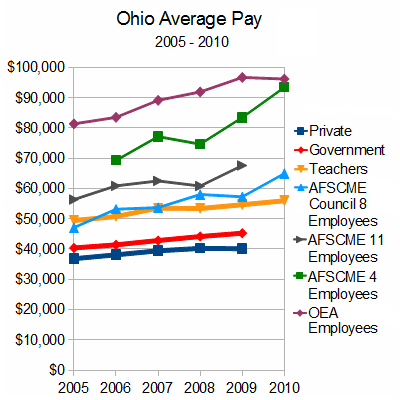
Ohio Average Pay: Public vs. Private
Ohio Average Pay: Public Unions vs. Private

Myths and truths about Ohio State Issue 2

Here’s a common myth:

State Issue 2 would “cut salaries and benefits.”

The truth:

Issue 2 would not cut salaries or benefits for any government employee. Employees would simply be asked to pay a modest share of their benefits, just like employees in the private sector do. For health care coverage, they would pay at least 15% of their overall plan. (Many local government employees currently pay less than 9% of their health care premium, while the average private sector worker pays upwards of 30%.) In addition, employees would be required to pay their personal share of a retirement plan (only 10%), rather than asking taxpayers to pay that share. That’s not too much to ask at a time when many private sector workers get no retirement benefit at all. Finally, Issue 2 requires that benefits apply equally to all public employees, so no one gets special treatment.

And another common myth:

State Issue 2 will eliminate government employee pensions.

The truth:

Government employees will still get a very generous pension benefit – an annual payment that averages their three highest annual salaries. That’s a pretty nice deal, when many private sector workers get no retirement benefit at all. State Issue 2 only ends a practice where some government union contracts require taxpayers to pick up the tab for BOTH the employer AND employee shares of a required pension contribution. In this economy, it’s simply not right to ask struggling taxpayers to foot the bill so government employees can get a free retirement. Issue 2 simply says government employees should pay their required share (10 percent) and taxpayers will contribute the employer share (14 percent).

Another myth:

State Issue 2 will cut teacher salaries.

The truth:

That’s one of the scare tactics government unions are using to turn people against these reforms. Nothing in Issue 2 determines salary levels. It only ends the practice of handing out automatic pay raises, or “step” increases, and longevity pay – or bonuses just for holding the job for a certain period of time. Issue 2 also asks that performance be added as a factor in teacher compensation, a goal President Barack Obama set out in his national education policy in 2009.

And another myth:

State Issue 2 will cost jobs

The truth:

Just the opposite is true. Ohio’s state and local tax burden ranks among the top third in the nation. As a result, companies large and small have left our state in pursuit of better tax incentives elsewhere, taking hundreds of thousands of jobs with them. If Ohio hopes to compete for new job growth, we have to make our state a more affordable place to live, work and do business. That starts with getting the cost of government under control so we can direct more of our limited resources into economic development, community revitalization and better schools.

More myths about Ohio State Issue 2 are corrected on this page.

Newspaper endorsements

So far, Issue 2 has been endorsed by several Ohio newspapers, including the biggest ones.

The Cleveland Plain Dealer:

The fiscal picture of local governments and school districts, especially, will improve as they are able to right-size their work forces and their expenditures on services. That will happen over time, not overnight, as new contracts are established.

Repeal SB 5, though, and it’s going to be awfully hard for local governments to manage their payrolls without resorting to larger-scale layoffs than would otherwise be necessary. And local governments will continue to be hamstrung by anti-merit seniority rules that lead to worker complacency and protect dead weight and time-servers.

Voting YES on Issue 2 will prevent layoffs by keeping public sector wages and benefits in line with what the private sector can afford to pay.

The Columbus Dispatch:

Despite the insistence of opponents, the effort to reform Ohio’s out-of-balance collective-bargaining law is not an expression of disrespect for or dissatisfaction with Ohio teachers, police officers, firefighters and other government employees. It is a much-needed attempt to restore control over public spending to the public officials elected to exercise that control.

It does not assert that public employees are worth less than the compensation they’re receiving, only that the compensation has grown faster than the public’s ability to pay for it.

[…]With more ability to control the escalation of salary and benefit costs, governments won’t be forced as often to impose layoffs, and might be able to afford to keep even more police and firefighters on the streets.

Again, no one is saying that public sector workers don’t matter – the question is whether we can afford to give them better wages and benefits than the private sector workers who are their customers and their employers. Public sector workers work for the public, and the public can only afford to pay so much.

Conclusion

Government employees are paid 43% more than private sector employees, in salary and benefits:

I think that people who care about the long-term prosperity of Ohio should vote “YES” on Issue 2 to make public and private salaries and benefits MORE EQUAL. Ohio is facing enormous economic pressure from the global recession, and everyone has to make sacrifices. Now is not the time for public sector workers to insist on higher wages and benefits, especially when the private sector workers who pay their salaries don’t make as much money, nor do they get the pensions, nor do they get the better job security. Ohio voters can certainly go back and renegotiate union salaries and benefits when Ohio is out of the recession.

Click here to learn more about Ohio State Issue 2.