Tag Archives: Prices

Indiana voucher program offers hope to low-income students

From the Courier Press, news of the latest success for Republicans in their long war against public sector teacher unions.

Excerpt:

Kristy Wentworth of Evansville said she was never dissatisfied with public education, and her three children, who attended schools in the Evansville Vanderburgh School Corp., were making good grades.

But when friends told her about Indiana’s new private school voucher program, she was intrigued.

After some discussion, Wentworth enrolled her children this year at Evansville Lutheran School, which is near her home. It didn’t take the single mother long to decide her choice was correct. Her children — who are in grades 7, 6 and 4 — are thriving at Evansville Lutheran. Wentworth noted the school’s small class sizes, and she marveled at the frequent communication she receives from her teachers.

“They come home from school excited, they leave for school excited. They can’t wait to get there,” Wentworth said. “(The school) encouraged them to sign up for Boy Scouts and volleyball, and on the first night they made the kids feel so welcome.”

Wentworth recently lost her job, and she said she couldn’t have afforded a private school without the voucher program, which proponents say helps overall educational achievement and closes achievement gaps along socioeconomic lines.

And these private schools help children to perform better in testing.

Can greater competition among schools help? That’s what state education officials are banking on. While scars from the lengthy spring debate over vouchers heal, they are encouraging local school districts to embrace the new environment.

Local nonpublic schools have courted voucher students. As of Friday, 114 were awarded to students in the EVSC district — the fourth highest number in the state.

Officials with the EVSC, meanwhile, point to recent academic progress, its network of community partnerships aimed at meeting students’ most fundamental needs and classroom innovations.

Delaware Elementary School, which is in the same neighborhood as Evansville Lutheran, has made strides in several areas in a short period of time, said Heather Ottilie, parent of a Delaware third-grader.

Delaware is in its second year as an EVSC “equity school.” Along with two other schools of similar socioeconomic demographics — McGary Middle School and Evans School — Delaware is free to have longer school days and longer school years and has more leeway in curriculum and rules. The three equity schools all showed gains on the spring ISTEP.

Ottilie said Delaware has placed heavy emphasis on independent reading. Other innovations include the use of netbook computers and iPod Touches in classrooms, world language instruction and new learning programs such as LEGO robotics, which emphasize problem-solving skills.

“I love it,” Ottilie said. “Everything is hands-on … the kids aren’t just doing worksheets.”

What is the conservative plan to help the poor? Is it wealth redistribution? Does that even work? Or is there a way to produce better results for the poor through free market capitalism? Those who advocate big government never bother to ask these questions. For those who take the time to study economics, the answer is clear – what works to reduce costs and raise quality is choice and competition.

Related posts

Must-see videos on education policy

Related posts

How the Obama administration deliberately ships jobs overseas

From the Wall Street Journal.

Excerpt:

This month, one year since the Deepwater Horizon explosion in the Gulf of Mexico, the Noble Clyde Boudreaux—an ultra-deepwater semi-submersible drilling rig—will start operations off the coast of Brazil. Until a few weeks ago it was stationed in the Gulf.

The two events are not unrelated. Moving the Noble out of U.S. waters is one of the adverse consequences of the Obama administration’s overreaction to last year’s Gulf spill.

Despite the president’s repeated claims that he’s been “encouraging” domestic oil production, administration policies have been driving drilling rigs out of the Gulf (six deepwater rigs in addition to the Noble have left the Gulf, with two more possibly on the way out). The overall result has been lower domestic oil production, slower economic growth, job losses and higher energy prices.

In the immediate aftermath of the Deepwater Horizon explosion and spill, President Obama announced a six-month moratorium on new deepwater drilling. According to the administration’s estimates, this cost nearly 19,000 jobs in the Gulf states alone—even though federal researchers then cut the figure by an ad hoc factor of 40%-60% to make the results more palatable.

In the months after lifting the ban, the administration slowed drilling permits to a crawl, effectively creating what some have called a “permatorium.” Dismayed by the delays, in February U.S. District Court Judge Martin Feldman tried to force the administration to act on seven pending permits, calling the inaction on permits “increasingly inexcusable.” Permitting has picked up recently, thanks in part to increasing political pressure, but remains far below pre-spill levels.

In December, the White House reversed course on its own five-year plan to open portions of the Eastern Gulf of Mexico, the Mid-Atlantic and the South Atlantic to offshore exploration. This effectively locks up an estimated 7.6 billion barrels of oil and 36.6 trillion cubic feet of natural gas.

Do you know what happens when the supply of a commodity goes down? Prices go up! And when gas prices go up, the price of every consumer good that is shipped using trucks and planes and boats also goes up.

Related posts

Obama spent $1.6 billion on Chinese wind and $2 billion on Brazilian oil

Obama Budget Deficit 2011

ABC News reports on the subsidies for Chinese wind turbines. (H/T GP)

Excerpt:

Despite all the talk of green jobs, the overwhelming majority of stimulus money spent on wind power has gone to foreign companies, according to a new report by the Investigative Reporting Workshop at the American University’s School of Communication in Washington, D.C.

Nearly $2 billion in money from the American Recovery and Reinvestment Act has been spent on wind power, funding the creation of enough new wind farms to power 2.4 million homes over the past year. But the study found that nearly 80 percent of that money has gone to foreign manufacturers of wind turbines.

“Most of the jobs are going overseas,” said Russ Choma at the Investigative Reporting Workshop. He analyzed which foreign firms had accepted the most stimulus money. “According to our estimates, about 6,000 jobs have been created overseas, and maybe a couple hundred have been created in the U.S.”

Even with the infusion of so much stimulus money, a recent report by American Wind Energy Association showed a drop in U.S. wind manufacturing jobs last year.

NewsMax reports on the subsidies for Brazilian oil driling. (H/T GP)

Excerpt:

Gulf Oil CEO Joe Petrowski says President Barack Obama’s weekend comments in Brazil that the United States looks forward to purchasing oil drilled for offshore by that nation “is rather puzzling,” and “hypocritical” as his administration has imposed a virtual moratorium Gulf Oil,Joe Petrowski, Barack Obama, Brazil, Drillingon domestic drilling. The signal to purchase more foreign oil comes after the U.S. Export-Import Bank invested more than $2 billion with Brazil’s state-owned oil company, Petrobras, to finance exploration.

“Any drilling, or any new production, especially production outside the Mideast – that is inherently unstable and probably is going to become more unstable as we move forward – is a positive,” Petrowski said Tuesday on Fox News.

“But why Brazil, when we could have the jobs and foreign exchange in this country, is rather puzzling – and I’d say somewhat humorous,” Petrowski told Fox News’ Neal Cavuto. “What is it about Brazil that they have that we don’t have?

“What concerns me – in addition to we are going to lose the jobs, and in addition to not having the foreign exchange – is one of the untold problems, I think, in the world oil markets, besides that we are getting too much of our oil from the Mideast, is 75 percent of our oil is being produced by government-run entities,” he continued.

“And I just have a theory that private companies are going to be more efficient in finding it, and getting it out at a more reasonable price, than state-owned companies,” Petrowski said.

Cavuto asked whether buying oil from Brazil is bad for the U.S. economy.

“It would be a lot better if we had the drilling here,” Petrowski said. “And it seems a double standard and it seems somewhat hypocritical [that] a country that desperately needs jobs, and we need them here, that we are encouraging other countries to create the jobs that we need.”

Obama has so much taxpayer money to hand out to China and Brazil, but now he wants to prevent AMERICAN oil companies from getting tax deductions for asset depreciation (depletion allowance).

What happens when we use American taxpayer dollars to stimulate energy production in other countries?

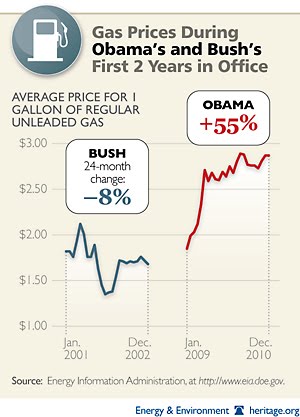
Gas Prices under Obama and Bush

We pay more for energy, that’s what. Because we shipped our energy sector jobs overseas.

From the Washington Examiner. (H/T JWF)

Excerpt:

At least $53 million in federal funds have gone to ACORN activists since 1994, and the controversial group could get up to $8.5 billion more tax dollars despite being under investigation for voter registration fraud in a dozen states.

The economic stimulus bill enacted in February contains $3 billion that the non-profit activist group known more formally as the Association for Community Organizations for Reform Now could receive, and 2010 federal budget contains another $5.5 billion that could also find its way into the group’s coffers.

An Examiner review of federal spending data found that ACORN has received at least $53 million in federal money since 1994.

Meanwhile, Obama gave $3 billion taxpayer dollars to ACORN, which has been indicted on voter fraud charges, and 0.35 billion taxpayer dollars to Planned Parenthood, which has been caught on film covering-up statutory rape. Why is it that organizations that support Democrats like ACORN and Planned Parenthood are below the radar, while Obama keeps complaining about oil companies? Does taxing oil companies make the price at the pump go down? Or rather, doesn’t taxing oil companies cause the price at the pump to go up? And if taxing companies is such a good idea, why did Obama’s favorite crony corporation GE make $14.2 billion in profits in 2010, but pay NOTHING in taxes?

UPDATE: This post linked by the Competitive Enterprise Institute.