the hook-up culture and its effects on men and women
cohabitation and its effect on marriage stability
balancing marriage, family and career
single motherhood by choice and IVF
donor-conceived children
modern sex: a sterile, recreation activity
the real purposes of sex: procreation and spousal unity
the hormone oxytocin: when it is secreted and what it does
the hormone vassopressin: when it is secreted and what it does
the sexual revolution and the commoditization of sex
the consumer view of sex vs the organic view of sex
fatherlessness and multi-partner fertility
how the “sex-without-relationship” view harms children
52 minutes of lecture, 33 minutes of Q&A from the Harvard students. The Q&A is worth listening to – the first question is from a gay student, and Dr. Morse pulls a William Lane Craig to defeat her objection. It was awesome! I never get tired of listening to her talk, and especially on the topics of marriage and family.
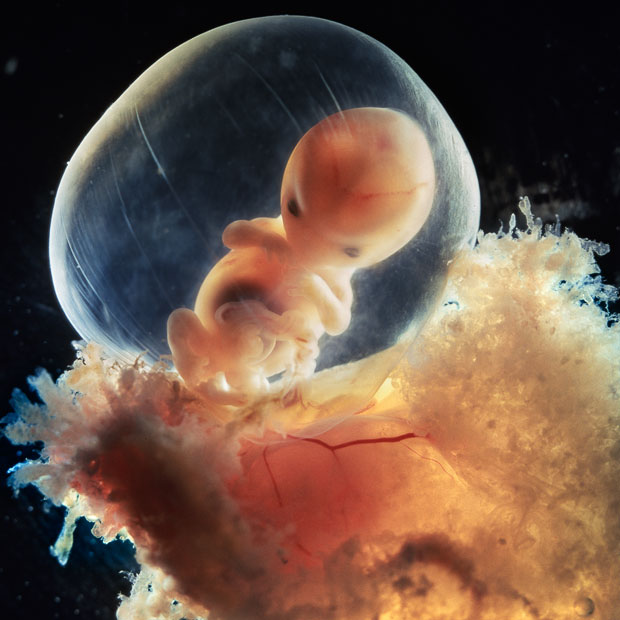
Was having a conversation by e-mail yesterday with a pro-abortion atheist, and he gave two reasons why he supported abortion in the first and second trimester. First, he said that unborn babies can’t feel pain, so it’s OK to kill them. Second, he said that unborn babies don’t have consciousness, so it’s OK to kill them. I thought it might be useful to link to something that answers both of these objections.
Frank Beckwith is the author of “Defending Life: A Moral and Legal Case Against Abortion Choice“. He wrote that book for Cambridge University Press, a top academic press. But before Cambridge University Press, Beckwith wrote four easy-to-understand essays for the Christian Research Journal. Part IV is the one that has the response to the two questions raised by my atheist friend.
Some ethicists argue that the unborn becomes fully human sometime after brain development has begun, when it becomes sentient: capable of experiencing sensations such as pain. The reason for choosing sentience as the criterion is that a being that cannot experience anything (i.e., a presentient unborn entity) cannot be harmed. Of course, if this position is correct, then the unborn becomes fully human probably during the second trimester and at least by the third trimester. Therefore, one does not violate anyone’s rights when one aborts a nonsentient unborn entity. [13]
There are several problems with this argument. First, it confuses harm with hurt and the experience of harm with the reality of harm. [14] One can be harmed without experiencing the hurt that sometimes follows from that harm, and which we often mistake for the harm itself. For example, a temporarily comatose person who is suffocated to death “experiences no harm,” but he is nevertheless harmed. Hence, one does not have to experience harm, which is sometimes manifested in hurt, in order to be truly harmed.
Second, if sentience is the criterion of full humanness, then the reversibly comatose, the momentarily unconscious, and the sleeping would all have to be declared nonpersons. Like the presentient unborn, these individuals are all at the moment nonsentient though they have the natural inherent capacity to be sentient. Yet to countenance their executions would be morally reprehensible. Therefore, one cannot countenance the execution of some unborn entities simply because they are not currently sentient.
Someone may reply that while these objections make important points, there is a problem of false analogy in the second objection: the reversibly comatose, the momentarily unconscious, and the sleeping once functioned as sentient beings, though they are now in a temporary state of nonsentience. The presentient unborn, on the other hand, were never sentient. Hence, one is fully human if one was sentient “in the past” and will probably become sentient again in the future, but this cannot be said of the presentient unborn.
There are at least three problems with this response. First, to claim that a person can be sentient, become nonsentient, and then return to sentience is to assume there is some underlying personal unity to this individual that enables us to say that the person who has returned to sentience is the same person who was sentient prior to becoming nonsentient. But this would mean that sentience is not a necessary condition for personhood. (Neither is it a sufficient condition, for that matter, since nonhuman animals are sentient.) Consequently, it does not make sense to say that a person comes into existence when sentience arises, but it does make sense to say that a fully human entity is a person who has the natural inherent capacity to give rise to sentience. A presentient unborn human entity does have this capacity. Therefore, an ordinary unborn human entity is a person, and hence, fully human.
Second, Ray points out that this attempt to exclude many of the unborn from the class of the fully human is “ad hoc and counterintuitive.” He asks us to “consider the treatment of comatose patients. We would not discriminate against one merely for rarely or never having been sentient in the past while another otherwise comparable patient had been sentient….In such cases, potential counts for everything.” [15]
Third, why should sentience “in the past” be the decisive factor in deciding whether an entity is fully human when the presentient human being “is one with a natural, inherent capacity for performing personal acts?” [16] Since we have already seen that one does not have to experience harm in order to be harmed, it seems more consistent with our moral sensibilities to assert that what makes it wrong to kill the reversibly comatose, the sleeping, the momentarily unconscious, and the presentient unborn is that they all possess the natural inherent capacity to perform personal acts. And what makes it morally right to kill plants and to pull the plug on the respirator-dependent brain dead, who were sentient “in the past,” is that their deaths cannot deprive them of their natural inherent capacity to function as persons, since they do not possess such a capacity.
These four essays are a very good introduction to common responses to pro-abortion arguments. I recommend that people get familiar with this, as once you look into it, you will see that the abortion issue can be debated with as much confidence as William Lane Craig defends Christian theism. You will have the same access to scientific evidence and rational arguments on this topic, and so you will have the upper hand. And that’s fun.
Here is a striking essay from the Public Discourse. It talks about how we, as a society, have generally taken on an anything-goes approach with respect to sex. The one exception (for now) is pedophilia, which is the sexual abuse of children by adults. The essay points out that there is no moral reason for having this one exception, on secularism. The exception exists because of a sort of “ick” factor – not because we have a moral framework that makes anything right or wrong objectively. The essay argues that we are not shy about harming children in a million other ways, and lists some examples. I just want to quote a few and then I’ll comment about my own moral views around sexuality.
Quick summary of his argument:
The moral structure of pedophilia is simply this: the welfare of children is subordinate to the sexual gratification of adults.
[…]We should be thankful that the Sanduskys and Laheys are still considered monstrous. But in contemporary America that condemnation rests on sentiment and not on moral reasoning. No one can simultaneously explain why their actions were so vile and uphold the first commandment of the sexual revolution: fulfill thy desires.
[…]No, it isn’t how Sandusky and Lahey did what they did, or under what circumstances, that explains the disgust. It’s what they did—but nobody wants to acknowledge that.
The reason for that reluctance becomes clear, if we keep in mind the moral structure of pedophilia. Sexual gratification trumps. Thank goodness that for now, there aren’t many men who are sexually attracted to youngsters. In that single case, we raise the banner for the children. But in no other case.
That’s his argument.
Now, a quick excerpt:
If we altered the question, and asked not how many people have done sexually abusive things with children, but how many people have done sexual things that redounded to the suffering of children, then we might confess that the only thing that separates millions of people from Jerry Sandusky is inclination. Everything that was once considered a sexual evil and that is now winked at or cheered, everything without exception, has served to hurt children, and badly.
We might point here to divorce. Unless it is necessary to remove oneself and one’s children from physical danger and moral corruption, the old wisdom regarding divorce should hold, if children themselves have anything to say about it. Parents will say, “My children can never be happy unless I am happy,” but they should not lay that narcissistic unction to their souls. Children need parents who love them, not parents who are happy; they are too young to be asked to lay down their lives for someone else. It is not the job of the child to suffer for the parent, but the job of the parent to endure, to make the best of a poor situation, to swallow his pride, to bend her knees, for the sake of the child.
We might point to births out of wedlock. The child has a right to enter more than a little nursery decorated with presents from a baby shower. He should enter a human world, a story, a people. He should be born of a mother and a father among uncles and aunts and cousins and grandparents, stretching into the distant past, with all their interrelated histories, with his very being reflected in all those mirrors of relation, not to mention his eyes and his hair, the talents in his fingers and the cleverness in his mind. This belonging to a big and dependable world can be secured only in the context of the permanent love of his mother and father, declared by a vow before the community and before the One in whom there is no shadow of alteration.
And now my comments about this article.
So pretty much all my regular readers know that I take extremely conservative views on social issues, since I am an evangelical Protestant Christian. But I don’t just have conservative views – I am also chaste at a personal level. I am not one of these re-virgins – I have never had sex. Not once. And I don’t mean I have never had sexual intercourse only, I mean that I have never even kissed a woman on the lips. I am a radical on the issue of chastity. I don’t view chastity as depriving oneself of something good, I view it is as a thing that serious Christian men do when we want to enable and develop other capabilities. It’s my conviction that chastity enables the capability to see women as God sees them, which is a precursor to growing them up to serve him. That’s what women are for, on my view – exactly like men are for knowing and serving God. It’s my belief that once a man has premarital sex, it becomes much harder for him to view women that way.
So, I am really really really against any kind of sexual activity of any kind prior to marriage. I think that if a man wants to show affection to a woman, then sex before marriage is not the way to do that. There are other ways, and men ought to know how to speak the language of love to a woman in many different ways apart from sex, assuming that this is his goal for her. A man needs to create a context for sex before he can have it. Marriage is how a man provides a context for sex. Not just by giving a woman safety, but by specifying a shared vision which the woman agrees to support when she agrees to marriage. Men shouldn’t have intimate experiences with women who are not committed to a constructive partnership with specific goals, e.g. – birthing or adopting children in order to give them a stable, loving sane environment to grow up in. That is so rare nowadays, especially on college campuses which are inundated with sexual liberalism, thanks to radical feminism. My conviction that sex is not something that should be done before marriage emerges partly from a concern that children should have the best opportunity for that stable environment. And that’s what I want to focus on – sexual restraint as a means of providing for children and protecting children.
First, premarital sex creates a situations where abortion happens. Men and women should not engage in activities for recreational reasons that could possibility lead to the death of another human being, period. I am not one of these people who thinks “oh, poor woman who is pregnant, what a beastly man who did that to her – but she can do the right thing and keep the baby”. I think that women are equally to blame with men for even having sex before marriage – the mistake was having sex in the first place. So getting pregnant and keeping the baby is good, but preventing fatherlessness and not putting burdens on taxpayers is much, much better. People who engage in premarital sex are not only selfish, immature and irresponsible, but they are actually acting in a negligent fashion towards the child that may result from their choices. We should not make choices that put innocent children at risk. Premarital sex can be compared with driving while drunk in that regard. You might think it’s fun, but it’s not a good, moral thing to do because of the harm that may result. Saying “but I didn’t mean to” after the fact doesn’t change the harm.
Second, I’ve blogged before about many studies (like this one) that show that premarital sex reduces relationship stability, duration, and quality. Another study I blogged about showed that the number of sexual partners that a man or woman has before marriage directly affects the probability that the relationship will provide a stable environment for raising children. So one of my reasons for being chaste is to maximize the probability of giving my future children that stable environment. Another reason to be chaste is to give my future wife that gift of fidelity. When a man has proven that he has the ability to restrain himself with his wife during the courtship, that is a signal to her that he is good at self-control. The ability to court without premarital sex shows her that he is able to think about her as a person, and that he is able to evaluate her objectively for the purpose of filling the roles of wife and mother. And that this is, in fact, his whole purpose for her. A purpose that will survive the decline of her appearance and youth. Security is another gift that a chaste man gives his wife, so that she can age confidently.
Thirdly, I have in the past blogged about research on gay unions showing how various factors that are more probable in gay relationships, (e.g. – elevated rates of domestic violence, low relationship stability, drug abuse, high rates of promiscuity, etc.), undermine the stability of the environment in which children grow up. More here. Dr. Ryan Anderson has argued that the norms present in gay relationships will undermine the norms of traditional marriage, (permanence, sexual exclusivity, etc.), if marriage is redefined to eliminate the gender requirement. I think we need to keep the traditional definition of marriage because it’s better for children if we do (and there are other reasons to prefer natural marriage, as I’ve written about before).
I think I’ve said enough here to show that very often when it comes to sexual activity what is driving my conservative views is concern for others. Concern not just for the future children, but for the future wife. And not just for them, but for society as a whole, who would have to pay the social costs of things like divorce, and the social costs of children of divorce, etc. And not just for society, but also for God, who intends sexuality for a very specific purpose – it is a form of communication for two people who have been bonded to each other for life. Marriage has to count for God and achieve his goals. One of those goals is raising up children well for his sake. And adults need to control themselves in order to provide children with what they need.


 WINTERY KNIGHT