
Tag Archives: Poverty

Who pays the bill for handing out $2.2 trillion of entitlements per year?

This article by Nicholas Eberstadt is the most popular article on the Wall Street Journal right now. I found it through Doug Ross’ links.

First, a quick review of the entitlement situation:

What is monumentally new about the American state today is the vast empire of entitlement payments that it protects, manages and finances. Within living memory, the federal government has become an entitlements machine. As a day-to-day operation, it devotes more attention and resources to the public transfer of money, goods and services to individual citizens than to any other objective, spending more than for all other ends combined.

The growth of entitlement payments over the past half-century has been breathtaking. In 1960, U.S. government transfers to individuals totaled about $24 billion in current dollars, according to the Bureau of Economic Analysis. By 2010 that total was almost 100 times as large. Even after adjusting for inflation and population growth, entitlement transfers to individuals have grown 727% over the past half-century, rising at an average rate of about 4% a year.

In 2010 alone, government at all levels oversaw a transfer of over $2.2 trillion in money, goods and services. The burden of these entitlements came to slightly more than $7,200 for every person in America. Scaled against a notional family of four, the average entitlements burden for that year alone approached $29,000.

Government’s job used to be to handle responsibilities like roads and bridges or like defending us at home and to defending our national interests abroad. But now government seems to be more interested in redistributing money taken from job creating businesses and their workers to those don’t create jobs and those who don’t work. What happens when you punish people for trying to succeed and reward people who don’t even try?

This is the result of wealth redistribution:

The proud self-reliance that struck Alexis de Tocqueville in his visit to the U.S. in the early 1830s extended to personal finances. The American “individualism” about which he wrote did not exclude social cooperation—the young nation was a hotbed of civic associations and voluntary organizations. But in an environment bursting with opportunity, American men and women viewed themselves as accountable for their own situation through their own achievements—a novel outlook at that time, markedly different from the prevailing attitudes of the Old World (or at least the Continent).

The corollaries of this American ethos were, on the one hand, an affinity for personal enterprise and industry and, on the other, a horror of dependency and contempt for anything that smacked of a mendicant mentality. Although many Americans in earlier times were poor, even people in fairly desperate circumstances were known to refuse help or handouts as an affront to their dignity and independence. People who subsisted on public resources were known as “paupers,” and provision for them was a local undertaking. Neither beneficiaries nor recipients held the condition of pauperism in high regard.

Overcoming America’s historic cultural resistance to government entitlements has been a long and formidable endeavor. But as we know today, this resistance did not ultimately prove an insurmountable obstacle to establishing mass public entitlements and normalizing the entitlement lifestyle. The U.S. is now on the verge of a symbolic threshold: the point at which more than half of all American households receive and accept transfer benefits from the government. From cradle to grave, a treasure chest of government-supplied benefits is there for the taking for every American citizen—and exercising one’s legal rights to these many blandishments is now part of the American way of life.

As Americans opt to reward themselves ever more lavishly with entitlement benefits, the question of how to pay for these government transfers inescapably comes to the fore. Citizens have become ever more broad-minded about the propriety of tapping new sources of finance for supporting their appetite for more entitlements. The taker mentality has thus ineluctably gravitated toward taking from a pool of citizens who can offer no resistance to such schemes: the unborn descendants of today’s entitlement-seeking population.

We used to want to earn our own success. Now we want to live on the backs of children not yet born. Slavery is a horrible crime, no matter where it is practiced. Isn’t it a kind of slavery to live it up now and then pass the bill for it on to generations not even born yet? It strikes me as a kind of slavery – taking an unfair portion of the income of others so that we can live at a higher standard than what we can afford through our own choices and labor.
Marriage researcher Brad Wilcox’s lecture on marriage and society

There are two parts. The lecture and then the Q&A.

Let’s learn a bit about Brad first:

W. Bradford Wilcox is Director of the National Marriage Project at the University of Virginia, Associate Professor of Sociology at the University of Virginia, and a member of the James Madison Society at Princeton University.

He earned his undergraduate degree at the University of Virginia and his Ph.D. at Princeton University. Prior to coming to the University of Virginia, he held research fellowships at Princeton University, Yale University and the Brookings Institution.

Mr. Wilcox’s research focuses on marriage, parenthood, and cohabitation, and on the ways that gender, religion, and children influence the quality and stability of American marriages and family life. He has published articles on marriage, cohabitation, parenting, and fatherhood in The American Sociological Review, Social Forces, The Journal of Marriage and Family and The Journal for the Scientific Study of Religion. His first book, Soft Patriarchs, New Men: How Christianity Shapes Fathers and Husbands (Chicago, 2004), examines the ways in which the religious beliefs and practices of American Protestant men influence their approach to parenting, household labor, and marriage. With Nicholas Wolfinger, Wilcox is now writing a book titled, Soul Mates: Religion, Sex, Children, & Marriage among African Americans and Latinos, for Oxford University Press. With Eric Kaufmann, Wilcox is finishing a book on the causes and consequences of low fertility in the West.

The MP3 file for the lecture is here.

The MP3 file for the Q&A is here.

This lecture covers marriage, cohabitation, single parenthood and divorce.

Obamanomics: a closer look at the economic achievements of Barack Obama

From Investors Business Daily.

Full text:

May’s weak jobs report further confirms the president’s policies are failing to help the economy. This is, indeed, the worst recovery since the Depression.

Negative superlatives associated with this presidency keep piling up. The toll so far:

  • The share of Americans who’ve been out of work a long time — now at 42% of the unemployed — is the highest since the Great Depression (source: Labor Department).
  • The proportion of the civilian working-age population actually working, at 58%, is the smallest since the Carter era (Labor Department).
  • Growth in nonfarm payroll jobs since the recovery began in June 2009 is the slowest of any comparable recovery since World War II (Hoover Institution).
  • The rate of new business startups — the engine of job growth — has plunged to an all-time low of 7.87% of all businesses (Census Bureau).
  • 3 in 10 young adults can’t find jobs and live with their parents, highest since the 1950s (Pew Research).
  • 54% of bachelor’s degree-holders under the age of 25 are jobless or underemployed, the highest share in decades (Northeastern University).
  • Black teen unemployment, now at 37%, is near Depression-era highs (Labor Department).
  • Almost 1 in 6 Americans are now poor — the highest ratio in 30 years — and the total number of poor, at 49.1 million, is the largest on record (Census).
  • The share of Hispanics in poverty has topped that of blacks for the first time, 28.2% to 25.4% (Census).
  • The number of Americans on food stamps — 45 million recipients, or 1 in 7 residents — also is the highest on record (Congressional Budget Office).
  • Total government dependency — defined as the share of Americans receiving one or more federal benefit payments — is now at 47%, highest ever (Hoover).
  • The share of Americans paying no income tax, at 49.5%, is the highest ever (Heritage Foundation, IRS).
  • The national homeownership rate, now at 65.4%, is the lowest in 15 years (Census).
  • The 30-point gap between black and white Americans who own their own homes is the widest in two decades and one of the widest on record (Census).
  • Federal spending, now at 23.4% of GDP, is the highest since WWII (CBO).
  • Excluding defense and interest payments, spending is the highest in American history, at 17.6% of the economy (First Trust Economics).
  • The federal debt, at 69% of GDP, is the highest since just after WWII (CBO).
  • The U.S. budget deficit, now at 9.5% of the economy, is the highest since WWII (CBO).
  • U.S. Treasury debt has been downgraded for the first time in history, meaning the U.S. government no longer ranks among risk-free borrowers (S&P).

This is what Obamanomics has wrought. Fiscal promiscuity. Trickle-up poverty. Shared misery.

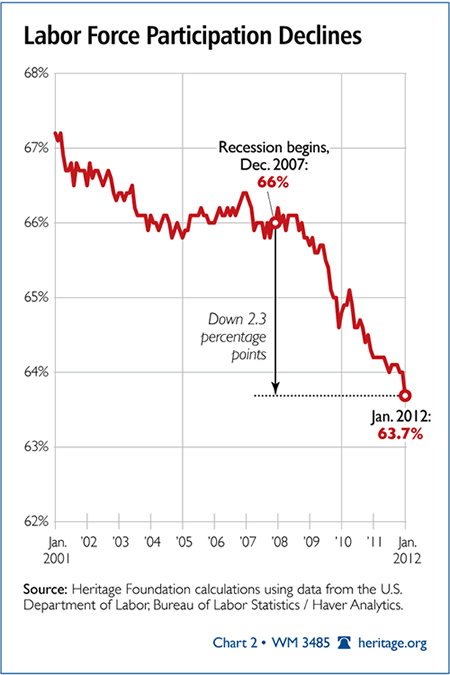
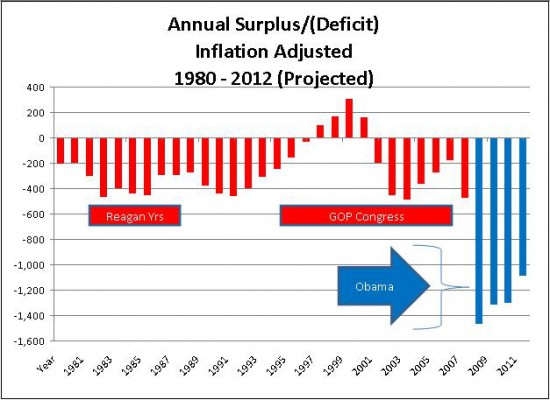
Here’s the Obama legacy in two charts:

US Labor Force Participation down 4.9 million people

The updated labor force participation is actually lower now than in January.

And:

Barack Obama: Budget Deficits

What I find alarming is that Obama is still polling competitively with his Republican rival.