
Tag Archives: Politics

Scott Walker’s plan to reform public sector unions

Political contributions to public sector unions
Political contributions to public sector unions (click for larger image)

(Source: OpenSecrets.org)

I am not sure if I really explained the importance of Scott Walker’s plan to rein in public sector unions in my last post.

Basically, public sector unions generate a lot of money from forced collection of union dues, and they turn around and use that money to donate to politicians who are in favor of growing government. Unions want bigger government, because they make more money if government grows.

This Wall Street Journal article explains that unions donate mostly to Democrats.

Excerpt:

Corporations and their employees… tend to spread their donations fairly evenly between the two major parties, unlike unions, which overwhelmingly assist Democrats. In 2008, Democrats received 55% of the $2 billion contributed by corporate PACs and company employees, according to the Center for Responsive Politics. Labor unions were responsible for $75 million in political donations, with 92% going to Democrats.

So how much money are we talking about?
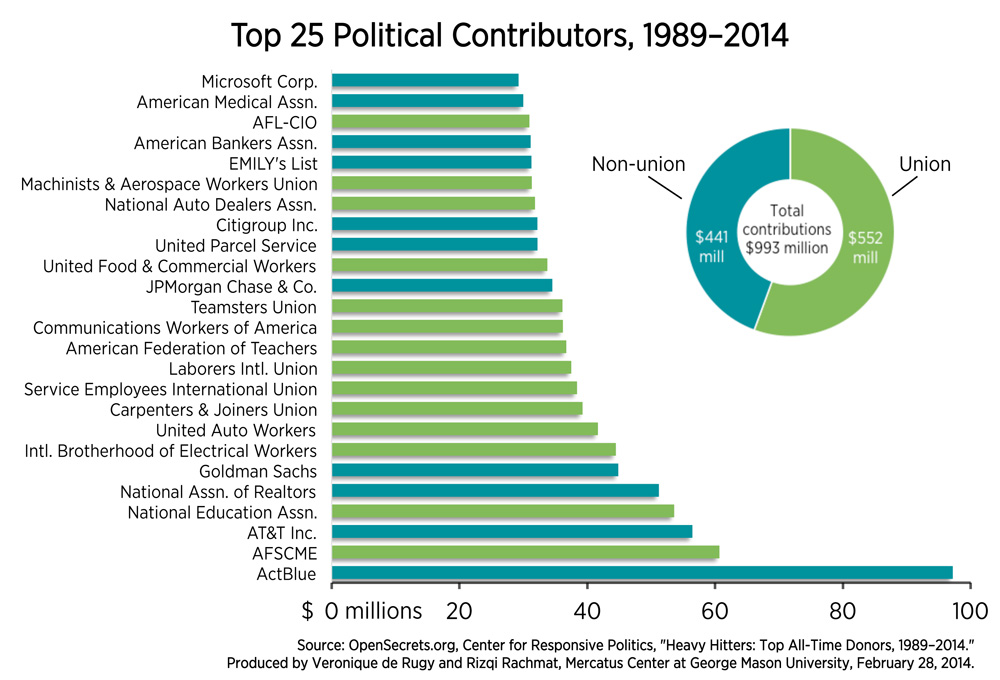
Total political contributions in 2014 election cycle
Total political contributions in 2014 election cycle (click for larger image)

To see how much unions control government, take a look at this story from National Review, written by economist Veronique to Rugy.

It says:

  • The top campaign donor of the last 25 years is ActBlue, an online political-action committee dedicated to raising funds for Democrats. ActBlue’s political contributions, which total close to $100 million, are even more impressive when one realizes that it was only launched in 2004. That’s $100 million in ten years.
  • Fourteen labor unions were among the top 25 political campaign contributors.
  • Three public-sector unions were among the 14 labor groups: the American Federation of State, County, and Municipal Employees; the National Education Association; and the American Federation of Teachers. Their combined contributions amount to $150 million, or 15 percent of the top 25’s approximately $1 billion in donations since 1989.
  • Public- and private-sector unions contributed 55.6 percent — $552 million — of the top 25’s contributions.

Where does the money go? The Daily Caller notes:

“Nearly all of labor’s 2012 donations to candidates and parties – 90 percent – went to Democrats,” the report from CRP concluded. “Public sector unions, which include employees at all levels of government, donated $14.7 million to Democrats in 2014.”

But someone has a plan to do something about this: Scott Walker.

This Investors Business Daily article by economist Veronique de Rugy explains what he would do to the unions if elected President in 2016.

She writes:

Wisconsin Gov. Scott Walker just proposed a plan to overhaul the country’s labor laws, called “My Plan to Give Power to the People, Not the Union Bosses.”

It would do that by expanding employee choice and holding unions accountable to their members.

One of the main underlying themes of the Republican presidential hopeful’s private-sector reforms is transferring power and decision-making from unions to their members.

For instance, the plan would guarantee employees’ rights by strengthening secret-ballot elections. Under current law, unions have ways to work around the protections, making such elections less than secret. The change would protect workers from retaliation by not disclosing their choices to unions during workplace elections.

Though federal laws outlaw extortion, the Supreme Court has ruled that they usually do not apply to unions. Walker’s plan would change that to protect workers from threats, violence and extortion from unions.

Similarly, his reforms would protect whistleblowers who report wrongdoing on the part of a union from being fired or discriminated against.

[…][Public sector unions]… also make the government less effective and more expensive.

That’s why a President Walker would work with Congress to prohibit public employee unions altogether. Meanwhile, he would implement taxpayer and paycheck protections.

As Heritage Foundation labor economist James Sherk explained for National Review, “Walker proposes cracking down on the use of ‘union time’ — that is, allowing federal employees to work for their unions at taxpayer expense.

“He also wants to stop unions from using federal resources to collect the portion of dues that they spend on political causes and lobbying.”

Walker’s plan also would establish a nationwide right-to-work law, making voluntary union dues the default option for all private- and public-sector workers. It would give workers the freedom to choose whether they want to be in a union or not.

States that want to take this freedom away from their workers would have to affirmatively vote to opt out of right-to-work status.

[…]The Walker plan includes many more reforms, such as a repeal of the Davis-Bacon wage controls, which alone could save taxpayers nearly $13 billion over the next 10 years. If implemented, it would be a giant step toward freeing businesses, employers, workers and taxpayers from the incredible burden imposed on them by federal labor laws and union bosses.

Why should we believe that he’ll really do it? Well, unlike some of the talker candidates, Walker has already done it in his state. And it worked – a $3.6 billion dollar deficit was erased.

If you are concerned about the growth of government, and all that that entails, e.g. – higher taxes, massive spending, bloated welfare state, huge levels of corruption, government waste, abortion, gay marriage, etc – then you should know that all of that is driven by the political donations of unions.

And I don’t want anyone to think that union workers are the same as union bosses. In Wisconsin, as soon as the union workers got the right to work without having the pay union dues, the vast majority of them chose not to pay union dues.


How Christianity shaped Margaret Thatcher’s conservative politics

Margaret Thatcher and Ronald Reagan

This is from the Daily Signal, and is really recommended for Christians who are tempted by the policies of the left.

Check it:

Few people are aware that former British Prime Minister Margaret Thatcher, one of the foremost politicians of the 20th century, was a lay Methodist preacher before she entered politics.

There has been very little examination into the role that her Christian faith played in her politics.

“Economics is the method; the object is to change the soul,” Thatcher once declared, revealing that the way she conceived her free-market ideology was as much about transforming values as about improving Britain’s ailing GDP.

More profoundly, there was a strong religious basis to Thatcher’s politics—one that stemmed from her strict Methodist upbringing and, more specifically, the chief influence in her life, her father, who was a greengrocer, councilor, and Wesleyan lay preacher.

In sourcing the origins of her free-market ideology, it is not in the pages of Frederick von Hayek’s “Road to Serfdom” or Milton Friedman’s monetarist theory where we find the answer, but in the sermon notes of her father, Alf Roberts.

Contained within his sermons, one finds the theological basis of what would later become the cornerstones of Thatcherism: an individualistic interpretation of the Bible, a nod to the spiritual dangers of avarice, praise of the Protestant work ethic, virtues of thrift and self-reliance, and finally, a divine justification for individual liberty and the free market.

In short, Thatcherism always owed more to Methodism than to Monetarism.

Thatcher herself was a preacher before she formally entered politics while a student at Oxford University. Even though she later transferred this missionary energy from the pulpit to the podium, her religious values remained an underlying core.

Indeed, on becoming leader of the Conservative Party in 1975, Thatcher (much like Ronald Reagan) saw it as her chief mission to completely undermine the moral credibility of socialism and communism and reconnect the broken link between Protestant and capitalist values in Britain.

Preaching from the pulpit on several occasions, Thatcher unashamedly asserted the Biblical case for the sovereignty of individual liberty and the “invisible hand.”

“Do not be tempted to identify virtue with collectivism,” she preached from the pulpit of St. Lawrence Jewry Church in London in 1978. “I wonder whether the State services would have done as much for the man who fell among the thieves as the Good Samaritan did for him.” According to Thatcher, “[i]t was to individuals that the Ten Commandments were addressed.” She continued, “We are called on to repent our own sins, not each others’.”

“What mattered,” in her words, “was Man’s relationship to God.”

Thatcher’s interpretation was that as Christianity was a call to men individually, so it should follow that political choices reside with the citizen rather than the state.

“The Road to Serfdom” and “Free to Choose” are two of my favorite economics books, and very suitable for laymen. If an understanding of the free enterprise system isn’t yet part of your Christian worldview, it might be a good idea to get studying! After all, Christians are not concerned with policies that make us feel good regarding the poor. We are concerned with policies that actually do good for the poor. There is a big difference.

Darrell Bock and Eric Chabot discuss the challenges of campus ministry

A conflict of worldviews

My good friend Eric Chabot did an episode of the The Table podcast, which is the culture podcast of Dallas Theological Seminary. Eric does campus ministry at Ohio State University, one of the largest universities in the United States. He has a frontline view of the challenges that Christians face on campus, which is a battle I am so passionate about.

Here’s the podcast:

The MP3 file is here.

Summary:

  • 00:15  What does a typical RC meeting look like at Ohio State?
  • 02:44  Key social issues facing Ohio students
  • 05:30  How do you engage with the same-sex issue on campus?
  • 11:01  How do you engage with political issues on campus?
  • 13:08  How do you engage with social justice issues on campus?
  • 16:19  How would you describe the Christian environment on campus?
  • 18:33  Advice for parents considering Ohio State for their child

I give this podcast and the discussion my highest recommendation. It’s so practical, and so different from what you hear in church from pastors who seem to be totally unaware of how worldviews conflict on the university campus. This podcast is practical and hands-on.

There is also a transcript (PDF).

I just want to excerpt a few questions to get you interested enough to listen:

Dr. Darrell Bock:

Ok. Well, that’s the intellectual background. Let’s move on to the other questions I told you we were going to discuss. The social pressures of campus? This, and I’ve done a handful of these interviews, in fact I think you’re the 5th or 6th campus that we’ve done.

We’ve done UCLA, UC Irvine, California, San Diego, A&M and Princeton, and the interesting thing is that as we move from campus to campus and I go to social issues, that – those kind of are more varied than the intellectual stuff. The intellectual stuff seems to be pretty consistent from campus to campus.

But the social challenges really are a reflection of the environment of the campus itself and certain emphasis are tied to certain campuses. So, what are the social challenges that students face in terms of their walk at Ohio State?

And:

Dr. Darrell Bock:

Ok. Well, let’s turn our attention to the final two questions that I want to be sure and get through, and that is you’re giving advice – let’s start with parents – you’re giving advice to parents. They’re thinking about, you know, sending their kid to Ohio State.

What do you regard as the, as keys for the preparation of that student that a parent should be thinking about? Perhaps in particular, thinking about their junior and senior years, they’re getting ready to think about college and the way you prepare a student for college and the choices and the freedom that they’re gonna fall into. How do you, what advice would you give to parents?

And:

Dr. Darrell Bock:

Ok. This may seem like a related question, but I do think the demands are slightly different and that is what advice do you give to youth leaders and to pastors as they are preparing kids who are going through their church programs for university?
And here, I sorta have in mind what kinds of things would you hope a youth leader who’s dealing with high school students, what kinds of issues do you hope that they’re dealing with and treating so that the student is prepared for the campus experience?

That’s why I focus so much on same-sex marriage and politics on this blog. We really have to explain to young people why natural marriage is best, and why the free enterprise system is best. We are seeing now the challenge that the combination of same-sex marriage and big secular government (socialism) poses for religious liberty.