
Tag Archives: Philosophy

Angus Menuge’s ontological argument against naturalism

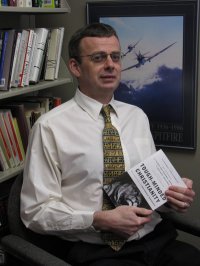
Dr. Angus Menuge
Dr. Angus Menuge

Here’s some information about Dr. Menuge:

Dr. Angus Menuge joined Concordia University Wisconsin in 1991. He earned his BA from the University of Warwick, England, and his MA and Ph.D. degrees from the University of Wisconsin-Madison, where he studied philosophy, computer science and psychology. Menuge’s dissertation was on the philosophy of action explanation, and his current research interests include philosophy of mind, philosophy of science and Christian apologetics.

In 2003, Menuge earned a Diploma in Christian Apologetics from the International Academy of Apologetics, Evangelism and Human Rights, which meets each July in Strasbourg, France. His thesis, a critique of scientific materialism, went on to become the book Agents Under Fire: Materialism and the Rationality of Science (Lanham, MD: Rowman and Littlefield, 2004).

Menuge has also edited volumes on C. S. Lewis, Christ and culture and the vocation of scientist, and has written several Bible studies. He is currently working with Joel Heck (Concordia Texas) on a collection of essays defining Lutheran education for the 21st century, entitled Learning at the Foot of the Cross (Concordia University Press, forthcoming).

A frequent speaker, Menuge has given presentations on Christianity and culture, science and vocation, philosophy of mind, C. S. Lewis, Intelligent Design and the case against scientific materialism. He is a member of the Evangelical Philosophical Society.

Dr. Menuge presented a paper at the real Evangelical Philosophical Society conference for students and professors of philosophy, and you can download the paper here in Word format. (here’s a PDF version I made)

Here is the introduction to the paper that Dr. Menuge read at the EPS conference:

The argument from reason is really a family of arguments to show that reasoning is incompatible with naturalism. Here, naturalism is understood as the idea that foundationally, there are only physical objects, properties and relations, and anything else reduces to, supervenes on, or emerges from that. For our purposes, one of the most important claims of naturalism is that all causation is passive, automatic, event causation (an earthquake automatically causes a tidal wave; the tidal wave responds passively): there are no agent causes, where something does not happen automatically but only because the agent exerts his active power by choosing to do it. The most famous version of the argument from reason is epistemological: if naturalism were true, we could not be justified in believing it. Today, I want to focus on the ontological argument from reason, which asserts that there cannot be reasoning in a naturalistic world, because reasoning requires libertarian free will, and this in turn requires a unified, enduring self with active power.

The two most promising ways out of this argument are: (1) Compatibilism—even in a deterministic, naturalistic world, humans are capable of free acts of reason if their minds are responsive to rational causes; (2) Libertarian Naturalism—a self with libertarian free will emerges from the brain. I argue that neither of these moves works, and so, unless someone has a better idea, the ontological argument from reason stands.

The paper is 11 pages long, and it is awesome for those of you looking for some good discussion of one of the issues in the area of philosophy of mind. The thing you need to know about Dr. Menuge is that he is quite strong and forceful in his writing and presentation, and to me, that is an excellent thing for a scholar to be. He reminds me of Doug Geivett, Paul Copan and William Lane Craig. Very direct, and very confrontational. You can even read an account of his debate with that radical atheist nutcase P.Z. Myers in 2008 here.

By the way, the epistemological argument from reason (P(R) on N & E is low) is the argument made by the famous Christian philosopher Alvin Plantinga. I blogged about that argument before here. You need to know BOTH of these arguments. Plantinga also spoke at the EPS apologetics conference, explaining exactly this argument.

Powerpoint slideshow

But there is more than just the paper! At the EPS apologetics conference, which is meant for lay people as well as scholars, he presented this Powerpoint slideshow, (here’s a PDF version I made) . The slides are easier to understand than the paper, but the paper is not too bad.

And here is another article by Dr. Menuge on intelligent design.

William Lane Craig debates Victor Stenger: Does God Exist?

Here are the details of the debate that I got from Cloud of Witnesses:

The OSU [Oregon State University] Socratic Club will sponsor a public dialogue entitled, “Two Philosophers Debate the Existence of God,” on Monday, March 1, at 7 p.m. in the LaSells Stewart Center on the OSU campus.  William Lane Craig will argue for the Christian view that a personal God exists and Victor J. Stenger the atheist position that there is no God.

In this debate, Victor Stenger does affirm his belief that the universe could be eternal in his second rebuttal (1:02:30), thus denying the standard Big Bang cosmology. He also denies the law of conservation of energy and asserts that something can come from nothing in his concluding speech (1:33:50). He also caused the audience to start laughing when he said that Jesus was not moral and supported slavery. There is almost no snark in this summary. Instead, I quoted Dr. Stenger verbatim in many places. I still think that it is very entertaining even without the snarky paraphrasing.

The debate includes 30 minutes of Q&A with the students.

Here is the MP3 file for the audio.

Here’s the video of the debate:

Dr. Craig’s opening speech:

  • The ontological argument
  • The contingency argument
  • The cosmological argument
  • The moral argument
  • The resurrection of Jesus (3-fact version)
  • Religious experience

Dr. Stenger’s opening speech:

  • There is no scientific evidence for God’s existence in the textbooks
  • There is no scientific evidence for God acting in the universe
  • God doesn’t talk to people and tell them things they couldn’t possibly know
  • The Bible says that the Earth is flat, etc.
  • There is no scientific evidence that God answers prayers
  • God doesn’t exist because people who believe in him are ignorant
  • Human life is not optimally designed and appears to be the result of a blind, ad hoc evolutionary process
  • The beginning of the universe is not ordered (low entropy) but random and chaotic
  • It’s theoretically possible that quantum tunneling explains the origin of the universe
  • The laws of physics are not objectively real, they are “our inventions”
  • Regarding the beginning of the universe, the explanation is that something came from nothing*
  • Nothing* isn’t really nothing, it is “the total chaos that we project existed just before the big bang”
  • If something has no structure, then “it is as much nothing as nothing can be”
  • Consciousness is explainable solely on the basis of material processes
  • There are well-informed, rational non-believers in the world and God would not allow that

Dr. Craig’s first rebuttal:

Stenger’s argument that there is no objective evidence for God’s existence:

  • First, it is not required that God rely only on objective evidence in order to draw people to himself (Alvin Plantinga)
  • Second, God is not required to provide evidence to everyone, only to the people who he knows would respond to him
  • Third, Craig gave lots of objective evidence, from science, history and philosophy
  • Stenger asks for certain evidence (answered prayers, prophecy, etc.), but Craig presented the evidence we have

Stenger’s argument that the balance of energy is zero so “nothing” exists:

  • if you have the same amount of assets and liabilities, it doesn’t mean that nothing exists – your assets and liabilities exist
  • Christopher Isham says that there needs to be a cause to create the positive and negative energy even if they balance
  • the quantum gravity model contradicts observations
  • the vacuum is not the same as nothing, it contains energy and matter
  • the BVG theorem proves that any universe that is expanding must have a beginning

Stenger’s argument that mental operations can be reduced to physical operations:

  • mental properties are not reducible to physical properties
  • epiphenomenalism: is incompatible with self-identity over time
  • epiphenomenalism: is incompatible with thoughts about other things
  • epiphenomenalism: is incompatible with free will
  • substance dualism (mind/body dualism) is a better explanation for our mental experience
  • God is a soul without a body
Dr. Stenger’s first rebuttal:

Craig’s cosmological argument:

  • Craig’s premise is “everything has a cause”, but quantum mechanics has causeless events
  • There are speculative theories about how something could have come into being uncaused out of nothing
  • “I don’t know of a single working cosmologist today who believes there was a singularity prior to the Big Bang”
  • “If there wasn’t a singularity then there’s no basis for arguing that time began at that point”
  • “There’s no reason from cosmology that we know of that the universe can’t be eternal”
  • “When I talk about an eternal universe, I mean a universe that has no beginning or end”
  • The Hartle-Hawking model doesn’t have a beginning
  • “There was no violation of energy conservation by having a universe coming from nothing”
  • “The universe could have come from a previous universe for example or even just from a region of chaos”
  • The paper by Vilenkin is counteracted by other papers (he doesn’t specify which ones)

Craig’s moral argument:

  • Dr. Craig is arguing from ignorance
  • But morality can be decided by humanity just like governments pass laws, and that’s objective
  • Dr. Craig has too little respect for the human intellect
  • I don’t need to tell me that slavery is wrong
  • The Bible supports slavery
  • Atheists can behave as good as theists
  • Morality just evolved naturally as an aid to survival

Craig’s resurrection argument:

  • No Roman historians wrote about the execution of Jesus but none of them did
  • The empty tomb is doubtful because it is only mentioned in the gospels, not by Paul
  • John Dominic Crossan says there was no empty tomb
  • Christianity only survived because the Roman empire thought that they were useful

Dr. Craig’s second rebuttal:

Craig’s cosmological argument:

  • There is no reason to prefer an indeterministic interpretation of quantum mechanics
  • Dr. Stenger himself wrote that deterministic interpretations of quantum mechanics are possible
  • The vacuum in quantum mechanics is not nothing
  • The quantum vacuum he proposes cannot be eternal
  • The cosmological argument does not require a singularity
  • The Hartle-Hawking model is from 1983
  • Hawking says that there is a beginning of space and time after that model
  • The Hartle-Hawking model does still have a beginning of time – the model is not eternal
  • The BVG theorem that requires a beginning for expanding universes is widely accepted among cosmologists

Craig’s moral argument:

  • Stenger redefined objective to mean that most people agree with it – but that’s not what objective means
  • Objective means right and wrong whether anyone accepts it or not
  • Richard Dawkins himself says that on atheism there is “no evil and no good” – why is he wrong?
  • Even Dr. Stenger says that morality is the same as passing laws – it’s arbitrary and varies by time and place
  • But on his view, right and wrong are the same as deciding which side of the road to drive on
  • But somethings really are right and some things are really wrong

Craig’s resurrection argument:

  • Josephus is a Roman historian and he wrote about Jesus, for example
  • There were four biographies of Jesus are the best sources for his life
  • The scholars that Stenger mentioned are on the radical fringe

Dr. Stenger’s second rebuttal:

Knowledge and the burden of proof:

  • Dr. Craig has to bear the burden of proof, not me – because his claim is more “extravagant”
  • “I don’t have to prove that a God was not necessary to create the universe”
  • “I don’t have to prove that a God did not design the universe and life”
  • “I don’t have to prove that the universe did not have a beginning”
  • “I don’t have to prove that God did not provide us with our moral sense”
  • There are a lot of books written about how morality evolved naturally
  • “I don’t have to prove that the events surrounding the supposed resurrection of Jesus did not take place”
  • Bart Ehrman says that the gospels are generally unreliable (Note: Ehrman accepts all 3 of Craig’s minimal facts)
  • Just because people are willing to die for a cause, does not make their leader God, e.g. – the Emperor of Japan

Aesthetic concerns about the universe:

  • I don’t like dark matter and I wouldn’t have made the universe with dark matter
  • I don’t like the doctrine of penal substitution
  • I don’t like the doctrine of original sin
  • I don’t like the heat death of the universe

Dr. Craig’s conclusion:

The case for atheism:

  • Dr. Stenger had two arguments and he has to support his premises
  • Dr. Craig addressed his two arguments and each premise and Dr. Stenger never came back on it

The contingency argument:

  • Dr. Stenger has dropped the refutation of this argument

The cosmological argument:

  • The theoretical vacuum he proposes cannot be eternal

The moral argument:

  • He asserts that things are wrong, but there is no grounding for that to be objective on atheism

The resurrection of Jesus:

  • There are surveys of scholars on the empty tomb and 75% of them agree with it
  • Bart Ehrman agrees with all 3 of the minimal facts that Dr. Craig presented
  • Ehrman’s objection to the resurrection is not historical: he’s an atheist – he thinks miracles are impossible

Religious experience:

  • No response from Dr. Stenger

Dr. Stenger’s conclusion

The cosmological argument:

  • “I argued that we have very good physical reasons to understand how something can come from nothing”
  • “There is a natural tendency in the universe… to go from.. simpler thing to the more complicated thing”
  • The transition from a vapor to a liquid to ice shows how something could come from nothing
  • “It cannot be proven that the universe had a beginning”

The moral argument:

  • Objective morality, which is independent of what people think, could be developed based on what people think
  • “Jesus himself was not a tremendously moral person… he had no particular regard for the poor… he certainly supported slavery… he was for the subjugation of women” (audience laughter)

The resurrection argument:

  • Bart Ehrman says that the majority of the gospels are unreliable

Religious experience:

  • I don’t see any evidence that there is anything more to religious experience than just stuff in their heads

God’s purpose of the world should be to make people feel happy:

  • God could have made people feel happier
  • God could have made people not die
  • God could could have made the universe smaller: it’s too big
  • God could have made it possible for humans to live anywhere “even in space”

Atheist Massimo Pigliucci gives helpful advice on how to be a skeptic

From Rationally Speaking blog, some good tips from a skeptic named Massimo Pigliucci on how to be skeptical. (H/T Ratio Christi Ohio State University via J Warner Wallace)

Excerpt:

I have been an active member of the self-described Community of Reason since about 1997. By that term I mean the broad set encompassing skeptics, atheists and secular humanists (and all the assorted synonyms thereof: freethinkers, rationalists, and even brights). The date is easily explainable: in 1996 I had moved from Brown University — where I did my postdoc — to the University of Tennessee, were I was appointed assistant professor in the Departments of Botany and of Ecology & Evolutionary Biology. A few months after my arrival in Knoxville, the extremely (to this day) unenlightened TN legislature began discussing a billthat would have allowed school boards to fire teachers who presented evolution as a fact rather than a theory (it is both, of course). The bill died in committee (though a more recent one did pass, go Volunteers!), in part because of the efforts of colleagues and graduate students throughout the State.

It was because of my local visibility during that episode (and then shortly thereafter because I began organizing Darwin Day events on campus, which are still going strong) that I was approached by some members of a group called “The Fellowship of Reason” (now the Rationalists of East Tennessee). They told me that we had much in common, and wouldn’t I want to join them in their efforts? My first thought was that an outlet with that name must be run by cuckoos, and at any rate I had a lab to take care of and tenure to think about, thank you very much.

But in fact it took only a couple more polite attempts on their part before I joined the group and, by proxy, the broader Community of Reason (henceforth, CoR). It has been one of the most meaningful and exhilarating decisions of my life, some consequences of which include four books on science and philosophy for the general public (counting the one coming out in September); columns and articles for Skeptic, Skeptical Inquirer, Free Inquiry, The Philosopher’s Magazine and Philosophy Now, among others; and of course this blog and its associated podcast. I made many friends within the CoR, beginning with Carl Ledendecker of Knoxville, TN (the guy who originally approached me about the Fellowship of Reason), and of course including the editor and writers of Rationally Speaking.

But… yes, there is a “but,” and it’s beginning to loom large in my consciousness, so I need to get it out there and discuss it (this blog is just as much a way for me to clarify my own ideas through writing and the feedback of others as it is a channel for outreach as an academic interested in making some difference in the world). The problem is that my experience (anecdotal, yes, but ample and varied) has been that there is quite a bit of un-reason within the CoR.

He’s got a little list, he’s got a little list:

The list, incidentally, features topics in no particular order, and it would surely be nice if a sociology student were to conduct a systematic research on this for a thesis…

Click this link and read the full list. You will find yourself in agreement with much of what he says. In fact, this observation that skeptics can believe weird things was even highlighted in the Wall Street Journal a while back, and I wrote about it.

Just look at some of the items:

Philosophy is useless armchair speculation. So is math. And logic. And all theoretical science.

The notion of anthropogenic global warming has not been scientifically established, something loudly proclaimed by people who — to the best of my knowledge — are not atmospheric physicists and do not understand anything about the complex data analysis and modeling that goes into climate change research.

Science can answer moral questions. No, science can inform moral questions, but moral reasoning is a form of philosophical reasoning. The is/ought divide may not be absolute, but it is there nonetheless.

Science has established that there is no consciousness or free will (and therefore no moral responsibility). No, it hasn’t, as serious cognitive scientists freely admit.

Feminism is a form of unnecessary and oppressive liberal political correctness. Oh please, and yet, rather shockingly, I have heard this “opinion” from several fellow CoRers.

Feminists are right by default and every attempt to question them is the result of oppressive male chauvinism (even when done by women). These are people who clearly are not up on readings in actual feminism (did you know that there have been several waves of it? With which do you best connect?).

All religious education is child abuse, period. This is a really bizarre notion, I think. Not only does it turn 90% of the planet into child abusers, but people “thinking” (I use the term loosely) along these lines don’t seem to have considered exactly what religious education might mean (there is a huge variety of it), or — for that matter — why a secular education wouldn’t be open to the same charge, if done as indoctrination (and if it isn’t, are you really positive that there are no religious families out there who teach doubt? You’d be surprised!).

About the author:

Massimo Pigliucci (born January 16, 1964) is the chair of the Department of Philosophy at CUNY-Lehman College.[1] He is also the editor in chief for the journal Philosophy & Theory in Biology. Pigliucci was born in Monrovia, Liberia, although he was raised in Rome, Italy. He has a doctorate in genetics from the University of Ferrara, Italy, a Ph.D. in botany from the University of Connecticut, and a Ph.D. in philosophy of science from the University of Tennessee. He is a fellow of the American Association for the Advancement of Science and of the Committee for Skeptical Inquiry.

Massimo Pigliucci even debated William Lane Craig in 2001 at the University of Georgia:

Here’s the review of their previous 1998 debate from Common Sense Atheism:

Craig vs. Pigliucci
Another typical debate in which Craig’s skills totally smash his opponent. Atheists seem to think they need not prepare for a debate with Craig because he is just another wacko with an invisible friend who grants him magical wishes. I think they are all surprised by how plausible Craig can make such an absurd idea sound.

If you can’t see the video, read the debate transcript at Leadership University or download the MP3 from Apologetics 315 (where else?). I would love to have such an intelligent skeptic as my friend, and you will too after you read his post. This is a must-read. You MUST READ IT. It is a great joy to have skeptics like Dr. Pigliucci out there, and I think that we should respect them and pray for them. These are the ones like Anthony Flew who interact with us in debates, and they can be persuaded if we have the right evidence and arguments to convince them.