Tag Archives: Pension

Budget guru Paul Ryan discusses the economy at the Heritage Foundation

My favorite GOP ideas-man speaking at my favorite think tank. Here’s the full transcript courtesy of National Review.

Excerpt:

The Treasury Department’s latest study on income mobility in America found that during the ten-year period starting in 1996, roughly half of the taxpayers who started in the bottom 20 percent had moved up to a higher income group by 2005.Meanwhile, half of all taxpayers ended up in a different income group at the end of ten years. Many moved up, and some moved down, but economic growth resulted in rising incomes for most people over this period.

Another recent survey of over 500 successful entrepreneurs found that 93 percent came from middle-class or lower-class backgrounds. The majority were the first in their families to launch a business.

Their stories are the American story: Millions of immigrants fled from the closed societies of the Old World to the security of equal rights in this land of upward mobility.

Telling Americans they are stuck in their current station in life, that they are victims of circumstances beyond their control, and that government’s role is to help them cope with it – well, that’s not who we are. That’s not what we do.

Our Founding Fathers rejected this mentality. In societies marked by class structure, an elite class made up of rich and powerful patrons supplies the needs of a large client underclass that toils, but cannot own. The unfairness of closed societies is the kindling for class warfare, where the interests of “capital” and “labor” are perpetually in conflict. What one class wins, the other loses.

The legacy of this tradition can still be seen in Europe today: Top-heavy welfare states have replaced the traditional aristocracies, and masses of the long-term unemployed are locked into the new lower class.

The United States was destined to break out of this bleak history. Our future would not be staked on traditional class structures, but on civic solidarity. Gone would be the struggle of class against class.

Instead, Americans would work, compete, and co-operate in an open market, climb the ladder of opportunity, and keep the fruits of their efforts.

Self-government and the rule of law would secure our equal, God-given rights. Our political and economic systems – rooted in freedom and responsibility – would reward, and thus cultivate, traditional virtues.

Given that the President’s policies have moved us closer to the European model, I suppose we shouldn’t be surprised that his class-based rhetoric has followed suit.

We shouldn’t be surprised… but we have every right to be disappointed. Instead of appealing to the hope and optimism that were hallmarks of his first campaign, he has launched his second campaign by preying on the emotions of fear, envy, and resentment.

This has the potential to be just as damaging as his misguided policies. Sowing social unrest and class resentment makes America weaker, not stronger. Pitting one group against another only distracts us from the true sources of inequity in this country – corporate welfare that enriches the powerful, and empty promises that betray the powerless.

Ironically, equality of outcome is a form of inequality – one that is based on political influence and bureaucratic favoritism.

That’s the real class warfare that threatens us: A class of bureaucrats and connected crony capitalists trying to rise above the rest of us, call the shots, rig the rules, and preserve their place atop society. And their gains will come at the expense of working Americans, entrepreneurs, and that small businesswoman who has the gall to take on the corporate chieftain.

It’s disappointing that this President’s actions have exacerbated this form of class warfare in so many ways:

While the EPA is busy punishing commercially competitive sources of energy, a class of bureaucrats at the Department of Energy has been acting like the world’s worst venture capital fund, spending recklessly on politically favored alternatives. While the unemployment rate remains stuck above 9 percent, a class of bureaucrats at the National Labor Relations Board is threatening hundreds of jobs by suing an American employer for politically motivated reasons. And while millions of Americans are left wondering whether their employers will drop their health insurance because of the new health care law, a class of bureaucrats at HHS has handed out over 1,400 waivers to those firms and unions with the political connections to lobby for them.

These actions starkly highlight the difference between the two parties that lies at the heart of the matter: Whether we are a nation that still believes in equality of opportunity, or whether we are moving away from that, and towards an insistence on equality of outcome.

If you believe in the former, you follow the American Idea that justice is done when we level the playing field at the starting line, and rewards are proportionate to merit and effort.

If you believe in the latter kind of equality, you think most differences in wealth and rewards are matters of luck or exploitation, and that few really deserve what they have.

That’s the moral basis of class warfare – a false morality that confuses fairness with redistribution, and promotes class envy instead of social mobility.

When you think of talented Republicans who will one day be President, you think of people like Paul Ryan, Marco Rubio, Bobby Jindal, Ted Cruz and Josh Mandel. It’s to take a look at these guys before they become famous. Paul Ryan is the best we have on the budget – he is universally respected. And, he is also 100% pro-life and 100% solid on foreign policy. You don’t have to pick and choose with Paul Ryan – you get everything. All of the above.

Related posts

One day of substitute teaching qualifies union lobbyists for teacher pensions

From the Chicago Tribune. (H/T Marathon Pundit)

Excerpt:

Two lobbyists with no prior teaching experience were allowed to count their years as union employees toward a state teacher pension once they served a single day of subbing in 2007, a Tribune/WGN-TV investigation has found.

Steven Preckwinkle, the political director for the Illinois Federation of Teachers, and fellow union lobbyist David Piccioli were the only people who took advantage of a small window opened by lawmakers a few months earlier.

The legislation enabled union officials to get into the state teachers pension fund and count their previous years as union employees after quickly obtaining teaching certificates and working in a classroom. They just had to do it before the bill was signed into law.

Preckwinkle’s one day of subbing qualified him to become a participant in the state teachers pension fund, allowing him to pick up 16 years of previous union work and nearly five more years since he joined. He’s 59, and at age 60 he’ll be eligible for a state pension based on the four-highest consecutive years of his last 10 years of work.

His paycheck fluctuates as a union lobbyist, but pension records show his earnings in the last school year were at least $245,000. Based on his salary history so far, he could earn a pension of about $108,000 a year, more than double what the average teacher receives.

[…]Over the course of their lifetimes, both men stand to receive more than a million dollars each from a state pension fund that has less than half of the assets it needs to cover promises made to tens of thousands of public school teachers. With billions of dollars in unfunded liabilities, the Illinois Teachers’ Retirement System, which serves public school teachers outside of Chicago, is one of several pension plans that are in debt as state government reels in a fiscal crisis.

This is why we need to rein these unions. Not only do they not provide quality educations for poor students in the inner city, but they are corrupt and wasteful.

If you missed my post on Ohio State Issue 2, then you should read it here.

Ohio Issue 2: Should voters vote yes or vote no on Ohio State Issue 2?

In the 2010 mid-term elections, Republican John Kasich won the governorship and promised to balance the state’s budget by reining in the state’s spending on salaries and benefits for public sector union employees. To accomplish this, the Ohio legislature pass Senate Bill 5. However, an effort is on the ballot to repeal the law, and Ohio voters will get a chance to keep or scrap the law on Tuesday, November 8th, 2011.

Here’s what Ohio’s Issue 2 is all about:

Issue 2 makes some very fair and common sense requests of our government employees to give local communities the flexibility they need to get taxes and spending under control, while providing the essential services that we rely on.

  • It allows an employee’s job performance to be considered when determining compensation, rather than just awarding automatic pay increases based only on an employee’s length of service.
  • It asks that government employees pay at least 15 percent of the cost of their health insurance premium.  That’s less than half of what private sector workers are currently paying.
  • It requires that government health care benefits apply equally to all government employees, whether they work in management or non-management positions.  No special favors.
  • It asks our government employees to pay their own share of a generous pension contribution, rather than forcing taxpayers to pay both the employee and employer shares.
  • It keeps union bosses from protecting bad teachers and stops the outdated practice of laying off good teachers first just because they haven’t served long enough.
  • Finally, it preserves collective bargaining for government employees, but it also returns some basic control of our schools and services to the taxpayers who fund them, not the union bosses who thrive on their mismanagement.

Even under the reforms of State Issue 2, Ohio’s government employees will still receive better pay, better health care and better retirement benefits, on average, than the vast majority of Ohioans who work in the private sector.

There are a number of myths going around about Issue 2, and it’s important to set the record straight, so I’ll do that below.

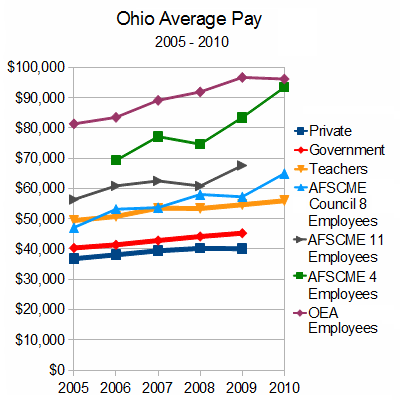
Ohio Average Pay: Public vs. Private
Ohio Average Pay: Public Unions vs. Private

Myths and truths about Ohio State Issue 2

Here’s a common myth:

State Issue 2 would “cut salaries and benefits.”

The truth:

Issue 2 would not cut salaries or benefits for any government employee. Employees would simply be asked to pay a modest share of their benefits, just like employees in the private sector do. For health care coverage, they would pay at least 15% of their overall plan. (Many local government employees currently pay less than 9% of their health care premium, while the average private sector worker pays upwards of 30%.) In addition, employees would be required to pay their personal share of a retirement plan (only 10%), rather than asking taxpayers to pay that share. That’s not too much to ask at a time when many private sector workers get no retirement benefit at all. Finally, Issue 2 requires that benefits apply equally to all public employees, so no one gets special treatment.

And another common myth:

State Issue 2 will eliminate government employee pensions.

The truth:

Government employees will still get a very generous pension benefit – an annual payment that averages their three highest annual salaries. That’s a pretty nice deal, when many private sector workers get no retirement benefit at all. State Issue 2 only ends a practice where some government union contracts require taxpayers to pick up the tab for BOTH the employer AND employee shares of a required pension contribution. In this economy, it’s simply not right to ask struggling taxpayers to foot the bill so government employees can get a free retirement. Issue 2 simply says government employees should pay their required share (10 percent) and taxpayers will contribute the employer share (14 percent).

Another myth:

State Issue 2 will cut teacher salaries.

The truth:

That’s one of the scare tactics government unions are using to turn people against these reforms. Nothing in Issue 2 determines salary levels. It only ends the practice of handing out automatic pay raises, or “step” increases, and longevity pay – or bonuses just for holding the job for a certain period of time. Issue 2 also asks that performance be added as a factor in teacher compensation, a goal President Barack Obama set out in his national education policy in 2009.

And another myth:

State Issue 2 will cost jobs

The truth:

Just the opposite is true. Ohio’s state and local tax burden ranks among the top third in the nation. As a result, companies large and small have left our state in pursuit of better tax incentives elsewhere, taking hundreds of thousands of jobs with them. If Ohio hopes to compete for new job growth, we have to make our state a more affordable place to live, work and do business. That starts with getting the cost of government under control so we can direct more of our limited resources into economic development, community revitalization and better schools.

More myths are corrected on this page.

Newspaper endorsements

So far, Issue 2 has been endorsed by several Ohio newspapers, including the biggest ones.

The Cleveland Plain Dealer:

The fiscal picture of local governments and school districts, especially, will improve as they are able to right-size their work forces and their expenditures on services. That will happen over time, not overnight, as new contracts are established.

Repeal SB 5, though, and it’s going to be awfully hard for local governments to manage their payrolls without resorting to larger-scale layoffs than would otherwise be necessary. And local governments will continue to be hamstrung by anti-merit seniority rules that lead to worker complacency and protect dead weight and time-servers.

Voting YES on Issue 2 will prevent layoffs by keeping public sector wages and benefits in line with what the private sector can afford to pay.

The Columbus Dispatch:

Despite the insistence of opponents, the effort to reform Ohio’s out-of-balance collective-bargaining law is not an expression of disrespect for or dissatisfaction with Ohio teachers, police officers, firefighters and other government employees. It is a much-needed attempt to restore control over public spending to the public officials elected to exercise that control.

It does not assert that public employees are worth less than the compensation they’re receiving, only that the compensation has grown faster than the public’s ability to pay for it.

[…]With more ability to control the escalation of salary and benefit costs, governments won’t be forced as often to impose layoffs, and might be able to afford to keep even more police and firefighters on the streets.

Again, no one is saying that public sector workers don’t matter – the question is whether we can afford to give them better wages and benefits than the private sector workers who are their customers and their employers. Public sector workers work for the public, and the public can only afford to pay so much.

Conclusion

Government employees are paid 43% more than private sector employees, in salary and benefits:

I think that people who care about the long-term prosperity of Ohio should vote “YES” on Issue 2 to make public and private salaries and benefits MORE EQUAL. Ohio is facing enormous economic pressure from the global recession, and everyone has to make sacrifices. Now is not the time for public sector workers to insist on higher wages and benefits, especially when the private sector workers who pay their salaries don’t make as much money, nor do they get the pensions, nor do they get the better job security. Ohio voters can certainly go back and renegotiate union salaries and benefits when Ohio is out of the recession.

Click here to learn more about Ohio Issue 2.