Tag Archives: Paper

What is the meaning and purpose of Father’s Day?

Father’s Day is the day that children and wives are supposed to honor fathers by giving them respect for being providers, protectors and moral/spiritual leaders. One of the best ways to motivate this duty is by studying research to find out the difference that fathers make.

Some statistics on the importance of biological fathers from Fathers.com.

Excerpt:

Some fathering advocates would say that almost every social ill faced by America’s children is related to fatherlessness. Six are noted here. As supported by the data below, children from fatherless homes are more likely to be poor, become involved in drug and alcohol abuse, drop out of school, and suffer from health and emotional problems. Boys are more likely to become involved in crime, and girls are more likely to become pregnant as teens.

For a summary, I’ll just list one fact from each of the six categories they listed.

1. Poverty

Fact:

– Children in father-absent homes are five times more likely to be poor. In 2002, 7.8% of children in married-couple families were living in poverty, compared to 38.4% of children in female-householder families.

Source: U.S. Census Bureau, Children’s Living Arrangements and Characteristics: March 2002, P20-547, Table C8. Washington, D.C.: GPO 2003.

2. Drug and Alcohol Abuse

Fact:

– The U.S. Department of Health and Human Services states, “Fatherless children are at a dramatically greater risk of drug and alcohol abuse.”

Source: U.S. Department of Health and Human Services. National Center for Health Statistics. Survey on Child Health. Washington, DC, 1993.

3. Physical and Emotional Health

Fact:

– Unmarried mothers are less likely to obtain prenatal care and more likely to have a low birthweight baby. Researchers find that these negative effects persist even when they take into account factors, such as parental education, that often distinguish single-parent from two-parent families.

Source: U.S. Department of Health and Human Services. Public Health Service. Center for Disease Control and Prevention. National Center for Health Statistics. Report to Congress on Out-of-Wedlock Childbearing. Hyattsville, MD (Sept. 1995): 12.

– Children in single-parent families are two to three times as likely as children in two-parent families to have emotional and behavioral problems.Source: Stanton, U.S. Department of Health and Human Services. National Center for Health Statistics.”National Health Interview Survey.” Hyattsville, MD, 1988.

4. Educational Achievement

Fact:

– After taking into account race, socioeconomic status, sex, age, and ability, high school students from single-parent households were 1.7 times more likely to drop out than were their corresponding counterparts living with both biological parents.Source: McNeal, Ralph B. Jr.”Extracurricular Activities and High School Dropouts.” Sociology of Education 68(1995): 62-81.

5. Crime

Fact:

– Children in single parent families are more likely to be in trouble with the law than their peers who grow up with two parents.

Source: U.S. Department of Health and Human Services. National Center for Health Statistics. National Health Interview Survey. Hyattsville, MD, 1988.

6. Sexual Activity and Teen Pregnancy

Fact:

– A white teenage girl from an advantaged background is five times more likely to become a teen mother if she grows up in a single-mother household than if she grows up in a household with both biological parents.Source: Whitehead, Barbara Dafoe. “Facing the Challenges of Fragmented Families.” The Philanthropy Roundtable 9.1 (1995): 21.

Now take a look at this Wall Street Journal article that explains some of the ways that fathers have beneficial effects on children.

Excerpt:

As an estimated 70.1 million fathers prepare to celebrate Father’s Day in the U.S., recent research shows that their distinct style of parenting is particularly worth recognition: The way dads tend to interact has long-term benefits for kids, independent of those linked to good mothering.

[…]The benefits of involved fathering are known: improved cognitive skills, fewer behavioral problems among school-age children, less delinquency among teenage boys and fewer psychological problems in young women, based on an analysis of 16 long-term studies of father involvement, published in 2008 in the scholarly journal Acta Paediatrica.

Some of dads’ behavior may spring from their roles as family breadwinners. Although mothers play a significant role in the workforce, men are still the primary breadwinners in more than three-fourths of married-couple households.

And 48% of working fathers spend less than six hours a day with their children, compared with 31% of working mothers, according to a recent poll of 459 working adults by Workplace Options, a provider of employee-assistance and work-life programs in Raleigh, N.C.

As a result, fathers may be less familiar with their children’s nonverbal cues. Such dads tend to challenge children more to express themselves in words, helping foster the better cognitive skills researchers have found in 2-year-olds with involved fathers.

Parenting patterns may be rooted in neurological differences. Under stress, research shows, men’s brains are wired to respond to challenges physically, leaping into action. Women are more likely to withdraw or shut down.

Because fathers have had to learn to manage their own impulses to strike out or react physically to frustration, they may be better equipped than mothers to help children manage their own urges to behave badly, Dr. Pruett says.

Indeed, fathers typically aren’t as upset as mothers by kids’ tantrums or bad behavior, based on a 2009 survey of 1,615 parents by Zero to Three, a nonprofit child-development research and policy organization. Only half as many fathers as mothers say their children’s temper tantrums are one of their biggest challenges.

Fathers matter, so women need to choose men who will be good fathers. And that means having an idea of what fathers do, and knowing how to evaluate a man to see if he can do what fathers do. There’s more to fathers than handsomeness and fun!

Related posts

Peer-reviewed journal apologizes for censoring pro-ID article

From Evolution News. (Excerpt below, with links removed)

Excerpt:

In one of their favorite soundbytes, members of the Darwin lobby like to assert that intelligent design scientists do not publish peer-reviewed research. That claim is manifestly false. But the fact that intelligent design scholars do publish peer-reviewed articles is no thanks to Darwinists, many of whom do their best to ensure that peer-reviewed articles by intelligent design scientists never see the light of day.

Witness the brazen censorship earlier this year of an article by University of Texas, El Paso mathematics professor Granville Sewell, author of the book In the Beginning and Other Essays on Intelligent Design. Sewell’s article critical of Neo-Darwinism (“A Second Look at the Second Law”) was both peer-reviewed and accepted for publication by the journal Applied Mathematics Letters. That is, the article was accepted for publication until a Darwinist blogger who describes himself as an “opinionated computer science geek” wrote the journal editor to denounce the article, and the editor decided to pull Sewell’s article in violation of his journal’s own professional standards.

The publisher of Applied Mathematics Letters (Elsevier, the international science publisher) has now agreed to issue a public statement apologizing to Dr. Sewell as well as to pay $10,000 in attorney’s fees.

“It’s hard to imagine a more blatant assault on intellectual freedom and the free exchange of ideas,” says attorney Pete Lepiscopo with the California firm of Lepiscopo and Morrow, which represented Sewell.

Lepiscopo points out that in retracting Sewell’s article, Applied Mathematics Letters “effectively accepted the unsubstantiated word and unsupported opinion of an inconsequential blogger, with little or unknown academic background beyond a self-professed public acknowledgment that he was a ‘computer science grad’ and whose only known writings are self-posted blogs about movies, comics, and fantasy computer games.” This blogger’s unsupported opinion “trumped the views of an author who is a well respected mathematician with a Ph.D. in Mathematics from Purdue University; a fully-tenured Professor of Mathematics at the University of Texas–El Paso; an author of three books on numerical analysis and 40 articles published in respected journals; and a highly sought-after and frequent lecturer world-wide on mathematics and science.”

After Dr. Sewell’s article was pulled, Darwinian zealots crowed about their achievement and maliciously speculated that the article was withdrawn because it wasn’t really peer-reviewed or because it was somehow substandard. The journal, meanwhile, left Dr. Sewell to twist in the wind, seemingly endorsing the Darwinists’ smears. The journal editor Dr. Rodin wrote a groveling letter to the Darwinist blogger who complained to him in which he agreed that publishing Sewell’s article would involve “impropriety.” Rodin further apologized “for our erroneous judgement in even considering this paper for publication.”

Dr. Rodin and his journal now have to issue a public statement providing “their sincere and heartfelt apologies to Dr. Sewell… and welcom[ing] Dr. Sewell’s submission of future articles for possible publication.” More important than the apology, the journal has to set the record straight by reiterating that “Dr. Sewell’s article was peer-reviewed and accepted for publication” and by making clear that his article was not withdrawn because of “any errors or technical problems found by the reviewers or editors.”

Wow. I actually clicked on some of the links in the post at Evolution News and was carried off to the lands of naturalistic blogging. It’s amazing how confident they are in their little echo chambers, but I cannot fathom why this should be since they are unwilling to debate their views in public. To me, you can only know something if you are willing to hear the criticisms against it. If you censor all your opponents and hang around in little online chat rooms gloating to your choir about how smart you are and how right you are, why think that you really know anything about what you are talking about?

The only way to be sure about any issue is to listen to both sides in a debate, and let your opponents have a hearing. I would not feel confident in asserting anything if I only heard the arguments on one side of the question. Not only do the Darwinbots seem to be confident in asserting their views without hearing their opponents, they are actually arrogant and insulting about it. But before you can be trumpet your victory in a disagreement, doesn’t there have to be an actual debate first? Canceling the debate by censorship doesn’t mean that you won the debate.  It means you’re scared of debate.

Here’s what you do. Slap a defamation lawsuit on the blogger who complained for a million dollars and let them have their day in court to explain why they said what they said. Then we’ll find out which side has the blind faith and which side has the knowledge.

The Cambrian explosion: biology’s Big Bang

Consider this article by Jonathan Wells.

First, let’s re-cap the challenge to evolution from the phenomenon of the Cambrian explosion.

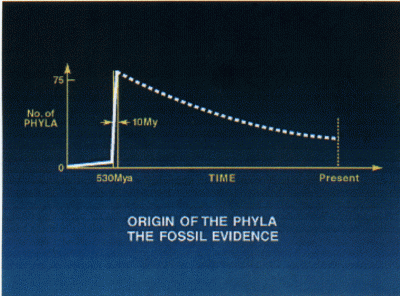
The newly released film “Darwin’s Dilemma” argues that the geologically abrupt appearance of the major groups of animals (the “phyla”) in the Cambrian Explosion posed a serious problem for Charles Darwin’s theory of evolution (as he himself knew), and that subsequent fossil discoveries—far from solving the problem—have made it worse.

Basically, all the major body plans we have today appear in the fossil record in a 2-3 million period about 543 million years ago. There are no precursors in the fossil record showing the gradual evolution of these major body plans.

The Cambrian Explosion: 0 to 60 in a few million years

Darwin expected to discover lots and lots of fossils leading up to the Cambrian explosion period that would show how all these phyla came into existence slowly over time. Unfortunately for the naturalistic evolutionists, the discoveries we’ve been making haven’t shown any hint of precursor fossils leading up the Cambrian explosion.

Since 1859, however, many Precambrian fossils have been found, including microfossils of single-celled bacteria in rocks more than three billion years old. In addition, multicellular Precambrian fossils have been found in the Ediacara Hills of Australia, though there is continuing debate over whether any—or how many—of the Ediacaran fossils were animals, or what relationship—if any—they had to the Cambrian phyla. In 1998, Cambridge University paleobiologist Simon Conway Morris (who is featured in the film “Darwin’s Dilemma”) wrote, “Apart from the few Ediacaran survivors… there seems to be a sharp demarcation between the strange world of Ediacaran life and the relatively familiar Cambrian fossils” (Crucible of Creation, 30).

But wait! Maybe we can’t find the precusor fossils required by Darwinism because they are too small or too soft to have survived for so long?

Since 1859, however, many Precambrian fossils have been found, including microfossils of single-celled bacteria in rocks more than three billion years old. In addition, multicellular Precambrian fossils have been found in the Ediacara Hills of Australia… In 1998, Cambridge University paleobiologist Simon Conway Morris… wrote, “Apart from the few Ediacaran survivors… there seems to be a sharp demarcation between the strange world of Ediacaran life and the relatively familiar Cambrian fossils” (Crucible of Creation, 30).

So there is now no shortage of Precambrian fossils. Not only do we have fossils of bacteria, but we also have many fossils of soft-bodied Multicellular organisms. “In the Ediacaran organisms there is no evidence for any skeletal hard parts,” wrote Conway Morris in 1998. “Ediacaran fossils look as if they were effectively soft-bodied” (Crucible of Creation, 28). The same is true of many of the organisms fossilized in the Cambrian explosion.

But wait! Scientists have discovered lots of exceptionally preserved microbes just before the Cambrian explosion. Don’t microbes count as precursors to the Cambrian explosion phyla?

Richard Callow and Martin Brasier reported in the January 2009 issue of the Journal of the Geological Society, London “a variety of exceptionally preserved microbes” from late Precambrian rocks in England that address “the paradox known as ‘“Darwin’s dilemma’.”

[…]Callow and Brasier didn’t solve Darwin’s dilemma. Instead, they put one more nail in the coffin of Darwin’s attempt to salvage his theory from it. The truth is that “exceptionally preserved microbes” from the late Precambrian actually deepen Darwin’s dilemma, because they suggest that if there had been ancestors to the Cambrian phyla they would have been preserved.

I am willing to believe in evolution. But in order to get me to believe it, I insist on seeing a fossil record that shows the gradual emergence of phyla, one or two at a time, over hundreds of millions of years. That is what Darwinism predicts. We now have a solid record of what came before the Cambrian explosion. So where are the precursors? Where is the record of gradual emergence? Where is my evidence?

What does the peer-reviewed research say?

Story from the Discovery Institute.

A new peer-reviewed paper has been published that concludes that there is no material explanation for the massive amounts of information introduced during the Cambrian explosion, when all of the phyla came into being in the blink of an eye, geologically speaking, with no fossilized precursors.

Excerpt:

Thus, elucidating the materialistic basis of the Cambrian explosion has become more elusive, not less, the more we know about the event itself, and cannot be explained away by coupling extinction of intermediates with long stretches of geologic time, despite the contrary claims of some modern neo-Darwinists.

Once again, the progress of science brings light.

The DI post goes on to cite another passage from the paper:

Beginning some 555 million years ago the Earth’s biota changed in profound and fundamental ways, going from an essentially static system billions of years in existence to the one we find today, a dynamic and awesomely complex system whose origin seems to defy explanation. Part of the intrigue with the Cambrian explosion is that numerous animal phyla with very distinct body plans arrive on the scene in a geological blink of the eye, with little or no warning of what is to come in rocks that predate this interval of time. The abruptness of the transition between the ‘‘Precambrian’’ and the Cambrian was apparent right at the outset of our science with the publication of Murchison’s The Silurian System, a treatise that paradoxically set forth the research agenda for numerous paleontologists — in addition to serving as perennial fodder for creationists. The reasoning is simple — as explained on an intelligent-design t-shirt.

Fact: Forty phyla of complex animals suddenly appear in the fossil record, no forerunners, no transitional forms leading to them; ‘‘a major mystery,’’ a ‘‘challenge.’’ The Theory of Evolution – exploded again (idofcourse.com).

Although we would dispute the numbers, and aside from the last line, there is not much here that we would disagree with. Indeed, many of Darwin’s contemporaries shared these sentiments, and we assume — if Victorian fashion dictated — that they would have worn this same t-shirt with pride.

Here is the reference for the paper:

(Kevin J. Peterson, Michael R. Dietrich and Mark A. McPeek, “MicroRNAs and metazoan macroevolution: insights into canalization, complexity, and the Cambrian explosion,” BioEssays, Vol. 31 (7):736 – 747 (2009).)

I linked before to a bunch of easy-to-understand videos that explain the Cambrian explosion. Here’s another peer-reviewed research paper on the Cambrian explosion written by Stephen C. Meyer, on the Cambrian explosion. This is the paper that got evolutionary biologist Richard Sternberg fired by secular leftists. He has two earned Ph.Ds in biology. I would expect that the people who fired him had never seen the inside of a biology lab. That’s the way it goes – science (intelligent design) vs. religion (materialism).

Videos on intelligent design