
Tag Archives: Origin of Life

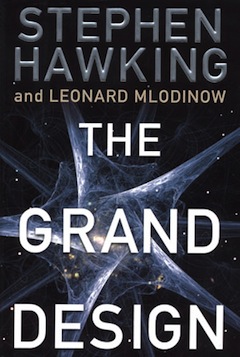
Book review of Stephen Hawking’s “The Grand Design” by Edgar Andrews

First, who is Edgar Andrews?

Professor Edgar H. Andrews (BSc, PhD, DSc, FInstP, FIMMM, CEng, CPhys.) is Emeritus Professor of Materials at the University of London and an international expert on the science of large molecules. In 1967 he set up the Department of Materials at Queen Mary College, University of London, and served both as its Head and later as Dean of Engineering. He has published well over 100 scientific research papers and books, together with two Bible Commentaries and various works on science and religion and on theology. His book From Nothing to Nature has been translated into ten languages.

Edgar Andrews was an international consultant to the Dow Chemical Company (USA) for over thirty years and to the 3M Company (USA) for twenty years. He was a non-executive director of Denbyware PLC throughout the 1970s and for five years a member of the Scientific Advisory Board of Neste Oy, the national oil company of Finland.

And now an excerpt from the book review: (H/T Apologetics 315)

Hawking and Mlodinow declare: ‘According to M-theory, ours is not the only universe. Instead, M-theory predicts that a great many universes were created out of nothing. Their creation does not require the intervention of some supernatural being or god. Rather, these multiple universes arise naturally from physical law. They are a prediction of science’ (p.9).

So what is this magical M-theory? The authors are rather coy about it. ‘M-theory’, they say, ‘Is not a theory in the usual sense. It is a whole family of different theories, each of which is a good description of observations only in some range of physical situations’ (p.8). Theoretical physicist Lee Smolin is more explicit: ‘… we still do not know what M-theory is, or whether there is any theory deserving of the name’ (The trouble with physics, Allen Lane, 2007, p.146).

The fact is that M-theory is an untestable mathematical construction which many scientists believe has no bearing on physical reality. But that doesn’t deter our authors because they don’t believe in ‘objective reality’ anyway. What we think is ‘real’, they say, is simply a model assembled in our brains from raw data input by our senses. But, confusingly, the authors then claim that the best models are those that reflect the way things really do happen in the real world — appealing to the very objective reality they say does not exist! Confused? Me too.

But it gets worse. They claim that M-theory (whatever it might be) predicts not one universe but a multiverse — a vast collection of universes which cannot be observed or known to us in any way. On their own criterion, this makes M-theory a very bad model indeed. So it’s hardly a useful replacement for God.

Here’s a better book to read if you want to understand how belief in God relates to experimental science.

My Dad just finished reading his book “Who Made God?” and called me up to tell me how much he liked the book. My Dad is not a scientist, yet he read the whole thing and learned a lot about science. This is the book for people who haven’t read a thing about science and religion. It’s easy to understand because he explains the same thing over and other giving more and more detail. Even a child can understand the first explanation, and then he keeps layering on details until he gets up to the state-of-the-art.

Remember Brian Auten of Apologetics 315 picked this book as his favorite of 2010. You can’t go wrong!

My Dad is now reading my copy of “Is God Just a Human Invention?” by Jonathan Morrow and Sean McDowell. I’m working on “Is God a Moral Monster?” by Paul Copan. I like books where difficult questions are asked and then careful answers are given. Then when people ask me the same questions, I can answer them using what I’ve learned – and often phrase the question even more clearly and forcefully than they did when they asked me.

Debate on the origin of life featuring Stephen C. Meyer and Doug Axe

Wow, this should be the most exciting debate of the year:

The conversation about God and Darwin is heating up. After several months of back-and-forth, the theistic evolutionists at BioLogos (notably attacking Stephen Meyer’s Signature in the Cell, in some cases without reading it) will meet and finally face intelligent design proponents, who are coming fresh off their successful salvo of essays and arguments in God and Evolution, which premiered with a conference at Biola University last week.

Next week the Vibrant Dance of Faith and Science becomes the God and evolution showdown in Austin, as the question of whether faith in God can co-exist with Darwinian evolution will be discussed and debated with people of faith on all different points of the spectrum. CSC Director Stephen Meyer will be presenting, as will CSC fellows Bill Dembski, Doug Axe, Richard Sternberg, Paul Nelson, Jack Collins, Walter Bradley, Bruce Gordon, and Ray Bohlin.

The Vibrant Dance of Faith and Science is unique for bringing together key leaders on both sides of the debate. Attendees have three days of speakers and sessions but should prepare for a rumble on Thursday, October 28, when Stephen Meyer and Doug Axe will go up against Darrel Falk and Randy Isaac in a debate on the origin of life, moderated by Walter Bradley. (If you haven’t been following it, there’s no small measure of disagreement between these thinkers).

For more on the conference, which runs from October 26-28 at Grace Covenant Church, and to register, visit vibrantdance.org.

I found this on Evolution News. It’s good to see one of my favorite Christians (Walter Bradley) still in the mix on science and religion.

How can you tell whether something is designed or not?

In honor of William Dembski’s debate tonight at 8 PM Eastern time, I present this article from Access Research Network.

Excerpt:

Instead of looking for such vague properties as “purpose” or “perfection”—which may be construed in a subjective sense—[intelligent design] looks for the presence of what it calls specified complexity, an unambiguously objective standard.

That term sounds like a mouthful, but it’s something we can all recognize without effort. Let’s take an example.

Imagine that a friend hands you a sheet of paper with part of Lincoln’s Gettysburg address written on it:

FOURSCOREANDSEVENYEARSAGOOURFATHERSBROUGHTFORTHONTHISCONTINENTANEWNATIONCONCEIVEDINLIBERTY …

Your friend tells you that he wrote the sentence by pulling Scrabble pieces out of a bag at random.

Would you believe him? Probably not. But why?

One reason is that the odds against it are just too high. There are so many other ways the results could have turned out—so many possible sequences of letters—that the probability of getting that particular sentence is almost nil.

But there’s more to it than that. If our friend had shown us the letters below, we would probably believe his story.

ZOEFFNPBINNGQZAMZQPEGOXSYFMRTEXRNYGRRGNNFVGUMLMTYQXTXWORNBWIGBBCVHPUZMWLONHATQUGOTFJKZXFHP …

Why? Because of the kind of sequence we see. The first string fits a recognizable pattern: It’s a sentence written in English, minus spaces and punctuation. The second string fits no such pattern.

Now we can understand specified complexity. When a design theorist says that a string of letters is specified, he’s saying that it fits a recognizable pattern. And when he says it’s complex, he’s saying there are so many different ways the object could have turned out that the chance of getting any particular outcome by accident is hopelessly small.

Thus, we see design in our Gettysburg sentence because it is both specified and complex. We see no such design in the second string. Although it is complex, it fits no recognizable pattern. And if our friend had shown us a string of letters like “BLUE” we would have said that it was specified but not complex. It fits a pattern, but because the number of letter is so short, the likelihood of getting such a string is relatively high. Four slots don’t give you as many possible letter combinations as 143, which is the length of our Gettysburg sentence.

So that’s the basic notion of specified complexity.

This is something you really need to understand in order to understand the arguments from biological building blocks and biological information in DNA.