Tag Archives: Origin of Life

Is Skeptic magazine keeping up with the progress of science?

Not if the progress of science undermines the speculations about a naturalistic origin of life. In their latest issue, Skeptic magazine espouses the old, discredited Miller-Urey experiments from half a century ago. The old science is Darwin-friendly. But is that old science still current?

Consider this post from Evolution News.

Excerpt:

Stanley Miller had not in fact “simulated atmospheric conditions on the early Earth.” And this has been known for quite a long time. Origin of life theorist David Deamer states:

This optimistic picture began to change in the late 1970s, when it became increasingly clear that the early atmosphere was probably volcanic in origin and composition, composed largely of carbon dioxide and nitrogen rather than the mixture of reducing gases assumed by the Miller-Urey model. Carbon dioxide does not support the rich array of synthetic pathways leading to possible monomers . . . .

(D.W. Deamer, “The First Living Systems: a Bioenergetic Perspective,” Microbiology and Molecular Biology Reviews, Vol. 61: 239 (1997).

As I discuss here, there’s very good reason to understand why an atmosphere on Earth of volcanic origin would not contain methane or ammonia. A 2010 paper in Cold Spring Harbor Perspectives in Biology states that the chemical properties of the Earth’s mantle have not changed over time, and thus if volcanoes don’t produce appreciable amounts methane and ammonia today (which they don’t), then they also wouldn’t back then:

Geochemical evidence in Earth’s oldest igneous rocks indicates that the redox state of the Earth’s mantle has not changed over the past 3.8 Gyr (Delano 2001; Canil 2002).(Kevin Zahnle, Laura Schaefer, and Bruce Fegley, “Earth’s Earliest Atmospheres,” Cold Spring Harbor Perspectives in Biology (2010).)

The papers cited in the quote above confirm this point. For example, Canil’s 2002 paper in Earth and Planetary Science Letters found that vanadium redox states in peridotite-bearing mantle xenoliths and Archean cratons imply that Earth’s mantle was just as oxidized in the Archean as it is today. The paper concludes:

Abiotic synthesis of molecules and hydrocarbons that can lead to life in early Archean mantle-derived volcanic gases requires they contain significant H2 and CO, but such reduced components are not supported by results of this and many other studies, which imply a scenario of Archean mantle redox not unlike that of today. Life may have found its origins in other environments or by other mechanisms.

(Dante Canil, “Vanadian in peridotites, mantle redox and tectonic environments: Archean to present,” Earth and Planetary Science Letters, Vol. 195:75-90 (2002) (internal citation removed).)

The situation is summed by authorities Kasting and Catling as follows: “For the 4 billion years for which a geological record exists, no evidence for a pronounced change in mantle redox state exists.” (James F. Kasting and David Catling, “Evolution of a Habitable Planet,” Annual Review of Astronomy and Astrophysics, Vol. 41:429-463 (2003).)

Skeptic magazine cannot be skeptical on the origin of life. They have to affirm a naturalistic origin of life, because they assume that there was no intelligent cause of the origin of life, before looking at the evidence. They affirm that the universe is eternal, before looking at the evidence. They affirm that there is a multiverse to explain the fine-tuning, before looking at the evidence. They affirm that habitable planets are common, before looking at the evidence. They assume that a gradual string of pre-Cambrian fossils exists, before looking at the evidence. They believe in man-made catastrophic global warming alarmism, before looking at the evidence. Evidence is very, very bad for skeptics. Which is why they oppose the progress of science and have to go back fifty years to the speculations. They don’t like the progress of science. They believe what they want to believe. And that’s why they don’t want to debate anything, but instead refuse to hire people who disagree with them – or fire them if they are already hired.

It’s Skeptic magazine versus the scientists. Religion versus science. The pre-supposition of naturalism versus reality.
Can intelligent design be front-loaded at the creation of the universe?

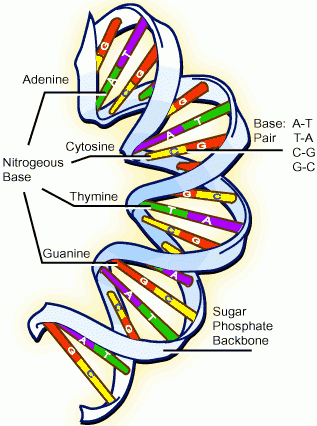
Structure of DNA
Structure of DNA

This video introduction to intelligent design packs a lot of information into a very small video. (H/T Brian Auten from Apologetics 315)

When it comes to the science of DNA, theistic evolutionists and atheists agree: matter, law and chance are sufficient to evolve DNA. No intelligence is needed to sequence the base pairs or the amino acids. That agreement that intelligent causes are not needed to explain DNA is why I call theistic evolution “functional atheism”.

Theistic evolutionists express subjective opinions about God that no one can investigate using science. These untestable opinions about God are similar to the opinions of little children about Santa Claus. And yet they insist that they be taken seriously alongside the people who actually think Christianity is objective knowledge, not subjective opinion.

To defuse a theistic evolutionist, simply ask them for  fully materialistic and naturalistic explanation for the first living organism – the origin of life. And then watch how they avoid answering the question. For even Richard Dawkins has no idea how life could begin, if only purely naturalistic, materialistic causes are allowed in the explanation.

Theistic evolutionists hate talking about evidence. They want to talk their private feelings and beliefs and experiences in order to reassure you that they are just like you. Don’t let them talk about religion – stick to what science can show. Demand evidence that the material processes can do the creating that the theistic evolutionists think that material processes can do.

Here’s an easy article that you can read that explains a bit more about what the video discussed. Here is one is a bit more difficult. These are mentoring articles for Christians.

If you want to read some serious research, then read this post and listen to this interview which are both about the work of Doug Axe.

Harvard astrophysicist backs the Rare Earth hypothesis

What is the Rare Earth hypothesis?

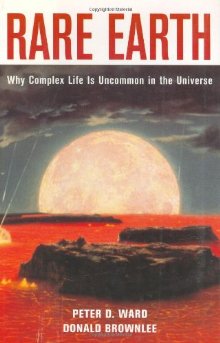
It’s the thesis of a recent book written by two scientists at the University of Washington.

Here’s the blurb:

What determines whether complex life will arise on a planet? How frequent is life in the Universe?

In this exciting new book, distinguished paleontologist Peter D. Ward and noted astronomer Donald Brownlee team up to give us a fascinating synthesis of what’s now known about the rise of life on Earth and how it sheds light on possibilities for organic life forms elsewhere in the Universe.

Life, Ward and Brownlee assert, is paradoxically both very common and almost nowhere. The conditions that foster the beginnings of life in our galaxy are plentiful. But contrary to the usual assumption that if alien life exists, it’s bound to be intelligent, the authors contend that the kind of complex life we find on Earth is unlikely to exist anywhere else; indeed it is probably unique to our planet.

With broad expertise and wonderful descriptive imagery, the authors give us a compelling argument, a splendid introduction to the emerging field of astrobiology, and a lively discussion of the remarkable findings that are being generated by new research. We learn not only about the extraordinary creatures living in conditions once though inimical to life and the latest evidence of early life on Earth, but also about the discoveries of extrasolar planets, the parts Jupiter and the Moon have played in our survival, and even the crucial role of continental drift in our existence.

Insightful, well-written, and at the cutting edge of modern scientific investigation, Rare Earth should interest anyone who wants to know about life elsewhere and gain a fresh perspective on life at home which, if the authors are right, is even more precious than we may ever have imagined.

And here’s a review by Library Journal:

“Renowned paleontologist Ward (Univ. of Washington), who has authored numerous books and articles, and Brownlee, a noted astronomer who has also researched extraterrestrial materials, combine their interests, research, and collaborative thoughts to present a startling new hypothesis: bacterial life forms may be in many galaxies, but complex life forms, like those that have evolved on Earth, are rare in the universe. Ward and Brownlee attribute Earth’s evolutionary achievements to the following critical factors: our optimal distance from the sun, the positive effects of the moon’s gravity on our climate, plate tectonics and continental drift, the right types of metals and elements, ample liquid water, maintainance of the correct amount of internal heat to keep surface temperatures within a habitable range, and a gaseous planet the size of Jupiter to shield Earth from catastrophic meteoric bombardment. Arguing that complex life is a rare event in the universe, this compelling book magnifies the significance — and tragedy — of species extinction. Highly recommended for all public and academic libraries.”

Note that Peter Ward is a militant atheist (he has debated against Stephen C. Meyer), and Donald Brownlee is an agnostic. These are not Christians, nor are they even theists. However, I have the book, I have read the book, and I recommend the book. I usually have this book on my shelf at work for show-and-tell.

Now for the latest news about the hypothesis of the book. (H/T Brian Auten of Apologetics 315)

There are always going to be optimistic predictions by scientists who need to attract research funding, but those are hopes and speculations. The data we have today says Earth is rare. The number of conditions required for complex life of any kind is too high for us to be optimistic about alien life in this galaxy, at least. And as the number of requirements for life roll in, the odds of finding alien life that can contact us get slimmer and slimmer.

From the UK Daily Mail. (H/T Peter S. Williams)

Excerpt:

Dr Howard Smith, a senior astrophysicist at Harvard University, believes there is very little hope of discovering aliens and, even if we did, it would be almost impossible to make contact.

So far astronomers have discovered a total of 500 planets in distant solar systems – known as extrasolar systems – although they believe billions of others exist.

But Dr Smith points out that many of these planets are either too close to their sun or too far away, meaning their surface temperatures are so extreme they could not support life.

Others have unusual orbits which cause vast temperature variations making it impossible for water to exist as a liquid – an essential element for life.

Dr Smith said: ‘We have found that most other planets and solar systems are wildly different from our own.

‘They are very hostile to life as we know it.’

‘The new information we are getting suggests we could effectively be alone in the universe.

‘There are very few solar systems or planets like ours. It means it is highly unlikely there are any planets with intelligent life close enough for us to make contact.’ But his controversial suggestions contradict other leading scientists – who have claimed aliens almost certainly exist.

These arguments are actually quite useful, and I include them in my standard list of scientific arguments for theism. (See below) You have to know this stuff cold. Most people believe in aliens because they watched movies made by artists. As a result, they think that humans are nothing special and that God is not interested in us in particular. Which is very convenient for them, because it means they can do whatever they want and not care what God thinks about what they are doing. If you want to defend against the idea that humans are nothing special, and that we were not placed here for a purpose, and that we are not accountable and obligated to seek and know the Creator/Designer, then you’ll need more than feelings. You’ll need science. You’ll need the best science available.

Related posts