The host is astrophysicist Neil deGrasse Tyson who believes “God is an ever-receding pocket of scientific ignorance.” Executive producers include comedian Seth MacFarlane, who expresses his desire to be “vocal about the advancement of knowledge over faith,” and Star Trek writer Brannon Braga, who says “religion sucks” and admits he “longs for” the day when “religion is vanquished.”
With Tyson himself admitting we must view “‘Cosmos’ not as a documentary about science,” the series barely hides its ambitions to bring Sagan’s materialistic views to a new generation.
[…]But have its creators pushed the agenda too far? “Cosmos” faced sharp criticism—from leading evolutionists—for inventing stories about religious persecution of scientists while whitewashing religion’s positive historical influence on science.
The first episode portrayed the 16th century scientist Giordano Bruno being burned at the stake by Catholic priests for teaching that the Earth orbits the Sun. The problem? Bruno wasn’t a scientist and he wasn’t persecuted for his heliocentric views. Of course Bruno’s persecution was tragic, but the church killed him for promoting the occult worship of Egyptian deities and other quirky theological beliefs.
Throughout the series, Tyson repeats this theme that religion opposes scientific advancement, whitewashing the chorus of historians who believe that religion had a positive influence on science.
As prominent historian Ronald Numbers argues, “[t]he greatest myth in the history of science and religion holds that they have been in a state of constant conflict.” One scholar at the staunchly pro-evolution National Center for Science Education even blasted “Cosmos” for its “slipshod history of science” and “antireligious bias.”
Numbers is not a theist – he is secular, so that’s an interesting quote.
The story also notes that Barack Obama endorses the series,and that’s not surprising to me. As I’ve argued before, the man is an atheist. This series is defending his religion.
A great post from Evolution News about my favorite animals in the whole world – BIRDS!
Excerpt:
How hard can it be to make a flexible wing flap for an airplane? Almost all aircraft today use rigid wings with rigid landing flaps. They work, but they waste fuel. German engineers embarked on a mission to reduce kerosene consumption by 6%: “integrating flexible landing devices into aircraft wings is one step towards that target,” a news item from Fraunhofer says. They’ve named the project SARISTU, for Smart Intelligent Aircraft Structures.
Birds are way ahead of them:
While birds are able to position their feathers to suit the airflow, aircraft wing components have so far only been rigid. As the name suggests, landing flaps at the trailing edge of the wing are extended for landing. This flap, too, is rigid, its movement being limited to rotation around an axis. This is set to change in the SARISTU project. “Landing flaps should one day be able to adjust to the air flow and so enhance the aerodynamics of the aircraft,” explains Martin Schüller, researcher at the Fraunhofer Institute for Electronic Nano Systems ENAS in Chemnitz. (Emphasis added.)
What are some of the challenges in building a flexible wing?
Knowing where to flex: The flap can’t be flexible all over, or it would be hard to control. The designers made “five hard and three soft zones, enclosed within a silicon skin cover extending over the top.”
Finding stretchy skin: When the soft zone moves, the skin of the aircraft has to stretch with it. “The mechanism that allows the landing flap to change shape can only function if the skin of the landing flap can be stretched as it moves, a problem tackled by researchers from the Fraunhofer Institute for Manufacturing Technology and Advanced MaterialsIFAM in Bremen.”
Covering the air gap: “Any gap between the flap and the fixed aircraft wingwould cancel out any positive effect,” the article notes. “This led us to develop an elastic connecting element, and this work already covers everything from the chemical makeup to the process technology andmanufacture of the component,” an engineer says.
Designing the material to tolerances: “The mechanism sits underneath the soft zones, the areas that are most distended. While the novel design is noteworthy, it is the material itself that stands out, since the flexible parts are made of elastomeric foam that retain their elasticity even attemperatures ranging from minus 55 to 80 degrees Celsius.”
No feathers, but it’s a start. The team showed off their prototype at the ILA Berlin Air Show in May. Apparently it was not quite ready for takeoff:
When the prototype takes off for the first time it will benefit from a development known as SARISTU, a deformable wing which is currently the subject of intensive research by Fraunhofer Gesellschaft. In future the landing flaps will be designed to adapt in flight to the air flow conditions, thereby always ensuring the best possible aerodynamics.
We celebrate this advance, but you know where we’re going. Birds had it all figured out long ago: the right shape, the right material, the control of airflow, and much more. As Dr. Timothy Standish says in the film Flight: The Genius of Birds, “Feathers do a number of jobs remarkably well.” They are individually controllable, they flex, they insulate, they save on weight, and they can handle the temperature requirements of avian flight. That’s just a partial list achievements in powered flight that surpass anything man has yet designed.
If you want to get hold of that DVD on “Flight” that they mentioned, it’s right here on Amazon.com. I highly recommend it.
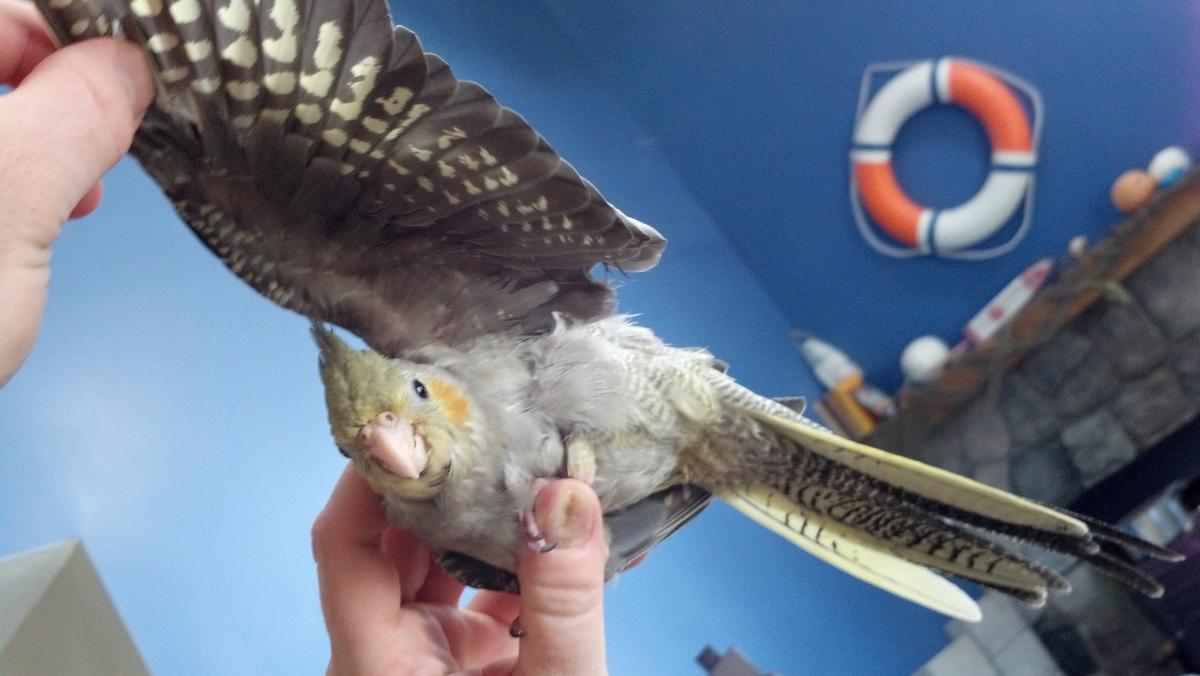
I also highly recommend owning birds – because if you work really hard at caring for one for a long time, they might grow to trust you. There is nothing quite like a tiny little bird trusting you enough to let you gently pull open his or her wing for a closer look at how it works:
Awww! Cockatiel lets a trusted friend see under her wing
There’s more to birds than just well-designed wings. There’s a well-designed heart in there, too! That might even be more amazing than the design of the wing. It is to me.
Note: although this post does not provide a rigorous case for intelligent design, that can be found by looking at the work of Stephen C. Meyer on the origin of life and on the Cambrian explosion. The books that demonstrate the superiority of the intelligent design hypothesis are “Signature in the Cell” and “Darwin’s Doubt“. If you’d like to see a good popular-level presentation of intelligent design related to the origin of life, click here for a lecture.
I highly recommend watching the lecture, and looking at the slides. The quality of the video and the content is first class. There is some Q&A (9 minutes) at the end of the lecture.
Topics:
intelligent design is concerned with measuring the information-creating capabilities of natural forces like mutation and selection
Darwinists think that random mutations and natural selection can explain the origin and diversification of living systems
Darwinian mechanisms are capable of explaining small-scale adaptive changes within types of organisms
but there is skepticism, even among naturalists, that Darwinian mechanisms can explain the origin of animal designs
even if you concede that Darwinism can account for all of the basic animal body plans, there is still the problem of life’s origin
can Darwinian mechanisms explain the origin of the first life? Is there a good naturalistic hypothesis to explain it?
there are at least two places in the history of life where new information is needed: origin of life, and Cambrian explosion
overview of the structure of DNA and protein synthesis (he has helpful pictures and he uses the snap lock blocks, too)
the DNA molecule is composed of a sequence of proteins, and the sequence is carefully selected to have biological function
meaningful sequences of things like computer code, English sentences, etc. require an adequate cause
it is very hard to arrive at a meaningful sequence of a non-trivial length by randomly picking symbols/letters
although any random sequence of letters is improbable, the vast majority of sequences are gibberish/non-compiling code
similarly, most random sequences of amino acids are lab-proven (Doug Axe’s work) to be non-functional gibberish
the research showing this was conducted at Cambridge University and published in the Journal of Molecular Biology
so, random mutation cannot explain the origin of the first living cell
however, even natural selection coupled with random mutation cannot explain the first living cell
there must already be replication in order for mutation and selection to work, so they can’t explain the first replicator
but the origin of life is the origin of the first replicator – there is no replication prior to the first replicator
the information in the first replicator cannot be explained by law, such as by chemical bonding affinities
the amino acids are attached like magnetic letters on a refrigerator
the magnetic force sticks the letters ON the fridge, but they don’t determine the specific sequence of the letters
if laws did determine the sequence of letters, then the sequences would be repetitive
the three materialist explanations – chance alone, chance and law, law alone – are not adequate to explain the effect
the best explanation is that an intelligent cause is responsible for the biological explanation in the first replicator
we know that intelligent causes can produce functional sequences of information, e.g. – English, Java code
the structure and design of DNA matches up nicely with the design patterns used by software engineers (like WK!)
There are some very good tips in this lecture so that you will be able to explain intelligent design to others in simple ways, using everyday household items and children’s toys to symbolize the amino acids, proteins, sugar phosphate backbones, etc.
Proteins are constructed from a sequence of amino acids:
A sequence of amino acids forming a protein
Proteins sticking onto the double helix structure of DNA:
Some proteins sticking onto the sugar phosphate backbone
I highly, highly recommend this lecture. You will be delighted and you will learn something.
Here is an article that gives a general overview of how intelligent design challenges. If you want to read something more detailed about the material that he is covering in the lecture above related to the origin of life, there is a pretty good article here.
UPDATE: There is a good breakdown of some of the slides with helpful flow charts here on Uncommon Descent.



 WINTERY KNIGHT